
You are using an out of date browser. It may not display this or other websites correctly.
You should upgrade or use an alternative browser.
You should upgrade or use an alternative browser.
Plasma Cosmology - Woo or not
- Thread starter Reality Check
- Start date
Zeuzzz
Banned

- Joined
- Dec 26, 2007
- Messages
- 5,211
That's just wrong. Virtual particles, with their energy, are created all the time all around you.
Sorry your wrong, even when a virtual particle is created the energy has merely been transferred from one form to another. Usually by a gluon. Could be a photon, a w- particle, many things. You should check out some feyman diagrams, they explain it all very well.
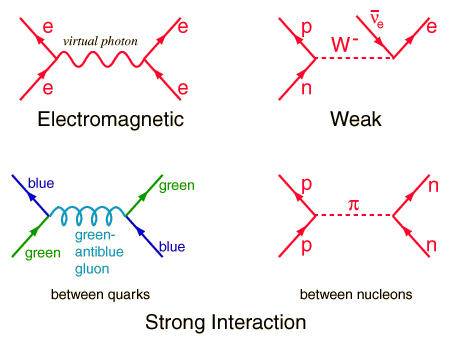
The current understanding is that the net energy in the universe is very very close to zero. So whatever issues you have with the Big Bang, you should scratch conservation of energy off the list.
I don't exactly follow.
Are you speaking about the zero point field here?
Zeuzzz
Banned
- Joined
- Dec 26, 2007
- Messages
- 5,211
You're sounding like an Intelligent Design proponent, or the usual woo proponent.
Cool. Attack the messenger

This could last a while.
*sigh*
If you have issues with ANY plasma cosmology publication published in various peer reviewed journals (astrophysics and space science, IEEE transactions on plasma science, astronomy and astrophysics, are the main ones) then please quote it and have a good old laugh. If your correct I'll have a good old laugh about my naivity too. You can even get the laughing hyena out on me if its a genuine whopper of a mistake.
Last edited:
Zeuzzz
Banned
- Joined
- Dec 26, 2007
- Messages
- 5,211
I don't believe there is a conspiracy to stifle the plasma theory. If it works better to explain the universe, it will be adopted.
I don't believe its a conscious conspiracy either, it just seems to be the way that the dominant paradigm has developed, and the scientific institutions around this. Funding problems have really been quite biased for a theory that has more accurate predictions on many variables then the other one does. They have literally got nothing, apart from some funding to build a small dense plasma focus device derived from plasma properties and constants first worked out in the original formulation of plasma cosmology. http://lawrencevilleplasmaphysics.com/index.php?pr=Dense_Plasma_Focus
Last edited:
Skwinty
Philosopher

- Joined
- Jun 16, 2008
- Messages
- 5,593
Cool. Attack the messenger
This could last a while.
*sigh*
If you have issues with ANY plasma cosmology publication published in various peer reviewed journals (astrophysics and space science, IEEE transactions on plasma science, astronomy and astrophysics, are the main ones) then please quote it and have a good old laugh. If your correct I'll have a good old laugh about my nativity too. You can even get the laughing hyena out on me if its a genuine whopper of a mistake.
 You must be missing the Science section.
I Ratant
Penultimate Amazing

- Joined
- Apr 8, 2008
- Messages
- 19,258
.I'm just saying that we should wait and see how your theory holds up in the scientific community. Normally, if it's any good, it should pass and be accepted.
Playing the victim card doesn't help.
It wasn't all that long ago that the number of "fundamental particles" was exceeding 200, if memory serves.
Seems like every cloud chamber experiment found "new" ones.
Sanity finally prevailed over the "publish or perish" frenzy and most of these were demoted to merely different energy states of a lot fewer particles.
If plasma cosmology does a good job, fine, but it won't affect the price of gas.
Zeuzzz
Banned
- Joined
- Dec 26, 2007
- Messages
- 5,211
I understand your feelings. The gaps are there to stay. The universe is too big for humans to know everything about. Scientists have filled in a lot of the gaps but there will always be things they don't know about. They will keep trying to understand but from what little I personally know it turns out that the more you learn the more you discover things that you don't know. For every mystery you solve theres another one waiting around the corner.
Thats why I'll happily say that current plasma cosmology is, in the big picture, just as much a load of hogwash as the big bang theory. Its just the best we can do at the moment to try to understand these titanic questions. And after comparing the two im firmly in the PC crowd.
The thrill is in the mystery. You dont have to fill it in with religion. Fill it in with science, even fringe science. Most main scientific models started off as fringe theories.
Its far better to come up with a scientific hypothesis to explain the mystery than to fill the mysteries with some sort of omnipotent god you've dreampt up, or been indoctrinated to believe in.
Reality Check
Penultimate Amazing
Current plasma cosmology is in fact "a load of hogwash"Thats why I'll happily say that current plasma cosmology is, in the big picture, just as much a load of hogwash as the big bang theory. Its just the best we can do at the moment to try to understand these titanic questions. And after comparing the two im firmly in the PC crowd.
However you are mistaken in trying to compare the PC hogwash with the scientific theory of the big band with its many successes (and a couple of mysteries).
I agree - the "some sort of omnipotent god" that PC cosmologists are indoctrinated with makes them seem ridiculous.Its far better to come up with a scientific hypothesis to explain the mystery than to fill the mysteries with some sort of omnipotent god you've dreampt up, or been indoctrinated to believe in.
Luckily the big bang theory is a scientific hypothesis with string evidence for it and predictions that have (mostly) been verified. That makes it into a scientific theory.
dafydd
Banned

- Joined
- Feb 14, 2008
- Messages
- 35,398
The problem is this. When the Big Bang was first proposed (as a joke by cosmologist fred hoyle "it just went "bang!" everything from nothing" he said, or something similar)
Fred Hoyle called it the Big Bang to make fun of the theory.He was quite cheesed off when the name caught on.He opposed it on philosophical grounds,not scientific.Don't tell me I'm wrong because I have a documentary on my computer in which he says that.He ended up with egg on his face as the evidence for the Big Bang began to mount up,especially the cosmic background radiation.He did some great work in the field of heavier elements forming in stars,but he was wrong about the Big Bang.
Reality Check
Penultimate Amazing
Lerners 2004 review has already been addressed in this thread. It is out of date and mostly wrong.Not my own, I just prefer Plasma Cosmology, as over the years all the predictions it has made based on its starting assumptions and numerous publications have shown with time to be much more accurate than BBT predictions, and plasma cosmology uses drastically less free parameters.
Plasma cosomlogy has shown with time to be totally unable to predict the details of the cosmic background radiation.
Wrong:Plus PC does not violate any of the basic laws of physics like BBT.
- BBT does not violate any of the basic laws of physics.
- PC does violate the basic laws of physics, e.g. plasma physics (see Debye length).
Errors in the "The Big Bang Never Happened"Its predictions for the CMB from plasma filaments are more accurate, it light element abundances predictions based on steller surface plasma properties are many orders of magnitude more accurate, the filamentary plasma origin of large scale structures and the origin of the cosmic microwave background in a "radio fog" of dense plasma filaments have now been demonstrated. It looks like a winner to me.
http://bigbangneverhappened.org/p27.htm
Its predictions
- for "CMB from plasma filaments" is nonexistant.
- for the light element abundances are physically dubious.
- the filamentary structure of the universe is not predicted at all. It is assumed in PC that because plasma forms filaments on small scales that the same happens on cosmic scales.
- for the origin of the CMB does not fit the observations.
Ziggurat
Penultimate Amazing

- Joined
- Jun 19, 2003
- Messages
- 61,745
Most main scientific models started off as fringe theories.
N, Zeuzzz, this is simply wrong. Scientific models often start out very speculative, but that's different from fringe. Plasma cosmology remains fringe not because it's speculative, but because it's fundamentally incompatible with observations.
sol invictus
Philosopher

- Joined
- Oct 21, 2007
- Messages
- 8,613
Not my own, I just prefer Plasma Cosmology, as over the years all the predictions it has made based on its starting assumptions and numerous publications have shown with time to be much more accurate than BBT predictions
That's untrue, as thousands of posts on this forum attest. Plasma cosmology fails miserably to explain the basic observations we've made of the cosmos; as a result it is ruled out with extremely high confidence.
Plus PC does not violate any of the basic laws of physics like BBT.
The BBT is a consequence of the basic laws of physics as they are understood today. Specifically, it is a prediction of general relativity. It does not violate any known law of physics.
Based on its superior predictive power
That's some epistemological closure, Zeuzzz. The only people who think PC has predictive power are the people who don't know enough math to know what that means. That sentence keeps coming up over and over---from you, Sol88, Mozina, etc.---but the only evidence for it is the circle of acolytes citing each other saying it.
PC will have predictive power when you can take 4/5ths of modern cosmology data (pick four of: SNe, CMB, CMBpol, LSS, weak lensing) and use them to predict the other one. This is mathematically exactly equivalent to asking "does PC have a chi^2/dof of ~1, or worse?" on these five datasets. Lots of different models, not just LCDM, have subjected themselves to this test (see http://lambda.gsfc.nasa.gov/product/map/dr4/parameters.cfm). Only LCDM passes. Why isn't PC on that list, Zeuzzz? Because the claim to be "predictive" is baloney, and the claim that LCDM is not predictive is ignorance.
ETA: Likewise: the Standard Solar Model predicted, in the ordinary "we calculated it before it was observed" sense that even statistical neophytes can understand, that the Sun should emit a certain number of neutrinos. This 1960s-era prediction very precisely matches the modern data (from SNO) with no tweaking whatsoever. If you use a spectrometer to measure the Sun's metals content, and plug them into the SSM's equation-of-state (which is, yes, a plasma equation of state, and yes, obeys the laws of physics regarding pressure and radiation-transport and whatnot), you precisely predict---no tweaking---the Sun's seismological oscillation modes. That's predictive. The one time I saw a PC helioseisemology "prediction" it was complete nonsense.
better more scientifically sound starting assumptions
Nope. To illustrate:
(not solid, liquid, or gas, like was assumed when the Big Bang theory and the standard model for the sun and stars was formulated)
Have you ever seen a Big Bang model? Have you ever seen a solar model? They're plasma all the way down. The CMB is a set of photons emitted from a rapidly-cooling plasma. The Alpha-Bethe-Gamow paper is nucleosynthesis in a plasma. The Standard Solar Model---does the name Saha mean anything to you? Before there was a theory of stars, there was a theory of the plasma physics of stars.
In other words: Zeuzzz, this "criticism" of mainstream theory is utterly made-up nonsense. It's like saying "I reject the theory of quantum mechanics because it ignores electrons."
Anyway---who cares what the genesis of the idea is? I don't care whether Emden included plasma in his solar model of 1907. That's not where I get my solar models from, I get them from modern calculations containing as much microphysics as we know. Why do you care whether Emden's 1907 book had accurate plasma physics? (My German is pretty weak, but I think that's the plasma equation of state on page 457 of Gaskugeln: Anwendungen der mechanischen Wärmetheorie auf kosmologische und meteorologische Probleme). If you think that Emden was the first and the last person to think about stellar interiors, you're wrong.
It's like saying "I reject the atomic theory of matter, because Democritus had no way of knowing about technetium."
and thus the universe should obey primarily complex plasma physics, dependent on the charge separation in space plasma, not fluid and gas equations that the big bang and solar models are based on.
And here's the usual wrong thing again. "Fluid and gas equations" are a subset of the plasma equations. Plasma has a pressure, mass density, temperature, viscosity, enthalpy, and so on just like a fluid. Do you think it doesn't? Why do you think that? If so you're wrong.
It can also, under some circumstances, have more complex behaviors---or it can not. (Pressure is always there. Mass density is always there. Convection is sometimes there. So far, that's all stuff that both gas and plasma does. But Alfven waves are sometimes there---they're plasma-only. The physics seems to be telling us that they're important in the Solar Wind but not in the interior. Charge separation is extremely rare---in fact charge separation is easier in an insulating gas (thunderstorms) than in a plasma---and there's no evidence whatosever that charge separations are important anywhere on or in the Sun.
You don't get to tell stars that they should have charge-separation---that's not how physics works. You have to look at the initial conditions and see whether something causes the charge separation. As far I can tell, PC's only reasons for rejecting gas-like-pressure and favoring charge-separation is:
a) Alfven spent more time talking about plasma-specific stuff than about pressure and hydro, therefore I am going to talk about plasma specific stuff and pretend the pressure/hydro isn't there.
b) If we said that Alfven's stuff wasn't important, we'd have to pack up and go home, so it had better be the most important thing.
Last edited:
Ziggurat
Penultimate Amazing
- Joined
- Jun 19, 2003
- Messages
- 61,745
Based on its superior predictive power, better more scientifically sound starting assumptions and the fact that we now know that 99.99% of the matter in the universe is infact matter in a plasma state (not solid, liquid, or gas, like was assumed when the Big Bang theory and the standard model for the sun and stars was formulated) and thus the universe should obey primarily complex plasma physics, dependent on the charge separation in space plasma, not fluid and gas equations
What precisely do you think the term "fluid" means, Zeuzzz? Perhaps you think "fluid" means "liquid", but in physics, it doesn't. Plasma is a fluid. So why on earth would anyone with any sense object to using fluid equations to describe a fluid?
Reality Check
Penultimate Amazing
Missed this bit of woo:
You are displaying a bit of ignorance: Plasma physics just happens to be based on fluid and gas equations!
Are you saying that we should not investigate the universe?
In fact you are wrong. The Plasma cosmology page exists, just without the pc woo (note the small letters). The previous version of it that you link to seems to have been rejected by the admins because of an editing war between Eric Lerner and other editors.
As noted in previous posts: PC is notably inferior in is predictive power.Based on its superior predictive power, better more scientifically sound starting assumptions and the fact that we now know that 99.99% of the matter in the universe is infact matter in a plasma state (not solid, liquid, or gas, like was assumed when the Big Bang theory and the standard model for the sun and stars was formulated) and thus the universe should obey primarily complex plasma physics, dependent on the charge separation in space plasma, not fluid and gas equations that the big bang and solar models are based on.
You are displaying a bit of ignorance: Plasma physics just happens to be based on fluid and gas equations!
WrongThe problem is this. When the Big Bang was first proposed (as a joke by cosmologist fred hoyle "it just went "bang!" everything from nothing" he said, or something similar) the equivalent of a messiah came to answer all these big questions cosmologists had been struggling with for years*.
- Fred Hoyle just created a new name for BBT.
- The Big Bang was around for about 30 years before it was called Big Bang.
- The Big Bang theory is a scientific theory. It exists so long as there is evidence for it and no longer.
The reason that it is accepted is not because of your delusion that it is somehow religious. It is because it has done what other accepted scientific theories have done - survived the cut and thrust of scientific debate.
This implies that you think that BBT describes the orgin of the universe. This is not true.Paradoxical as a beginning in time from nothing is, if you assume this then you can work from there very easily.
The effect was very ordinary. Scientists starting coming over all curious about this issue as scientists do. This is despite you citing a web site full of cherry picked quotes. It ignores the millions of non-religious lines of text that there are about the BBT. Try reading scientific cosmology papers something.The effect was very weird. Scientists starting coming over all religous about this issue*.
Wrong - it is taught as an accepted scientific theory (not fact). In actual fact typical undergraduate classes go through the history of cosmological theories....snipped rant...
Even mention at uni that the Big Bang never happened and you'll be a laughing stock. Its just accepted fact. But show one of the people laughing an alternative explanation for the origin of the CMB by one of the various scientists that have made such models, or one of the better tired light related theories to put inflation into doubt, and they will just go kinda quiet.
So?The Big Bang based projects get billions. Literally billions to send satellites up to study the data in space they have chosen to be significant.
Are you saying that we should not investigate the universe?
And your evidence that the admins took it down because of their personal opionions about cosmology is?Heres the *uncensored* plasma cosmology Wikipedia. It was taken down by admins at wikipedia that did not like the fact that the big bang had a competing theory that seemed to get far much more right with far simpler ideas.
In fact you are wrong. The Plasma cosmology page exists, just without the pc woo (note the small letters). The previous version of it that you link to seems to have been rejected by the admins because of an editing war between Eric Lerner and other editors.
Zeuzzz
Banned
- Joined
- Dec 26, 2007
- Messages
- 5,211
Wooooooooooop.
ere we go again. I need to come up with some sort of ticket system so I can deal with you one by one and not get lambasted with 20 posts in reply to each of mine.
Before I take the plunge I might as well give you all something to debunk for the next page or two while im at work. The trouble is that anything I say now I may as well just go back and copy / paste what I've already said. If I feel that it was ignored (like most of my links seemingly were) I may do just that.
These few publications have taken my eye recently. Mainly as they, and many other papers it would seem, are finally stating exactly the same ideas proposed years back by plasma cosmology (albeit by varying, yet still conceptually similar, phenomenon). Don't let your knee jerk reaction to the title cloud your judgment.
Observational evidence favors a static universe
http://adsabs.harvard.edu/abs/2010arXiv1009.0953C
Cosmology and Extragalactic Astrophysics, September 5, 2010.
And page 31 of this one maybe worth skimming (depending on your level of understanding, this one is a simplified overview);
THE NUCLEAR, PLASMA, AND RADIATION UNIVERSE
https://netfiles.uiuc.edu/mragheb/w...he Nuclear, Plasma and Radiation Universe.pdf
There are a few mistakes I picked up on. And I hate the recent trend (usually done by "we nearly know it all now" scientists) of trying to link completely disparate problems with various new models in one go, there are so many other paradoxes to choose from yet its always the slight neutrino deficiency, pioneer 10 and the temperature of the CMB which they try to explain and link. The temparature of CMB is not even important unless you assign it a special meaning. All you need is a banal explanation for its temperature, uniformity and various other properties and you can get onto the other much more interesting and varied properties of the rest of the EM spectrum.
Bah. I say the fact that current models imply that most of the universe is made of something we have no experimental scientific evidence for, other than some inferences resting on the assumption that gravity behaves the same throughout the entire extent of the universe irrespective of location or force scaling. We are still far from proving beyond doubt the specifics of the cosmological principle, or if universality truly always holds for gravity. The scale that gravity has been shown to be consistent with models is absolutely tiny compared to the rest of the universe.
In his excellent, critically acclaimed, book on the worrying situation of theoretical physics, Lee Smolin gives an example of the mechanism that leads to such a narrowing of our view:
There are major problems with the applicability of Newtons law of gravitation. This law is the sole reason why cosmology/astronomy is filled with so many unresolved problems, most notably dark matter and dark energy. Rarely are dark matter and dark energy seen as problems with gravity, but that is exactly what they are, entities invoked to try to explain the plethora of objects in space that do not follow the gravitational model of an exclusively attractive field.
There is no definitive law for gravity at all scales. Newtonian gravity is accurately measured and proven with the bounds of the solar system. However, Newtonian gravity remains untested in other areas. All we have is the formula. This formula has been used to determine the mass of the Earth, we don't even know the valid range for Newtonian gravity. To get the mass of another planet in our solar system you have to use the value used for the Earth or sun. And to work out the tremendously important value of G you then have to use MEG, using the mass of the Earth, under the presumption it is correct, and then other methods using the suns mass are derived again from MEG. So when people say that a distant object in orbit is a certain mass and they thus know the gravitational forces involved etc, this is more an assumption than a fact, depending on the value of G and the mass of the sun or earth.
Oh to hell with it. Cut. Snip. Paste. Dont ignore my main points this time though!
ere we go again. I need to come up with some sort of ticket system so I can deal with you one by one and not get lambasted with 20 posts in reply to each of mine.
Before I take the plunge I might as well give you all something to debunk for the next page or two while im at work. The trouble is that anything I say now I may as well just go back and copy / paste what I've already said. If I feel that it was ignored (like most of my links seemingly were) I may do just that.
These few publications have taken my eye recently. Mainly as they, and many other papers it would seem, are finally stating exactly the same ideas proposed years back by plasma cosmology (albeit by varying, yet still conceptually similar, phenomenon). Don't let your knee jerk reaction to the title cloud your judgment.
Observational evidence favors a static universe
http://adsabs.harvard.edu/abs/2010arXiv1009.0953C
Cosmology and Extragalactic Astrophysics, September 5, 2010.
ABSTRACT
The common attribute of all Big Bang cosmologies is that they are based on the assumption that the universe is expanding. However examination of the evidence for this expansion clearly favours a static universe. The major topics considered are: Tolman surface brightness, angular size, type 1a supernovae, gamma ray bursts, galaxy distributions, quasar distributions, X-ray background radiation, cosmic microwave back-ground radiation, radio source counts, quasar variability and the Butcher–Oemler effect. An analysis of the best raw data for these topics shows that they are consistent with expansion only if there is evolution that cancels the effects of expansion. An alternate cosmology, curvature cosmology, is in full agreement with the raw data. This tired-light cosmology predicts a well defined static and stable universe and is fully described. It not only predicts accurate values for the Hubble constant and the temperature of cosmic microwave background radiation but shows excellent agreement with most of the topics considered. Curvature cosmology also predicts the deficiency in solar neutrino production rate and can explain the anomalous acceleration of Pioneer 10.
Key words: cosmology: observations, large-scale structure of universe, theory
And page 31 of this one maybe worth skimming (depending on your level of understanding, this one is a simplified overview);
THE NUCLEAR, PLASMA, AND RADIATION UNIVERSE
https://netfiles.uiuc.edu/mragheb/w...he Nuclear, Plasma and Radiation Universe.pdf
There are a few mistakes I picked up on. And I hate the recent trend (usually done by "we nearly know it all now" scientists) of trying to link completely disparate problems with various new models in one go, there are so many other paradoxes to choose from yet its always the slight neutrino deficiency, pioneer 10 and the temperature of the CMB which they try to explain and link. The temparature of CMB is not even important unless you assign it a special meaning. All you need is a banal explanation for its temperature, uniformity and various other properties and you can get onto the other much more interesting and varied properties of the rest of the EM spectrum.
Bah. I say the fact that current models imply that most of the universe is made of something we have no experimental scientific evidence for, other than some inferences resting on the assumption that gravity behaves the same throughout the entire extent of the universe irrespective of location or force scaling. We are still far from proving beyond doubt the specifics of the cosmological principle, or if universality truly always holds for gravity. The scale that gravity has been shown to be consistent with models is absolutely tiny compared to the rest of the universe.
In his excellent, critically acclaimed, book on the worrying situation of theoretical physics, Lee Smolin gives an example of the mechanism that leads to such a narrowing of our view:
“The possibility - that we are wrong about Newton’s laws, and by extension general relativity - is too scary to contemplate.” (page 15).
There are major problems with the applicability of Newtons law of gravitation. This law is the sole reason why cosmology/astronomy is filled with so many unresolved problems, most notably dark matter and dark energy. Rarely are dark matter and dark energy seen as problems with gravity, but that is exactly what they are, entities invoked to try to explain the plethora of objects in space that do not follow the gravitational model of an exclusively attractive field.
There is no definitive law for gravity at all scales. Newtonian gravity is accurately measured and proven with the bounds of the solar system. However, Newtonian gravity remains untested in other areas. All we have is the formula. This formula has been used to determine the mass of the Earth, we don't even know the valid range for Newtonian gravity. To get the mass of another planet in our solar system you have to use the value used for the Earth or sun. And to work out the tremendously important value of G you then have to use MEG, using the mass of the Earth, under the presumption it is correct, and then other methods using the suns mass are derived again from MEG. So when people say that a distant object in orbit is a certain mass and they thus know the gravitational forces involved etc, this is more an assumption than a fact, depending on the value of G and the mass of the sun or earth.
Oh to hell with it. Cut. Snip. Paste. Dont ignore my main points this time though!
Zeuzzz said:So from an experimental viewpoint, Newtons law runs into various problems even right here on Earth. Who knows what problems it faces when extrapolated to the large scale constituents of the universe.
Since gravity was related by Einstein to the geometry of space-time (whatever the hell that physically is) gravity has received support from various tests, such as the perihelion of mercury, and others. However, the following quote from a very popular book on astronomy, is quite remarkable:
Galactic dynamics (page 635)
"It is worth remembering that all of the discussion so far has been based on the premise that Newtonian gravity and general relativity are correct on large scales. In fact, there is little or no direct evidence that conventional theories of gravity are correct on scales much larger than a parsec or so. Newtonian gravity works extremely well on scales of ∼ 10^14cm (the solar system).
(...) It is principally the elegance of general relativity and its success in solar system tests that lead us to the bold extrapolation that the gravitational interaction has the form GM/r2 on the scales 10^21 − 10^26cm..."
[....]
The above cited 'bold extrapolation' of gravity seems to have encountered problems even in the solar system now, with the pioneer and voyager anomalies, so it seems very naive to presume that gravity functions how we currently model it when applied to much larger scales.
Many tests show that gravity obeys an inverse square law in terms of distance, but little work has been done on observations that test the dependence on the field mass, M. Since mass estimates of the whole universe depend on it, determining the absolute value of G is kinda important. The thing is that they all tend to give different values for G, and whereas other (fundamental) constants in nature achieve an accuracy of over 12 decimal places the value of the gravitational constant lags behind with far greater uncertainty, with only about 3-4 decimal places remaining undisputed by various methods. This indicates that we still have a lot to learn about the true nature of gravity.
A lot of work has been done on determining the value of G. What seems lacking however are test which test the spatial and temporal dependence of G, which can also be used to test Newtons law as well. At the atomic level, although you can work out the ratio of electric and gravitational forces at 2.27x1039 (respectively), this has never been measured as particles this size are too light to be used as field masses. Gravity is amazingly illusive at this small scale, and remains so right up to much larger scales. At the standard laboratory scale the torsion balance is the usual method, done usually over a distance of 10 – 30 cm, which is the method used by originally by cavendish, which has changed very little to this day. One further method is by using a superconducting gravimeter and a moving mass (see http://www.iop.org/EJ/abstract/0957-0233/10/6/311).
And that’s about it from methods of determining G directly. We only have direct confirmation of this law over a very small scale range, from laboratory to geological size, it is presumed from this that it applies exactly to all other scales. Other larger scale methods like satellite based experiment’s to find the value of G, such as LLG, are in fact finding the product MEG, using the mass of the Earth, under the presumption it is correct, and other larger scale estimates use generally use the mass of the sun (inferred from the mass of the Earth) to determine G.
Another interesting way to test gravity would be check the dependency of Newtons law on the amount of field mass in question. Which is an idea lacking much experimental verification too. When M = m (in F=GMm/r2) the law becomes symmetric, but a deviation for large masses would not violate the equivalence principle, at least within its experimental constraints which apply mostly to test masses. It is often claimed that any physical theory has to be linear in the weak-field-limit, but this cannot be definitively proven, mainly due to the amazingly weak nature of gravity making tests for this very hard. We just perform an extrapolation of our mathematical methods, which should be tested. There are plenty of ways to test the r2 term in Newtons law, but testing the exponent 1 on M is much more difficult to prove.
Torsion balance experiments typically use masses in the range 5 – 20 Kg, and this is the mass at which we base our most accurate measurements of G. And this mass range goes up to about 107 Kg with lake experiments to measure gravity (see: Determination of the gravitational constant with a lake experiment.), which achieved results close to laboratory values, but not to such a high degree of accuracy. Generally, the more mass is used the less reliable the value becomes. And when you get to the solar system scale satellite data of planetary orbits can not be used to find the field mass dependence of Newtons law (ie, the exponent of M not equal to 1 in F=GMm/r2) as the same data is used to measure the mass. You can use Keplers law to test the validity of the inverse square relationship, but this can not reveal an exponent of M different from 1. This problem stems from not being able to find independent mass estimates of these larger scale objects (apart from some very crude methods with a very high amount of uncertainty), and so from the mass range of the moon \earth (1023 kg) all the way up to sun, no accurate test for this exists. When dealing with the galactic scale (from 1039 to 1044) you run into the same problem of not having independent mass estimates. And this applies to all scales above the solar system. Solar mass to light ratio measurements for galaxies do not fit the dynamically determined mass, and so dark matter is invented to explain this failure of Newton’s law. And right up on the cosmological scale Newtons law fails, and so dark energy is invoked to explain the anomalies. So over time Newtons law has been patched up with numerous ad hoc solutions, but maybe instead of just assuming these entities exist and can explain away everything we should just consider that the law of gravity is plain wrong when applied to large scales. This is where theories like MOND and others come in. And while MOND presents more problems than it solves (in my opinion), it has been very useful in pointing out another problem with Newtons law, that it is poorly tested for accelerations below 10−10ms−2.
I think that it is highly likely that the hierarchy of structures in the universe, the lab, earth, solar system, galactic, cosmic does not stop at the laws that we use in the solar system but requires a corresponding hierarchy of theories. Inventing new entities and new free parameters to simulations will not be sufficient; this type of approach seems to me to be a modern day version of the epicycles of Ptolemy. Extrapolating theories beyond their true testable scope should be avoided, unless we want to walk down the path of ever more complex theories piled up ontop of each other in an attempt to try to hold on to the basic law underlying them all, this type of approach merits a warning from history.
The amount of research that is done in cosmology based on this unverified extrapolation of gravity over some 14 orders of magnitude is quite a remarkable spectacle.
There are considerable gaps in our knowledge about how gravity functions at large scales. Take a look at this graph for example;
http://img502.imageshack.us/img502/6536/gravityvd8.jpg
Generally objects fall into three groups at different scales. The group on the left are the only area where direct absolute measurements of G are possible, from tiny scales up to geological scales. Everything else on this table, from our satellites up to super-massive black holes are extrapolations of Newtons law that remain to be tested, as even the middle group are testing Keplers law rather than Newtons. For the group on the right, none of them offer any sort of undisputable evidence for Newtons law, without having to invoke quantities such as dark matter or energy. To put it simply, tests of the field mass dependence are entirely determined by only 1-2 independent types of experiments on the small scale. The extrapolation to the other larger objects is assumed.
The interesting thing about Maxwells electromagnetism is that it is not like gravity, it is scale invariant. Gravity has no effect on that atomic scale. But it does on the solar scale. And it is assumed to be the only force that can effect even larger scales. But the sheer amount of large scale objects that do not obey Newtons law by their shape and structure, certainly imply that other forces are at work on the large scale. And now we know that plasma is so pervasive in the universe, something not known when most gravitational models were invented back when they thought that space was a void of empty space, EM forces in plasma are the obvious candidate to explain these objects.
Zeuzzz
Banned
- Joined
- Dec 26, 2007
- Messages
- 5,211
And your evidence that the admins took it down because of their personal opionions about cosmology is?
The multitude of pages in the discussion section where their motives are all too clear. Their rules are supposed to be to let peer reviewed work onto wiki sites only, plus a few press releases. They fail, after dozens of pages of quotes and links, to even recognize one recent plasma cosmology publication, whether in "astrophysics and space science" or an IEEE journal. All they will let on there are old, dated, wrong publications that relate to Alfven. By Wikipedia rules they are quite clearly breaking them, as they do not give a reason, let alone a scientific reason, to not allow people to reference peer reviewed work from reputable journals. Their excuse seems to be "umm well I haven't heard about this theory in this journal, I was only taught about the Big Bang, so this theory must be being ignored by professional scientists so completely wrong".
Most professional scientists dont ignore models they dont like. They may cite them, refute them, or reply to them indirectly. The fact that they have not been able to find ONE peer reviewed refutation of any plasma cosmology material speaks absolute volumes. Scientists must read it and pretty much agree, else there would be rebuttals.
Oddly they let Ed wrights article "errors in the big bang never happened" on there, which is not peer reviewed (and was refuted promptly by lerner anyway) yet wont let a single modern peer reviewed plasma cosmology publication on there.
In fact you are wrong. The Plasma cosmology page exists
Correction, the plasma cosmology page that only references now falsified old models and things relevant to Alfven exists.
The previous version of it that you link to seems to have been rejected by the admins because of an editing war between Eric Lerner and other editors.
Yeah a great decision. They seemed to be quite alarmed with how much material there was to PC when Lerner wrote that detailed article. Due to his persistence in trying to post the interesting studies from various journals that offered an alternative to their Big Bang based ideas that they could not refute without looking like they were just blatantly censoring good science they had no choice but to ban him.
Naturally this sort of behavior ensures wikipedias credibility. As long as all the people that are world leading experts in any field are banned from the respective wiki articles for knowing too much about the subject and doing a really good job at updating it with the most recent journal literture I guess we can all rest assured that either some complete novice will try instead, or someone who will personally gain from stopping such material being public.
Take a look at the wiki user "scienceappologist", see his controversial history, his articles about how "The Big Bang is the foundation of modern science, how dare people question it", his confrontational and rude reviews on amazon of PC journals and books [which he often writes one day after they start selling (he obviously does not read them)] and judge who out of him and Lerner is more impartial. I'm amazed hes still a moderator to be frank. He is a personal friend of moderator Art Carlson, who has managed to stop him being sacked on numerous occasions if I recall correctly.
Cant be arsed to reply to anything else.
Zeuzzz
Banned
- Joined
- Dec 26, 2007
- Messages
- 5,211
To make my point about the bias in the wiki article this is a brief simplified section I added, complete with references from reputable journals that have yet to be refuted in the literature. It was promptly taken down because it uses the work of a top expert in plasma cosmology ... "It leans very strongly to Lerner's flavor of PC" Guess we'll have to put up with people that dont even know what they are talking about writing the rest of the article, so not just me.
Guess we'll have to put up with people that dont even know what they are talking about writing the rest of the article, so not just me.Main Differences
The main differences in predictions the cosmologies have made are as follows;[26]
Big Bang Theory: The universe has a time of creation. Plasma Cosmology: The universe is assumed infinite in time and constantly evolving. [27]
Big Bang Theory: The universe originated from a highly homogeneous state and will remain largely so in the future. Plasma Cosmology: The universe is filamentary and clumpy. The large scale structure of the cosmos will not be homogeneous but highly filamentary.[28][29]
Big Bang Theory: CMB radiation will be isotropic. Plasma Cosmology: The CMB will not be as isotropic, as the syncrotron scattering process creates an isotropic formation, estimating the GeV of electrons to be inversely proportional to distance in the range 1-400 mpc. And the observed radio luminosity will fall as D-0.36, in excellent agreement with observations.[30]
Big Bang Theory: The anisotropy of the CBR will be random. Plasma Cosmology: The anisotropy of the CBR will show a strong preferred orientation in the sky. Mainly due to magnetic anisotropy which occurs in a plasma, so that its magnetic field is oriented in a preferred direction.[31][32]
Citations:
[26] Lerner, E.J Two world systems revisited: a comparison of plasma cosmology and the Big Bang Plasma Science, IEEE Transactions on, Dec. 2003, Volume: 31, Issue: 6, Part 1, On page(s): 1268- 1275
[27] Hannes Alfven, Cosmology: Myth or Science? J. Astrophys. Astr. (1984) 5, 79–98
[28] E.J. Lerner, "Radio Absorption by the Intergalactic Medium" The Astrophysical Journal, Vol. 361, pp. 63-68, Sept. 20, 1990.
[29] E.J. Lerner, "Confirmation of radio absorption by the intergalactic medium Astrophysics and Space Science (ISSN 0004-640X), vol. 207, no. 1, p. 17-26
[30] E.J. Lerner, "Radio Absorption by the Intergalactic Medium" The Astrophysical Journal, Vol. 361, pp. 63-68, Sept. 20, 1990.
[31] E.J. Lerner, "Magnetic Vortex Filaments, Universal Invariants and the Fundamental Constants" IEEE Transactions on Plasma Science, Special Issue on Cosmic Plasma, Vol. PS-14, No. 6, Dec. 1986, pp. 690-702.
[32] Lerner, Eric J, Intergalactic Radio Absorption and the COBE Data Astrophysics and Space Science, Volume 227, Issue 1-2, pp. 61-81