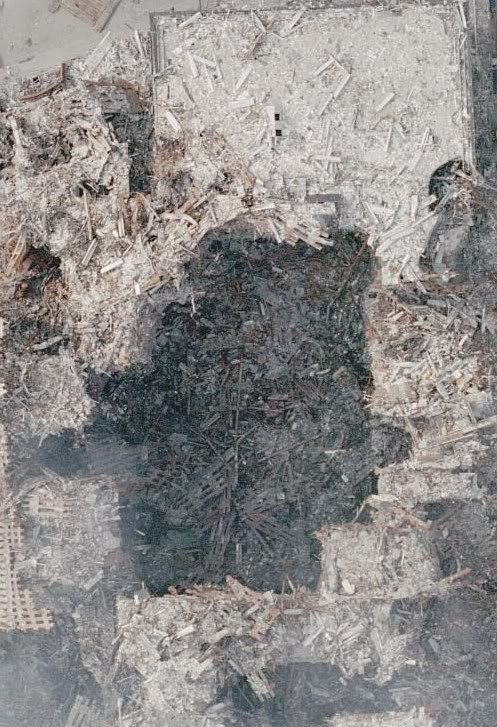
Oh, I'm sorry. I was. I was trying to allow you the absolute minimum required energy to meet the conditions of all the steel having gone missing.
We know that steel is iron with a few impurities mixed in (alloyed) with it.
We know from the sampling of the dust that the dust present after the towers fell did not contain enough iron to account for the steel being converted to dust.
I was going to allow you the option, however silly, that the iron had literally vaporized, then blown away without being redeposited on anything in the vicinity.
If you reject that, then we must consider other options. Just remember that it's your claim, not mine, that the steel ( and thus, the iron present in the steel) is missing.
So, let's say that the iron did not vaporize, but through some unknown process was transmuted into the other elements that were found in the dust samples. In theory, you can take two light atoms (like Hydrogen) and fuse them together into a single heavier atom and get out the difference in binding energy. That's fusion. In theory, you can take a single heavy atom (like Uranium) and split it into lighter atoms and get out the difference in binding energy. That's fission.
But because of the curve of binding energy, you only get energy out when the resulting elements are more stable than the initial element. Moving toward less stable atoms means that you have to add energy -- in exactly the same huge mass-equivalent amounts that you could extract if you were going the other direction.
And the most stable atom is... Iron 56.
Transmuting iron into the elements actually found in the dust means that you not only need enough energy to overcome the mechanical binding energy of the steel, you also need enough additional energy to create the additional nuclear binding energy of the new element.
So if the iron is, as you contend, missing, you should be able to explain where the energy to make it go missing came from. It didn't come from the iron. Iron is a nuclear ash. You can't "burn" it into lighter or heavier elements to extract energy.
And the amount is huge. I won't begin to try to calculate the amount of energy required to turn two hundred thousand tons of iron into silicon, but a rule of thumb for atomic bombs is that about fifty thousandths of a gram is converted for each kiloton of yield.
You should take note that my objections to your contention don't care how the energy is applied. This is an argument from first principles.