• Security incident: ISF was recently accessed by intruders. Please change your password, and change it anywhere else you used it. Read more

UFOs: The Research, the Evidence

Status
Not open for further replies.
Oops! Didn't you forget to include Campeche in your list? We have FLIR from two different instruments and numerous witnesses (trained military observers).
I feel RRamjet has a love hate relationship with Campeche, one moment it's solved and clearly not a UFO(his term) Then it's there was a UFO(his term) but it wasn't what they captured on the FLIR

I am not sure what you are both trying to achieve with your statements here. Both of you know my position on the case yet still you choose to misrepresent that position.

On numerous occasions I have clearly and concisely put my position regarding Campeche on the record in this thread. That is:

Based on the circumstantial evidence, I consider the FLIR likely to be a representation of oil well fires, subsequently misinterpreted by investigators as UFOs, and the crew at the time, in their heightened state of expectation, caused by prior unidentified radar contacts, also misidentified their observations of those oil well fires as UFOs.

Nevertheless, I do consider the case to be a probable RADAR UFO case because there were radar contacts with an unobserved object that behaved in such a manner as to make anomalous propagation (for example) implausible.

I have written about this case extensively in this thread and I have repeatedly invited RoboTimbo (because he is the one who insists on referring back to the case) to discuss this case with me (in reference to this analysis in particular: http://brumac.8k.com/MexicanDOD5mar04/), but to date he has simply refused any request to do so.
 
Though I appreciate your enthusiasm, I'm not sure what any of this is supposed to achieve. The shuttle can translate in 3 directions and rotate about three axes. It can follow any desired trajectory, meaning that an ice particle may appear to follow any thinkable trajectory in the camera view.

You would need at least two particles in view to be able to see if the changes in motion can possibly be consistent, but even then, it depends on the initial relative velocities of the particles and their size and distance.

So, good luck, I guess.

I guess this means you did not actually read (or alternatively, did not understand) my stated aim in that post. Let me see if I can make it a little clearer for you. I stated:

“Returning now to the “ice crystal” hypothesis and the conceptual understanding of the shuttle’s motion as outlined above, the most relevant measurements to take would obviously be related to the motion of the background stars, for any change in rotation of the shuttle should be reflected in their motion. It only remains to be seen whether the resolution of the film is high enough to allow the measurements required to be taken to the degree of accuracy needed.”

Now even though the “ice crystal” scenario is your claim – and thus strictly speaking you have the burden of proof to support that claim with evidence - I have indicated I am willing to conduct an analysis to see if there is evidence that can support your claim.

There are many “particles” in the video (including the object under discussion, other “debris” particles, MIR and also the background stars). Depending on what hypothesis we are investigating, measurements in relation to any (or all) these objects may be warranted. For example, your “ice crystal” hypothesis warrants (in the first instance) measurements of the movements of the background stars.

I hope this makes my aim a little clearer for you.

I also asked if anyone could see any flaws in my investigative methodology or general conceptualisation of the problem to indicate such. Given that you missed the point of my post altogether, and considering it is your hypothesis we are discussing, perhaps you would also care to read over my post again in light of that request?

Thank you.
 
I stated:
“Given that we know the shuttle is already rotating upward (shown by the movement of the background stars)…”
Are you talking about a rotation around it's own axis to keep the space station in the center of the view or it's rotation around the space station or around the earth or what? Are you defining upward with respect to the FOV or with respect to something else?
I simply noted that the background stars drift downward in the frame over the course of the video and asked myself what motion of the shuttle (our POV) could cause this drift. Clearly then our FOV (the whole frame) must be rotating in the opposite direction (ie; upward) in relation to those stars (also because the stars are so far away, a simple lateral shift of our POV - without rotation - would not cause the stars to move at all over the time period of the video).

Given that the voiceover on the video states that the shuttle is executing an orbit around MIR and because we know from experience that such orbits are invariably conducted to inspect the external features and components of the subject of such an orbit, we can therefore reasonably conclude that this rotation does indeed serve to keep MIR within our FOV.
 
I stated:
“Given that we know the shuttle is already rotating upward (shown by the movement of the background stars)…”

I simply noted that the background stars drift downward in the frame over the course of the video and asked myself what motion of the shuttle (our POV) could cause this drift. Clearly then our FOV (the whole frame) must be rotating in the opposite direction (ie; upward) in relation to those stars (also because the stars are so far away, a simple lateral shift of our POV - without rotation - would not cause the stars to move at all over the time period of the video).

Given that the voiceover on the video states that the shuttle is executing an orbit around MIR and because we know from experience that such orbits are invariably conducted to inspect the external features and components of the subject of such an orbit, we can therefore reasonably conclude that this rotation does indeed serve to keep MIR within our FOV.

You seem to have grasped that the Shuttle has to be rotating around its own axis in order to keep the Mir in the field of view. Do you understand that there is a series of translations of the Shuttle in order to "orbit" the Mir? Do you understand that all of this -- the translations, any change in rotation -- must all be done by the RCS? Do you understand that not only will there be apparent changes in motion due to the changes in motion of the Shuttle, but depending on the size and distance of the reflective particle, there may be actual changes in its motion, caused by the expanding gases from the RCS? Are you aware that there may be a lag between the RCS firing and the gases reaching the whatever-it-is?

Now, in principle, if you have all the variables, you could calculate what such a particle should do under those conditions. But to do that, you'd have to know what it was, and where it was. That would pretty much remove the U from the UFO.
 
I am not sure what you are both trying to achieve with your statements here. Both of you know my position on the case yet still you choose to misrepresent that position.
I'm trying to get you to see that witnesses, even with electronic systems to confirm them, can be mistaken. Until you can grasp that, I'll keep reminding you of it everytime you bring up one of your lists of cases.

On numerous occasions I have clearly and concisely put my position regarding Campeche on the record in this thread. That is:

Based on the circumstantial evidence, I consider the FLIR likely to be a representation of oil well fires, subsequently misinterpreted by investigators as UFOs, and the crew at the time, in their heightened state of expectation, caused by prior unidentified radar contacts, also misidentified their observations of those oil well fires as UFOs.

Nevertheless, I do consider the case to be a probable RADAR UFO case because there were radar contacts with an unobserved object that behaved in such a manner as to make anomalous propagation (for example) implausible.

I have written about this case extensively in this thread and I have repeatedly invited RoboTimbo (because he is the one who insists on referring back to the case) to discuss this case with me (in reference to this analysis in particular: http://brumac.8k.com/MexicanDOD5mar04/), but to date he has simply refused any request to do so.
So are you referring to Campeche as a TrueUFOTM case then? If so, we go back to my original question, "Didn't you forget to include Campeche in your list?" I think Campeche sums up pretty well what Sagan meant by "Extraordinary claims require extraordinary evidence" and why everyone agrees that it is still valid today as a concise way to explain that you still have the burden of proof.

Are you claiming that every anomalous radar blip is aliens piloting UFAOs? If not, why is this one different?
 
I guess this means you did not actually read (or alternatively, did not understand) my stated aim in that post. Let me see if I can make it a little clearer for you. I stated:

“Returning now to the “ice crystal” hypothesis and the conceptual understanding of the shuttle’s motion as outlined above, the most relevant measurements to take would obviously be related to the motion of the background stars, for any change in rotation of the shuttle should be reflected in their motion. It only remains to be seen whether the resolution of the film is high enough to allow the measurements required to be taken to the degree of accuracy needed.”

Now even though the “ice crystal” scenario is your claim – and thus strictly speaking you have the burden of proof to support that claim with evidence - I have indicated I am willing to conduct an analysis to see if there is evidence that can support your claim.

There are many “particles” in the video (including the object under discussion, other “debris” particles, MIR and also the background stars). Depending on what hypothesis we are investigating, measurements in relation to any (or all) these objects may be warranted. For example, your “ice crystal” hypothesis warrants (in the first instance) measurements of the movements of the background stars.

I hope this makes my aim a little clearer for you.

I also asked if anyone could see any flaws in my investigative methodology or general conceptualisation of the problem to indicate such. Given that you missed the point of my post altogether, and considering it is your hypothesis we are discussing, perhaps you would also care to read over my post again in light of that request?

Thank you.
Okay, and now read again what I'm telling you: The shuttle can translate along 3 axes. That is, it can move forward, backward, sideways, up and down without rotating.
This means that it can change direction without anything being visible in the background stars.
 
Okay, I've done a fairly in depth analysis of the images that Rramjet sent me, and the following are some of my results and conclusions.

Let's start with the basic position of the object in question, as measured from the images.

9574c9ec1df47d2b.jpg


There certainly seem to be several changes in direction, but then, we haven't taken the movement of MIR into account, and that's going to be our zero point for this exercise. In order to account for MIR's movement I took measurements from a position on the body of MIR. I had to find a point that remained fairly constant in both size and brightness in all of the images. I chose this point;

9574c9ec4f5d3a17.jpg
9574c9ec4f5ee478.jpg


If you look at all of the images this particular point remains almost constant. It's also on the body, which means it will suffer less from any effects due to the rotational translation of our view.

So, here's how the position of MIR changes over the period that the object appears on the film.

9574c9ec5e9e44d9.jpg


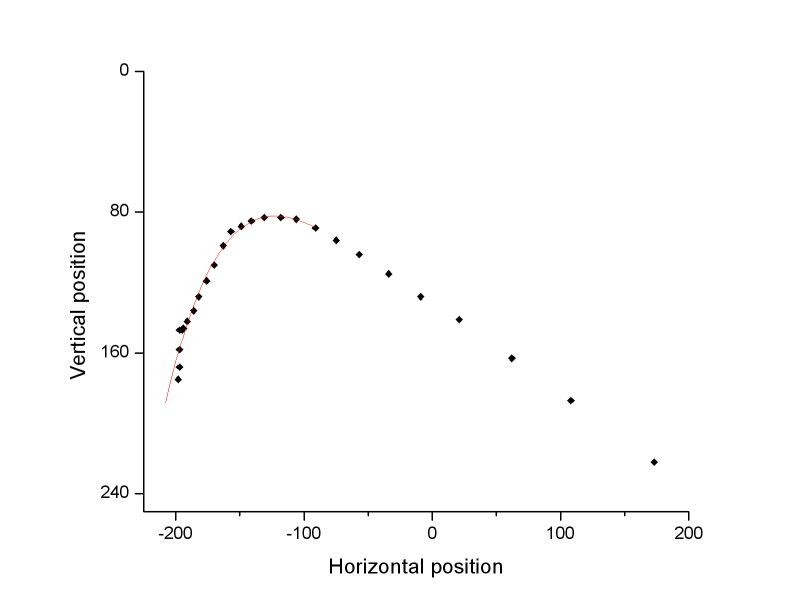
And here's what happens to the position of the object using the position of MIR as a zero point. It also includes a first quick pass at a fit to the curve, in red.

9574c9ec6972dd0d.jpg


Well, it's not looking great, but it's a lot smoother than the first graph, and I'm nowhere near finished yet.

First off let's try to take the uncertainties of the positional measurements into account, because, as I hope you can see from the graph of MIR's position, there are definitely uncertainties present. So I assumed a 1 pixel error in the measurement of MIR's position, which I think is conservative, but just for the sake of argument and illustration it'll do. I then assumed a 2 pixel error in the measurement of the object's position. This is because there are two factors to consider, firstly the object is not round in all of the images, so it's impossible to define the exact centre, and secondly the pixelation introduces an extra error. That gives us an error of about three pixels in both the horizontal and vertical measurements of the object relative to MIR. As I said, these errors are, in my opinion, conservative, but they serve to illustrate the point.

9574c9ec21401d71.jpg


I've drawn a straight line that passes through the first two points, just to illustrate that the object doesn't travel in a straight line on the first section of it's movement, and I've made a polynomial fit to the more obviously curved section. Now, within the errors, almost all of the points fall onto the polynomial fit to the curve. But let's have a closer look at those sections of the plot where they don't.

9574c9ec24761978.jpg
9574c9ec2141c18a.jpg


On the upper section of the curve only one point doesn't fall on to the fit within the errors, but as I stated earlier, I think the errors are conservative, and it only misses by a whisker. On the lower section, however, there are three points that don't fall on to the fit. This would seem to be a problem for my satellite idea. But hang on a moment, there's more.

As several people have pointed out, Rramjet included, the movement and rotation of the shuttle could also have an effect on the measurements. So let's look at how the aspect of MIR alters with time. The best way to do this is to measure the relative positions of the solar panels.

9574c9ec2477b0c1.jpg


These are the positions of the tips of the three upper solar panels. As you can see, they don't all move in the same direction, because the relative position are changing due to the shuttle's movement and rotation. But more than this, their paths seem to be curved slightly upwards. So let's take a closer look at each of those in separate horizontal and vertical plots.

This is Panel A, the right most panel.
9574c9ec24792434.jpg
9574c9ec310d1aa6.jpg


The red and blue lines are linear and polynomial fits respectively. What we can see from this plot is that for the vertical position graph the linear and polynomial fits are almost identical, but for the horizontal position graph they're different, and the polynomial is a much better fit. It also appears that the curve is more pronounced in the first half of the movement.

Is this the same for the other two solar panels?

9574c9ec310e961e.jpg
9574c9ec31111b38.jpg
9574c9ec32e41ec8.jpg
9574c9ec32e5e316.jpg


Why, yes it is.

So what does this tell us about the apparent motion of the object? Well, to start with it tells us that the movement of the shuttle wasn't constant throughout the film, which will obviously have a knock on effect to the measured position of anything that was recorded, including the object. It also tells us that at some point, probably around the 80 second mark, either the linear speed or rate of rotation (or both) of the shuttle in the horizontal position was altered.

Why is that significant? Because 80 seconds is just before the most deviant points on the positional plot of the object appear.

But it doesn't stop there.

The most deviant points are right at the end of the sequence, when the object is at it's faintest and hardest to measure positionally.

Add to that the fact that the film is grainy due to digital compression, and there are several bits of crap that just appear and disappear on the image, and we can't be certain that what we're looking at is the object in question.

Here's one spurious object.
9574c9ed2db494ea.jpg


And another.

9574c9ed2db5a5bd.jpg


And here's our object right next to a third.

9574c9ed2db6d571.jpg


In fact there's yet another just to the lower right of those two!

The point of this is that the film is "noisy", making it hard to measure the position with any accuracy, and less than certain that what we're measuring from frame to frame is actually the same object.

So, my conclusions are;
1. That the measured position of the object does fit with the hypothesis that it's a satellite, within the errors.
2. That the position of the object is difficult to measure due to it's brightness, size & shape and the graininess of the film, and importantly it's most difficult to measure at the point where it appears to deviate significantly.
3. That the effects due to the change in the linear and rotational speeds of the shuttle are pretty much impossible to account for.

The final conclusion, and bottom line of my analysis, is that it's impossible to tell what the hell this object is, or even if it's actually the same object throughout, although within the measurement errors it does fit reasonably well with the satellite hypothesis.

 
http://www.reuters.com/article/idUS166901+15-Sep-2010+PRN20100915

U.S. Nuclear Weapons Have Been Compromised by Unidentified Aerial Objects

PR Newswire

WASHINGTON, Sept. 15

Ex-military men say unknown intruders have monitored and even tampered with American nuclear missiles

Group to call on U.S. Government to reveal the facts


WASHINGTON, Sept. 15 /PRNewswire-USNewswire/ -- Witness testimony from more than 120 former or retired military personnel points to an ongoing and alarming intervention by unidentified aerial objects at nuclear weapons sites, as recently as 2003. In some cases, several nuclear missiles simultaneously and inexplicably malfunctioned while a disc-shaped object silently hovered nearby. Six former U.S. Air Force officers and one former enlisted man will break their silence about these events at the National Press Club and urge the government to publicly confirm their reality.

Edited by Gaspode: 
Edited for Rule 4


-----------------------------------------------------------------------------------------


What do you think about this? If they are not lying then I think this is and should be a very big news!

The old military folks are slowly opening up and revealing some interesting stuff they´ve experienced and don´t care about a hush-hush anymore so much.

What are the sceptics opinion about this. Isn´t this an evidence of an extraterrestrial visitation or what would better resolve this?
 
Last edited by a moderator:
http://www.reuters.com/article/idUS166901+15-Sep-2010+PRN20100915

U.S. Nuclear Weapons Have Been Compromised by Unidentified Aerial Objects

PR Newswire

WASHINGTON, Sept. 15

Ex-military men say unknown intruders have monitored and even tampered with American nuclear missiles

Group to call on U.S. Government to reveal the facts

WASHINGTON, Sept. 15 /PRNewswire-USNewswire/ -- Witness testimony from more than 120 former or retired military personnel points to an ongoing and alarming intervention by unidentified aerial objects at nuclear weapons sites, as recently as 2003. In some cases, several nuclear missiles simultaneously and inexplicably malfunctioned while a disc-shaped object silently hovered nearby. Six former U.S. Air Force officers and one former enlisted man will break their silence about these events at the National Press Club and urge the government to publicly confirm their reality.

Edited by Gaspode: 
Edited for Rule 4


-----------------------------------------------------------------------------------------


What do you think about this? If they are not lying then I think this is and should be a very big news!

The old military folks are slowly opening up and revealing some interesting stuff they´ve experienced and don´t care about a hush-hush anymore so much.

What are the sceptics opinion about this. Isn´t this an evidence of an extraterrestrial visitation or what would better resolve this?


The thread for this is here, if you want to pose the same question.
 
No. This is evidence of a press release advertising a news conference.
 
No. This is evidence of a press release advertising a news conference.

I think it´s more than that. Surely the news has some info on it too but as you can´t explain it you are left with that kind of an "answer".

Every bit of news could be waved away similarly: it´s just some text in a web or it´s just some images and text on a newspaper - as if there was not anykind of meaning or content.

Edited by Tricky: 
Edited for moderated thread.
 
Last edited by a moderator:
I think it´s more than that. Surely the news has some info on it too but as you can´t explain it you are left with that kind of an "answer".

Every bit of news could be waved away similarly: it´s just some text in a web or it´s just some images and text on a newspaper - as if there was not anykind of meaning or content.

Edited by Tricky: 
Edited for moderated thread.

What you linked to was a press release for a news conference. The press release was advertising a book containing the stories that was being used as the "hook" to hang the story on.

Why don't you go buy the book, and then come back and tell us what the story actually is.
I don't know what the Air Force equivalent of "sea stories" is -- propwash, maybe? I like 'em, myself. Some people tell really good stories.

Could some of the stories be based on actual alerts? Absolutely. The Battle of Los Angeles was real, there just didn't happen to be an enemy there.

But I'm not likely to be convinced by an announcement that someone is going to try and tell a convincing anecdote at a press conference prominently advertising a book.
 
I think it´s more than that.

Then dig up that "more" and present it here. As of now, all we have is a newsarticle about an upcomming press conference.

Every bit of news could be waved away similarly: it´s just some text in a web or it´s just some images and text on a newspaper - as if there was not anykind of meaning or content.

Exactly! Now you're employing critical thinking. Without any further evidence, it's just words on a webpage.
 
Before I get on to replying to Wollery and his extensive analysis I must comment about tomi71’s post:
U.S. Nuclear Weapons Have Been Compromised by Unidentified Aerial Objects

In response to tomi71 the UFO debunkers contend that the article he links (http://www.reuters.com/article/idUS166901+15-Sep-2010+PRN20100915) has no content apart from being a promotional piece about an upcoming press conference. Aside from being a typical UFO debunker response (deny the evidence) it is an incorrect assessment. For example the article mentions:

Captain Robert Salas (ret.). He was involved in this incident:

The Malmstrom AFB UFO/Missile Incident (16 Mar 1967)
(http://www.cufon.org/cufon/malmstrom/malm1.htm)
(http://www.nicap.org/malmstrom67dir.htm)
Video: (http://www.youtube.com/watch?v=4F08xJwA2qI&feature=related)

Then of course there was Colonel Charles Halt (ret.):

Rendlesham Forest/Bentwaters UFO Incident (25–27 Dec 1980)
(http://www.ufoevidence.org/topics/RendleshamForest.htm)
(http://www.ufologie.net/htm/rendles.htm)
The Halt Tape (http://www.ufologie.net/htm/rendlestape.htm)
Video: (http://www.youtube.com/watch?v=jgW3vEYA-Bg&feature=player_embedded)

Another “nuclear” case:

Minot AFB UFO (15 Mar 1967, 24 Oct 1968)
(http://www.ufocasebook.com/minotafb.html)
(http://ufocasebook.com/minotafbufo1968.html)
(http://www.rense.com/general2/dak.htm)

On the issue of the UFO/nuclear connection overall:

Nuclear Connection Project
(http://www.nicap.org/ncp/ncp-home.htm)

…plenty of content in all that wouldn’t you say? Whatever else it is, it cannot be denied as evidence of a UFO/nuclear base connection. This is precisely the kind of thing that indicates that statements such as:
...I'm not likely to be convinced by an announcement that someone is going to try and tell a convincing anecdote at a press conference prominently advertising a book.

represent a flat out denial of the evidence that does exist and that the UFO debunkers simply refuse to look at.

Well done tomi71 – your post references exactly the type of information that needs to be brought to public attention.
 
Okay, I've done a fairly in depth analysis of the images that Rramjet sent me, and the following are some of my results and conclusions.
I commend you on your efforts in this regard.

Let's start with the basic position of the object in question, as measured from the images.

[qimg]http://www.internationalskeptics.com/forums/imagehosting/9574c9ec1df47d2b.jpg[/qimg]

There certainly seem to be several changes in direction, but then, we haven't taken the movement of MIR into account, and that's going to be our zero point for this exercise.

And this is precisely where you go wrong.

The movement of MIR cannot be the “zero point” - as you calculate and use it - for three primary reasons:

First, the movements of MIR, the shuttle and the “satellite” are all independent of each other. While we can calculate the relation of MIR and the shuttle, we cannot do so also in relation to the “satellite” – that is, the whole shuttle/MIR “system” could be on a radically different path than the “satellite” (and probably is – IF it is a satellite), thus our FOV is no indicator of the true motion of the “satellite” in this regard.

This is not an easy concept to grasp. MIR drifts upward and to the right in our FOV. You then use that drift to “adjust” the observed motion of the “satellite”. But what if it is our FOV that stays related to the “satellite” and MIR is the one drifting off? The upward drift of MIR might then be totally incidental (have nothing to do whatsoever) with the observed motion of the satellite.

Second, you have not accounted for the “roll” of our FOV. We know that only “roll” (left/right and/or up/down) will cause the stars to move in our FOV (simple lateral movements without roll will not cause the stars to shift). But… adding another level of complexity to this, the stars may also shift depending on our orbit around the earth.

Third, as the “satellite” is travelling away from us, the movement of any MIR based “zero point” will have proportionately less and less affect on the true motion as distance increases.

Nevertheless, the only way you can obtain true a “zero point” is to use the background stars as an initial starting position and account for all three of the abovementioned factors. You have not done that at all... Simply, MIR is not and cannot be utilised as a “zero point” as you have attempted to use it.

Then… even if your “MIR as zero point” was able to be used as you use it… the latter section of the object’s trajectory simply does not fit with your projections. You simply skate over this with claims of poor resolution.

But critically you then make a major error. You claim shuttle rotation effects and claim these can be calculated from the changing perspective on MIR. This is incorrect. It is a translational movement of the shuttle in relation to MIR that we are seeing here – the rotational movement is indicated in the movement of the background stars!

You then proceed to state that this tells us that “the movement of the shuttle was not constant … which will obviously have a knock on effect”. Sure, but you don’t account for that affect as you did in the first part of your workings (other than merely stating it). This becomes critical because:

Finally you have forgotten to account for the fact that the object basically ceases all movement in our FOV - over FOUR time points - while you seemingly have it in your graph only as three (although I will admit that in plotting those points, two fall indistinguishably close together and so your failure to actually mention this was a simple oversight on your behalf I am sure). However, this cessation of movement is critical to your projections because while MIR (your zero point) continues to drift unabated through this period – critically so do the background stars! If MIR was the zero point – then MIR should also have stopped drifting during this period. It just does not do that (and neither do the stars).

The only way we can reconcile this is if the object is actually very close to us and so any change in our FOV to cause the cessation of motion does not translate to MIR or the stars because it is so small. In other words, if it is a “satellite”, at the point that the object halts, we know it is a lot further away from us than it initially was (it is much fainter and it will disappear altogether in a relatively short period) and so any movement of our FOV to cause a halt in motion, should also be visible on the movement of MIR or the stars.

Then you note some “spurious objects” indicating that this means “we can’t be certain that what we are looking at is the object in question”. You forget that what I sent you were snapshots taken at three second intervals. In the video, these “spurious objects” resolve as “debris” travelling at various speeds across the FOV and moreover, that in the video, we can track the object in question minutely from point to point so that we do not lose it at any point (until it actually does disappear…).

I am not contending that your actual measurements are incorrect, just that you have not accounted for the true zero point – or as close as we will ever come to one - the background stars.

So your conclusions that:

1. “…the measured position of the object does fit with the hypothesis that it's a satellite, within the errors.” has not been demonstrated because your calculations begin with a foundational error and this compounds by leaving out critical motion components.

2. …” That the position of the object is difficult to measure due to it's brightness, size & shape and the graininess of the film, and importantly it's most difficult to measure at the point where it appears to deviate significantly.” is misleading in the extreme because it is not difficult to measure the position of the object at all – in fact you had no trouble positioning it in your very first plot – and you skate over large deviations in the object’s trajectory by the sleight of hand of statistically based “polynomial curves” (I could fit a polynomial curve to a car turning a right angle corner, but it would not detract from the fact that the car actually did turn a right angle corner!)

3. “…the effects due to the change in the linear and rotational speeds of the shuttle are pretty much impossible to account for.” Yet you have just used such changes to support you satellite hypothesis! Either they ARE “impossible to account for” – in which case you cannot conclude as you have done – or you can account for them (and draw conclusions) – in which case, unfortunately, your accounting is in serious error.

4. ”The final conclusion, and bottom line of my analysis, is that it's impossible to tell what the hell this object is, or even if it's actually the same object throughout, although within the measurement errors it does fit reasonably well with the satellite hypothesis.”

This is not a “final conclusion, it is merely a summary of the above three unsafe conclusions. Unsafe because they are based on erroneous assumptions (as I have demonstrated).

I commend you on and appreciate your effort here Wollery, but the bottom line is you simply cannot uphold your satellite hypothesis based on your workings.
 
Okay, I've done a fairly in depth analysis of the images that Rramjet sent me, and the following are some of my results and conclusions.

Let's start with the basic position of the object in question, as measured from the images.

[...]

There certainly seem to be several changes in direction, but then, we haven't taken the movement of MIR into account, and that's going to be our zero point for this exercise. In order to account for MIR's movement I took measurements from a position on the body of MIR.

[...]

So, my conclusions are;
1. That the measured position of the object does fit with the hypothesis that it's a satellite, within the errors.
2. That the position of the object is difficult to measure due to it's brightness, size & shape and the graininess of the film, and importantly it's most difficult to measure at the point where it appears to deviate significantly.
3. That the effects due to the change in the linear and rotational speeds of the shuttle are pretty much impossible to account for.

The final conclusion, and bottom line of my analysis, is that it's impossible to tell what the hell this object is, or even if it's actually the same object throughout, although within the measurement errors it does fit reasonably well with the satellite hypothesis.
A couple of notes:

I can't think of any compelling reason to prefer taking MIR over the background stars as a reference for the motion of the object.
Secondly, the large number of objects in the entire video, some of which can be seen crossing in front of MIR, would suggest there is a cloud of debris originating from MIR and/or the shuttle.
Several of the objects can be seen to "flash", indicating to me that these are likely rotating, flat objects, and thus probably not satellites.

So in short, I think the presence of a large number of identifiably small objects between MIR and the shuttle makes the object you analysed more likely one of these objects, rather than a satellite. More so because the last change in direction also seems to involve a relatively large, impulse-like acceleration.
I believe you are right. The satellite hypothesis just does not cut it.

Of course using MIR as a “zero point” reference is erroneous.

The irregularity of some of the objects is obvious. However, as there is debris going every which way (and must have been doing so for some time), I don’t know about the “originating from MIR and/or the shuttle”… but at the same time obviously the debris has to have come from somewhere and the shuttle/MIR is the obvious contender.

I am definitely leaning toward your “debris close to the camera” hypothesis …but that trajectory is just so unusual… because, for the first part of its travels it is going in a straight line, so at least initially it must have the same rotational momentum as the shuttle (compared to the background stars). But then things become a bit difficult to describe – especially a complete halt and the subsequent “impulse acceleration” (as you describe it). I have to get to actually measuring the background star movement and that should give us a better picture of what the shuttle is doing rotationwise (ughhh, time…).
 
Status
Not open for further replies.

ISF - Join now!

Every member here is approved by hand. No bots, no spam, just people who care about evidence and honest debate.

Membership is free!

Create your free account

Back
Top Bottom