Merged Applicability of Bazant's model to the real world

The velocity losses which I said could be missed are insignificant and would not have had any effect on the structure. They were well below 1g and you are talking about it being possible for 3 to 6g jolts to be missed, and that is total nonsense.

You either don't understand what I said or are trying to be misleading.

Tony said:
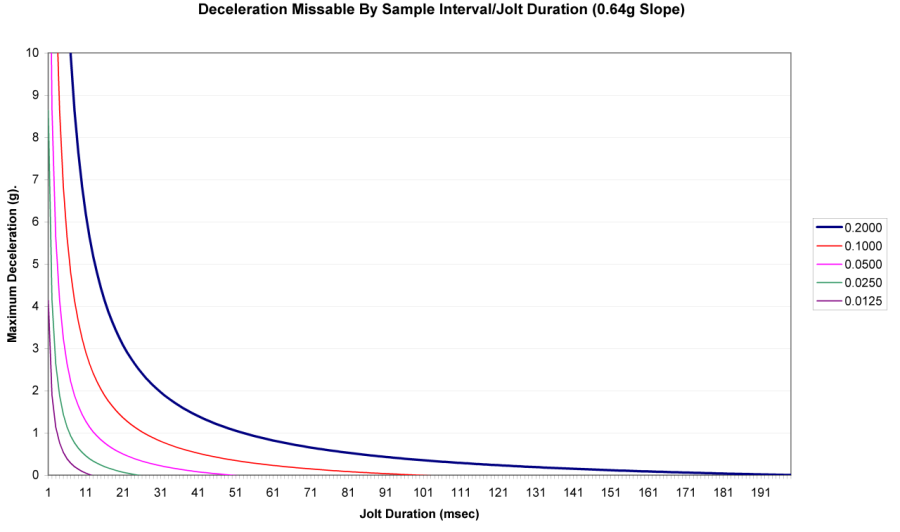
I told you what the maximum magnitude of the 61 msec jolt would be that could be missed by a 200 msec measurement frequency. It is 0.82 g's.

On the graph...200 msec measurement frequency...61msec jolt...0.82g.

There may well be something I don't undrstand, but your specified result is there.

What's the problem ?
 
On the graph...200 msec measurement frequency...61msec jolt...0.82g.

There may well be something I don't undrstand, but your specified result is there.

What's the problem ?

0.82g is less than the static load, so it is not an amplified load and does not qualify as a jolt.

The problem here seems to be your lack of understanding that an amplified load is what would be required to cause structural failure.
 
Last edited:
0.82g is less than the static load, so it is not an amplified load and does not qualify as a jolt.

The problem here seems to be your lack of understanding that an amplified load is what would be required to cause structural failure.

Perhaps bending, rather than breaking, of the core columns to set it in motion.

I can't make heads or tails of the maths, but I just wonder whether the initial downward acceleration was in fact so great that there would have to be a jolt.
 
They are measurable and they are present in every single Verinage demolition, which were looked at due to their similarity to a natural collapse after their instigation, since no explosives are used after removing the columns on a couple of floors with hydraulics.

Well, DUH!

That was not what I was asking. I was asking whether there is ever a jolt of any kind in a standard demolition, in which internal structures are blown and thus rendered incapable of resisting collapse.
 
0.82g is less than the static load, so it is not an amplified load and does not qualify as a jolt.

The problem here seems to be your lack of understanding that an amplified load is what would be required to cause structural failure.
Tony...
Tony said:
I told you what the maximum magnitude of the 61 msec jolt would be that could be missed by a 200 msec measurement frequency. It is 0.82 g's
You qualified it as a jolt.

Now you are saying it isn't ?

The graph is the simple extrapolation of your provided calcs.

I've said nothing about structural failure Tony, simply shown the magnitude of *jolt* that would not be visible given the specified system setup, namely that freefall occurs post impact for velocity recovery to the specified slope (0.64g in this case).

With 200ms sample interval, as per your specified jolt, the magnitude is 0.82g. With a shorter jolt duration, the magnitude maskable by the sample interval clearly increases...11ms -> nearly 6g.

What is the error in the presented graph ?

Are you saying a jolt duration of less than 61ms is not possible ?
 
Last edited:
Perhaps bending, rather than breaking, of the core columns to set it in motion....
The whole "mini discussion" is running the risk of forgetting the context it is set in. That context is:
  • The brief period when the "top block' first starts to fall (therefore it is falling, which is a key point for some conclusions); AND
  • Within Tony's adoption of the Bazant and Zhou "worst case" that column on column axial contact will cause a "significant" jolt.
So for purposes of the recent and continuing mini discussion it matters not how things got to that stage.

Tony then disagreed with femr2's post on the basis that no matter how short the jolt the change in velocity caused by the jolt would last longer. He specified 200msec because that was the boundary of contention.

I said that I agreed with Tony - my emphasis being on the fact that the velocity change would endure longer than the jolt which caused it.
...I can't make heads or tails of the maths, but I just wonder whether the initial downward acceleration was in fact so great that there would have to be a jolt.
My approach to these analyses differs from both femr2 and Tony - both like to rely on the maths - the risk with that is that you can lose sight of - or maybe never have a sight of - what you are trying to use the maths on. If the underlying model is wrong all the maths in the world will not put it right. You may get wrong answers. Even worse you may get near enough right answers for totally wrong reasons.

The second part of your last para I will leave. I cannot fit the concept within Tony's model and I have fundamental differences with Tony on his model.

But he is right IMO that the velocity change caused by a jolt will last longer than the jolt which causes it.

femr2 may be able to finesse the figures one way or the other. My interest was in the principle.
 
But he is right IMO that the velocity change caused by a jolt will last longer than the jolt which causes it.
Yes, but MacQueen and Szamboti miscalculated the magnitude of that change in their Missing Jolt paper.

They subtracted the delta-V attributable to the jolt from the velocities generated by the approximately 0.7g average downward acceleration. That's a form of double counting, because the jolts are the cause of the acceleration being less than 1g. In their model, recovery from a jolt would involve accelerations at 1g, not 0.7g. When you correct that aspect of their calculations, their own data show both the jolts they claim to be missing and the velocity losses attributable to the jolts.

To produce his graph, femr2 calculated the velocity loss correctly. That's why Tony is arguing with femr2's graph.
 
Tony then disagreed with femr2's post on the basis that no matter how short the jolt the change in velocity caused by the jolt would last longer. He specified 200msec because that was the boundary of contention.
I agree that the change in velocity would last longer than the jolt duration, and indeed that's what's in the graph...61ms jolt, 200ms maximum recovery time, resulting in maximum 0.82g deceleration that the 200ms sample interval could mask, with the assumption of freefall after the jolt. Much in the same underlying way that W.D.Clinger showed how jolts could be masked.

both like to rely on the maths
Try not to rely upon, but thought with the inclusion of the W.D.Clinger detail that this was a nice simple way of expressing the same thing. Guess things don't always work out as expected ;)

Does balk that when presented with detail Tony himself helped produce that the response is "This is an unscientific joke you have posted here." and "You either don't understand what I said or are trying to be misleading.". Sigh.
 
...They subtracted the delta-V attributable to the jolt from the velocities generated by the approximately 0.7g average downward acceleration.....
The set up is sort of ass backwards and I have to stop, think, breath deeply etc every time I look at it. And, when others do make a fumble it can be easy to pass over without noticing. Conversely it can jump off the page at you...

And, if you do it yourself all the proof reading in the world won't help. You read what you want to be there, not what is.

Lesson - dunno - maybe "never get too smug"????
 
Tony...

You qualified it as a jolt.

Now you are saying it isn't ?

The graph is the simple extrapolation of your provided calcs.

I've said nothing about structural failure Tony, simply shown the magnitude of *jolt* that would not be visible given the specified system setup, namely that freefall occurs post impact for velocity recovery to the specified slope (0.64g in this case).

With 200ms sample interval, as per your specified jolt, the magnitude is 0.82g. With a shorter jolt duration, the magnitude maskable by the sample interval clearly increases...11ms -> nearly 6g.

What is the error in the presented graph ?

Are you saying a jolt duration of less than 61ms is not possible ?

You are completely wrong here and are now just playing with semantics. Unless an amplification of the static load occurred it would not be considered a dynamic load and that is what Bazant's use of the term jolt was referring to.

I explained why you were wrong here a month or so ago on the 911 forum, so if anyone is curious they can go there to see the discussion.
 
Yes, but MacQueen and Szamboti miscalculated the magnitude of that change in their Missing Jolt paper.

They subtracted the delta-V attributable to the jolt from the velocities generated by the approximately 0.7g average downward acceleration. That's a form of double counting, because the jolts are the cause of the acceleration being less than 1g. In their model, recovery from a jolt would involve accelerations at 1g, not 0.7g. When you correct that aspect of their calculations, their own data show both the jolts they claim to be missing and the velocity losses attributable to the jolts.

To produce his graph, femr2 calculated the velocity loss correctly. That's why Tony is arguing with femr2's graph.
Tony does not understand gravity collapse. CD, looks like gravity collapse, gravity collapse, looks like gravity collapse. Tony has 9 solid years of the CD delusion, hard to give up delusions.

The momentum model shows the changes in velocity as mass is added, I think the real-cd-deal is the problem with Tony.
 
You are completely wrong here
Which bit Tony ?

femr2 said:
You qualified it as a jolt.
or
Now you are saying it isn't ?
or
The graph is the simple extrapolation of your provided calcs.
or
I've said nothing about structural failure Tony, simply shown the magnitude of *jolt* that would not be visible given the specified system setup, namely that freefall occurs post impact for velocity recovery to the specified slope (0.64g in this case).
or
With 200ms sample interval, as per your specified jolt, the magnitude is 0.82g.
or
With a shorter jolt duration, the magnitude maskable by the sample interval clearly increases...11ms -> nearly 6g.
or
What is the error in the presented graph ?
or
Are you saying a jolt duration of less than 61ms is not possible ?

If I've made a mistake on any of those points, I'd like to know which.

Tony said:
I explained why you were wrong here a month or so ago on the 911 forum, so if anyone is curious they can go there to see the discussion.
Please post a link.
 
Tony does not understand gravity collapse. CD, looks like gravity collapse, gravity collapse, looks like gravity collapse. Tony has 9 solid years of the CD delusion, hard to give up delusions.

The momentum model shows the changes in velocity as mass is added, I think the real-cd-deal is the problem with Tony.

It is more like 9 years and we don't have a natural collapse explanation for why WTC 7 was in freefall for over 100 feet or the that WTC 1's upper section never decelerated.
 
Last edited:
If I've made a mistake on any of those points, I'd like to know which.


Please post a link.

You have been shown that your attempt to show a jolt could be missed due to a 167 or 200 millisecond sampling rate is nonsensical, as it could not exceed 1 g and thus does not provide for an amplification of the load. I showed you this on the 911 forum.

Bazant was referring to a dynamic load when he used the term jolt.

You provided the link to our discussion on the 911 forum in one of your posts above.
 
Last edited:
It is more like 9 years and we don't have a natural collapse explanation for why WTC 7 was in freefall for over 100 feet or the that WTC 1's upper section never decelerated.
Fire Tony, firemen know this, why can't you figure it out? 9 years of failure and you have failed to publish anything in a reality based journal.

Tony the inside of WTC7 collapsed before the facade. Nothing was holding up the facade. The overall collapse time of WTC7 is past 15 seconds, your failure to grasp reality is noted.

NIST explained it, you can't grasp it, nor refute it in a reality based journal. Got thermite? lol
 
Fire Tony, firemen know this, why can't you figure it out? 9 years of failure and you have failed to publish anything in a reality based journal.

Tony the inside of WTC7 collapsed before the facade. Nothing was holding up the facade. The overall collapse time of WTC7 is past 15 seconds, your failure to grasp reality is noted.

NIST explained it, you can't grasp it, nor refute it in a reality based journal. Got thermite? lol

Fireman don't know why WTC 7 would have been in freefall acceleration for over 100 feet of its fall. Why would you say they do?

NIST admitted it occurred but did not explain the freefall acceleration for over 100 feet of WTC 7. Why would you say they did?
 
Last edited:
Your attempt to show a jolt could be missed due to a 167 or 200 millisecond sampling rate is nonsensical as it could not exceed 1 g and thus does not provide for an amplification of the load as I showed on the 911 forum.
Yee gads Tony. Who is playing with semantics here... ?

Here's the graph again...
358993252.png


As you can see, for a 200ms sampling rate, and a 61ms *jolt* duration, the deceleration is indeed under 1g.

The graph content is clear.

I asked you a question...

Are you saying a jolt duration of less than 61ms is not possible ?

You stated "You are completely wrong here", yet have not highlighted any error whatsoever.

You know where the link is as you quoted from that discussion here. You really should provide the link so everyone else can see everything that was said.
Your tone is quite humerous. How am I to know what discussion you are referring to ? And by asking you to post a link, do you really think I have any issue with posting a link to it ? Not good Tony.

Now I know what discussion you are referring to, yes, I posted the link at the time here. And you quoted the bleedin' thing here, but here it is again...

Clicky
 

Back
Top Bottom