Merged Applicability of Bazant's model to the real world

Aren't there other possible causes for "no jolt"?

Like, "no jolt measured in the perimeter means that the perimeter's movement was damped with respect to that of the core, making the jolt too small to be measured".
Sorry - nearly missed this one.

Yes and no! (Sorry again. :rolleyes: )

I'm trying to get clarity of the straightforward case. The whole arena of core versus perimeter balance/transfer is a level of complexity to be added....


....later :confused:
 
I would just interject at this point that none of this matters, as you still have to get a small chunk of building through a larger chunk of building in under 15 seconds, "naturally", whether the columns are meeting up, or whether they're mangled and look like dried steel noodles, it's all still mass and the upper mass is not stronger than the lower. It may have an initial advantage if it can actually "fall" through the plane impact zone (which it can't) but the advantage stops quickly as that initial impact is shared and transferred between the two colliding bodies. There is no further advantage to be had gravitationally because the lower block easily arrests the upper.
 
The science ignorance, or is it anti-science? on this forum is shocking.

Even if column ends are missing each other initially, eventually the collision interface will meet intact building structure and must produce a deceleration, in accordance with the physical phenomenon known as Newton's Third Law. This applies to all materials in our physical universe, whether they are an assemblage of different things, or whether they are more rigid structures.


Really? Newton's Third Law says that the upward force acting on a falling mass from the collision interface meeting intact building structure must always exceed the downward force of gravity acting on the falling mass, so as to produce a deceleration?

No, it does not.

Respectfully,
Myriad
 
I would just interject at this point that none of this matters, as you still have to get a small chunk of building through a larger chunk of building in under 15 seconds, "naturally", whether the columns are meeting up, or whether they're mangled and look like dried steel noodles,...
..reasonable to this point other than the claim "none of this matters".

Then you degenerate into nonsensical gobbledegook:
... it's all still mass and the upper mass is not stronger than the lower. It may have an initial advantage if it can actually "fall" through the plane impact zone (which it can't) but the advantage stops quickly as that initial impact is shared and transferred between the two colliding bodies. There is no further advantage to be had gravitationally because the lower block easily arrests the upper.
If you want a rational reasoned explanation say so and I will provide it. Otherwise I will leave this bit of meaningless tripe unanswered.
 
Going bump, bump, bump each time, as they meet resistance. That is if we could even realistically posit that a top block of storeys (that have burned for an hour or more) will remain intact through these "impacts" all the way through 95 floors.

You do realize how ridiculous this theory is?

Clunkety-clunk even :p
I don't say they remain intact. I say the first 1 or 2 bottom floors of the top part get compacted (totally destroyed). The rest of the burning floors probably damaged.
But the bulk of the compression will then happen below the compressed zone.

Do you realize that you try to only argue from your layman's intuition, which is bound to fail in these dimensions? Do you realize how ridiculous THAT is?

If the top assembly is "elastic" (and I don't even know what you mean by this) then so is the bottom.

Highlight: Nuff said
The bottom part endures harder beating. And no, this does not violate Newton.

There is no "velocity" after the first impact. All kinetic energy in such a model would be redirected both upward and downward, resulting in destruction of whatever floors are still colliding.

Wrong.
There are plenty of papers out that show that the first impact will only absorb a small percentage of the kinetic energy before all columns have buckled and concrete has turned into rubble. Kinetic energy means: Still velocity left.
If you disagree: Show your work.
That would involve some numerical assumptions and actual math.

I wouldn't feel so great when my fat slab of concrete hits a lower fat slab of concrete (presuming it misses all the columns and other building components) and cracks into several pieces, losing its kinetic energy in that fracturing.

Oh, it won't miss all the columns, and all the other building components. It will actually overwhelm them one by one, each time "feeling" relatively little resistance.
When your slab hits the slab below, there will be a bigger bump, yes. How big? Well, if your slab consists of the material of 3 floors, and hits the next 1 floor, you, standing on it, will feel a bump about as strong as if you jumped from a cabinate 3 feet high on the ground. Yes, definitely a serious bump, but you'll manage. Your buddy below you will fare much worse.
This "jumping down from 3 feet" is, by the way, still bad enough to break columns above your slab. That's why the first couple of impacts will do some crush-up.
As your slab accrues more and more material and grows to 5, 6, 8, 20... floors of mass, impacting with a new 1-floor slab will result in smaller and smaller bumps that make your situation on top more and more comfortable, will do less and less damage to the top block, but wreak more and more havoc to your poor buddy below, and the structure below.
 
The second post should have ended the debate a couple of months ago, at the latest.

Thanks. Bookmarked.

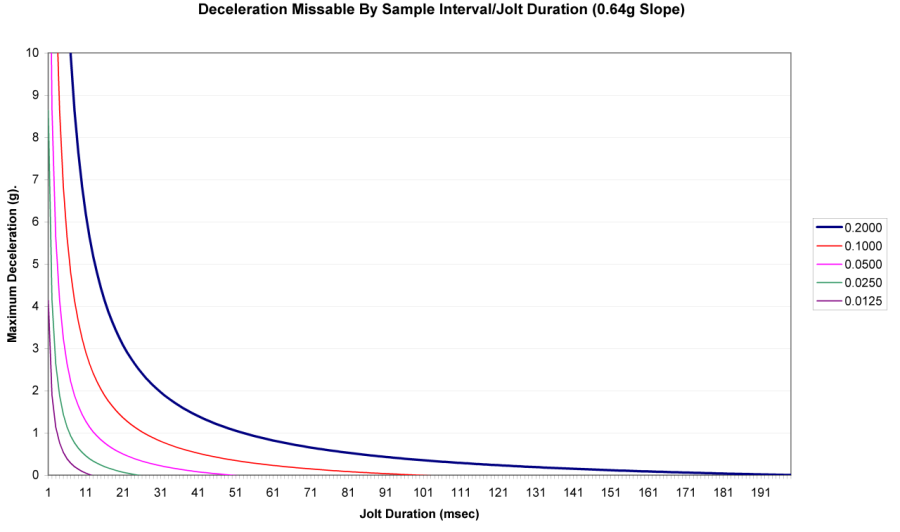
A bit later in that thread I posted the following image, which shows the magnitude of *missable jolts*...
358993252.png


The different graph series are the sample interval in seconds.

The sample interval for the Tony/Chandler data is ~0.2s (The blue line)

So a 20msec *jolt* of magnitude 3G would not show up in the data, and neither would a 10msec *jolt* of over 6G.

The sample rate for my data is 1/59.94s (~0.017s) so would show up any jolt duration over ~15msec.
 
I believe Tony is saying that there must be a jolt in order to deliver the impact required to initiate failure in this model.
...

Yes. There must be jolt. In fact, there must be many jolts.
Local jolts.
These do not necessarily translate into an immediate and equal jolt at the roof, where Tony has attempted to measure them.

However, as W.D.Clinger has shown, Tony's own data, and Chandler's data, both support an interpretation that involves actual decelerations of the roof.
And there you have the jolts that Tony is looking for.

So Tony is fundamentally wrong on two counts:
a) He is wrong in postulating that the many individual impacts at the bottom of the top block should result in jolts at the roof. In other words, he is wrong when he claims that no deceleration at the roof means no unassisted collapse.
b) He is also wrong in claiming that his data shows no deceleration. In fact, the opposite is true: Most competent and probable interpretations of his data suggest that there were indeed several episodes of actual deceleration of the roof during the first 3.5 seconds of collapse.
 
I would just interject at this point that none of this matters, as you still have to get a small chunk of building through a larger chunk of building in under 15 seconds, "naturally", whether the columns are meeting up, or whether they're mangled and look like dried steel noodles, it's all still mass and the upper mass is not stronger than the lower. It may have an initial advantage if it can actually "fall" through the plane impact zone (which it can't) but the advantage stops quickly as that initial impact is shared and transferred between the two colliding bodies. There is no further advantage to be had gravitationally because the lower block easily arrests the upper.

Totally, fully, wholly WRONG. Not a bit of actual understanding of physics involved here.

Most science-ignorant post in recent history.

Listen. An intact column can, by desing, excert a maximum force upwards of about
2 x m x g
Where m is the mass resting on that column, g is gravitational acceleration, and 2 is the safety factor (you may wiggle that to 3, if you like, won't change the argument much)
It does normaly excert a force of 1 x m x g - the simple static load.

The column must be intact for that - unbent, vertical, and laterally braced. In other word: Part of an undamaged assembly.

Now, if that mass m is not at rest, but moving downards at a speed of v, then our so far undamaged column has to excert more force to arrest that fall:
- It still must bear the mass' weight of 1 x m x g
- In addition, it must decelerate that mass according to delta-v= a x t, where a is the (negative) maximum acceleration associated with the remaining force the column has to spare, and t is the time, measured from beginning of impact. Since the remaining force is (2 x m x g) - (1 x m x g) = 1 x m x g, it follows that a = g

It will take some time until the falling mass has decelerated to 0, and during that time, the mass will travel down a certain distance h = 1/2 a t2.

It is easy to show (high school physics) that this distance (height) is equal to the height that the mass fell freely just before impact. So, if the mass had fallen only 3 feet at g, or twice as long by 1/2 g, then our intact column would arrest the fall after another 3 feet.
This would imply that the column gets shortened by 3 feet!
Which it can't.
It will seize being an intact column after a few inches. More likle, the bolts which conncet it to the column piece below will break.
In any case, after a few inches of fall, the force our column can still apply up, will diminish greatly, and pretty soon something will break, and force goes down to 0.

Long before the fall is arrested.
The falling mass, plus the newly added floor, will then fall freely until they hit the next floor.
Where the game starts over.


In an overall picture, it can be shown that the energy needed to break all structural steel elements on all floors is only a small fraction of the potential energy contained in the building's mass on account of its height. So only a fraction of the potential energy will be dissipated by buckling. Another fraction will be dissipated by inelastic collisions with non-structural material (breaking concrete floors etc). But 2/3 of the energy will be available to be converted into kinetic energy. And that translates into a fall at 2/3 of g.

 
A bit later in that thread I posted the following image, which shows the magnitude of *missable jolts*...
[qimg]http://femr2.ucoz.com/_ph/6/358993252.png[/qimg]

The different graph series are the sample interval in seconds.

The sample interval for the Tony/Chandler data is ~0.2s (The blue line)

So a 20msec *jolt* of magnitude 3G would not show up in the data, and neither would a 10msec *jolt* of over 6G.

The sample rate for my data is 1/59.94s (~0.017s) so would show up any jolt duration over ~15msec.

Yes, thanks. I have seen that before, and makes good sense.
The meaning of your graph is a little harder to grasp for science-ignorant people like ergo, I am afraid, than W.D.Clinger's graphs of possible velocities and accelerations fit into Chandel's and Szamboti's data.
 
I would just interject at this point that none of this matters, as you still have to get a small chunk of building through a larger chunk of building in under 15 seconds, "naturally", whether the columns are meeting up, or whether they're mangled and look like dried steel noodles, it's all still mass and the upper mass is not stronger than the lower. It may have an initial advantage if it can actually "fall" through the plane impact zone (which it can't) but the advantage stops quickly as that initial impact is shared and transferred between the two colliding bodies. There is no further advantage to be had gravitationally because the lower block easily arrests the upper.

I've already explained to you why this is. Do you have a rebuttal other than, "nuh-uh"?
 
There is no further advantage to be had gravitationally because the lower block easily arrests the upper.

Show me the arresting mechanism. I can't find one that should have been strong enough.

And as for little Dickie Gage's rants about how a small box cannot crush a larger one, let me repeat:

Never is a small block crushing a larger one, even in the rarified atmosphere that spawns twoofer vids. The upper blocks crushed one floor at a time.
(Actually knocked out the floors, one at a time.)
 
A bit later in that thread I posted the following image, which shows the magnitude of *missable jolts*...
[qimg]http://femr2.ucoz.com/_ph/6/358993252.png[/qimg]

The different graph series are the sample interval in seconds.

The sample interval for the Tony/Chandler data is ~0.2s (The blue line)

So a 20msec *jolt* of magnitude 3G would not show up in the data, and neither would a 10msec *jolt* of over 6G.

The sample rate for my data is 1/59.94s (~0.017s) so would show up any jolt duration over ~15msec.

This is an unscientific joke you have posted here.

It isn't the jolt itself that would be measurable. It is the resulting velocity loss which require much more time than 200 milliseconds to recover from.
 
I am just begining to wonder whether or not jolts may be visible in some known CDs.

They are measurable and they are present in every single Verinage demolition, which were looked at due to their similarity to a natural collapse after their instigation, since no explosives are used after removing the columns on a couple of floors with hydraulics.
 
They are measurable and they are present in every single Verinage demolition, which were looked at due to their similarity to a natural collapse after their instigation, since no explosives are used after removing the columns on a couple of floors with hydraulics.
True. Verinage works by causing one big jolt, or for the pedantic, one layer of linked jolts. And Verinage fits legitimately within the assumptions of Bazant and Zhou.
 
Last edited:
This is an unscientific joke you have posted here.
Is that so ?

Hmm, then perhaps you can explain why you provided the calculations for it then ... ?

Clicky

Tony said:
In response to your request, I did some calculations to determine how much of a jolt could occur and be missed when using a 200 msec measurement frequency.

First there are a few assumptions which have to be made and they are:

1. The jolt would occur immediately after the first data point being discussed.
2. Using Enik's 4.09 Hz vertical natural frequency and the fact of full transmissibility at a shock pulse duration to structural period ratio of 0.25, the jolt would have had a duration of 61 msec during which the velocity would be lost.
3. The velocity recovery would occur at full gravitational acceleration.

I used points 7 and 8 in the Tracker data where the velocities are 4.568 and 5.920 m/s respectively and where the first floor collision would have likely taken place about 1 second into the fall. The slope between these points is 6.28 giving an acceleration of 0.64g. The difference is then 0.36g and the amount of additional velocity that could be gained at 0.36g over 139 msec is 0.49 m/s. This would be the velocity loss due to the jolt. This velocity loss over a 61 msec duration equates to a jolt of about 0.82 g's.

The velocity loss we determined would be required due to the kinetic energy transfer needed to fail the columns and accelerate the floor mass in the Missing Jolt paper was 17.38 ft./s or 5.3 m/s. So it seems all that could be missed when using a 200 msec measurement frequency is a jolt less than one tenth the size of what would be necessary, at a minimum, since there were other energy sinks not calculated in the Missing Jolt paper such as, building vibration, sound, and heat from friction.
 
Is that so ?

Hmm, then perhaps you can explain why you provided the calculations for it then ... ?

Clicky

The velocity losses which I said could be missed are insignificant and would not have had any effect on the structure. They were well below 1g and you are talking about it being possible for 3 to 6g jolts to be missed, and that is total nonsense.

You either don't understand what I said or are trying to be misleading.
 
Last edited:
...er. For what it's worth I agree.

Even with the inclusion of post-jolt freefall to recover the velocity ?

It's for a 0.64g slope...

The equation...

g=9.8 (m/s^2)
s=slope (acceleration between samples - fraction of g)
i=interval (s)
d=jolt duration (s)

=((1-s)g(i-d))/d/g

=(1-s)(i-d)/d
 
Last edited:

Back
Top Bottom