
-
Security incident: ISF was recently accessed by intruders. Please change your password, and change it anywhere else you used it. Read more
You are using an out of date browser. It may not display this or other websites correctly.
You should upgrade or use an alternative browser.
You should upgrade or use an alternative browser.
The Laverty PGF track photos.
- Thread starter LTC8K6
- Start date
LTC8K6
Penultimate Amazing

I think the footers need a new idea regarding tracks, so I'm going to throw one out there for them.
If the tracks are significantly deeper than your own footprints, they are fake.
If the tracks are significantly deeper than your own footprints, they are fake.
SweatyYeti
Master Poster

- Joined
- Dec 1, 2006
- Messages
- 2,919
LTC8K6
Penultimate Amazing
The rocking stamp is an ingenious idea.
I don't know if it's ingenious or not, but it would probably work. On every third track or so, you could push the front part towards the rear a little to get a little pile of soil pushed backwards for a midtarsal break.
These folks were fooled by the simplest of flat fake feet, so it probably won't take much.
The stamp is one way you could make tracks near a road or on a trail without leaving your own prints behind. Along with numerous other ways, of course.
It's still a wonder to me that most prominent footers never seem to stop and think how they would have made the tracks they find in woods.
SweatyYeti
Master Poster
- Joined
- Dec 1, 2006
- Messages
- 2,919
Because you picked two that were the same length?
You're right, I did.
SweatyYeti
Master Poster
- Joined
- Dec 1, 2006
- Messages
- 2,919
The stamp is one way you could make tracks near a road or on a trail without leaving your own prints behind.
Along with numerous other ways, of course.
Of course, there must be.
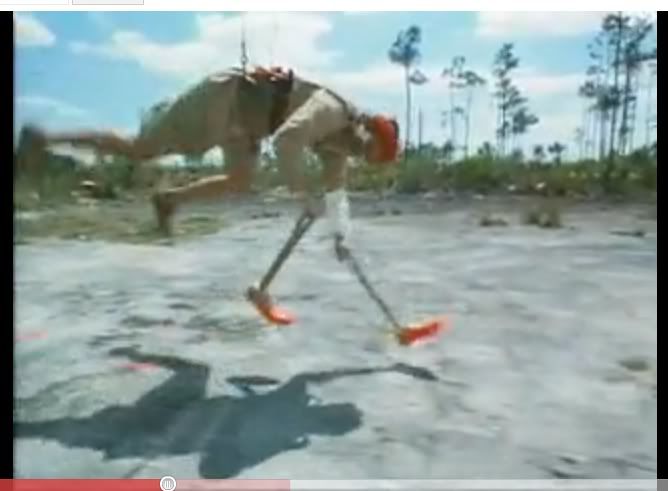
Here is one method. It's just a slight variation on Drew's stompers, using the assistance of an airship, of some type....(seen here, actually being used to 'hunt down' Beatles)...
Last edited:
William Parcher
Show me the monkey!

- Joined
- Jul 26, 2005
- Messages
- 27,672
If the tracks are significantly deeper than your own footprints, they are fake.
If the giant tracks are the same depth as yours - they are from a real Bigfoot?
LTC8K6
Penultimate Amazing
If the giant tracks are the same depth as yours - they are from a real Bigfoot?
Sure, since the suggestion is for footers.
LTC8K6
Penultimate Amazing
Of course, there must be.
Here is one method. It's just a slight variation on Drew's stompers, using the assistance of an airship, of some type....(seen here, actually being used to 'hunt down' Beatles)...
[qimg]http://i172.photobucket.com/albums/w28/SweatyYeti/Fun/HELP1.jpg[/qimg]
We were taught how to hide our tracks in the military, sweaty. We were never told to use an airship or a crane or to suspend ourselves from trees, etc.
Somehow we managed to do it without much more than what we were carrying with us, or could find in the woods.
I'll just put this off to your sense of humor sweaty, and assume that you too can figure out how to fake a trackway.
Think about it, if you can't figure out how to fake trackways, then you are at a great disadvantage when confronted by a hoaxer who has figured it out.
If the detective can't figure out how the crime was committed, he's unlikely to convict the criminal.
tube
Muse

- Joined
- Aug 1, 2005
- Messages
- 917
Some years ago, Roger Knights sent me a small sample of soil collected by MK Davis at what was believed to be the film site. Indeed the proponents are correct, it's not really even soil, it's more like fine, sharp, black gravel.
Yet this sample was collected nearly 40 years after the filming, so we really don't know if Davis' sample was representative of the conditions of 1967, especially considering that the creek was known to experience periodic and violent flooding.
I've always been amused how the proponents of the Skookum elk cast were quick to rationalize how there were no Sasquatch footprints leading up to the main impression by arguing that there were significant differences in the soil compliance within such a confined area, yet argue that the substrate of Bluff Creek circa '67 was uniformly rigid!
At the risk of repetition, it's certainly possible to impress a rigid prosthetic into non-compliant substrates with repeated stampings.
http://www.flickr.com/photos/matthetube/4818196349/
To be a bit boastful, I feel the inclusion of the mashed plants in the track was a nice little touch, as it demonstrates that there was no excavation...
I've personally attended several conferences where Jeff Meldrum gave presentations. He seems to have an ongoing feud with Dave Daegling to the effect that rigid prosthetics WORN by the hoaxer tend to dig into the substrate in an unnatural way. The toes tend to dig in too much. Clearly the centerpiece of Meldrum's argument is the particular track seen in one of the Laverty photos. I concede to Meldrum that indeed that track doesn't seem to have been made with a rigid prosthetic worn by a hoaxer. It's a strong enough claim that it deserves to be addressed specifically:
http://orgoneresearch.com/2009/10/19/bigfoots-mid-tarsal-break/
Here is what I suspect, but cannot prove:
1. The film is almost certainly a hoax.
2. That the tracks exhibiting a "mid-tarsal break" were probably made by the flexible feet of the guy wearing the suit.
3. Those tracks were made in a localized patch of compliant substrate, probably wet mud near the creek.
4. Additional tracks were made to create a convincingly long trackway using flat, rigid prosthetics in a non-compliant substrate like the kind I was given a sample of.
5. These rigid prosthetics were probably made of wood or concrete, rather than plaster of Paris, as I'm highly skeptical that plaster of Paris could survive the shock loads involved with repeated stampings.
6. Tracks made in non-compliant substrates could have excavated prior to impressioning. As far as I know, there was no fine plant matter in the creek bed like that seen in my front yard.
7. Additional human footprints alongside the alleged Sasquatch tracks are easily rationalized by claiming that curious people approached closely to examine the big tracks.
8. For what it's worth, in the test track from my front yard, my own footprint was made some years ago, when I weighed somewhere between 240 and 260 pounds.
9. If we accept that the casts Patterson displayed in the short film clip are from the Bluff Creek trackway, they most certainly model a track with a very flat and proportionately shallow impression, like that seen in my front yard test.
Yet this sample was collected nearly 40 years after the filming, so we really don't know if Davis' sample was representative of the conditions of 1967, especially considering that the creek was known to experience periodic and violent flooding.
I've always been amused how the proponents of the Skookum elk cast were quick to rationalize how there were no Sasquatch footprints leading up to the main impression by arguing that there were significant differences in the soil compliance within such a confined area, yet argue that the substrate of Bluff Creek circa '67 was uniformly rigid!
At the risk of repetition, it's certainly possible to impress a rigid prosthetic into non-compliant substrates with repeated stampings.
http://www.flickr.com/photos/matthetube/4818196349/
To be a bit boastful, I feel the inclusion of the mashed plants in the track was a nice little touch, as it demonstrates that there was no excavation...
I've personally attended several conferences where Jeff Meldrum gave presentations. He seems to have an ongoing feud with Dave Daegling to the effect that rigid prosthetics WORN by the hoaxer tend to dig into the substrate in an unnatural way. The toes tend to dig in too much. Clearly the centerpiece of Meldrum's argument is the particular track seen in one of the Laverty photos. I concede to Meldrum that indeed that track doesn't seem to have been made with a rigid prosthetic worn by a hoaxer. It's a strong enough claim that it deserves to be addressed specifically:
http://orgoneresearch.com/2009/10/19/bigfoots-mid-tarsal-break/
Here is what I suspect, but cannot prove:
1. The film is almost certainly a hoax.
2. That the tracks exhibiting a "mid-tarsal break" were probably made by the flexible feet of the guy wearing the suit.
3. Those tracks were made in a localized patch of compliant substrate, probably wet mud near the creek.
4. Additional tracks were made to create a convincingly long trackway using flat, rigid prosthetics in a non-compliant substrate like the kind I was given a sample of.
5. These rigid prosthetics were probably made of wood or concrete, rather than plaster of Paris, as I'm highly skeptical that plaster of Paris could survive the shock loads involved with repeated stampings.
6. Tracks made in non-compliant substrates could have excavated prior to impressioning. As far as I know, there was no fine plant matter in the creek bed like that seen in my front yard.
7. Additional human footprints alongside the alleged Sasquatch tracks are easily rationalized by claiming that curious people approached closely to examine the big tracks.
8. For what it's worth, in the test track from my front yard, my own footprint was made some years ago, when I weighed somewhere between 240 and 260 pounds.
9. If we accept that the casts Patterson displayed in the short film clip are from the Bluff Creek trackway, they most certainly model a track with a very flat and proportionately shallow impression, like that seen in my front yard test.
LTC8K6
Penultimate Amazing
Bobbie has made a rather stunning claim regarding the photos at the beginning of this thread:
Referencing Kitakaze's post # 3929 and the photo he uploaded in the middle; that set of photographs were taken from Meldrum's book, "Sasquatch: Legend Meets Science" page 232.
The photos on that page in LMS are attributed to Lyle Laverty but they were NOT photographed by Laverty or Bob Titmus.
They were photographed on the evening of Sunday August 28, 1967 by Rene Dahinden in the dusk hours after he and John Green arrived by chartered plane from Canada, landing at the little airstrip in Orleans w/the tracking dog, "Lady" and the handler Dale Moffitt. Met by Al Hodgson and his son Mike in the family station wagon at the airstrip, they drove to the area along side Bluff Creek where these tracks had been seen. It was getting dark. (see JG:*Chapter 4 pag 74)
"At the first sniff the dog turned as rigid as if she had been given an electric shock, but no one cared to try following the tracks off into the woods in the dark. At dawn the dog’s reaction was entirely different."
It was getting dark and they were afraid to put the tracking dog on scent because night was falling fast. Before calling it a night, Rene took these pictures with his flash camera; his signature Dunhil pipe laid by the track for comparison size is a dead-giveaway. He was never without it.
In fact, I believe all these photos taken with a flash, dark around the outer edges were taken by Rene that same first night in August.
LTC8K6
Penultimate Amazing

Correa Neto
Philosopher

- Joined
- Aug 4, 2003
- Messages
- 8,548
By now I think it would be interesting to review some of Desertyeti's posts on a test to detect forgery from pictures. It starts at
http://www.internationalskeptics.com/forums/showpost.php?p=2242235&postcount=406
The other paralell discussions, albeit quite often off-topic, are also intrumental on the way footers build and present arguments and evidences full of holes. Some are disgusting...
http://www.internationalskeptics.com/forums/showpost.php?p=2242235&postcount=406
The other paralell discussions, albeit quite often off-topic, are also intrumental on the way footers build and present arguments and evidences full of holes. Some are disgusting...
The Shrike
Philosopher

By now I think it would be interesting to review some of Desertyeti's posts . . .
They might be helpful, but that thread is 130 pages long. We need a sarcasm-free, crystal clear, 1-2 paragraph summary with photos that illustrates how to tell a truly organic footprint from a foot-shaped impression made by something else. If that can't be done, then that'd be nice to know too.
LTC8K6
Penultimate Amazing
http://www.cryptomundo.com/wp-conte...of_giant_hominoid_tracks_in_north_america.pdf
Meldrum's paper referencing the photos and the cast as being related to the PGF.
Meldrum's paper referencing the photos and the cast as being related to the PGF.
Correa Neto
Philosopher
- Joined
- Aug 4, 2003
- Messages
- 8,548
They might be helpful, but that thread is 130 pages long. We need a sarcasm-free, crystal clear, 1-2 paragraph summary with photos that illustrates how to tell a truly organic footprint from a foot-shaped impression made by something else. If that can't be done, then that'd be nice to know too.
Yes, I can understand your points. I feel a completely on-topic discussion with footers is something almost impossible to achieve. And keeping sarcasm away is hard, especially when you are discussing once again with the same person the same thing you already beated to death lots of times before while watching the same others spewing offenses once again, since they are unable to produce anything better.
Now, back on track (pun intended), a quote from DY:
desertyet@thread "simple challenge" said:So, what did this “prove”? Well, it shows that deciding whether a single print is real or forged based only on a photograph is probably not possible. Anyone can form a convincing-looking print and cast or film it. What’s better is to have several prints. But as in this case, all 3 look different despite being from the same guy! So, similarity isn’t a good criterion. The most helpful insight might be that the interaction of the foot with a particular substrate can offer clues as to its authenticity, but not confirm or deny it. A series of tracks in mud with no slippage would be very suspicious indeed. And toes that don’t clench in a viscous substrate are also cause for skepticism. Finally, it should be evident that guys like Grover Krantz who boldly proclaim that they can tell whether a print or cast is real or not simply by examining a photo or plaster cast are full of it.
http://www.internationalskeptics.com/forums/showpost.php?p=2252133&postcount=576
It sums quite nicely my opinion- what you want is quite probably very difficult. Of course there are pictures which scream "I AM A FAKED FOOTPRINT" (and this include some specimens taken by footers as prime examples of real bigfoot footprints). So, a list of unrealistic features of these prints can be assembled. I must say that personally I think many of those who think this sort of prints are real would be blind to evidence showing they are wrong.
This put, I must say a more dedicated hoaxer quite possible could forge a print with most if not all the key items pointed by desertyeti and tube as indicative of a real print. Maybe in-situ investigation could disclose the hoax, but in pictures (and possibly casts) it would be next to impossible.