• Quick note - the problem with Youtube videos not embedding on the forum appears to have been fixed, thanks to ZiprHead. If you do still see problems let me know.

9-11 Presentation at NMSR, May 19 2010

Too many posts all at once, gentlemen. And I have to go. Back later.
 
Then please show me where other highrise buildings naturally collapse the way the Twin Towers did.

First show me other highrise buildings built like the WTC that were hit by airliners or burned uncontrollably for 7 hours.
 
Verinage is not an example of a minor portion of a structure crushing through via gravity its major portion.
This shows 3 stories against at least 8 stories, liar. I have shown it to you multiple times.


I can't believe ergo is still posting at all. If I was caught with my pants down as he has, I would quietly leave the discussion. It seems he's a masochist.
I'd vote for troll.
 
One large piece of evidence I will cite is your inability to come up with an example in nature or engineering in which an object or structure is crushed gravitationally by a smaller portion of itself.

This definition essentially relies on a misconception or strawman argument, because the structure is not a solid object, and the upper mass (which gravity is accelerating) is not crushing the entire lower portion simultaneously, only that structure immediately in contact with it.

To help you conceive of this, just imagine the strength of any particular set of structure which is being impacted. It could be flanges, bolts etc..
Assign a strength value, x
Then assign a value to the energy available in the upper block, e

You can actually calculate the approximate value of e based on the number of floors of the upper block, and of course this value greatly exceeds the strength of any particular floor below, based on two simple things:

1) The upper mass is in motion, not static
2) The load of the upper mass is not being carried by the structural elements which the engineers intended, but by random and unevenly distributed elements instead. These include any structure which happens to be in contact with the upper block rubble and intact structure - in particular think of a column impacting a portion of floor system, something the designers did not designate as a correct load path.

The problem 9/11 Truthers have when attempting to prove their alternative views is that they will never be able to rely on competent math in support, namely to get this work accepted by mainstream engineering journals.
Neither Gordon Ross nor David Chandler has succeeded in passing a competent peer-review and publishing in the journal of ASCE, for example. Yet Dr. Bazant has done this several times in support of the fire-induced collapse hypothesis.

You may gripe all you like about how physics doesn't allow the conventional scenario, but until you can come up with a properly peer-reviewed engineering alternative, you are really just full of hot air, and no substance.
You will never get acceptance by the engineering community, and you will be ignored by mainstream science - and this is not their fault, it's yours.
The burden of proof is on you, much as you'd like to shift it to others.

ps, you might want to get in touch with demolition engineers who work in verinage, and ask them to provide an estimate of what constitutes a sufficient upper block to completely crush a lower block.
Ask them how many upper floors would be needed in, say, a 60 story building, to do this. I'm sure they can provide an answer.

Include this info in your engineering paper when you put it together.

Good luck :)

ps Avalanches and landslides are excellent examples of 'rubble' or accumulations of mass and momentum gathering energy.
I notice you use the curious term 'path of greatest resistance' - but you're using a rhetorical device to avoid the inevitable, which is that the avalanche and the building collapse (including verinage, as you must know) both collapse or accelerate in the direction of LEAST resistance.

Before you try to defend a lost position, just read this word again - verinage. Those buildings collapse pretty much straight down, through the path of least resistance. Even though the lower floors have not been weakened below the initiation point.

You see, the Richard Gage rhetorical trick is a fraudulent concept. Verinage proves this without a doubt. It's time you realized this, and stopped thinking like a fool.
 
Then please show me where other highrise buildings naturally collapse the way the Twin Towers did.

The towers were 110 stories and were hit by airplanes. To demonstrate the absurdity of your request, try to find another example of such buildings which didn't collapse:D
 
If ae911truth had a party, and they played the game "Jenga," would their heads assplode? Just asking questions.
 
I can't believe people are still feeding him. After his "physics" statements, I gave up hope.
I preserved hope thinking that he could still be educated. But he proved his absolute desire of remaining ignorant, his lies and his refusal to back any of his claims, yet he still argues endlessly. If that doesn't match the definition of troll, what does?

Now I'm merely dedicated to exposing his lies.
 
Please show how my estimation is wrong.

It would help if you actually gave an estimation other than asserting that 'gravity can't do it'. You say you're using someone's calculations, yet refuse to provide them.

It's been explained to you repeatedly how your physics understanding is incorrect, but you ignore it because you can't possibly be wrong. It's been explained to you how your understanding of structural engineering is wrong, but you ignore it because you can't possibly be wrong. You refuse to do any basic research or give any credence to something brought up that doesn't fit in your view of what happened, no matter how well it's backed up. We're not here to do your work for you or hold your hand, it's your responsibility to reference your claims. We stand by the explanation given by the agencies responsible for the investigation of the WTC disaster, and all the published material related to it. You know the research is out there, yet you refuse to acknowledge it and say we have no evidence. Read the materials. If you don't understand them, go get a textbook and learn. Incredulity and lack of understanding is not acceptable evidence, yet you seem all too keen on using it.

I'm more than willing to accept that the WTC was CD/lasers/nukes, but there is zero evidence to support the hypothesis. So far, after 9 years, the truther movement has absolutely nothing. If there was something substantial, it would have been published long ago, instead of 'debated' repeatedly on obscure internet forums. Someone who presented a valid paper showing that the WTC was CD and not a direct result of an airplane crash would probably win a pulitzer. Get to work.
 
Last edited:
ergo, in case you're actually interested in the physics, R. Mackey made some very good points in another thread. In particular this post explains why the upper block would not be crushed.

The gist of it is that the upper floors were experienced a net deceleration of roughly 1/3 g - that's only 1/3 of the force of gravity, which is less than it was experiencing when it was static.

Conversely the lower structure was getting clobbered with an increasing mass and eccentric loads, completely overwhelmed and unable to resist these forces.

As for the overall collapse time, even at 2/3 (64% observed) gravitational acceleration, it happened quite quickly. You can roughly estimate the expected time given that acceleration with a simple algebraic equation and the 9.22 s 'freefall' time from 110 stories:

14.4 seconds.

Remember that's only about 64% of 'freefall speed' (Gage's term)
 
Oh, ffs.


Moving goalposts and twit logic on top of it. Stop wasting people's time.
You can't do math, you proved by posting a diagram of a WTC floor it could be crushed to 5 inches.

Now you call pointing out your delusions is a waste of time; irony coming from someone who has failed to figure out 911 given the answers and over 8 years. All you can do is spew idiotic delusions made up by liars.

Then please show me where other highrise buildings naturally collapse the way the Twin Towers did.

You mean how many buildings collapsed due to aircraft impacts of 1300 and 2093 pounds of TNT kinetic energy impacts followed by fires set with 66,000 pounds of jet fuel. lol, you are being delusional.

I know of many buildings that were totaled by fire; high-rise buildings. And had they not been fought by firemen for hours, over 10 hours in some cases, the buildings would have collapsed. As it stands they were never used again. The cool part is you had 8 years to find these buildings and you failed! Instead you spew delusions based on ignorance and your own failed opinions based on lies, hearsay, and fantasy.

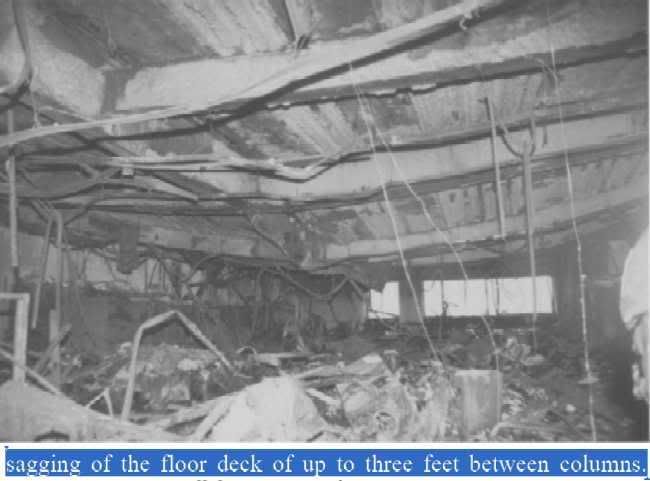
Here is one building which almost collapsed, but the fire was fought constantly and the building sprinkler system finally stopped the fire.
onemeridiansag.jpg

You don't do math, and you only like delusions. Does that sum it up; wait, you don't do math.
 
Last edited:
In the crush-down model (not in reality) and judging by the time of collapse and the video evidence, whatever rubble was created in the initial crush-up of the upper block would have allegedly hit the uppermost floor of the lower section in a fraction of a second.


A fraction of a second. Good.

So the rubble of the upper section impacts the uppermost floor of the lower section over a fraction of a second. Let's take that as, oh, (off the top of my head) 0.10 seconds.

Let's assume the rate of impact is constant.
That is, over said fraction of a second, the rate at which the rubble is hitting the floor is constant.

Now, approximately how much does our impacting mass mass?
Let's just pull another number from thin air, say 100 kg.


From here, we will be delving into the wild and wonderful world of physics.
Buckle up.
(Apologies, I cannot recall how to work the equation-writing system here)


Behold Impulse.

I = F*dt = m*vf - m*vi

where
I = impulse (kg*m/s)
F = Force (kg*m/s2)
dt = change in time (s)
m = mass (kg)
vf = final velocity (m/s)
vi = initial velocity (m/s)


We have two scenarios:

a) upper block is intact
b) upper block is rubble

Let's assume an initial velocity (vi) of 1 m/s
Let's assume a maximum impulse case. That is, the vinfal velocity (vf) is zero.


For case a), we have the following:

I = 100 kg * (0 m/s - 1 m/s) = -100 kg*m/s

dt, if you'll recall, is known.

Thus, F = I/dt = (-100 kg*m/s) / (0.10 s) = -1,000 N

Remember that number.


For case b), we have to look at the rate of mass impact.
To do this, we'll need to adapt some terms into a time-based form. Sadly, I cannot recall the forum's equation writer coding, so I can't give you dots. So pay attention to the units!


m_rate = 100 kg / 0.1 s = 1,000 kg/s
Therefore, the rubble is coming down at a rate of 1,000 kg/s.

I_rate = 1,000 kg/s * (0 m/s - 1 m/s) = -1,000 kg*m/s2
Guess what? kg*m/s2 is a common unit of measure. It has another name. The Newton. It is a measure of force.

So, remember that number from a)?

Yah, they're equal.


Thus, your claim that rubble does not behave the same in an impact scenario as does a solid object of equal mass is wrong.

Thank you come again.


However, the video I posted from plaguepuppy shows that the lower part of the building starts to descend independently from what the upper part is doing.


Irrelevant to your claim that a rubble does not impact the same way as a sold block of the same mass.
 
(Apologies, I cannot recall how to work the equation-writing system here)

I think it's [latex]...[/latex] with $ signs around the contents, e.g.:

[latex]$I = F dt = m v_f = m v_i$[/latex]
 
Yeah, that sounds right.
I've used it before, it's just been a while.
 
Sorry it took me so long to get back, I got distracted by something shiny (life, don't talk to me about life...).


Much of the debris is in the form of dust, as we can see by the dust plumes in the pictures and that then covered Manhattan for days afterward, and as evidenced by the absence of larger chunks of matter at Ground Zero that one would normally find in natural collapses. That dust did settle of course, but it was not part of the "falling" debris that you are trying to include in this discussion of mass, and I don't think there has been an accurate estimate of how much of the buildings were converted into this dust, or what I like to call powder. Just sayin'.

Large amounts of other debris, as we know, fell outside the building, yes, landing on the ground, outside the building's footprint.

Other people have pointed out that the argument that most of the mass of debris is escaping over the sides of the building is not valid, so I'll just ask what velocity does rubble from the core of the building need to attain to escape the footprint of the building in the time it takes to fall 3.7m in free fall? An object that started at the center of the tower and escaped directly to one of the four sides would have had to move at an average of 36m/s (129 kph) beginning immediately upon collapse initiation in order to escape the footprint before the building had fallen a floor, and while that number decreases as we move further from the center of the building, the fact is that given the time between when a floor is 'rubblized' and when it slams into the next floor, not that much of it has time to escape. The result is a mass of debris that is growing larger and faster along the way.


: That's a given - as I said, I'm just trying to lay out a scenario in which we can come to a consensus about the physics right now. One question from earlier that you did not answer: do you agree that two objects or groups of objects with the same mass traveling at the same speed have the same kinetic energy?


I will agree that two objects with the same mass traveling at the same speed will have the same momentum. I am not clear in this example of how momentum would be distinct from kinetic energy. I also don't see the point of bringing into the discussion "groups" of objects. Just discuss the objects on their own.


We group objects that have the same properties or are behaving the same way - a bowling ball is a group of atoms which we don't care to discuss individually. Similarly, if I want to compare a 5 kg bowling ball hitting someone in the head vs. 5 kg of sand, I couldn't just consider one of the grains of sand, I've got to consider them all at once.

Momentum is a measurement of how fast and in what direction a mass is moving, kinetic energy is a measurement of how much work it took to get it moving and both are important in understanding the WTC collapse. To understand why, let's look at the beginning of the collapse. A global collapse was initiated (whether by progressive failure, controlled demolition, or orbital space laser :D) and the upper block dropped 3.7m and impacted the lower block. In it's fall, the upper block acquired both momentum and kinetic energy. In my opinion, a good rough model of the situation is to view the tower as a series of plates connected by columns. The plates can absorb energy on impact (via the pulverization of concrete) and the columns can absorb energy as well (by compressing). If we assume that the columns on a single floor were instantly removed (a scenario biased toward building survival compared to what happened, I would argue) the upper block would free-fall 3.7m until the bottom floor of the upper block impacted the upper floor of the lower block. The total momentum of the two floors would be conserved and some of the kinetic energy would have been absorbed by fracturing the concrete in both floors. The columns would then start absorbing kinetic energy as their loads returned and began increasing (the loads would have been zero in free-fall and any energy inducing a load below the elastic limit of a beam can be transferred by the beam into the floor it's attached to). If we didn't account for this energy, then the momentum of the floors in the upper block would be alternately increased by gravity and shared by newly impacted floors all the way to the bottom. Momentum alone argues for the sustainability of the collapse once it was initiated (to be fair momentum and energy combined argue for sustainability as well, just not as strongly...). In order to understand how the WTC collapse proceeded we need to look at both momentum and kinetic energy and how they are transferred.
 

Back
Top Bottom