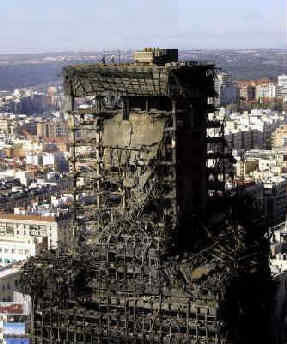
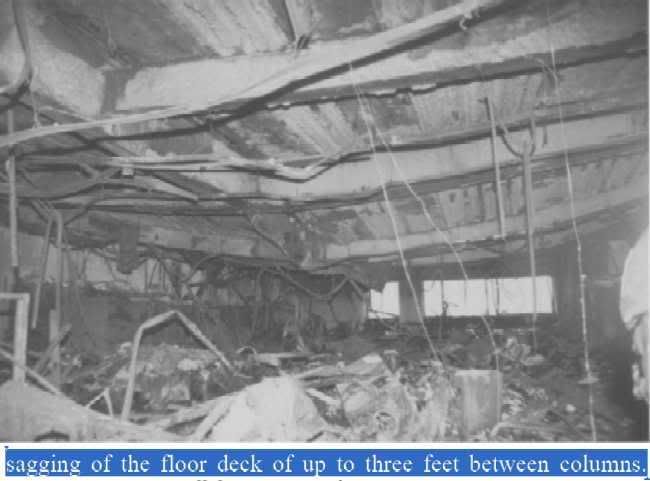
It's really time to set things straight. No laws of conservation were violated. The period of unresisted collapse - i.e. "free fall" - was explained by the progression of failures during the collapse and the internal failures necessary to have caused what we saw on the outside.
For starters, we all need to understand what the observed progression of failures in the structure was:
- The interior structure below the east penthouse failed, causing that penthouse to fall.
- Progression of failures from east to west lead to the north face starting to fall several seconds later.
- The east side of the tower begins it's descent, then the west side very soon (less than a second) after.
The penthouse fall and north face, east and west wall descents were observed from the outside. Repeat: Those are
observations, not suppositions. That is what happened, and what can be seen in recordings of the collapse.
Next, we need to realize (and
I need to remember

) that what was observed descending at near
g acceleration was a portion of the exterior of the building: Part of the north face of the structure. This was noted in NCSTAR 1A.
We know what order visible parts of the exterior started falling; all we have to do is look at videos to determine this. We know that the upper part of the north face is what's observed to have falled at
g or near
g; NIST comes out and says it. What we don't directly see is why that part of the north face - as well as the floors attached to it - met little resistence, but it can be figured out from the fact that the interior was on fire, and from the design of the building. All of that is detailed in the NIST reports (in painful detail in 1-9), but the bottom line is that to explain the initial failure that led to the Penthouse collapse, fires had to have caused a or some interior column(s) to fail. NIST identifies that as column 79 around the 13th floor, but that level of detail isn't needed for this explanation. What
is important is that a failure around that level of the main support columns on the east side of the tower would, due to the design of the building (look up the sections regarding "long span trusses" in the WTC7 report) also cause a series of floor failures. Those in turn would cause buckling of columns lower in the building (hence, the "progressive" in "progressive collapse"). When those columns buckle, they can't support weight. So what happens when the upper segments eventually start to descend? They come to those buckled columns and meet practically no resistance, definitely not a level that can be measured in a video. So an entire section of the tower suddenly falls at
g (or close to it) because of those failures. Once the loads from the descending segment gets past those columns, there's resistence again.
Note that the explanation wasn't that 8 floors "were blown" or anything like that. It is that interior failures known to have occurred because of the east penthouse failure also buckled columns on lower floors, and the upper part of the north wall fell for around 8 stories unopposed. Poorly communicating that as a failure of floors all at once is my fault, but the ultimate point is that that segment of tower - floors, exterior wall, etc. - falling at
g was doing so because other failures had buckled lower supports to the point where they provided little to no resistence. There's nothing magical about this, nor is there anything that violates any supposed conservation laws (note that cmatrix hasn't identified
which law

; there are multiple such laws in physics). All that happens is that a failure starts in a critical point in the building, and initiates other failures that eventually
progresses to the point of total collapse.
No magic, certainly no energy deficit. Most definitely no energy devoted to removing 8 entire floors (that's absolutely not what happened, nor was it what any of us were trying to say what happened). All that's needed is an understanding of what actually was seen, and what happened on the interior to cause it in the order that it was seen in. That's it.