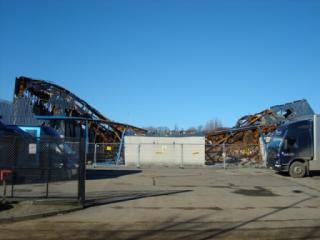
Debunk Alert: Experiment to Test for Eutectic Reaction

Wrong. Ask any fireman.
You ask a fireman.:D

ETA:The freeway fire was in a pile of combustibles, not a building collapse where most of the materials were non-combustible. It was an open air fire underneath the steel beams.

This condition could not exist in the WTC 7 debris pile.

It did not "melt" the steel as reported.
 
Last edited:
You ask a fireman.:D

ETA:The freeway fire was in a pile of combustibles, not a building collapse where most of the materials were non-combustible. It was an open air fire underneath the steel beams.

This condition could not exist in the WTC 7 debris pile.

It did not "melt" the steel as reported.

And no steel at WTC was literally melted.
 
And no steel at WTC was literally melted.
Wrong! :rolleyes:

"Heating of the steel into a hot corrosive environment approaching 1,000°C (1,800°F) results in the formation of a eutectic mixture of iron, oxygen, and sulfur that liquefied the steel." - FEMA C pg 5

liquefied: to become or make liquid
melted: change from solid to liquid state.


[FONT=&quot]"[/FONT][FONT=&quot]Various metals (most notably iron and lead) were melted during the WTC [/FONT]
[FONT=&quot]event, producing spherical metallic particles. Exposure of phases to high[/FONT]
[FONT=&quot]heat results in the formation of spherical particles due to surface tension.[/FONT]
[FONT=&quot]Figure 21 [/FONT]
[FONT=&quot]and Figure 22show a spherical iron particle resulting from the[/FONT]
[FONT=&quot]melting of iron (or steel)[/FONT]
[FONT=&quot]." - R.J. Lee Group report p[/FONT][FONT=&quot]g 17 [pdf pg 21][/FONT]
 
Last edited:
That is a matter of opinion, yours and mine being a bit biased. :D

You find reasons to deny it. I accept it a face value. Why do you doubt Dr. Harrit and Dr. Farrer?

Because their methods are invalid, i.e. incapable of doing what the authes want them to do. Most notably, they heated their samples of red and grey chips in normal atmosphere and had no was of discerning whether the chips burned with atmopheric oxygen, in which case they would not be thermate.
However, if we assume the method to be valid, then their own data would show conclusively that their sample could not possibly have been thermate, as it released more energy in the form of heat than thermate contains as potential energy.
Either way, the paper only claims to present proof for thermate, when in fact it is proof against thermate.

Furthermore, they failed to take several more possibilties into account. For example, they did not rule out paint in any meaningful way, as they compared the sample to only one kind of paint - and did not even bother to state WHICH paint, so their results cannot possibly be checked and repeated (that blunder alone tells us that the paper was not peer-reviewed in any way that deserves the name).

Lastly, they did not do any tests on thermate. Therefore they did not check if their methods would at all be capable of identifying thermate.


All in all, there is ample reason to throw this piece of vanity publishing by a bunch of amateurs right where it belongs: a nice smouldering trash pile.
 
47 stories were compressed into about 4 stories. Therefore, there was a lot less air space and air flow. Well ventilated fires burn at 1000oC. Fires with restricted air flow do no burn as hot. This is easy enough to understand.
...

So you decided on oxygen supply as limiting factor, and against fuel supply as the limiting factor? Fine ;)

...
ETA:The freeway fire was in a pile of combustibles, not a building collapse where most of the materials were non-combustible...

So you decided on fuel supply as the limiting factor and against oxygen supply as the limiting factor? Fine ;)


urrrrr wait - fine??? Nooo you are still trying to have it both ways!
 
i thought it was a great experiment! i just wish i had the money and resourses to do what he did. thumbs up to jon cole. i always wondered why sisson and gang didnt do exactly what he did....try to simulate an office debris fire instead of using powders to get the eutectic. its not like the towers and 7 were full of powder like that. it was an office fire/debris fire.

This is what office/debris fires do to steel frame buildings.


Wrong! :rolleyes:

"Heating of the steel into a hot corrosive environment approaching 1,000°C (1,800°F) results in the formation of a eutectic mixture of iron, oxygen, and sulfur that liquefied the steel." - FEMA C pg 5

liquefied: to become or make liquid
melted: change from solid to liquid state.


[FONT=&quot]"[/FONT][FONT=&quot]Various metals (most notably iron and lead) were melted during the WTC [/FONT]
[FONT=&quot]event, producing spherical metallic particles. Exposure of phases to high[/FONT]
[FONT=&quot]heat results in the formation of spherical particles due to surface tension.[/FONT]
[FONT=&quot]Figure 21 [/FONT]
[FONT=&quot]and Figure 22show a spherical iron particle resulting from the[/FONT]
[FONT=&quot]melting of iron (or steel)[/FONT]
[FONT=&quot]." - R.J. Lee Group report p[/FONT][FONT=&quot]g 17 [pdf pg 21][/FONT]

Euetectic debunks your claim. Sorry you are not bright enough to see that.

Please answer why there were only a few pieces showing this effect? It is not a subject shift it is a valid question. The steel was examined by forensic investigators, demo team members and public offials. Why is there a scarcity of pieces like this?
 
So you decided on oxygen supply as limiting factor, and against fuel supply as the limiting factor? Fine ;)

So you decided on fuel supply as the limiting factor and against oxygen supply as the limiting factor? Fine ;)
The flaw in your reasoning is the "and against" assumption. In fact, both oxygen and fuel were insufficient. :cool:
 
"Heating of the steel into a hot corrosive environment approaching 1,000°C (1,800°F) results in the formation of a eutectic mixture of iron, oxygen, and sulfur that liquefied the steel." - FEMA C pg 5

liquefied: to become or make liquid
melted: change from solid to liquid state.


[FONT=&quot]"[/FONT][FONT=&quot]Various metals (most notably iron and lead) were melted during the WTC [/FONT]
[FONT=&quot]event, producing spherical metallic particles. Exposure of phases to high[/FONT]
[FONT=&quot]heat results in the formation of spherical particles due to surface tension.[/FONT]
[FONT=&quot]Figure 21 [/FONT]
[FONT=&quot]and Figure 22show a spherical iron particle resulting from the[/FONT]
[FONT=&quot]melting of iron (or steel)[/FONT]
[FONT=&quot]." - R.J. Lee Group report p[/FONT][FONT=&quot]g 17 [pdf pg 21][/FONT]

Euetectic debunks your claim. Sorry you are not bright enough to see that.
:D There is no "claim" here. Just information from official reports. [emphasis mine :)]

Please answer why there were only a few pieces showing this effect?
I have already answered that question. :cool: Go back and read please.
 
"Heating of the steel into a hot corrosive environment approaching 1,000°C (1,800°F) results in the formation of a eutectic mixture of iron, oxygen, and sulfur that liquefied the steel." - FEMA C pg 5

liquefied: to become or make liquid
melted: change from solid to liquid state.


[FONT=&quot]"[/FONT][FONT=&quot]Various metals (most notably iron and lead) were melted during the WTC [/FONT]
[FONT=&quot]event, producing spherical metallic particles. Exposure of phases to high[/FONT]
[FONT=&quot]heat results in the formation of spherical particles due to surface tension.[/FONT]
[FONT=&quot]Figure 21 [/FONT]
[FONT=&quot]and Figure 22show a spherical iron particle resulting from the[/FONT]
[FONT=&quot]melting of iron (or steel)[/FONT]
[FONT=&quot]." - R.J. Lee Group report p[/FONT][FONT=&quot]g 17 [pdf pg 21][/FONT]

:D There is no "claim" here. Just information from official reports. [emphasis mine :)]

So you agree that high temps were not required for this effect to take place so it did not have to be thermite. In fact thermite temps would have been too high. Agreed?

I have already answered that question. :cool: Go back and read please.

All I see is a lie about 99% of the steel being destoyed. The steel was examined prior to this happening (even if it was as high a % as you claim).

Sop dodging and answer.

Please answer why there were only a few pieces showing this effect? It is not a subject shift it is a valid question. The steel was examined by forensic investigators, demo team members and public offials. Why is there a scarcity of pieces like this?
 
The flaw in your reasoning is the "and against" assumption. In fact, both oxygen and fuel were insufficient. :cool:

insufficient <> limiting factor.

You playing semantic games again :D


Thing is: Rubble pile of office building contains the same combustibles and the same non-combustibles as the same office building still standing. Yet you agree that office fires can reach 1000°C. So fuel supply is not insufficient to reach such temperatures.

If you collapse the building, I agee, you will likely have less oxygen available.
But at the same time less airflow means more insulation. You always forget about the insulation!
So I remain where we were all along: I don't care if fuel or oxygen was the limiting factor.
Heat = Heat input - heat output
If heat output decreases faster than heat input, heat will rise.

BigAl has told you this several times, so have I. You have ignored or handwaved that info. Apparently you don't understand it.

Ask a fireman what it means.
 

It is a matter of fact that the method used by Harriet ed.al. cannot discriminate between combustion with or without atmospheric oxygen, not a matter of opinion.

You seem to be of the opinion that intuitions about matters of fact can be correctly called opinion. They cannot. If you say that the moon is made of cheese, that is not an opinion. Its a mistake. It would be an opinion if you said you wished the moon were made of cheese.
Same here: You wish for the Harriet ed.al. paper to be scientifically valid. That opinion is ok. But fact is: the method in question is invalid. Your inability to understand this does not make your opinion worthy of consideration.
 
Thing is: Rubble pile of office building contains the same combustibles and the same non-combustibles as the same office building still standing. Yet you agree that office fires can reach 1000°C. So fuel supply is not insufficient to reach such temperatures.
The fuel supply cannot reach those temperatures in the debris pile due to the limited oxygen. Insulation cannot increase the temperature above what the fire is burning at, it can only maintain that temperature longer.
 
Last edited:
The fuel supply cannot reach those temperatures in the debris pile due to the limited oxygen. Insulation cannot increase the temperature above what the fire is burning at.

The oxygen supply doesn't affect the temperature at which the combustion takes place, it simply limits the rate of combustion and hence the rate of heat transfer to the surroundings. The temperature in any region will increase to an equilibrium point at which the rate of heat loss is equal to the rate of heat generation. Reducing the rate at which heat is generated will reduce this equilibrium temperature, whereas reducing the rate of heat loss will increase it. In the rubble pile, the rate of oxygen supply was limited, reducing the heat generation rate and hence the equilibrium temperature; however, the fire was surrounded by insulating material, reducing the rate of heat loss and hence increasing the equilibrium temperature. Without knowing the combustion rate and the temperature dependence of the rate of heat loss, we can't predict the equilibrium temperature of the rubble pile, but we can see that there are two opposing processes taking place; we can't therefore state that the temperature is necessarily either lower or higher than that of an open fire with a greated oxygen supply but less insulation. What we do know, however, is that there is no reason to suspect that the temperature is necessarily lower than that of the open fire; in other words, of an open fire can typically achieve 1000ºC, there are no grounds for claiming that a rubble pile fire cannot do so.

To determine any more information, as I said above, we need to know the rate of heat supply and the temperature dependence of the rate of heat loss. Chris, do you have any quantitative data on these? If not, please stop posting unfounded guesses.

Dave
 
The oxygen supply doesn't affect the temperature at which the combustion takes place
Wrong. A bellows is used to force more oxygen thru the fuel to increase the temp.
More oxygen = hotter fire
Less oxygen = fire not as hot

Insulation cannot increase the temperature above what the fire is burning at.
 
Last edited:

Back
Top Bottom