• Quick note - the problem with Youtube videos not embedding on the forum appears to have been fixed, thanks to ZiprHead. If you do still see problems let me know.

100 Reasons Why Evolution Is Stupid (Part 1 of 11)

1. Termites. The "little critters" in termites stomachs which digest the cellulose can't survive without the termites and the termites can't survive without the critters. Which evolved first?

This is a question which underlines a fundamental ignorance of evolution. Don't feel bad, though, it's a common one.

The thing to remember is this: if both are symbiotic NOW, it doesn't mean they always were.
 
Here is an example how misleading it is to use terms like straw man, word salad, true Scotsman, or any of the other terms atheists like to use in an argument.

It doesn't correct or educate the one making the claim, it simply dismisses them or feeds the fire.

If Dr. Hovind or I ask what exploded in the Big Bang theory and I get 327 responses calling us idiots, Creotards, straw men or tin men I'm just going to come back at you with more of the same. That it is my opinion that almost all atheists are just socially and or politically frustrated people in a "Christian" society I would imagine that an occasional scapegoat is exactly what you need, but the fact that you would stress the importance of education falls on deaf ears.

I have learned from this myself in just the last couple of days, though my terminology tends to be far more vulgar and politically incorrect it amounts to the same thing.

I posted this reply to you:

I was an anthropology student. We studied evolution extensively. I have taken several classes specifically on the subject of evolution. I've read all of Darwin's books, and a huge number of books on the theory of evolution.

I have never, not once, been told that cosmology had anything what so ever to do with evolution. I know next to NOTHING about cosmology save what I've learned from "Scientific American" episodes, Dana Sobel's "Planets," and Bill Bryson's "A Short History of Nearly Everything." Cosmology and evolution are completely, utterly different fields of study. They are not the same. I don't even know how to address a person who starts off the argument by saying that cosmology is part of evolutionary study. I don't know how to argue against this, because the entire question starts from a false premise.
If this is the kind of argument Hovind uses in debates, then it's not surprising he appears to "mop the floor with people." If I were to engage in debate, I would have the expectation that the person would even know what we were debating.

It would be like going to a debate about, say, the merits of offshore drilling after the BP oil spill, and the opening argument is, "How can you possibly justify off shore drilling after catastrophies like Chernoble?"


The biggest problem I have found with people who deny evolution is that they have never actually studied arguments FOR evolution. Most people (like the OP) who don't "believe" in evolution cannot even properly define it. They just listen to people like Ray Comfort or Hovind who TELLS them what evolution is, and then their "debunking" seems solid because they are debating things no one has ever claimed to be true in the first place.

I have time and time again pressed people who deny evolution to please, just read ONE book on the subject by someone who is not a creationist. Read Coyne's wonderful, "Why Evolution is True." I have never, ever had someone agree to do this.

And the whole "evolution is a religion" argument is just ridiculous. Evolutionary science is based on observations about the physical world and allows scientists to make accurate predictions. For instance, Neil Shubin stated that a transitional species between fish and amphibians would be found in a certain kind of environment, and would be at a certain point in the fossil record (the time between the emergence of fish and the emergence of amphibians). Low and behold, Tiktaalik, a transitional species that is half fish, half amphibian, was found in the exact kind of environment he said it would, and fell into the fossil record timeline where he said it would.

Also, religion is based on principles that are sacred. Scientific training, ESPECIALLY when it comes to evolution, comes with the premise, "Question everything. Nothing is sacred." In fact, something can only be accepted as a scientific theory if it can be disproved given conflicting evidence. So, for instance, evolutionary theory as it exists would be disproved if we were to suddenly find evidence in the fossil record that there were mammals before there were troglodytes. The very fact that scientific theory is only accepted if it could possibly be disproven makes it utterly different that religion. For something to be "sacred" requires faith. Faith is not reliant on proof or evidence. Therefor, something believed due to faith alone could not be disproven... i.e. there is no way to prove God/reincarnation/etc does not exist. The fact that evolution COULD be disproven if the evidence presented itself makes it, by default, not a product of faith.


In which I did not just dismiss your arguments as strawmen (though they were). I explained why they were strawmen, and I answered your questions directly and in detail.

Also, please stop making it seem like atheists are the only ones who believe in evolution. I am not an atheist. Catholics, Lutherans, Jews, and many other faith systems are perfectly fine with evolutionary theory. I was taught evolution in Catholic school. When I lived in Europe, I never met a creationist, though I knew plenty of people who were not secularists. For that matter, when living in New England as a kid, I didn't even know creationism was still a thing. I grew up in an extremely religious community filled with Catholics and orthodox Jews. I knew maybe one or two atheists in my whole life. It wasn't until I moved to the south that I even knew that creationism still was believed by a lot of people, and that evolution is not universally accepted (which I found shocking). I find it offensive that some people make it seem like atheists are the only people capable of understanding the scientific method. They are not.
 
Last edited:
Here is a quote I find interesting: Not saying it isn't somehow flawed, just interesting.
Feel free to object or crticize.

So you were engaged with me in a discussion the other day and I thought we were getting somewhere, and I asked you a specific question.. are you going to answer it so we can continue on? There's a very specific goal and point with the question.
 
Here is a quote I find interesting: Not saying it isn't somehow flawed, just interesting.
Feel free to object or criticize.

I found that interesting as well, Radrook, but have two problems with it. First of all if the humans did develop gills that wouldn't necessarily mean they were not human. They hadn't produced something else. Now that is stretching it, of course, but if the Biblical Kinds isn't in agreement with the biological species the entire subject of evolution, can, at least to some degree, depend upon who is drawing the boundaries and what those boundaries are.

Secondly, the amount of time this "would" or "could" take millions and millions of years so that there would be no way of determining that it actually had done so.

I like your point about the opposite being proposed by evolution. Fish growing lungs because it would be better if they had if for no other reason than I know it would drive them nuts to hear anyone say that.
 
...Really the paragraph you show describes what is known as lamarckian evolution and was discounted as a theory over 100 years ago.

Which particular aspect of it marks it out as Lamarckian rather than Darwinian?
 
1. Termites. The "little critters" in termites stomachs which digest the cellulose can't survive without the termites and the termites can't survive without the critters. Which evolved first?
Actual Evolution
The term coevolution is used to describe cases where two (or more) species reciprocally affect each other’s evolution. So for example, an evolutionary change in the morphology of a plant, might affect the morphology of an herbivore that eats the plant, which in turn might affect the evolution of the plant, which might affect the evolution of the herbivore...and so on.
http://evolution.berkeley.edu/evosite/evo101/IIIFCoevolution.shtml
2. Hovind doesn't know where God comes from and says that science doesn't know where the "dirt" or matter came from as a result of the Big Bang, and since it isn't known he assumes it isn't science. It is religion.
Not evolution: Cosmology and physics
What we know of matter/gravity/nuclear reactions/quantum mechanics etc etc etc is through evidence and observation.
It's origins are currently unknown and not relevant to evolution.
3. Conservation of Angular Momentum - If the universe began as a swirling dot why do some planets (2) and moons (6) spin "backward"?
Not evolution: Basic physics and astronomy
Objects executing motion around a point possess a quantity called angular momentum. This is an important physical quantity because all experimental evidence indicates that angular momentum is rigorously conserved in our Universe: it can be transferred, but it cannot be created or destroyed. For the simple case of a small mass executing uniform circular motion around a much larger mass (so that we can neglect the effect of the center of mass) the amount of angular momentum takes a simple form. As the adjacent figure illustrates the magnitude of the angular momentum in this case is L = mvr, where L is the angular momentum, m is the mass of the small object, v is the magnitude of its velocity, and r is the separation between the objects.
http://csep10.phys.utk.edu/astr161/lect/solarsys/angmom.html
Translation: It doesn't violate the law of Angular Momentum
4. Galaxies and voids - If the Big Bang were true why isn't matter evenly distributed?
Not evolution: Cosmology
Gravity. Being studied.
http://imagine.gsfc.nasa.gov/docs/science/mysteries_l2/lumpy.html
5. Novas and supernovas - If stars evolve why do star deaths not equal star births? Supernova are observed every 30 years but there are less than 300 of them in billions of years. (keeping in mind that I don't believe in a YEC)
Not evolution: Cosmology and astronomy. This claim is false, based on a Creationists false claim concerning supernova remnants that could be observed.
http://spider.ipac.caltech.edu/staff/vandyk/supernova.html.
http://www.talkorigins.org/indexcc/CE/CE401.html
6. Radio polonium halos - If the Earth formed from a hot mass 4.6 billion years ago then why would the polonium halos not have melted?
Not Evolution: Geology and Physics. Because these halos were formed by OTHER radioactive decay.
http://www.talkorigins.org/faqs/po-halos/gentry.html
 
Last edited:
Which particular aspect of it marks it out as Lamarckian rather than Darwinian?

A skill developed during a lifetime (holding one's breath longer) being passed on to the next generation. That's kind of the whole premises of lamarckism. And since lamarckism isn't true, the argument is a strawman to attack evolution with.
 
Last edited:
..The bacteria in the termites stomachs evolved first. In fact, only bacteria have so far managed to evolve the ability to digest cellulose ...

Several termites can produce their own cellulase, though most of the work is still done by bacteria.

And fungi as well.
 
So, you are not really into the religious or scientific aspects, have no ideas of your own, and are not particularly interested in the answers?

Sounds like he's just self stroking his ego.
 
Secondly, the amount of time this "would" or "could" take millions and millions of years so that there would be no way of determining that it actually had done so.
We can. Fossil records and genetics.
I like your point about the opposite being proposed by evolution. Fish growing lungs because it would be better if they had if for no other reason than I know it would drive them nuts to hear anyone say that.
Why do you like something that is basically false?
 
Let me try again with the Big-Bang thingy.
I am not a physicist so, that is a layman's understanding. Maybe layman to layman explanations ill be clearer and, surely, more knowledgeable people on these fora will correct my most glaring mistakes and I will learn something...

Initially, we are talking in 1912 here, people started to measure what we call a 'red-shift' in his observations from celestial objects called nebulae. This was attributed to the Dopler effect wich is an apparent change in the frequency of from objects moving away.
These observations multiplied and, by the mid-20ies, Hubble had shown that these nebulae were other galaxies just like our own and confirm that the red shift was not only the rule, but that it was proportional to the distance from the observed galaxies, we'll come back to that later. So, the universe was not only much larger than what we initially suspected, the red-shift also indicated that the galaxies composing it were moving away from each others.

The idea that galaxies were moving away automatically suggested that they were initially closer from each other and Lemaitre (both a catholic priest and confirmed astronomer at the Catholic university of Leuven) took the idea to its logical conclusions: the universe must have initially been all clustered together into a 'primeval atom' (atom, here, taken in its original sense of a tiny, discrete unit) that they flew apart.
Stuff flowing apart at great speed from an original point of origin seems a lot like an explosion and Hoyle, that strongly opposed Lemaitre's ideas, derisively called it the 'Big-Bang theory'.

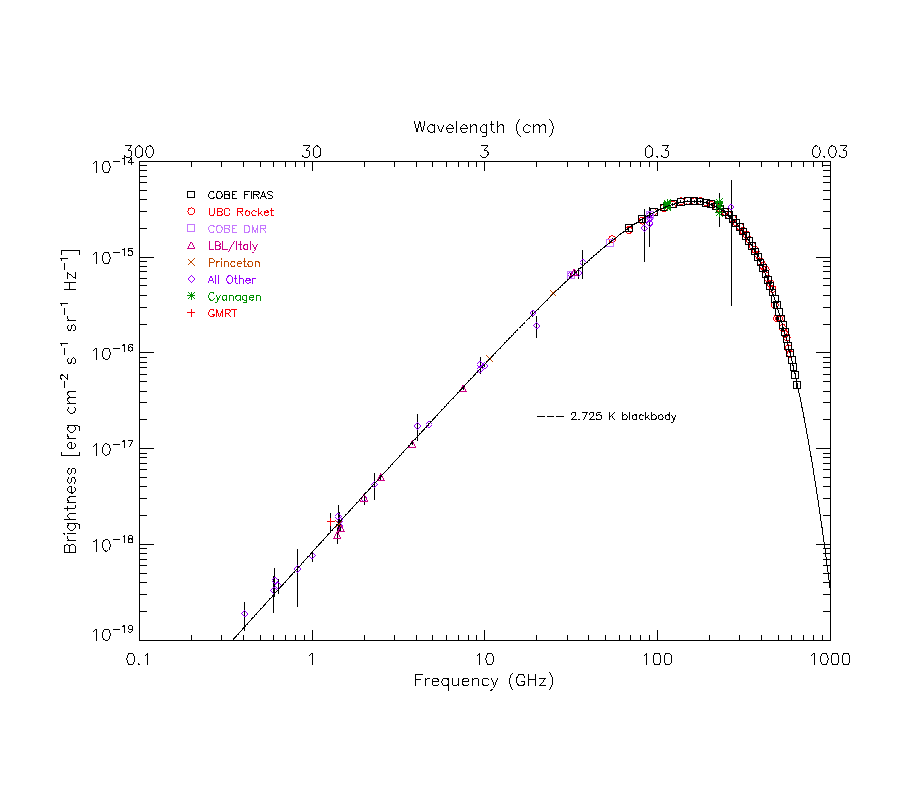
Things stayed like that for a while under WWII when it was predicted that a microwave background must have been produced while the expanding universe was still homogenous and cooled down under a certain point. Because it was produced at the most primeval level with no matter to get in the way, this radiation would have very characteristic features (refered to under the term "perfect black body").
This cosmic microwave background was first detected in 1962 by radioastronomers Penzias and Wilson although they did not initially realized what it was.
It was soon to be determined to be isotropic (coming from all direction in the same manner) as the theory suggested.
Still later, during the 1970ies, measurements started to show that these cosmic radiations were indeed displaying a 'black body' characteristic, which was predicted by the Big Bang theory but that the competting theory (the steady state one) was unable to account for, leading the Big Bang to become the accepted model.
Still later, in the 90ies, a series of satellites were launched that allowed to measure the Cosmic Radiation with intricate sensitivity, confirming its near perfect black body's characterisitics.
ispectrum.gif

These measures also allowed to dectect a shift in the cosmic background, quite similar to the galactic redshift, confirming that, not only did other galaxies fly away from us but that our own was also moving compared to the background.

At the same time, the theory was refined. What was initially imagined as an 'explosion', the universe expanding into a surrounding void, was refined as being time and space themselves expanding.
If you want, the galaxies are 'drawn' on the surface of a balloon, and, when the balloon is inflated, its surface stretches and the distance between the points representing the galaxies increases. This explain why the more distant galaxies appear to be moving away faster.

Astronomers also started to look at the ends of the universe.
On the future end, there was two possible solution.
We knew that the galaxies were flying apart.
We also knew that their gravity were affecting each others, trying to pull them back again.
Now either the gravity was stronger that the strength pulling the galaxies apart. In which case their move would ultimately slow down, stop, then reverse itself, presumably until the universe had compacted itself is yet another 'primeval atom'. That was the 'Big Crunch' model and, as somebody else stated, it was pretty elegant.
The other solution was for some other energy to counter gravity (we already know it exists and labelled it 'Dark energy which is physicist for 'no clue what that is'). In this case, the expansion would continue ad infinitum until every become an isolated island in the vast universe, slowly radiating energy to be diluted away until the universe become some incredibly vast and cold expenses of isolated wandering protons. This depressing scenario is cold the 'Heat death' of the universe, a name that does not make it much more cheerful.
It's only in the past few years that our measurements of the universe's distances were sensitive enough to reliably measure the changes in the expansion rate and the jury is back in... Expansion is accelerating, whatever black energy is, it is stronger than the gravity pull and, toward the heat death we (according to all appearances) go. The timelines I've seen suggest something in the 10100 years from now, though, so it's not quite yet an emergency.

On the other side of the problem is the origin of the universe. The actual Big Bang.
Obviously, if time itself originated simultaneously with matter, as our models suggest, the idea of 'what came before the Big Bang' is meaningless rhetoric.
Furthermore, the closer your get, the denser and hotter the universe is. At T=0, the universe will be located in a (theoretically) infinitely small place. Real life does not deal with infinite, so we can't really work with that either.
But how close from T=0 can we predict? The problem is that when we get to such ridiculous levels of energies, the laws of physics get very funky on us. People are working on it. The LHC was constructed for a big part to investigate such subject, but it's difficult. So far, our models go up to about the Plank epoch (at T=10−43 seconds). It might seem pretty good compared to the 14 billion years we know about, but the period we miss is quite critical. The problem is, beyond that point, the universe was so different from what it is now that we can't really understand it. The laws of physics are wonkier than a drunken meerkat on a wild pony ride (I like drunken meerkats). Matter does not exist and time itself is probably doing weird-stuff (like, stuff that the Catholic church reproves and is illegal in Mississippi) and it's totally possible that these physics will forever elude us...
But, I don't think it is stupid...

 
Last edited:
Why do you like something that is basically false?

I don't know, I like lamarckism. I think it's an interesting idea, but I know full well it doesn't happen.

But then I also like Star Trek, and I know that's not real either.
 
Here is a quote I find interesting: Not saying it isn't somehow flawed, just interesting.
Feel free to object or crticize.

Objection: the whole passage is just wrong.
Unless you are willing to read something by someone who actually knows about evolution, I cannot be bothered pointing out just how it is wrong.

(Am I allowed to bring up scarecrows at this point?)
 
Let me try again with the Big-Bang thingy.
I am not a physicist so, that is a layman's understanding. Maybe layman to layman explanations ill be clearer and, surely, more knowledgeable people on these fora will correct my most glaring mistakes and I will learn something...

Initially, we are talking in 1912 here, people started to measure what we call a 'red-shift' in his observations from celestial objects called nebulae. This was attributed to the Dopler effect wich is an apparent change in the frequency of from objects moving away.
These observations multiplied and, by the mid-20ies, Hubble had shown that these nebulae were other galaxies just like our own and confirm that the red shift was not only the rule, but that it was proportional to the distance from the observed galaxies, we'll come back to that later. So, the universe was not only much larger than what we initially suspected, the red-shift also indicated that the galaxies composing it were moving away from each others.

The idea that galaxies were moving away automatically suggested that they were initially closer from each other and Lemaitre (both a catholic priest and confirmed astronomer at the Catholic university of Leuven) took the idea to its logical conclusions: the universe must have initially been all clustered together into a 'primeval atom' (atom, here, taken in its original sense of a tiny, discrete unit) that they flew apart.
Stuff flowing apart at great speed from an original point of origin seems a lot like an explosion and Hoyle, that strongly opposed Lemaitre's ideas, derisively called it the 'Big-Bang theory'.

Things stayed like that for a while under WWII when it was predicted that a microwave background must have been produced while the expanding universe was still homogenous and cooled down under a certain point. Because it was produced at the most primeval level with no matter to get in the way, this radiation would have very characteristic features (refered to under the term "perfect black body").
This cosmic microwave background was first detected in 1962 by radioastronomers Penzias and Wilson although they did not initially realized what it was.
It was soon to be determined to be isotropic (coming from all direction in the same manner) as the theory suggested.
Still later, during the 1970ies, measurements started to show that these cosmic radiations were indeed displaying a 'black body' characteristic, which was predicted by the Big Bang theory but that the competting theory (the steady state one) was unable to account for, leading the Big Bang to become the accepted model.
Still later, in the 90ies, a series of satellites were launched that allowed to measure the Cosmic Radiation with intricate sensitivity, confirming its near perfect black body's characterisitics.
[qimg]http://www.astro.ubc.ca/people/scott/ispectrum.gif[/qimg]
These measures also allowed to dectect a shift in the cosmic background, quite similar to the galactic redshift, confirming that, not only did other galaxies fly away from us but that our own was also moving compared to the background.

At the same time, the theory was refined. What was initially imagined as an 'explosion', the universe expanding into a surrounding void, was refined as being time and space themselves expanding.
If you want, the galaxies are 'drawn' on the surface of a balloon, and, when the balloon is inflated, its surface stretches and the distance between the points representing the galaxies increases. This explain why the more distant galaxies appear to be moving away faster.

Astronomers also started to look at the ends of the universe.
On the future end, there was two possible solution.
We knew that the galaxies were flying apart.
We also knew that their gravity were affecting each others, trying to pull them back again.
Now either the gravity was stronger that the strength pulling the galaxies apart. In which case their move would ultimately slow down, stop, then reverse itself, presumably until the universe had compacted itself is yet another 'primeval atom'. That was the 'Big Crunch' model and, as somebody else stated, it was pretty elegant.
The other solution was for some other energy to counter gravity (we already know it exists and labelled it 'Dark energy which is physicist for 'no clue what that is'). In this case, the expansion would continue ad infinitum until every become an isolated island in the vast universe, slowly radiating energy to be diluted away until the universe become some incredibly vast and cold expenses of isolated wandering protons. This depressing scenario is cold the 'Heat death' of the universe, a name that does not make it much more cheerful.
It's only in the past few years that our measurements of the universe's distances were sensitive enough to reliably measure the changes in the expansion rate and the jury is back in... Expansion is accelerating, whatever black energy is, it is stronger than the gravity pull and, toward the heat death we (according to all appearances) go. The timelines I've seen suggest something in the 10100 years from now, though, so it's not quite yet an emergency.

On the other side of the problem is the origin of the universe. The actual Big Bang.
Obviously, if time itself originated simultaneously with matter, as our models suggest, the idea of 'what came before the Big Bang' is meaningless rhetoric.
Furthermore, the closer your get, the denser and hotter the universe is. At T=0, the universe will be located in a (theoretically) infinitely small place. Real life does not deal with infinite, so we can't really work with that either.
But how close from T=0 can we predict? The problem is that when we get to such ridiculous levels of energies, the laws of physics get very funky on us. People are working on it. The LHC was constructed for a big part to investigate such subject, but it's difficult. So far, our models go up to about the Plank epoch (at T=10−43 seconds). It might seem pretty good compared to the 14 billion years we know about, but the period we miss is quite critical. The problem is, beyond that point, the universe was so different from what it is now that we can't really understand it. The laws of physics are wonkier than a drunken meerkat on a wild pony ride (I like drunken meerkats). Matter does not exist and time itself is probably doing weird-stuff (like, stuff that the Catholic church reproves and is illegal in Mississippi) and it's totally possible that these physics will forever elude us...
But, I don't think it is stupid...

thanks for this thoughtful post
 
I don't know, I like lamarckism. I think it's an interesting idea, but I know full well it doesn't happen.

But then I also like Star Trek, and I know that's not real either.
There appears to be a certain form of "lamarckism" that is being studied in modern genetics. Some forms of environmental factors can actually affect control genes and epigenetics of a person through their lives and these factors can actually be passed on to their progeny.

Research is still in the early stages and it may really change what we know about evolution.
 
I don't know if you are familiar with Lil`abner a rather old comic-book, but it have a presidential candidate whose only claim to fame is to have never held an opinion or done anything. The idea is that he will not earn enemies. :D

Used to read it in the paper. At a certain age Daisy Mae became very interesting.
 
David, why do you believe the Bible and not, say, the Koran?

I used to, and will again, have a collection of other sacred texts including the Koran on my website. I haven't studied them as well as I have the Bible, of course, but, although I like some of them, none of them are nearly as reliable and trustworthy as the Bible.
 
I used to, and will again, have a collection of other sacred texts including the Koran on my website. I haven't studied them as well as I have the Bible, of course, but, although I like some of them, none of them are nearly as reliable and trustworthy as the Bible.
Well they aren't very trustworthy then because if you think the bible is reliable you better get another think comming. The morality is horrible, the history is horrible and the science is horrible.
 

Back
Top Bottom