Let me try again with the Big-Bang thingy.
I am not a physicist so, that is a layman's understanding. Maybe layman to layman explanations ill be clearer and, surely, more knowledgeable people on these fora will correct my most glaring mistakes and I will learn something...
Initially, we are talking in 1912 here, people started to measure what we call a 'red-shift' in his observations from celestial objects called nebulae. This was attributed to the Dopler effect wich is an apparent change in the frequency of from objects moving away.
These observations multiplied and, by the mid-20ies, Hubble had shown that these nebulae were other galaxies just like our own and confirm that the red shift was not only the rule, but that it was proportional to the distance from the observed galaxies, we'll come back to that later. So, the universe was not only much larger than what we initially suspected, the red-shift also indicated that the galaxies composing it were moving away from each others.
The idea that galaxies were moving away automatically suggested that they were initially closer from each other and Lemaitre (both a catholic priest and confirmed astronomer at the Catholic university of Leuven) took the idea to its logical conclusions: the universe must have initially been all clustered together into a 'primeval atom' (atom, here, taken in its original sense of a tiny, discrete unit) that they flew apart.
Stuff flowing apart at great speed from an original point of origin seems a lot like an explosion and Hoyle, that strongly opposed Lemaitre's ideas, derisively called it the 'Big-Bang theory'.
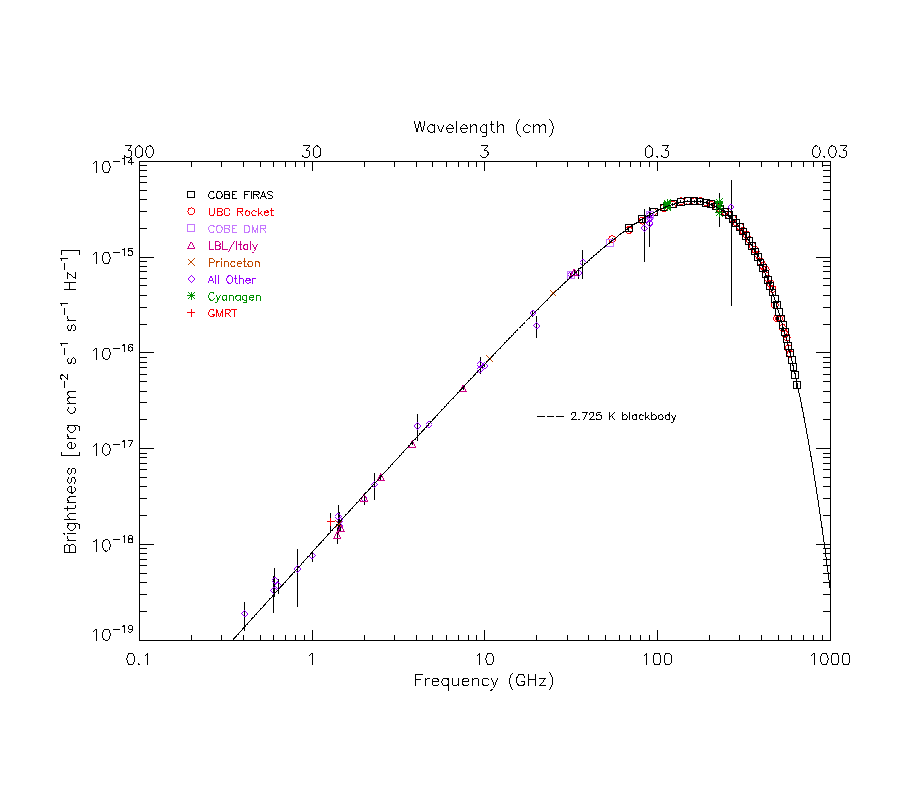
Things stayed like that for a while under WWII when it was predicted that a microwave background must have been produced while the expanding universe was still homogenous and cooled down under a certain point. Because it was produced at the most primeval level with no matter to get in the way, this radiation would have very characteristic features (refered to under the term "perfect black body").
This cosmic microwave background was first detected in 1962 by radioastronomers Penzias and Wilson although they did not initially realized what it was.
It was soon to be determined to be isotropic (coming from all direction in the same manner) as the theory suggested.
Still later, during the 1970ies, measurements started to show that these cosmic radiations were indeed displaying a 'black body' characteristic, which was predicted by the Big Bang theory but that the competting theory (the steady state one) was unable to account for, leading the Big Bang to become the accepted model.
Still later, in the 90ies, a series of satellites were launched that allowed to measure the Cosmic Radiation with intricate sensitivity, confirming its near perfect black body's characterisitics.
These measures also allowed to dectect a shift in the cosmic background, quite similar to the galactic redshift, confirming that, not only did other galaxies fly away from us but that our own was also moving compared to the background.
At the same time, the theory was refined. What was initially imagined as an 'explosion', the universe expanding into a surrounding void, was refined as being time and space themselves expanding.
If you want, the galaxies are 'drawn' on the surface of a balloon, and, when the balloon is inflated, its surface stretches and the distance between the points representing the galaxies increases. This explain why the more distant galaxies appear to be moving away faster.
Astronomers also started to look at the ends of the universe.
On the future end, there was two possible solution.
We knew that the galaxies were flying apart.
We also knew that their gravity were affecting each others, trying to pull them back again.
Now either the gravity was stronger that the strength pulling the galaxies apart. In which case their move would ultimately slow down, stop, then reverse itself, presumably until the universe had compacted itself is yet another 'primeval atom'. That was the 'Big Crunch' model and, as somebody else stated, it was pretty elegant.
The other solution was for some other energy to counter gravity (we already know it exists and labelled it 'Dark energy which is physicist for 'no clue what
that is'). In this case, the expansion would continue
ad infinitum until every become an isolated island in the vast universe, slowly radiating energy to be diluted away until the universe become some incredibly vast and cold expenses of isolated wandering protons. This depressing scenario is cold the 'Heat death' of the universe, a name that does not make it much more cheerful.
It's only in the past few years that our measurements of the universe's distances were sensitive enough to reliably measure the changes in the expansion rate and the jury is back in... Expansion is accelerating, whatever black energy is, it is stronger than the gravity pull and, toward the heat death we (according to all appearances) go. The timelines I've seen suggest something in the 10
100 years from now, though, so it's not quite yet an emergency.
On the other side of the problem is the origin of the universe. The actual Big Bang.
Obviously, if time itself originated simultaneously with matter, as our models suggest, the idea of 'what came before the Big Bang' is meaningless rhetoric.
Furthermore, the closer your get, the denser and hotter the universe is. At T=0, the universe will be located in a (theoretically) infinitely small place. Real life does not deal with infinite, so we can't really work with that either.
But how close from T=0 can we predict? The problem is that when we get to such ridiculous levels of energies, the laws of physics get very funky on us. People are working on it. The LHC was constructed for a big part to investigate such subject, but it's difficult. So far, our models go up to about the Plank epoch (at T=10
−43 seconds). It might seem pretty good compared to the 14 billion years we know about, but the period we miss is quite critical. The problem is, beyond that point, the universe was so different from what it is now that we can't really understand it. The laws of physics are wonkier than a drunken meerkat on a wild pony ride (I like drunken meerkats). Matter does not exist and time itself is probably doing weird-stuff (like, stuff that the Catholic church reproves and is illegal in Mississippi) and it's totally possible that these physics will forever elude us...
But, I don't think it is stupid...