Moderated Iron sun with Aether batteries...

Status
Not open for further replies.
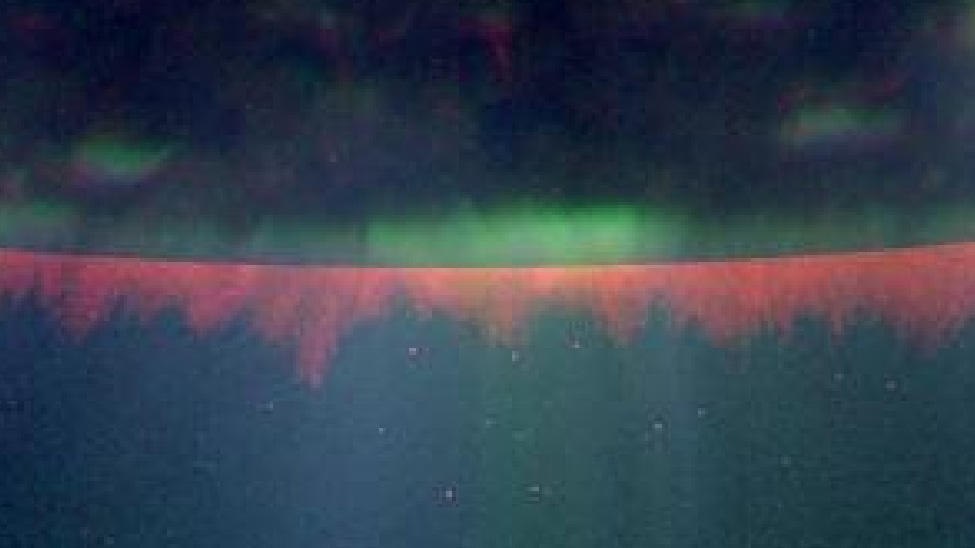
There is a significant density shift between the neon layer and the helium layer. That density difference prevents a lot of movement in B but if you look along the right hand side of the composite image you'll see some white interfering with (in front of) the base of the helium layer. The helium is pretty much all the same density and the mass flow movements away from the sun are not homogeneous. That creates some areas with higher regions, and some areas in C with lower elevations.

So the He/Ne density gradient is sufficient to make the surface smooth, but the Fe/Ne gradient at A isn't?

The mass flows are erupting through B, how does B remain smooth? Why isn't B ragged the way that A and C are, especially since the raggedness in C is caused by mass flows coming through B?

B isn't just smoother than A and C; it's flat. There are no spikes visible anywhere on B, and instead of having a blurry transition like A and C, it's completely sharp.

Maybe we should try this differently. Do you see anything about B that would suggest that it's not a semi-transparent disk that someone added in photoshop?
 
http://aia.lmsal.com/public/firstlight/20100408_013015/f0193.gif

I guess I need to tackle this limb dimming "artifact" claim head on. One of you needs to use this image (or any iron ion SDO image) to show me where the "limb dimming" is not present. Which position on the clock does not show that jagged limb dimming feature?


:dl:

Another absolutely ludicrous comment. You need to tackle this limb dimming thing head on? You!? Then the next sentence you type you say one of us needs to do your work for you!? Really, Michael, we've been going over that burden of proof issue for years now. It's your crackpot claim. You do the work.

Oh, and about limb dimming? Your qualifications to communicate in a sane, rational, intelligent manner on the issue of solar physics has been challenged. Your continued insistence on using common terms incorrectly only goes to demonstrate that you simply do not possess those qualifications.
 
Is it hopeless because you can't pick out the GM style "opaque" limb, or because you expected me personally to simply take GM at his word?
[qimg]http://www.internationalskeptics.com/forums/images/smilies/confused.gif[/qimg]

It's hopeless because it's like listening to a discussion about rocket science between an engineer and someone from the stone age. If only you could step back and take a look at how foolish your comments are.
 
Originally Posted by Michael Mozina
Now that I finally understand how to go about destroying mainstream theory, I'll start working on it. I think *THAT* little project might even motivate me to do a little math.
How is *THAT* coming?

:v:
 
Last edited:
B.

The A location is the surface of the sun, and where the RD outline will end. The jagged edges are due to the iron in the base of the coronal loops that hasn't yet been fully ionized. As it gets further from the opaque surface, it eventually is fully ionized and it turns the atmosphere a yellow or blue or green depending on which iron line(s) we use and what color we assign each wavelength.

The region from A to B is suppose to "opaque" to these specific wavelengths in "meters" in any atmosphere that is not heavily (I mean heavily) ionized. That's not a problem for my solar model, but it's a giant problem for the SSM.

The C region is angular due to the mass flow movements inside the loops moving from point A through B) all the way through the chromopshere. That mass flow creates the jagged patterns in the upper chromosphere area marked C).


You claim to be able to see through over 80,000 kilometers of plasma, yet you abandoned the discussion where you were going to... Oh wait... You abandoned your responsibility to provide the numbers for someone else to do the actual work to show how you could do that. Pesky old math. That and actually having to lift a finger to support your own crackpot conjecture. Math and work, gets you ever time, doesn't it? :p
 
So the He/Ne density gradient is sufficient to make the surface smooth, but the Fe/Ne gradient at A isn't?

At A), pieces of the ionized surface are being lifted into the atmosphere by the discharge filaments. The iron at the base of the loop isn't fully ionized. It therefore absorbs certain amounts of iron ion light. That's what creates the jagged edges along the opaque limb. It's not about density gradients at that point, it's about ionization states at location A).

The mass flows are erupting through B, how does B remain smooth?

It's not necessarily 100% smooth, but it would have to change that surface by a lot (360 km) to get any visual change. The Helium on the other hand can simply "rise up" with nothing much on top to push it back down.

Why isn't B ragged the way that A and C are, especially since the raggedness in C is caused by mass flows coming through B?

A) is ragged due to iron ion ionization states. C) is ragged due to mass flow. B) is not ragged because there is a layer of helium sitting on B) that has a gravitational force associated with it.

Maybe we should try this differently. Do you see anything about B that would suggest that it's not a semi-transparent disk that someone added in photoshop?

Yes, those green lines.
 
Last edited:
Is it hopeless because you can't pick out the GM style "opaque" limb, or because you expected me personally to simply take GM at his word?


It's not my word. The folks at NASA who run the SDO program said you're wrong. That would be the people who designed the equipment, got that equipment into space, made it work, acquired the data to make that picture, processed the data, and published it.

And again I'll remind you that they are highly educated astrophysicists, and you haven't been able to demonstrate that you even possess the qualifications to speak intelligently, rationally, or sanely on the subject of astrophysics. Some of them hold doctorate degrees in physics, while you've been unable to show that you have the qualifications to add and subtract three digit numbers as well as a junior high school kid. Some of those people are well trained experts in satellite image processing, while you haven't even been able to show that you're qualified to find a sixteen pixel error in an image you claim shows thirteen pixels of significant data.

It's your word against the SDO team at NASA, Michael. Who do you think is better qualified to get it right? :D
 
There is a significant density shift between the neon layer and the helium layer. That density difference prevents a lot of movement in B but if you look along the right hand side of the composite image you'll see some white interfering with (in front of) the base of the helium layer. The helium is pretty much all the same density and the mass flow movements away from the sun are not homogeneous. That creates some areas with higher regions, and some areas in C with lower elevations.


Yes, it looks like a bunny to you. We know that. But making up crap is not allowed in real science, Michael. You've fabricated this from scratch. It's utter nonsense. You are wholly unable to demonstrate that anything you've said here is remotely true.
 
At A), pieces of the ionized surface are being lifted into the atmosphere by the discharge filaments. The iron at the base of the loop isn't fully ionized. It therefore absorbs certain amounts of iron ion light. That's what creates the jagged edges along the opaque limb. It's not about density gradients at that point, it's about ionization states at location A).

But if I understand what your saying (and I may not), the jagged edge at A still represents radial mass flows.

A) is ragged due to iron ion ionization states. C) is ragged due to mass flow. B) is not ragged because there is a layer of helium sitting on B) that has a gravitational force associated with it.

So, do the radial mass flows at C mass result from mass flowing through B or not?

Yes, those green lines.

Which green lines, and how are they inconsistent with a transparent disk overlaid in photoshop?
 
Yes, it looks like a bunny to you. We know that. But making up crap is not allowed in real science, Michael. You've fabricated this from scratch. It's utter nonsense. You are wholly unable to demonstrate that anything you've said here is remotely true.

So you're now ready to put up your public opinion on the outcome of the RD test? Yes or no?
 
But if I understand what your saying (and I may not), the jagged edge at A still represents radial mass flows.

Yes, they represent the bottom of the "relatively small" coronal loop filaments. The form ordinary plasma filaments, but it takes time to ionize the iron inside the loops.

So, do the radial mass flows at C mass result from mass flowing through B or not?

Ah, I think I see the confusion. My bad. It's the mass flows of the electrons and "protons" (hydrogen) *and* the coronal loop activity that create those patterns at point C). It's not only the mass flows in the loops that do that. It's the mass flows of *ALL* the charged particles that causes those patterns in C). That mass flow includes electrons, protons, *and* coronal loop material.

Which green lines, and how are they inconsistent with a transparent disk overlaid in photoshop?

sd01.jpg


The green lines are a combination of the yellow line and the blue line. Both iron ion lines originate from the same location. That isn't a "transparent" layer, it's part of the iron ion images. The chromosphere is overlayed around that iron ion composite image.
 
Yes, those green lines.


Unfortunately for your crackpot conjecture, the experts on the SDO team at NASA and at least one image processing expert, myself, take the position that you're wrong. This piece of material has been rejected as evidence to support your claim. Rejected, Michael. Those green lines are not evidence of anything except a minor error in sizing the gradient filter overlay used when processing that PR image.
 
How is *THAT* coming?

:v:

It seems rather pointless after seeing the SDO images. That "opacity" claim is in fact the achilles heel of the standard theory. There's no evidence in the gband that it's "opaque" to a depth of at least 2000Km. That Hinode image shows a filament descending into that some "opaque" region. There's nothing "opaque" about it as the SDO images also demonstrate.

The notion that the limb darkening is in any way an "artifact" is simply absurd. There isn't an iron ion wavelength in the whole AIA published material that doesn't exhibit that same "feature". There isn't even a single frame in any iron ion movie from SDO that does not also show that same jagged, opaque outline on the limb.
 
Unfortunately for your crackpot conjecture, the experts on the SDO team at NASA and at least one image processing expert, myself, take the position that you're wrong. This piece of material has been rejected as evidence to support your claim. Rejected, Michael. Those green lines are not evidence of anything except a minor error in sizing the gradient filter overlay used when processing that PR image.

Then you really should have no problem at all taking that bet on your public position based on the outcome of the 6 step RD "test" I suggested?
 
The notion that the limb darkening is in any way an "artifact" is simply absurd. There isn't an iron ion wavelength in the whole AIA published material that doesn't exhibit that same "feature".

You're wrong, Michael. Look at post 3035.
 
So you're now ready to put up your public opinion on the outcome of the RD test? Yes or no?


That "RD test" you've been babbling about for a couple of weeks now? The one where you can't even define the test in quantitative terms? The test you keep badgering people about where you have limbs and chromospheres and disks and pixels and kilometers all mixed up in an unintelligible jumble of words? The one where you don't even have enough confidence in your crackpot claim to have an organization of professional astrophysicists determine the results? Is that the "RD test" you're talking about? :p
 
Ah, I think I see the confusion. My bad. It's the mass flows of the electrons and "protons" (hydrogen) *and* the coronal loop activity that create those patterns at point C). It's not only the mass flows in the loops that do that. It's the mass flows of *ALL* the charged particles that causes those patterns in C). That mass flow includes electrons, protons, *and* coronal loop material.

So there's very little mass flow through B?

The green lines are a combination of the yellow line and the blue line. Both iron ion lines originate from the same location. That isn't a "transparent" layer, it's part of the iron ion images. The chromosphere is overlayed around that iron ion composite image.

I understand that that's your interpretation. I'm asking what characteristics there are in these sun images that show that the green disk couldn't simply be a photoshop overlay.
 

Attachments

  • another limb crop 3.jpg
    another limb crop 3.jpg
    32.2 KB · Views: 5
I guess I need to tackle this limb dimming "artifact" claim head on. One of you needs to use this image (or any iron ion SDO image) to show me where the "limb dimming" is not present.

You need to tackle something head-on by getting somebody else to do your work for you?
 
You're right it was put there.

Tsig, I disagree. A feature much like the green stripe could very well be compatible with the standard solar model---broadly speaking this sort of feature (if observed in on the actual Sun) would be the result of a thin emitting layer in the chromosphere or corona, and would not conflict at all with the standard solar model with an opaque photosphere. The presence or absence of this feature tells you nothing about whether the photosphere is made of unobtanium---rather, it tells you whether or not there's a thin emitting layer in the chromosphere or corona.

This point went over MM's head several times, but I'd like to make sure it's not lost on the mainstream posters and lurkers as well.

(Of course, the non-photoshopped data appear to tell us that there's NOT a thin emitting layer in the chromosphere or corona at these wavelengths.)
 
Status
Not open for further replies.

Back
Top Bottom