dasmiller
Just the right amount of cowbell

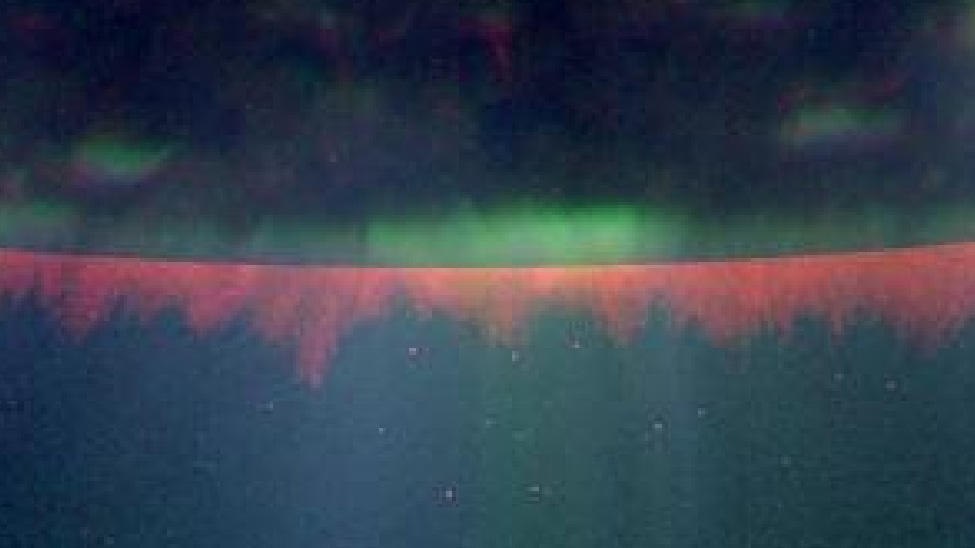
There is a significant density shift between the neon layer and the helium layer. That density difference prevents a lot of movement in B but if you look along the right hand side of the composite image you'll see some white interfering with (in front of) the base of the helium layer. The helium is pretty much all the same density and the mass flow movements away from the sun are not homogeneous. That creates some areas with higher regions, and some areas in C with lower elevations.
So the He/Ne density gradient is sufficient to make the surface smooth, but the Fe/Ne gradient at A isn't?
The mass flows are erupting through B, how does B remain smooth? Why isn't B ragged the way that A and C are, especially since the raggedness in C is caused by mass flows coming through B?
B isn't just smoother than A and C; it's flat. There are no spikes visible anywhere on B, and instead of having a blurry transition like A and C, it's completely sharp.
Maybe we should try this differently. Do you see anything about B that would suggest that it's not a semi-transparent disk that someone added in photoshop?