Moderated Iron sun with Aether batteries...

Status
Not open for further replies.
Actually, I'm quite confident in the validity that 3D sunspot computer simulation. There's every logical reason to believe that it is correct and accurate even from my perspective and certainly it is verified by satellite imagery and ground based equipment.

Those simulations requires inputs about stuff like composition. If the composition is wrong, the simulations will be too. Your ideas about composition are incompatible with those used in the simulations.

Furthermore, that cross-section graph goes down to 6,100 km below the outer surface of the photosphere. That's below the point at which you think your solid surface resides. If you can't see why that makes the simulations incompatible with your own theory, you're even more clueless than I currently believe you to be. And even if you try to adjust the depth of your solid surface, the temperature profile won't match what you have claimed (it gets hotter with depth in the simulations).
 
It predicts that the bases of the loops originate somewhere in the chromosphere/corona, when clearly that is physically impossible.

And once more MM shows his utter lack of understanding what mainstream solar phyiscs is saying. The idea that mainstream would say that the "base of the loops" originate in the chromosphere/corona is so rediculous that only MM could come up with it.

Coronal loops are created in the sun, they emerge through buoyance and extend, keeping their footpoint naturally in the region where they were created.

Apparently MM has discovered the magnetic monopole, which miraculously makes magnetic foot points in the corona.
 
And once more MM shows his utter lack of understanding what mainstream solar phyiscs is saying. The idea that mainstream would say that the "base of the loops" originate in the chromosphere/corona is so rediculous that only MM could come up with it.

http://spaceflightnow.com/news/9912/17tracemoss/

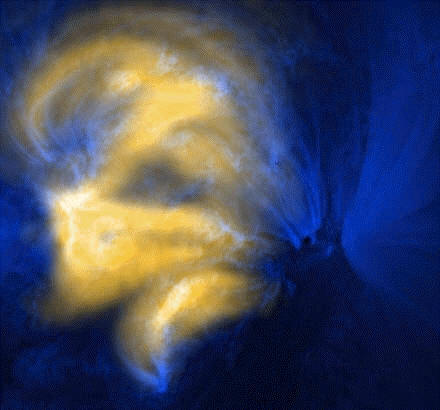
Solar moss occurs at the base of certain coronal loops, immense magnetic arches of hot gas that are anchored in the Sun's visible surface and could span several dozen Earths laid end to end. It appears only below high pressure coronal loops in active regions, typically persisting for tens of hours, but has been seen to form rapidly and spread in association with loops that arise after a solar explosion, called a flare.

The moss consists of hot gas at about two million degrees Fahrenheit which emits extreme ultraviolet light observed by the TRACE instrument. It occurs in large patches, about 6,000 - 12,000 miles in extent, and appears between 1,000 - 1,500 miles above the Sun's visible surface, sometimes reaching more than 3,000 miles high.

Emphasis mine.

Let's look at how things get heated up according to LMSAL too, shall we?

http://trace.lmsal.com/POD/TRACEpodarchive4.html
http://trace.lmsal.com/POD/images/T195171_990809_2300_clip.gif
The fact that the temperature is so nearly constant along the length requires that most of the heating is concentrated low down, in the bottom 15,000 km or so.

mossyohkoh.jpg

http://solarb.msfc.nasa.gov/movies/xrt_pfi_gband_20061113.mpg

The composite Hinode images shows that the x-rays remain visible far into the penumbra, and the Trace/Yohkoh composite shows that the 171A is visible much "deeper" into the atmosphere, far *UNDER* the photosphere. The mass flows into and out of the photosphere also demonstrate that the loops are not magically heated up above the photosphere, but far below it.
 
Last edited:
You're simply ignoring the visual evidence and the physical ramifications of your own computer models. Those filament don't extend out into the umbra as surface features, they "follow the goatse" in D'rok's lingo (love that comparison). Those penumbral filaments do have a depth component to them which is clearly visible in nearly every wavelength related to the photosphere.
More bunnies, MM.
I could be like you and state:
Those penumbral filaments do have a *HEIGHT* component to them which is clearly visible in nearly every wavelength related to the photosphere.
and by just as wrong because there is no way by looking at the images to tell whether the filaments go down or up.

Ya, you can't go "Flying stuff? What flying stuff?". You have to put some effort into it. I see no evidence at all that you folks actually "analyze" anything, or even comprehend the value of satellite imagery at all. They are all just 'pretty pictures' evidently that you don't begin to comprehend, or you folks would not believe the bases of the loops seen in 171A originate in some magical place in the sky/atmosphere.
Your ignorance is astounding - I have never said "Flying stuff? What flying stuff?". The analysis of the images by the TRACE astronomers shows that the "flying stuff" in the RD movie that you fantasize about is the changes in temperature of a CME event.

Strawman or more ignorance, MM?
No one has stated that the bases of loops in the 171A originalte in the photosphere.
The footprints of the lops are defined as the place where the loops emerge from the photosphere.
The opacity of the photosphere means that you cannot see the loops extending far (a few 100 km at most) below the photosphere.

The Hinode images in particular simply blow your theories into the dust. I can see where I'll be spending my time for awhile.
The Hinode images in particular simply support the standard theories. I can see that you will continue not to understand this and repeat your fantasies until everyone here is certain that you are a crank.

P.S. Micheal Mozina's iron crust has been debunked!
 
Exactly what theories do the Hinode images invalidated and how

The Hinode images in particular simply blow your theories into the dust. I can see where I'll be spending my time for awhile.
First asked 21 April 2010
Michael Mozina,
Exactly what theories do the Hinode images invalidated and how?
Provide the calculations that you made to do this.
You do know that astronomers actually study the Hinode images and compare then to the current theories?
 
More bunnies, MM.

No, more supercomputer simulated math that you simply ignored because I didn't do it for you personally.

...and by just as wrong because there is no way by looking at the images to tell whether the filaments go down or up.

Boloney. You can see the convection patterns for one. You can also see the filaments "curve in the umbra" due to the flow of mass.
http://www.aavso.org/images/jenkins33.jpg

Notice the long filament at the top of the sunspot about the 12:00 position. Is that flowing UP or DOWN in the image and how can you tell?
 
Citation for filaments flow down into the sunspot depression and how far they descend

If you understood your own computer models you wouldn't say stuff like that. All I can say is you need to sit down and actually look at what the computer models "predict" in terms of that "hole" and specifically the sides of that hole. The filaments are not 2D surface features, they are 3D filaments flowing down into the hole.

http://www.ucar.edu/news/releases/2009/images/bb.jpg
Another pretty picture.
First asked 21 April 2010
Michael Mozina
Citation for filaments flow down into the sunspot depression and how far they descend?

Personally I have no problem with this. I suspect that this is what the current theories and models state.
Your problem is that all you have is a unsupported assertion about how far these filamants go under the photosphere.
 
What do you think the standard model of coronal loops predicts

It predicts that the bases of the loops originate somewhere in the chromosphere/corona, when clearly that is physically impossible. ....
Still ignorant Michael Mozina:
No theory predicts that the bases of the loops originate somewhere in the chromosphere/corona.
No theory states that the bases of loops originate in the photosphere.
The footprints of the loops are defined as the place where the loops emerge from the photosphere.
The opacity of the photosphere means that you cannot see the loops extending far (a few 100 km at most) below the photosphere.

Try again. Maybe you should read a textbook and cite it?
Or even Wiki!

First asked 20 April 2010
Michael Mozina,
What do you think the standard model of coronal loops predicts?

Perhaps you can cite all of the published papers that state that loops will never appear to be in front of unbra and there is no mass flow in loops.

Or maybe they all say:
  1. A coronal loop emerging into the photosphere though the umbra of a sunspot will appear "in front" of the umbra.
  2. As the coronal loop emerges it will fill with plasma - thus the mass flow through the loop.
 
http://solarb.msfc.nasa.gov/movies/xrt_pfi_gband_20061113.mpg

That images shows us the alignment between the coronal loops and the filament pattern:
That image shows a partial alignment between the coronal loops and the filament pattern (e.g. broken at the 3 o'clock position)

http://solar-b.nao.ac.jp/QLmovies/movie_sirius/2010/03/14/FG_CAM20100314150429_174906.mpg

That image shows the effect the base of the filaments when the loops discharge through the filaments.
That image shows the effect on the base of the filaments when the loops emerge through the photosphere.

http://solarb.msfc.nasa.gov/movies/sakao.mpg

This movie shows the mass flows in the loops that is responsible for the penumbral filament effect we observe in the previous image.
This movie shows that there are mass flows in the loops. This happens at the same time that the loops emerge from the photosphere and create the effect in the previous movie. This is to be expected because a coronal loop is a magnetic flux that fills with plasma (thought to be from the chromosphere) as it emerges from the photosphere.

The "transition region" is located *OVER* the photosphere.
 
Try this one. Notice the 'curvature' of the bright stuff on the right. Are the ends of the filaments pointing up or down?
http://dancekorean.net/images/sunspot-wow.jpg
Definitely up. The dark area is obviously the top of a mountain range as in this strange guy's Iron Sun fantasy.
:dl:

ETA
But as I said: I have no issue with the filaments descending into the sunspot depression. The issues I have are
  1. There is no way to tell from looking down on the sunspot which way the filaments are going. Their ends could be pointing directly at the detector as they climb out of the depression.
  2. There is no way to tell if they are floating above the depression or not.
  3. You have this fantasy about the filaments extending 1000's of kilometers below the photosphere. This is a fantasy because
    1. The depression as at more 1000 km deep.
    2. The opacity of the photosphere means that we can only see some 100's of kilometers deep in it.
 
Last edited:
Micheal Mozina's iron crust has been debunked

This iron crust within the Sun idea of Micheal Mozina is very easy to disprove (big surprise :eye-poppi!): It is thermodynamically impossible since it must be at a temperature of at least 9400 K (as measured within the photosphere) and so be a plasma. This has been pointed out to MM many times over the years. Here are some of the explanations given to him that he continues to not be able to understand:
This alone makes his idea into a complete fantasy and his continued belief with it a delusion and so we could stop there but...

The continuous issuing of unsupported assertions, displays of ignorance of physics and fantasies about what he imaginings in images are illustrated in this list of unanswered questions (still more in this thread to be added!). The first question was asked on 6th July 2009.

  1. What is the amount of 171A light emitted by the photosphere and can it be detected?
  2. What discharge rates and processes come from your hypothetical thermodynamically impossible solid iron surface to show up as records of change in the RD animation in the corona.
  3. Where is the the solar wind and the appropriate math in Birkeland's book?
  4. Please cite where in his book Birkeland identified fission as the "original current source"
  5. Please cite where in his book Birkeland identified a discharge process between the Sun's surface and the heliosphere (about 10 billion kilometers from the Sun).
  6. Coronal loops are electrical discharges?
  7. Can Micheal Mozina answer a simple RD animation question?
  8. More questions for Michael Mozina about the photosphere optical depth
  9. Formation of the iron surface
  10. How much is "mostly neon" MM?
  11. Just how useless is the Iron Sun model?
  12. Coronal loop heating question for Michael Mozina
  13. Coronal loop stability question for Michael Mozina.
  14. Has the hollow Iron Sun been tested?
  15. Is Saturn the Sun?
  16. Question about "streams of electrons" for Micheal Mozina
  17. What is the temperature above the iron crust in the Iron Sun model?
  18. What part of the Sun emits a nearly black body spectrum with an effective temperature of 5777 K?
  19. Is the iron surface is kept cooler than the photosphere by heated particles?
  20. Entire photon "spectrum" is composed of all the emissions from all the layers
  21. Same event in different passbands = surface of the Sun moves?
  22. Why neon for your "mostly neon" photosphere?
  23. Where is the "mostly fluorine" layer?
  24. What is your physical evidence for "mostly Li/Be/B/C/N/O" layers?
  25. What is your physical evidence for the "mostly deuterium" layer?
  26. Explain the shape of your electrical arcs (coronal loops)
  27. What is your physical evidence for the silicon in sunspots?
  28. How do MM's "layers" survive the convection currents in the Sun?
  29. Where are the controllable empirical experiments showing the Iron Sun mass separation?
  30. How can your iron "crust" not be a plasma at a temperature of at least 9400 K?
  31. How can your "mountain ranges" be at a temperature of at least 160,000 K?
  32. Where is the spike of Fe composition in the remnants of novae and supernovae?
  33. Which images did you use as your input for the PM-A.gif image, etc.?
  34. Where did your "mountain ranges" go in Active Region 9143 when it got to the limb?
  35. Do RD movies of inactive regions show "mountain ranges"?
  36. Just how high are your "mountain ranges"?
  37. How does your iron crust exist when there are convection currents moving through it?
  38. Why does the apparent height of your "mountain ranges" depend on the timing of source images for the RD process when the light sources and mountains in the images are the same?
  39. Why does the lighting of your "mountain ranges" move depending on the RD process?
  40. Why are the coronal loops in the RD images aligned along your "mountain ranges" rather than between them as expect fro electrical discharges?
  41. Why are the sunspot umbra not "mostly" iron plasma (Fe was also detected by SERTS as was C and a dozen more elements)?
  42. Can you show how you calculated that "3000-3750 KM" figure for the photosphere depth?
  43. How did you determine that the filaments "abruptly end right there"?
  44. Citation for the LMSAL claim that coronal loops all originate *ABOVE* the photosphere?
  45. Citation for Birkeland's prediction for the speed of the solar wind
 
Definite fail. And *this* is supposed to represent the "trained professionals" point of view? Hoy.
You missed the ETA:
Definitely up. The dark area is obviously the top of a mountain range as in this strange guy's Iron Sun fantasy.
:dl:
ETA
But as I said: I have no issue with the filaments descending into the sunspot depression. The issues I have are
  1. There is no way to tell from looking down on the sunspot which way the filaments are going. Their ends could be pointing directly at the detector as they climb out of the depression.
  2. There is no way to tell if they are floating above the depression or not.
  3. You have this fantasy about the filaments extending 1000's of kilometers below the photosphere. This is a fantasy because
    1. The depression as at more 1000 km deep.
    2. The opacity of the photosphere means that we can only see some 100's of kilometers deep in it.
And who said I was a professional?
A professionsl what?

As for you: Micheal Mozina's iron crust has been debunked!
Hoy
 
Status
Not open for further replies.

Back
Top Bottom