• Quick note - the problem with Youtube videos not embedding on the forum appears to have been fixed, thanks to ZiprHead. If you do still see problems let me know.

Does Pi terminate or never?

Finite formula : 1/3; infinite amount of information
Finite formula : sqrt(2); infinite amount of information.

Just string the integers together, as a decimal:
0.123456789101112131415161718192021222324 etc.

It will never end, and it will never repeat. And there are an infinite number of variations on that (by 2s: 0.2468101214 etc. Start with 31: 0.31323334 etc. Add a 0 for each: 0.0102030405 etc). And there are many other approaches to generating long strings of digits.

It's simply the case that for some infinitely long sequences of digits, there are exact finite descriptions ("'0.' followed by the series of Base 10 digits created by appending the Base 10 digits of each successive integer, starting at 1"). Of course, for a particular "maximum description length" within any finite language, the fraction of infinitely long sequences that can be finitely described will be infinitesimal.
 
Last edited:
Here's a question that I find more interesting:

Is it true that any arbitrary sequence of digits, no matter how long, will appear within the digits of pi, not merely once, but an infinite number of times?
 
Here's a question that I find more interesting:

Is it true that any arbitrary sequence of digits, no matter how long, will appear within the digits of pi, not merely once, but an infinite number of times?

Let's take this a step at a time.

If we start at the nth digit of pi, pi has an infinitely long sequence of digits after that. It follows that there's an infinitesimally small chance (effectively 0) that any particular sequence of digits will not appear in pi somewhere after the nth digit. So, your arbitrary sequence will appear at least once.

But if it appears at, say, the billionth digit, then starting at the billion+1'th digit, pi has an infinitely long sequence of digits after that, so your arbitrary sequence will appear a 2nd time, somewhere after the billionth digit. But pi has an infinite sequence of digits after that 2nd appearance, too . . .

and so ad infinitum.
 
My wife's long, long tresses go on for as far as I can see, and I've never found the ends, which surely must be split...

that's right. My wife has a hair-pi.
 
It IS often twisted into a humorous form that may be difficult for non-insiders to catch on to. One of my favorites is "for sufficiently large values of "nil", you approach infinity"; other people like to make up their own.

I suspect the origin is from limit and infinitesimal theorems. (I hope I said that right.)

Cheers,

Dave

I get it now. Kind of.

I remember thinking there had to be an easy way to calculate pi in some high school class--probably one I wound up not doing very well in. I tried to figure it out by using progressively smaller triangles fitted within a circle and seeing how much longer the sides got. I hate to date myself but we didn't even have pocket calculators. I tried to work it out with a slide rule.
 
Is it true that any arbitrary sequence of digits, no matter how long, will appear within the digits of pi, not merely once, but an infinite number of times?

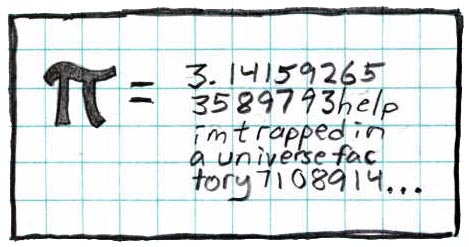
Yes, and therefore the following cartoon is factually correct (though somewhat truncated).

pi.jpg


As usual, XKCD is way ahead of you.

Dave
 
I've been idly wondering - would physical reality be observably different in any way if pi was equal to 3, or any other rational number? I.e., is the irrational or transcendental character of pi in any way responsible for major characteristics of physical reality?

If you use the geometric determination of pi (the ratio of a circle's circumference to it's diameter, where a 'circle' is the set of all points a fixed distance from a single, central, point), pi only takes on it's familiar value in perfect Euclidean space*. Other spaces have a different pi metric, and many have no fixed value for pi.

Example:

On the surface of the earth, make a circle one inch across, and measure it's circumference: You'll get a ratio of the two close to the familiar 3.14. Increase the diameter to 12,000 miles, and you'll find that the ratio is close to 2.000! Increase the diameter to 25,000 miles, and the ratio actually goes to zero! What happened? You weren't using a flat surface to draw on, but one that curved, and that curvature will change how geometry works.

In the real universe, it gets even weirder, as the curvature of space (and thus the 'radius' of a circle) would depend on how much matter and energy were inside the circle, and could change as that energy moved around!

Fortunately, at low enough energies for us to survive, things work pretty close to Euclid's ideal.

*Actually, there are other spaces for which pi has the same value, but they're not salient to the point being made
 
Good point, GodMark2. In the same vein, the mysterious Bermuda Triangle has three angles that actually add to more than 180 degrees. :jaw-dropp
 
Is it possible something changed and I missed it ... ?
I think the April Fool suggestion must be right. CaveDave, didn't it occur to you that "an ending to pi" would imply a proof of the non-existence of transcendental numbers, which (if true) would blow apart the foundations of (post-medieval) mathematics and logic? It would be huge orders of magnitude more world-shattering (and mind-boggling) than any conceivable scientific reversal (e.g. the speed of light is infinite, the age of the universe is 6000 years, most human disease and death is caused by vaccination).


... a transcendental number that by definition can NEVER terminate. It, and others in that class, continue endlessly, adding precision but never ending.
Your understanding is 100% correct, CaveDave.
Not 100%. First, the definition should exclude repeating expansions (and non-rational bases). Second, transcendental numbers are a subset of irrationals, and the corrected definition would apply to all irrationals. Third (though it's a subtle point), continuing the numeric expansion adds precision to the expansion only, not to the number itself.


On a related note, how many ways are there to calculate the digits of Pi?

...

Is it possible to get a listing w/references to the method?
Not a complete list, as there are infinitely many!

Here's a start.


How is it possible that a finite formula can produce an infinite amount of information?
It can't, for any useful definition of "finite formula".

So, here's a "finite formula": "Pick any number"! Or, if you prefer, "Write down all numbers"!

That's not what you meant, though, is it? Let's stipulate that a "finite formula" for some number (such as pi) has to define that number uniquely. Also, of course, that it can be expressed in a finite number of symbols (or steps, or definitions). In that case, it can't produce an infinite amount of information - though it can produce an infinite number of digits (repeating or not).

The numeric representation of pi, in any (non-transcendental!) base, is infinite (and non-repeating) - else it wouldn't be transcendental. But, by definition, this numeric representation is exactly equivalent to any formula for pi, so both contain the same information.


Assuming there's an infinite amount of information there, there's no reason it can't.
Finite formula: Start with one. Add one. Repeat.
... see how that works?
Not a useful answer, as your formula is of the "Pick any number" type. For sure, "assuming there's an infinite amount of information there" (all positive integers, in this case), a finite formula can produce this infinity, but the topic here is a formula for a unique number, pi.


Finite formula : 1/3 = 0.3333333... : infinite amount of information
Finite formula : sqrt(2) = 1.41421356... : infinite amount of information.
Neither of these numeric expansions contains an infinite amount of information (see above).


1/3 repeats in base 10 notation. In other bases, a base divisible by 3, this decimal expansion wouldn't repeat.
See under, as a response to "Pi does not terminate"

...unless you are counting in base Pi. ;)
Pi terminates, just not in base 10 Cartesian :)
Not sure whether you're being serious, but if so:
1. Note smilies!
2. Doesn't help your argument - a finite formula for a number can't produce an infinite amount of information. You can't increase the information content of a number by changing its base - even to a transcendental base.

 
Last edited:
I think the April Fool suggestion must be right. CaveDave, didn't it occur to you that "an ending to pi" would imply a proof of the non-existence of transcendental numbers, which (if true) would blow apart the foundations of (post-medieval) mathematics and logic? It would be huge orders of magnitude more world-shattering (and mind-boggling) than any conceivable scientific reversal (e.g. the speed of light is infinite, the age of the universe is 6000 years, most human disease and death is caused by vaccination).

This is interesting to me. What would that proof imply? I imagine it would extend to "e" and SQRT(-1) too. Am I right or wrong about that?

Please bear with me. The whole topic interests me but I'm not a professional mathematician nor do I play one on TV.
 
I think the April Fool suggestion must be right. CaveDave, didn't it occur to you that "an ending to pi" would imply a proof of the non-existence of transcendental numbers, which (if true) would blow apart the foundations of (post-medieval) mathematics and logic? It would be huge orders of magnitude more world-shattering (and mind-boggling) than any conceivable scientific reversal (e.g. the speed of light is infinite, the age of the universe is 6000 years, most human disease and death is caused by vaccination).
I absolutely agree!
Actually, the way it occurred was:
My acquaintance and I and a couple other guys were shooting the breeze after work, and the conversation came to a point somehow where he announced that he had read that factoid in [local paper], and I immediately started shaking my head emphatically and said "no, never, impossible, can't happen, you're wrong, it was a joke or misprint or you dreamed it, not in this universe!", and he being stubborn as I, asked me to "go on the internet and check" so I promised I would.

When I am fulfilling an honest request for knowledge, my standard is to go, not where I will have my preconceptions confirmed, but to go where I can expect many answers and trust that many of those will be will be good and likely to be including a couple at least from REAL experts, which is why I usually choose JREF.
In composing my title post, I make every attempt to present the question in an honest and fair way so that I don't bias the responses toward my point of view, or to leave out important detail to the same end. Even though I don't try to conceal my opinion, I am loath to unduly slant the responses in my favor, and whatever the results, I report back to the person with as much accuracy as my (aging) memory will permit.:)

Not 100%. First, the definition should exclude repeating expansions (and non-rational bases). Second, transcendental numbers are a subset of irrationals, and the corrected definition would apply to all irrationals. Third (though it's a subtle point), continuing the numeric expansion adds precision to the expansion only, not to the number itself.
Thanks for the clarification.

Not a complete list, as there are infinitely many!

Here's a start.
Thanks for that link.

It can't, for any useful definition of "finite formula".

So, here's a "finite formula": "Pick any number"! Or, if you prefer, "Write down all numbers"!

That's not what you meant, though, is it? Let's stipulate that a "finite formula" for some number (such as pi) has to define that number uniquely. Also, of course, that it can be expressed in a finite number of symbols (or steps, or definitions). In that case, it can't produce an infinite amount of information - though it can produce an infinite number of digits (repeating or not).

The numeric representation of pi, in any (non-transcendental!) base, is infinite (and non-repeating) - else it wouldn't be transcendental. But, by definition, this numeric representation is exactly equivalent to any formula for pi, so both contain the same information.
Fascinating.

Not a useful answer, as your formula is of the "Pick any number" type. For sure, "assuming there's an infinite amount of information there" (all positive integers, in this case), a finite formula can produce this infinity, but the topic here is a formula for a unique number, pi.

Neither of these numeric expansions contains an infinite amount of information (see above).

Not sure whether you're being serious, but if so:
1. Note smilies!
2. Doesn't help your argument - a finite formula for a number can't produce an infinite amount of information. You can't increase the information content of a number by changing its base - even to a transcendental base.
Cool!

Thank you (and the others) for the informative replies.

Cheers,

Dave
 
There is no cake pie..
The cake is a lie
or
The pie is a lie
or
The pie is a lake.

Neither of these numeric expansions contains an infinite amount of information (see above).

I was referring to his concept of "infinite amount of information". Of course, it's not infinite, but I tried to interpret what he said by giving other examples that fit his definition of "infinite amount of information".


Not sure whether you're being serious, but if so:
1. Note smilies!
2. Doesn't help your argument - a finite formula for a number can't produce an infinite amount of information. You can't increase the information content of a number by changing its base - even to a transcendental base.

Ibidem. I know a finite formula for a number can only THAT number, but I was still using his "definition". In base Pi, Pi is 10. That isn't useful at all, but it opposes his notion of "infinite amount of information".

I think this is just a misunderstanding of positions. I didn't agree with him, so I used arguments and examples using his "suppositions" to prove he was wrong and, therefore, that his definitions were wrong. That also why I added : "ETA: What's that "finite formula" you are talking about? "
:o
 
It bothers me how very little this ratio would need to be nudged to terminate.

It should prove the existence or non-existence of god.

It makes me so angry sometimes.
 
It bothers me how very little this ratio would need to be nudged to terminate.

It should prove the existence or non-existence of god.

It makes me so angry sometimes.

What are you talking about?
 
This is interesting to me. What would that (hypothetical) proof (of the non-existence of transcendental numbers) imply? I imagine it would extend to "e" and SQRT(-1) too. Am I right or wrong about that?
"e", yes, but not the square root of minus 1.
 
Not 100%. First, the definition should exclude repeating expansions (and non-rational bases). Second, transcendental numbers are a subset of irrationals, and the corrected definition would apply to all irrationals. Third (though it's a subtle point), continuing the numeric expansion adds precision to the expansion only, not to the number itself.
Your points are, of course, right. But it's quite nitpicking, and not all correct criticism on what CaveDave wrote.
As to the first, the issue whether the expansion is repeating or not is not relevant to CD's statement that "pi is transcendental and therefore has an infinite expansion". It is true regardless whether the expansion is repeating or not.
Likewise, the second is also irrelevant to the truth of that statement.
The third is just a bit sloppy wording, of which everyone with a modicum of math knowledge knows what is actually meant.
 

Back
Top Bottom