• Quick note - the problem with Youtube videos not embedding on the forum appears to have been fixed, thanks to ZiprHead. If you do still see problems let me know.

Does Pi terminate or never?

Last edited:
"e", yes, but not the square root of minus 1.

I thought the evaluation of SQRT(-1) was partly dependent on the existent of transcendental numbers. Or vice versa.

Or is it that the result of SQRT(-1) wouldn't be SQRT(-1) but something "close-ish"?
 
Although the square root of minus one is not a transcendental number, it is an imaginary number, and therefore, together with π and e, it belongs in the general category of "geek numbers".
 
Of course, the ultimate geek numbers are 1 and 0, in that order.

Not a binary thing. Two friggin important ideas.
 
What are you talking about?

Just goofing. Not angry.
But i find it amusing that theologists and sometimes mathematicians prefer tidy sums. Pi is quite bizarre. Perfectly so. It almost deserves a religion. That sequence of numbers could be a Bible! My old girl-friend's phone number is in there, for christ's sake.
 
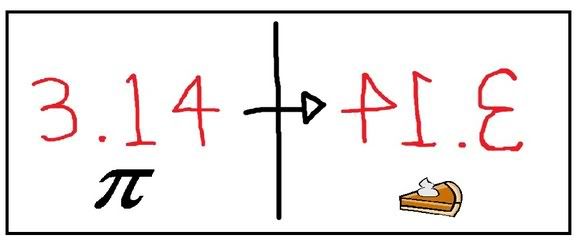
My brain just exploded:

Pi.jpg


http://www.chicagonow.com/blogs/redeye-puzzler/2010/04/get-ready-to-have-your-mind-blown.html
 
{reminder to self. Post lots of lauging gifs}

No, Pi does not terminate. It also never repeats. It is based on a circle which cannot be calculated 100% accurately by base 10 numbers that we use.

Think of it this way. If you wanted to represent a perfect sphere by using a box and you could only make angles to the shape of the box, how many angles would you have to make to form it into a perfect sphere.

Another way to think of it. Suppose you had a ruler and a pencil. You could only make straght lines. How many little lines would it take to make a circle? First, with three lines, you would could make a triangle. With 4, a square.

With each digit we add to PI, we are increasing the accuracy of representing a circle using numbers by 10 times. But we cannot ever got there and say "all done". Impossible.

I wonder if people here can get it. Please tell me you understand.
 
It is based on a circle which cannot be calculated 100% accurately by base 10 numbers that we use.
What makes you think that has anything to do with it? Actually, Pi exhibits its transcendental nature no matter what integer you use as a base.
 
Although the square root of minus one is not a transcendental number, it is an imaginary number, and therefore, together with π and e, it belongs in the general category of "geek numbers".


[latex]\sqrt{-69}[/latex] :D
 
Pi is transcendental no matter what integer base is used. For example, in base 16, Pi is approximately 3.243F6A8885A22. (Online Base Converter)

In my post #63 I asked, "Is it true that any arbitrary sequence of digits, no matter how long, will appear within the digits of Pi?"

The answer appears to be "yes."

Hexadecimal (base 16) numbers are a convenient way of expressing the contents of a computer file. Other bases that are equally appropriate are base 8 (octal) and even base 2 (binary).

Therefore, any file that exists on any computer or digital storage medium, whether it be music, a movie, a computer program, a picture, or whatever, can be found within the digits of Pi.

Can anyone seriously claim to own the rights to any portion of the digits of Pi?

Of course not!

That settles that! Now to see if Avatar is available on BitTorrent yet.
 
With each digit we add to PI, we are increasing the accuracy of representing a circle using numbers by 10 times. But we cannot ever got there and say "all done". Impossible.

I wonder if people here can get it. ..

I get the analogies, you explain it well.
But it's still curious to me what makes it an irrational (non-repeating) number.

But I'm relearning calculus, where limits allow you to throw around pi, infinity, etc, so I see it doesn't impede anything (...also as per the Planck length observation above).
 
Outside of pure theoretical mathematics, Pi does terminate in a way.
I'm a CAD-oid and find, in everyday calculations OR in converting between metric and imperial, or vice versa, five decimal points usually suffice. HOWEVER, when aiming ones laser cutter, "good enough is NOT good enough," despite my Latin-trained brother's claims, such unseemly language leaves end and start points far enough away to cause the software to fail.

Which is pretty good, since in reality several MILLIONTHS will cause it to fail.

These days people ask for dimensions rounded off to the nearest inch. Between mentally asking when they will go metric and making the conversion between decimal and fractional, I ask why they bother, but give the answers. BOTH answers.

FTR, I thought I was the last defender of the Imperial scales. I was wrong.
 
I'm a CAD-oid and find, in everyday calculations OR in converting between metric and imperial, or vice versa, five decimal points usually suffice.

You'd think that, wouldn't you? And yet, I was associated with an aerospace project, maybe 15 years ago, for which the weight database was maintained in lb and the customer worked in kg. The software would work in any units, so this wasn't a problem . . . until a customer checked our math and discovered that we were using 0.453592 as a conversion factor. Of course, the true conversion is 0.45359237.

Yes, they were upset that the weight of our several-thousand-pound thing was being mis-reported by 0.001 kg, which was a full 1000X better than our weighing accuracy.

Okay, um, back to pi . . . back in my aspiring-SF-writer days, I had a civilization that discovered that it was in a computer-generated universe. The thing that first tipped them off was when they were doing precise measurements of space, and they discovered that sometimes their calculations would come closer to the measured values if they used a 64-bit approximation for pi rather than more exact solutions.
 
I would but it would take forever to tell you ;)

Use Knuth's up-arrow notation to describe obscenely large numbers, such as Graham's number which has more digits than there are planck volumes in the visible Universe; give an upper bound.
 
Last edited:
Is it possible that pi is a rational numbers if you express it in some unconventional integer base like base 2927?
 
Is it possible that pi is a rational numbers if you express it in some unconventional integer base like base 2927?
No. A rational number is a number that can be expressed as a ratio of two integers, and it doesn't make any difference what base you use to write those two integers. In fact, you could just line up two rows of apples to represent the two integers and not use any particular base at all. Therefore, any rational number that can be written in one base can be written in any other base, including base 10.

The bottom line is that there's no number of apples that you could line up in two rows such that the number of apples in one row would exactly represent the circumference of a circle, and the number of apples in the other row would exactly represent the diameter of the same circle.
 
Last edited:
Is it possible that pi is a rational numbers if you express it in some unconventional integer base like base 2927?
No. If that were true, then it would be possible to establish a 1:1 relationship with the {other base} number and base 10. That would require a fixed (rational) number for both. By definition, not possible.
 
Last edited:

Back
Top Bottom