• Quick note - the problem with Youtube videos not embedding on the forum appears to have been fixed, thanks to ZiprHead. If you do still see problems let me know.

David Chandler Proves that Nothing Can Ever Collapse

That would refer to the collapse initiation only. It's more than sufficiently explained by the uneven redistribution of loads and the reduction in load bearing capacity from the exposure to high temperatures. The combination lead to creeping of the structure that made it unstable. Providing you in fact read the NIST report with out cherrypicking it, this is a pretty straightforward answer. Of coarse I know already you will not be revising your assertion on the fires, so don't even bring it up.

Once the upper mass began moving, all failures of the structure were from very high, localized impact loads AKA dynamic loads. This is what you're apparently... egregiously avoiding.

The failure from south to north of the 98th floor in WTC 1 occurred in less than 0.7 seconds so the separate discreet impacts would have been compensated for by the continuing fall theory doesn't work. There should have been significant velocity loss and there wasn't.

Additionally, the 98th floor had almost no aircraft impact damage and the first floors to fail after it were above it which had no damage at all and less fire.

The NIST does a gigantic hand wave to go from their south wall failed postulation to their claim that the instability then propagated across the entire building. Their analysis does not show anywhere near high enough stresses on the columns of the east and west walls to cause their failure and their core column creep analysis does not provide the stresses required for a core failure mechanism.
 
Last edited:
The failure from south to north of the 98th floor in WTC 1 occurred in les than 0.7 seconds so the separate discreet impacts would have been compensated for by the continuing fall theory doesn't work.

Additionally, the 98th floor had almost no aircraft impact damage and the first floors to fail after it were above it which had no damage at all and less fire.

The NIST does a gigantic hand wave to go from their south wall failed and then the instability propagated across the entire building. Their analysis does not show anywhere near high enough stresses on the columns of the east and west walls to cause their failure.

You are saying unprotected steel can hold up in fires? Why protect it?

you fail, steel does not do well with fire

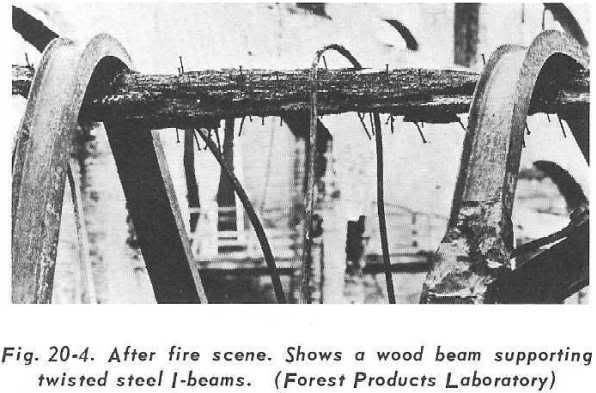
NotMelted.jpg

Warped and bent, it failed, due to fire, you are not a structural engineer, and if you are you should keep it a secret.

Fire destroys the strength of steel quickly, this is why you have to insulate it.
Edited by Tricky: 
Edited for rule 12.

woodsteelfire.jpg

Steel, it fails in fire. You failed with your real-cd-deal. After 8 years you offer zero evidence for a new investigation. Good work.

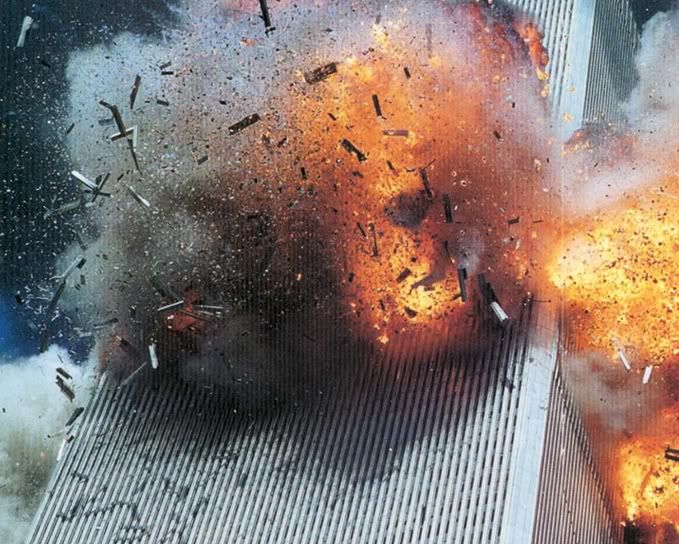
Are you saying the aircraft impacts of 1300 and 2093 pounds of TNT KE did not knock off the insulation?

OOPS
WTCcladdingflying.jpg

Impacts did knock off insulation. Darn I was checking for you, but I see major damage. And I have use my fist to destroy wall board which was used and under the floors the insulation would flake off by using a finger.

Do you support the idiotic notion of thermite in the Ceiling tiles like Jones does?
 
Last edited by a moderator:
You are saying unprotected steel can hold up in fires? Why protect it?

you fail, steel does not do well with fire

http://i286.photobucket.com/albums/ll116/tjkb/NotMelted.jpg
Warped and bent, it failed, due to fire, you are not a structural engineer, and if you are you should keep it a secret.

Fire destroys the strength of steel quickly, this is why you have to insulate it.
Edited by Tricky: 
Edited for response to modded post.
http://i286.photobucket.com/albums/ll116/tjkb/woodsteelfire.jpg
Steel, it fails in fire. You failed with your real-cd-deal. After 8 years you offer zero evidence for a new investigation. Good work.

Are you saying the aircraft impacts of 1300 and 2093 pounds of TNT KE did not knock off the insulation?

OOPS
http://i286.photobucket.com/albums/ll116/tjkb/WTCcladdingflying.jpg
Impacts did knock off insulation. Darn I was checking for you, but I see major damage. And I have use my fist to destroy wall board which was used and under the floors the insulation would flake off by using a finger.

Do you support the idiotic notion of thermite in the Ceiling tiles like Jones does?

I would be embarassed to keep showing those puny 1/8 inch wall thickness 4 inch I-beams you keep showing. The heat capacity of the columns in the towers was orders of magnitude greater than what they had.

Part of your delusion is that the aircraft impacts had anything to do with the collapses. As for fire causing the collapses, the NIST analysis of the small amount of steel they did get does not show the steel experienced high enough temperatures to even weaken it.

Sorry Beachnut, but the present official government analysis and explanation for those collapses is not convincing at all. We need a new investigation.
 
Last edited by a moderator:
If I put a 100 lb weight on a column which can only withstand a static load of 50 lbs would you call that dynamic loading or would you say it failed due to the static load?

Additionally, in this case there will be some resistance and the weight will not fall at 9.81 m/s/s.

What seems to have happened in the towers is that the strength of the columns below was removed to the point where they could not resist the static load above them.


“A static load is one which does not vary. A dynamic load is one which changes with time. If it changes slowly, the structure's response may be determined with static analysis, but if it varies quickly (relative to the structure's ability to respond), the response must be determined with a dynamic analysis.”

http://en.wikipedia.org/wiki/Structural_dynamics

1. If I put a 100 lb weight on a column which can only withstand a static load of 50 lbs slowly such as by placing it atop the column, this is a dynamic load because the load on the column changes with time. I can remove the load and reapply it at intervals. If the load imposition changes slowly, the structure's response may be determined with static analysis, but the load remains a dynamic load that can be calculated with static analysis.

2. If I put a 100 lb weight on a column which can only withstand a static load of 50 lbs quickly such as by dropping it 12 feet ,this is a dynamic load because the load on the column changes with time. If the load imposition varies quickly (relative to the structure's ability to respond), the response must be determined with a dynamic analysis. This load is a dynamic load and must be calculated with a dynamic analysis.

3. In the WTC 1,2 the loads from the collapse above were changing quickly with time and were therefore dynamic loads that need to be calculated with dynamic analysis.

4. TS is wrong in claiming the falling WTC loads were static ones and not dynamic ones . His static analysis using static load bearing capabilities of the columns below the collapse is wrong. Once again.
 
I... orders of magnitude greater than ...
So the WTC has special steel that does not fail in fire. ORDERS OF MAGNITUDE; cool. AN engineering like term from the never published 911 delusions author.

Prove it. Prove
heat capacity of the columns in the towers was orders of magnitude greater
Post the numbers. Show us.

NotMelted.jpg

No warped steel from fire here? OOPS, WTC steel bent in fire. Darn, orders of magnitude down the drain.

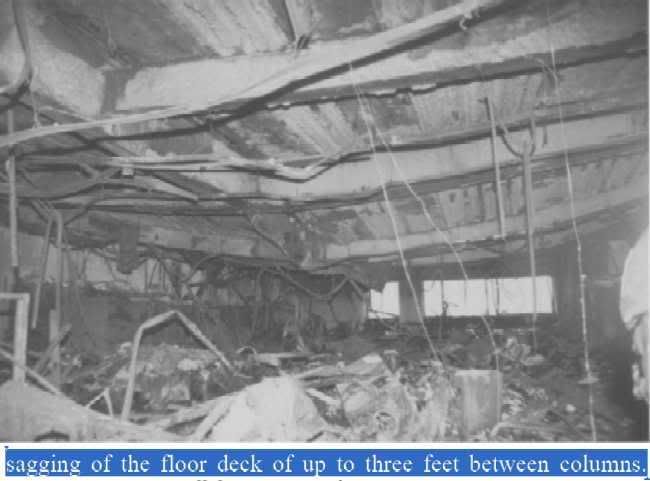
Office fires damage steel.
onemeridiansag.jpg

No damage in the building to the fire proofing but the building failed in fire and was taken down. (hi-rise)

Real fire, real steel, fails.
 
Last edited:
“A static load is one which does not vary. A dynamic load is one which changes with time. If it changes slowly, the structure's response may be determined with static analysis, but if it varies quickly (relative to the structure's ability to respond), the response must be determined with a dynamic analysis.”

http://en.wikipedia.org/wiki/Structural_dynamics

1. If I put a 100 lb weight on a column which can only withstand a static load of 50 lbs slowly such as by placing it atop the column, this is a dynamic load because the load on the column changes with time. I can remove the load and reapply it at intervals. If the load imposition changes slowly, the structure's response may be determined with static analysis, but the load remains a dynamic load that can be calculated with static analysis.

2. If I put a 100 lb weight on a column which can only withstand a static load of 50 lbs quickly such as by dropping it 12 feet ,this is a dynamic load because the load on the column changes with time. If the load imposition varies quickly (relative to the structure's ability to respond), the response must be determined with a dynamic analysis. This load is a dynamic load and must be calculated with a dynamic analysis.

3. In the WTC 1,2 the loads from the collapse above were changing quickly with time and were therefore dynamic loads that need to be calculated with dynamic analysis.

4. TS is wrong in claiming the falling WTC loads were static ones and not dynamic ones . His static analysis using static load bearing capabilities of the columns below the collapse is wrong. Once again.

You sound confused here. In structural design and analysis dynamic loading is the term used in reference to an amplified load during an impact or when resonant conditions occur during vibration loading. In the case of impact loading the amplification occurs due to deceleration greater than gravity and it requires velocity loss by the impacting object, which did not occur in the fall of the upper section of WTC 1.
 
Last edited:
... Sorry Beachnut, but the present official government analysis and explanation for those collapses is not convincing at all. We need a new investigation.
Your ignorance is not a need for a new investigation. Your paranoid explosives did it conclusion based on zero evidence is not a need for a new investigation. Your paper failed, David's paper is pure nuts, and the 911 truth movement failed 8 years ago.

Sorry Tony, you lack of knowledge, skill and paranoid conspiracy theories are not a reason for a new investigation in a gravity collapse you are not equipped to understand. 8 years of failure.

Was you paper turned down? David's paper is funny, I am going to show it around to real engineers so they can laugh at it. But please submit it to real journal, everyone should see the best you guys can do.

Why not submit your paper and David's to a real journal and get back to us!? Why not?
 
You sound confused here.... it requires velocity loss by the impacting object, which did not occur in the fall of the upper section of WTC 1.
How long did it take the towers to fall? A lot slower than dropping a mass from the same hight.

The velocity of the towers were significantly lower than that of an object free to fall without interference. You fail.

The towers were not in free fall, not even close. But keep up your delusion, since 70 percent is 100 percent for 911 truth; no wonder you paper is junk.

David's paper is going to be published in a real journal? When?

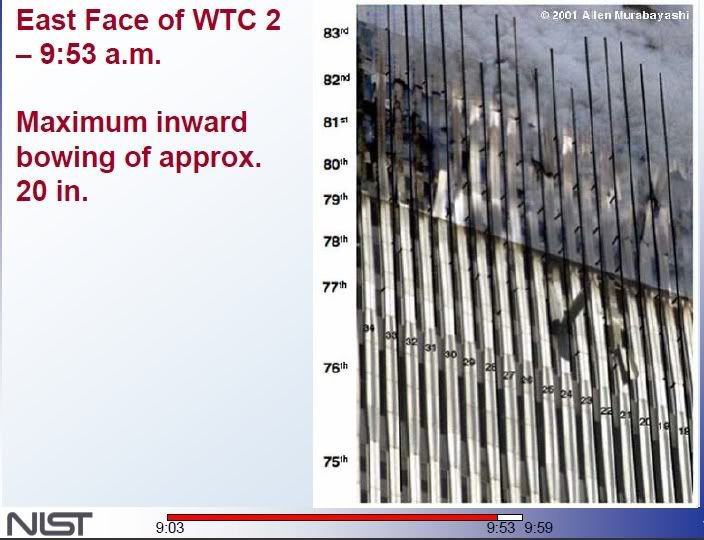
The WTC is bowing, it bowed real slowly. This bowing means the tower is coming down slowly. Does this time count too for the collapse?

wtc2bowing.jpg

What caused the bowing? Heat? Gravity? There were zero explosives heard and no evidence of bombs, or thermite. Why are you making up lies? Why are you apologizing for terrorist by spreading delusions based on your failure to do real engineering work?

Why are 11 floors too much weight for one floor of the WTC?
Why were the impacts 7 and 11 times greater than Robertson's 180 mph 707 impact design? Did you know there was a study proving the WTC could take a 200 mph aircraft impact and stop the plane? Robertson was right. Why did the aircraft destroy the fire systems, and fire proofing?

8 years... And not a single reputable journal has published the claptrap you and your fellow 911 truth cult members have offered up as science. Why?
 
Last edited:
OK, Tony, I will humor you. Let us assume for the sake of an argument that a falling object hitting another object must decelerate. I am not entirely convinced it does, but let's assume it does.

So say an object is travelling at 1g, it hits another object, and slows to .6g for say, .01 seconds, before both objects continue accelerating at 1g again. Velocity is not going down of course, but the acceleration is.

Now obviously in order to measure this you are going to have to make observations at certain intervals of time. If you are only measuring it at say, intervals of .05 seconds though, you will never see a deceleration, just an average acceleration which will be something slightly lower than 1g, and you will claim that it falls at a constant acceleration.

So it seems to me the only way that you could even make this hypothesis relevent would be to calculate exactly how long your collisions would take, and then make observations with a higher precision. Something which I would imagine would be exceedingly difficult based off of a compressed YouTube video.
 
I still remember his video where he tried to asser the force of the upper 'block' on the bottom part of the wtc was less while falling than when static.

It is. He's correct with this point.

That said, he doesn't understand load paths. Only the columns of the lower block can resist the weight of the upper block. The weight of the upper block was applied through the floors of the lower block, not through the columns. Hence collapse. And since the upper block is falling somewhere between 0 and 1g, the force of the upper block on the lower block is somewhere between 0 and 1mg. But it's the lower block floors, not the columns.

I don't know why there's such an inability to understand this concept.
 
I am still stunned that even a high school physics teacher cannot understand the difference between a static force and a dynamic force.

haa!!!

are debunkers now suggesting that static brought down the WTC towers!!

everybody knows that static electricity can't do squat!!

now you guys are the conspiracy theorists!!!

;)
 
OK, Tony, I will humor you. Let us assume for the sake of an argument that a falling object hitting another object must decelerate. I am not entirely convinced it does, but let's assume it does.

It doesn't have to decelerate. It can, but it depends on the dynamics of the impact.
 
OK, Tony, I will humor you. Let us assume for the sake of an argument that a falling object hitting another object must decelerate. I am not entirely convinced it does, but let's assume it does.

Simple analysis using Newton's Third Law*:

If the object above (mass = m) is applying a force of 2mg to the object below, the object below is also applying a force of 2mg to the object above. This assumes that the lower object has a fixed support and is able to deform (like a spring).

* for every action there is an equal and opposite reaction.
 
Last edited:
OK, Tony, I will humor you. Let us assume for the sake of an argument that a falling object hitting another object must decelerate. I am not entirely convinced it does, but let's assume it does.

So say an object is travelling at 1g, it hits another object, and slows to .6g for say, .01 seconds, before both objects continue accelerating at 1g again. Velocity is not going down of course, but the acceleration is.

Now obviously in order to measure this you are going to have to make observations at certain intervals of time. If you are only measuring it at say, intervals of .05 seconds though, you will never see a deceleration, just an average acceleration which will be something slightly lower than 1g, and you will claim that it falls at a constant acceleration.

So it seems to me the only way that you could even make this hypothesis relevent would be to calculate exactly how long your collisions would take, and then make observations with a higher precision. Something which I would imagine would be exceedingly difficult based off of a compressed YouTube video.

The deceleration has to be greater than 1g to amplify the load. This is another point that is frequently missed here.

The impulse itself is too short in duration to see in video of 30 frames/second. However, the velocity loss is observable.

What we did in the Missing Jolt paper was calculate the column energy dissipation due to their elastic and plastic deformation and buckling and looked for the correlatable loss of kinetic energy and velocity loss. It wasn't there.

The only way to avoid the issue of the low resistance and lack of velocity loss is if the columns miss each other, but kinematic studies of the actual motion of WTC 1 have now been done and they show that the columns would not miss each other.

It appears that something was artificially removing most of the strength of the columns and only a small residual resistance remained.
 
The deceleration has to be greater than 1g to amplify the load. This is another point that is frequently missed here.

I don't think this is correct. An upper block deceleration of 1g means the net resistance from the lower block is 2g, which is a load amplification. If the upper block were not accelerating at all (or accelerating at less than 1g) then there would not be an amplified load.
 
Several posts edited and a couple infracted. Asking someone if they have a drinking problem is only on-topic if the thread is about drinking. Doing so as an insult is a rule 12 violation. So don't do it.
Replying to this modbox in thread will be off topic  Posted By: Tricky
 
The failure from south to north of the 98th floor in WTC 1 occurred in less than 0.7 seconds so the separate discreet impacts would have been compensated for by the continuing fall theory doesn't work. There should have been significant velocity loss and there wasn't.

Additionally, the 98th floor had almost no aircraft impact damage and the first floors to fail after it were above it which had no damage at all and less fire.

The NIST does a gigantic hand wave to go from their south wall failed postulation to their claim that the instability then propagated across the entire building. Their analysis does not show anywhere near high enough stresses on the columns of the east and west walls to cause their failure and their core column creep analysis does not provide the stresses required for a core failure mechanism.
Ya know tony. I am reminded of something my professors used to say in class.

PROVE IT.

Now, the easiest way to do that and shut up ALL of these critics would be just to get your theories published in any peer reviewed journal.

Why won't you do that?

I mean, I have 3 publications on my CV (in three different fields) over the last 8 years. I'm sure that if your theories are correct you can easily show how NIST is wrong, where they are wrong, and how your theories are right. Writing that paper should already be done (because you keep bleating on about it), so you should submit it, and in the next 3 months or so have it published.

Feel free. I for one would LOVE to read any twoof peer reviewed journal articles.

Instead you waste your time on this forum and others... why is that? I mean you have revolutionary data (according to you). You have proof that it didn't happen like the common narrative and over 75 peer reviewed engineering journals state. Yet instead of slaving away in your home, making sure your assumptions are correct, double and triple checking your data and conclusions.... you are posting drivel on internet forums...
 
I don't think this is correct. An upper block deceleration of 1g means the net resistance from the lower block is 2g, which is a load amplification. If the upper block were not accelerating at all (or accelerating at less than 1g) then there would not be an amplified load.

If the upper block only decelerates at 1g then the force applied is equal to the static load. If it decelerates at less than 1g then the force applied is less than the static load. Remember F = ma.

In order to get an amplification the deceleration needs to be greater than 1g.

If the deceleration were 2g then the force applied would be twice the static load.
 
Last edited:

Back
Top Bottom