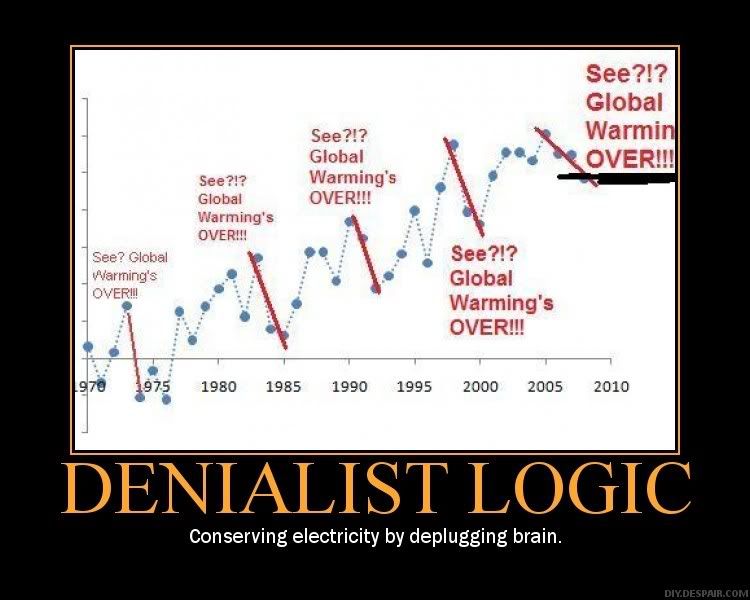
OK, this is my first post in a Global Warming thread. I've never weighed in on the matter because I'm just not sure. I was pretty certain during my University years that there was something to it. I felt that as a society we weren't doing enough to prevent it. Then I went to a lecture by a notable Canadian scientist by the name of David Suzuki. He's rather well respected here in Canada and I was excited to hear his presentation. It was coincidentally around 1995, although I believe the exact year was 1998.
I was disappointed to hear him present a rather biased version of "the facts". He seemed to have already come to a conclusion not entirely based in the available science at the time. He was urging for drastic action. This seemed a little out of character and as a result I began to question what was held as seemingly shared beliefs.
This seems to be one of the types of things that has caused the most backlash. Since so many scientists have grown to be rather alarmed about the issue and are so serious about doing something about it
now, the general public who is typically resistant to change has balked in many ways at the implications proposed. Also as a result of the more fervent demands from the 1980's and 1990's there has been a fairly strong denier movement that's grown in opposition to those demanding drastic change.
Something to keep in mind, however, is that those claiming global warming for the past few decades have pretty much kept saying the same thing (with data obviously adding to or refining predictive analysis), while the opposition has pretty much changed from arguing no warming at all (or cooling) as the primary skeptical argument to admitting that yes, there is some warming taking place, but there's nothing to be done about it.
Since then I have yet to come to a firm conclusion one way or the other. I realize the planet is warming but to what extent I'm not certain. I live in an area that was once covered in glacial ice several miles thick. There's no doubt we are in a period of global warming, but I have to question at what point are we and how fast are we getting there?
Both completely sensible questions in my opinion, and far more logical and reasonable than the personal attacks and quote-mining that typically occurs in these debates. The question of what point we're at is somewhat difficult to answer unless we define the measure we're going by first, in order to select a point along that measure and say "we are here." Between the 'warmers' and the 'deniers' no such measure has been agreed upon, and indeed both approach even the question of measure in fundamentally different ways, which makes specifying a point more difficult. In the loosest and broadest of terms, what can be estimated from the data we have is that we're somewhere in a point of rather intense warming, and when or how the climb in global temperature is going to plateau is currently not known for sure. What is known is that changes of even a few degrees Celsius are going to affect weather patterns, land availability, and (drinkable) water scarcity, among other things. Those are pretty much undeniable effects of global warming by just a few degrees, and it's those effects extrapolated out that have gotten those who are adamant that something must be done as soon as possible so worked up that changes need to happen quickly. To those opposing quick change, it's not the effects but the proposed causes that are the primary arguing motivation, with (as best as I can tell) the main gist of the argument being that if mankind has nothing to do with the changes then mankind should do nothing in response to the changes, or sort it out once there are demonstrable problems to face. The second part of your question, how fast we're getting there, is reasonable because it gets to the heart of the first part-- namely, what level of urgency should there be regarding the issue? I think this is a highly appropriate question to ask because I don't think the extremes on either side are approaching the urgency issue on reasonable terms, but I do think there should be urgency to be ready and address the issue
before there are severe problems as opposed to waiting for things to snowball before action is taken. Whether or not there are demonstrable problems
now becomes a point of contention with this question, though I think evidence is clear in many parts of the world that there are indeed demonstrable problems attributable to global warming, and land aridity and/or water scarcity are among the leading demonstrable issues.
The change in recorded temperature over the last 100 years doesn't seem that dramatic when compared over say 500 000 years, which unless you're a creationist is still a very short time span. The rate of increase however seems a little steep. Unless I'm mistaken it's unprecedented.
Correct.
But what sets the precedent? We haven't exactly been keeping track of global temperature for the last million years or so. We know for a fact it's gone through cycles of warming and cooling but we just don't have accurate enough data to gauge the current warming trend against. At least to my knowledge.
What sets the precedent has to do with that problem between the two extremes I mentioned earlier about defining the point we're at now. You're not going to get a clear, absolute answer on that where both sides can agree. We can go back through geological records and work out warming periods from before, and can tell that they occurred at a much different pace compared to the current warming, but depending on the source interpreting what this means you're going to get two different interpretations on the importance of this information. What I would suggest instead, if you're trying to look at this independent of the ideological sides of the debate, is to examine what this meant for life on the planet when these periods occurred, and what changes took place in previous cycles. There are smaller warming periods where humans existed and had to deal with the changes, and those periods would be quite applicable to judging how the current rise is going to affect us in the modern-day. This, I think, would color the answers you would get to the questions you ask in the following quote:
So we arrive at my current question. Why would I care? I live in Canada. I'm not exactly concerned about it being a few degrees warmer. Sure it would make the Summer a little less pleasant, but that is easily overlooked in the Winter. There's no shortage of snow or glaciers in this country.
Am I really to believe our current trend, as small as it is, is really going to lead to some cataclysmic earth altering extinction level event?
So what's the deal? Am I missing something here or has this just become an over politicized doomsday prediction I can continue to ignore by taking public transit and using stick deodorant?
Okay, so why should you care? Well, a few degrees Celsius has a huge impact on where people are capable of living cheaply and easily, which certainly has a direct effect on you regardless of where you live-- if you live somewhere that may remain cheap it means population increases as people migrate, and if you live in less-cheap places it means an increase in cost to remain where you are. More importantly, this has an effect on the economics of food production over the course of a few decades, where it gradually becomes more difficult in some areas to produce food where there may have been abundance (or at least sufficient amounts) previously. Something will need to make up for the gaps, and that will mean starvation, (again) migration, or changes in the redistribution of foodstuffs, which would alter prices (and costs to you). Chances are likely that even with the current rate of warming being steep, the change will remain gradual enough that all three are likely going to happen simultaneously, which will also affect you directly (though over time). Whether this translates to should you care
more than you already do really depends not just on your own sense of comfort, but that of the community in which you live and how you feel about the relative comfort of subsequent generations, which (if the trend continues) will experience increasing amounts of change as time continues.
Another economic impact will be that of energy production, which is something that constantly gets bandied about by politicians as part of their platform but rarely sees any significant changes from previous administrations, and as the climate changes there will likely be new reservoirs of resources to be tapped, which will change the structure of political influence around the world as countries vie for the resources. Now predicting what will happen politically as a result would be a crap shoot (and something I'm not inclined to do), but what is clear is that all those changes politicians are
talking about now are going to become front-and-center issues of change no matter what. Chances are rather high that energy production is going to become far more diversified than it is currently, which (right now) relies heavily on burning of fossil fuels as the primary power source. The distribution of power technologies may very well be a good thing for costs, and it's certainly going to mean profits for those who are producing better and more alternatives than competitors, but who is going to lead in such things is currently up in the air since
we're not even sure what other natural resources may be discovered yet. It's fairly certain that solar power is going to play more of a role in the years to come, though the more research that is done on it seem to imply less of a power grid relying on huge production stations and more of a distributed network that is applicable as far down the chain as the consumer level, which is highly incompatible with the current power production infrastructure that is very top-down in terms of access. Maybe someone will figure out a way to incorporate the newer technologies into the current top-down structure, but it's unlikely and that is where a great deal of the changes in the economics of power production are likely to come.
But should you care? Well, that depends on you, mostly. I would say that it depends most distinctly on how you prefer political and world leaders to address inevitable problems. I'm of the opinion that addressing things when there are less severe problems to start out with is going to yield better results in the long run, which is why I hold the position that doing things now to lessen the impacts is a smarter idea. Others hold the position that putting off doing anything now until things become more problematic is a more economical route to take, to which I disagree-- addressing anything in a 'crisis mode' is always going to be more expensive than taking measures before a problem gets out of hand, and that applies to business as well as our daily lives. We can't go back in time to where there weren't any problems, because 1) there are always going to be existential problems to face and 2) we're not 8-year-olds reading a sci-fi comic. Holding our fingers to our ears and ignoring the global climate change is untenable, so removing all the stupid political ideology and looking at the problem on its face the question really boils down to this: do you think that it's a better idea to approach warming now or do you think it's better left off until later?



 .
.