• Quick note - the problem with Youtube videos not embedding on the forum appears to have been fixed, thanks to ZiprHead. If you do still see problems let me know.

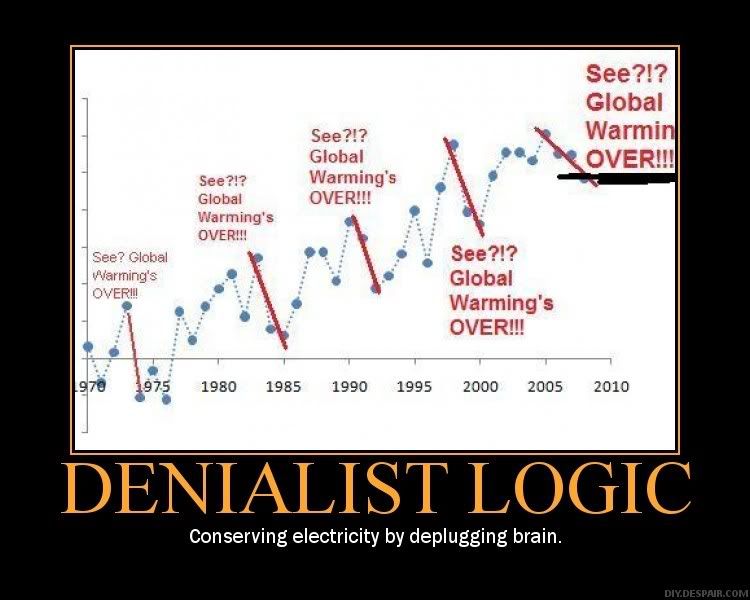
No global warming since 1995?

http://news.bbc.co.uk/2/hi/science/nature/8511670.stm

Originally Posted by BBC
Question: Do you agree that from 1995 to the present there has been no statistically-significant global warming Phil Jones: Yes, but only just. I also calculated the trend for the period 1995 to 2009. This trend (0.12C per decade) is positive, but not significant at the 95% significance level. The positive trend is quite close to the significance level. Achieving statistical significance in scientific terms is much more likely for longer periods, and much less likely for shorter periods.
Statistically speaking, lack of significance at the 95% confidence level leads us to accept the null hypothesis that there is no difference and to reject the alternate hypothesis that the difference is significant. "Statistical Methods", Snedecor and Cochran http://www.eric.ed.gov/ERICWebPorta...&ERICExtSearch_SearchType_0=no&accno=EJ598316
This is the essential material always covered in the first week's lesson in any Introduction to Statistics college course.

Dr. Jones clearly states that the statistics are not significant at the 95% level, so there is no positive trend, period. There is no trend and the trend that doesn't exist is not in an upward direction.

"There is no positive temperature trend since 1995. There is no positive temperature trend since 1995. "There is no positive temperature trend since 1995. There is no positive temperature trend since 1995. "There is no positive temperature trend since 1995. There is no positive temperature trend since 1995. "There is no positive temperature trend since 1995. There is no positive temperature trend since 1995. "There is no positive temperature trend since 1995. There is no positive temperature trend since 1995. "There is no positive temperature trend since 1995. There is no positive temperature trend since 1995. "There is no positive temperature trend since 1995. There is no positive temperature trend since 1995. "There is no positive temperature trend since 1995. There is no positive temperature trend since 1995. "There is no positive temperature trend since 1995. There is no positive temperature trend since 1995. "There is no positive temperature trend since 1995. There is no positive temperature trend since 1995. "There is no positive temperature trend since 1995. There is no positive temperature trend since 1995. "There is no positive temperature trend since 1995. There is no positive temperature trend since 1995. :cool:
Coloured letter and highligher spam does not make you seem better informed:rolleyes:.

Oh, and as others have pointed out:

poster39378854.jpg


Why is nobody happy we've successfully started to terraform Earth to a warmer place? Glaciers are cute and all, but really. I thought People were First.


Farmland in Antarctica now!
Doesn't it get tiring to use the same debunked, ridiculous, insensitive arguments over and over and over again?
 
Last edited:
Statistically speaking, lack of significance at the 95% confidence level leads us to accept the null hypothesis that there is no difference and to reject the alternate hypothesis that the difference is significant.

No, it doesn't.

That's just fundamentally wrong. You can never "reject" the alternate hypothesis; you can only reject the null hypothesis. Writing "to reject the alternate hypothesis" is a good way to fail stats 101.

Dr. Jones clearly states that the statistics are not significant at the 95% level,

He does, yes.

so there is no positive trend, period.

That's simply wrong. In fact, the word "trend" is a term of art in statistics that means "an effect that is probably there but does not rise to the level of 'statistical significance.'" What we have is a positive "trend" that cannot be confirmed to be a "significant effect."

There is no trend and the trend that doesn't exist is not in an upward direction.

Wrong on both counts. The trend is very clear and it is positive, as Dr. Jones makes clear. "This trend (0.12C per decade) is positive." I don't know how you can twist this into a claim either that there is no trend (when Jones says directly that there is) or that it is not upwards (when, again, he says clearly that it is).
 
OK, this is my first post in a Global Warming thread. I've never weighed in on the matter because I'm just not sure. I was pretty certain during my University years that there was something to it. I felt that as a society we weren't doing enough to prevent it. Then I went to a lecture by a notable Canadian scientist by the name of David Suzuki. He's rather well respected here in Canada and I was excited to hear his presentation. It was coincidentally around 1995, although I believe the exact year was 1998.
I was disappointed to hear him present a rather biased version of "the facts". He seemed to have already come to a conclusion not entirely based in the available science at the time. He was urging for drastic action. This seemed a little out of character and as a result I began to question what was held as seemingly shared beliefs.

This seems to be one of the types of things that has caused the most backlash. Since so many scientists have grown to be rather alarmed about the issue and are so serious about doing something about it now, the general public who is typically resistant to change has balked in many ways at the implications proposed. Also as a result of the more fervent demands from the 1980's and 1990's there has been a fairly strong denier movement that's grown in opposition to those demanding drastic change.

Something to keep in mind, however, is that those claiming global warming for the past few decades have pretty much kept saying the same thing (with data obviously adding to or refining predictive analysis), while the opposition has pretty much changed from arguing no warming at all (or cooling) as the primary skeptical argument to admitting that yes, there is some warming taking place, but there's nothing to be done about it.

Since then I have yet to come to a firm conclusion one way or the other. I realize the planet is warming but to what extent I'm not certain. I live in an area that was once covered in glacial ice several miles thick. There's no doubt we are in a period of global warming, but I have to question at what point are we and how fast are we getting there?

Both completely sensible questions in my opinion, and far more logical and reasonable than the personal attacks and quote-mining that typically occurs in these debates. The question of what point we're at is somewhat difficult to answer unless we define the measure we're going by first, in order to select a point along that measure and say "we are here." Between the 'warmers' and the 'deniers' no such measure has been agreed upon, and indeed both approach even the question of measure in fundamentally different ways, which makes specifying a point more difficult. In the loosest and broadest of terms, what can be estimated from the data we have is that we're somewhere in a point of rather intense warming, and when or how the climb in global temperature is going to plateau is currently not known for sure. What is known is that changes of even a few degrees Celsius are going to affect weather patterns, land availability, and (drinkable) water scarcity, among other things. Those are pretty much undeniable effects of global warming by just a few degrees, and it's those effects extrapolated out that have gotten those who are adamant that something must be done as soon as possible so worked up that changes need to happen quickly. To those opposing quick change, it's not the effects but the proposed causes that are the primary arguing motivation, with (as best as I can tell) the main gist of the argument being that if mankind has nothing to do with the changes then mankind should do nothing in response to the changes, or sort it out once there are demonstrable problems to face. The second part of your question, how fast we're getting there, is reasonable because it gets to the heart of the first part-- namely, what level of urgency should there be regarding the issue? I think this is a highly appropriate question to ask because I don't think the extremes on either side are approaching the urgency issue on reasonable terms, but I do think there should be urgency to be ready and address the issue before there are severe problems as opposed to waiting for things to snowball before action is taken. Whether or not there are demonstrable problems now becomes a point of contention with this question, though I think evidence is clear in many parts of the world that there are indeed demonstrable problems attributable to global warming, and land aridity and/or water scarcity are among the leading demonstrable issues.

The change in recorded temperature over the last 100 years doesn't seem that dramatic when compared over say 500 000 years, which unless you're a creationist is still a very short time span. The rate of increase however seems a little steep. Unless I'm mistaken it's unprecedented.

Correct.

But what sets the precedent? We haven't exactly been keeping track of global temperature for the last million years or so. We know for a fact it's gone through cycles of warming and cooling but we just don't have accurate enough data to gauge the current warming trend against. At least to my knowledge.

What sets the precedent has to do with that problem between the two extremes I mentioned earlier about defining the point we're at now. You're not going to get a clear, absolute answer on that where both sides can agree. We can go back through geological records and work out warming periods from before, and can tell that they occurred at a much different pace compared to the current warming, but depending on the source interpreting what this means you're going to get two different interpretations on the importance of this information. What I would suggest instead, if you're trying to look at this independent of the ideological sides of the debate, is to examine what this meant for life on the planet when these periods occurred, and what changes took place in previous cycles. There are smaller warming periods where humans existed and had to deal with the changes, and those periods would be quite applicable to judging how the current rise is going to affect us in the modern-day. This, I think, would color the answers you would get to the questions you ask in the following quote:

So we arrive at my current question. Why would I care? I live in Canada. I'm not exactly concerned about it being a few degrees warmer. Sure it would make the Summer a little less pleasant, but that is easily overlooked in the Winter. There's no shortage of snow or glaciers in this country.
Am I really to believe our current trend, as small as it is, is really going to lead to some cataclysmic earth altering extinction level event?
So what's the deal? Am I missing something here or has this just become an over politicized doomsday prediction I can continue to ignore by taking public transit and using stick deodorant?

Okay, so why should you care? Well, a few degrees Celsius has a huge impact on where people are capable of living cheaply and easily, which certainly has a direct effect on you regardless of where you live-- if you live somewhere that may remain cheap it means population increases as people migrate, and if you live in less-cheap places it means an increase in cost to remain where you are. More importantly, this has an effect on the economics of food production over the course of a few decades, where it gradually becomes more difficult in some areas to produce food where there may have been abundance (or at least sufficient amounts) previously. Something will need to make up for the gaps, and that will mean starvation, (again) migration, or changes in the redistribution of foodstuffs, which would alter prices (and costs to you). Chances are likely that even with the current rate of warming being steep, the change will remain gradual enough that all three are likely going to happen simultaneously, which will also affect you directly (though over time). Whether this translates to should you care more than you already do really depends not just on your own sense of comfort, but that of the community in which you live and how you feel about the relative comfort of subsequent generations, which (if the trend continues) will experience increasing amounts of change as time continues.

Another economic impact will be that of energy production, which is something that constantly gets bandied about by politicians as part of their platform but rarely sees any significant changes from previous administrations, and as the climate changes there will likely be new reservoirs of resources to be tapped, which will change the structure of political influence around the world as countries vie for the resources. Now predicting what will happen politically as a result would be a crap shoot (and something I'm not inclined to do), but what is clear is that all those changes politicians are talking about now are going to become front-and-center issues of change no matter what. Chances are rather high that energy production is going to become far more diversified than it is currently, which (right now) relies heavily on burning of fossil fuels as the primary power source. The distribution of power technologies may very well be a good thing for costs, and it's certainly going to mean profits for those who are producing better and more alternatives than competitors, but who is going to lead in such things is currently up in the air since we're not even sure what other natural resources may be discovered yet. It's fairly certain that solar power is going to play more of a role in the years to come, though the more research that is done on it seem to imply less of a power grid relying on huge production stations and more of a distributed network that is applicable as far down the chain as the consumer level, which is highly incompatible with the current power production infrastructure that is very top-down in terms of access. Maybe someone will figure out a way to incorporate the newer technologies into the current top-down structure, but it's unlikely and that is where a great deal of the changes in the economics of power production are likely to come.

But should you care? Well, that depends on you, mostly. I would say that it depends most distinctly on how you prefer political and world leaders to address inevitable problems. I'm of the opinion that addressing things when there are less severe problems to start out with is going to yield better results in the long run, which is why I hold the position that doing things now to lessen the impacts is a smarter idea. Others hold the position that putting off doing anything now until things become more problematic is a more economical route to take, to which I disagree-- addressing anything in a 'crisis mode' is always going to be more expensive than taking measures before a problem gets out of hand, and that applies to business as well as our daily lives. We can't go back in time to where there weren't any problems, because 1) there are always going to be existential problems to face and 2) we're not 8-year-olds reading a sci-fi comic. Holding our fingers to our ears and ignoring the global climate change is untenable, so removing all the stupid political ideology and looking at the problem on its face the question really boils down to this: do you think that it's a better idea to approach warming now or do you think it's better left off until later?

 
I don't know much about statisitics, but I do know that in statistics "significant" does not mean the same as in other uses of the word. It does not mean "important", it means "with high confidence".

Hey, I think this is the first time I've heard the 95% confidence figure in the GW/AGW discussion. Or any confidence number?
 
I don't know much about statisitics, but I do know that in statistics "significant" does not mean the same as in other uses of the word. It does not mean "important", it means "with high confidence".

Hey, I think this is the first time I've heard the 95% confidence figure in the GW/AGW discussion. Or any confidence number?


Then perhaps you haven't been reading very many of teh papers. I've seen CI's all over the place in climate papers, from paleoclimate reconstructions to temperature projections to estimates of the current global temperature anomaly.
 
question really boils down to this: do you think that it's a better idea to approach warming now or do you think it's better left off until later?
More precisely the question should be, what is the best use of financial resources for the betterment of the world. That question has been looked at by economists and global warming is at the bottom of the list.
 
More precisely the question should be, what is the best use of financial resources for the betterment of the world. That question has been looked at by economists and global warming is at the bottom of the list.

A quick look at North vs. South Korea shows government can indeed have a much greater toll on human quality of life than the worst of global warming will have.


The erroneous conclusion is "global warming...and therefore massive intervention in the economy is warranted". That's what's behind all this, not the mild and arguably beneficial effects of actual climate change.


Julian Simon destroyed climate and ecological scientists in the '70s who tried to reason from this or that issue to horrible impact on humanity, which was an economic issue, of which they had no concept or clue and were akin to children when reasoning into that domain. Stupid children, at that, who kept believing Santa existed even as reams of paper and observations were lain at their feet.
 
Last edited:
What bothers me about this is not the behavior of the scientists -- of course anybody who knows the first thing about science knows that no statistically significant global warming in the short term doesn't mean the global warming hypothesis is wrong in general.

(And, by the way, no fair cheating by claiming the change is "probably real" but "only" not statistically significant. The whole point of having statistical tests is for people not to have to use their intuition, with all the embedded bias, false positives, etc.)

What bothers me is the behavior of the media. We've been hearing, not from scientists, but from personalities like Al Gore, how in the last few years global warming has accelerated terribly and therefore tons of stuff needs to be done NOW.

That is what was disproved here, the media hysteria, not the theory of global warming. Such hysteria -- things are getting worse really, really quick, we must do tons of stuff RIGHT NOW at enormous cost OR ELSE WE ARE FACING CATASTROPHE WITHIN FIVE YEARS never matched the reality of the facts.

But this hysteria had been going on in the last 40 years -- as the planet warmed about, I believe, half a degree? The change surely exists, but it is slow. I fail to see why the normal economic response -- the same response we have to, say, changes in the price of oil or whatever -- will not be able to deal with it.
 
Last edited:
What bothers me about this is not the behavior of the scientists -- of course anybody who knows the first thing about science knows that no statistically significant global warming in the short term doesn't mean the global warming hypothesis is wrong in general.

Exactly. Which is why all the ranting by some here about "GW is false" is so silly and little more than wishful thinking, it seems.

What bothers me is the behavior of the media. We've been hearing, not from scientists, but from personalities like Al Gore, how in the last few years global warming has accelerated terribly and therefore tons of stuff needs to be done NOW.

That is what was disproved here, the media hysteria, not the theory of global warming. Such hysteria -- things are getting worse really, really quick, we must do tons of stuff RIGHT NOW at enormous cost OR ELSE WE ARE FACING CATASTROPHE WITHIN FIVE YEARS never matched the reality of the facts.

On this point you have no argument from me. My biggest beef on this entire issue is how thoroughly it has been overly politicized by the media and various ideologues on both the right & left. The one thing which gets lost in all the hysteria is the actual science; sometimes I wish everyone else (media, politicians, celebrities, big business, etc) would just shut up and let the scientists do the talking.

But this hysteria had been going on in the last 40 years -- as the planet warmed about, I believe, half a degree? The change surely exists, but it is slow. I fail to see why the normal economic response -- the same response we have to, say, changes in the price of oil or whatever -- will not be able to deal with it.

This is another important point. What many people need to do is distinguish between two things: the science and the political/economic implications and/or policy decisions based upon that science. The science of GW can (and is, imo) be sound, but there can be very good or very bad policy decisions made based upon that science. That doesn't necessarily reflect upon the validity of the science, though there are those who think that it does because they see every damn thing in the world through their particular ideological lens. Hence, we get silliness like "the Earth is cooling, GW is a lie" on one side and idiocy like "it's going to be Waterworld!" on the other.
 
(And, by the way, no fair cheating by claiming the change is "probably real" but "only" not statistically significant. The whole point of having statistical tests is for people not to have to use their intuition, with all the embedded bias, false positives, etc.)

Except that that's not cheating and is, in fact, quite standard scholarly practice.

There's a reason that the word "trend" exists, in the same way that scientists have been using words like "hypothesis," "theory," and "law" to distinguish statements with different level of epistemological firmness.

When a scientist points something out as a "trend" (as Dr. Jones did), that's implicitly a statement that (in the opinion of the scientist) there is likely to be a signal there, but there isn't enough data to make a more positive-sounding statement. But that's also something that's key for (for example) exploratory-level research (where you haven't yet had time to look at vast amounts of data) or small-scale research (where vast amounts of data simply don't exist). If I were to go to a funding agency, for example, and show an interesting and important potential finding at "trend" level (say, p < 0.10), that would be a strong argument for renewal funding precisely because it means (and the funding agencies accept this) that I'm likely to be on to something. If I showed something that just looked like noise, they're more likely to tell me to go away, precisely because there are other potential findings out there that are more strongly supported and more promising.

And, in fact, I could easily use some sort of Bayesian framework to reanalyze the climate data if I really wanted to know (numerically) if " the change is "probably real" but "only" not statistically significant." Jones did not use a Bayesian framework in his answer, and the climate deniers are not going to do the reanalysis, precisely because it will almost certainly show that the effect is "probably real."
 
Your man Dr. Jones disagrees with you.

Really? So when he said "This trend (0.12C per decade) is positive," he really meant that the trend wasn't positive?

In that case, I'm fairly confident that when he said that the trend was not significant, he really meant that the trend was extremely significant. I mean, if you really think that he means the opposite of what his words actually say, then you should go all the way.....
 
This seems to be one of the types of things that has caused the most backlash. Since so many scientists have grown to be rather alarmed about the issue and are so serious about doing something about it now, the general public who is typically resistant to change has balked in many ways at the implications proposed. Also as a result of the more fervent demands from the 1980's and 1990's there has been a fairly strong denier movement that's grown in opposition to those demanding drastic change.

Something to keep in mind, however, is that those claiming global warming for the past few decades have pretty much kept saying the same thing (with data obviously adding to or refining predictive analysis), while the opposition has pretty much changed from arguing no warming at all (or cooling) as the primary skeptical argument to admitting that yes, there is some warming taking place, but there's nothing to be done about it.


Both completely sensible questions in my opinion, and far more logical and reasonable than the personal attacks and quote-mining that typically occurs in these debates. The question of what point we're at is somewhat difficult to answer unless we define the measure we're going by first, in order to select a point along that measure and say "we are here." Between the 'warmers' and the 'deniers' no such measure has been agreed upon, and indeed both approach even the question of measure in fundamentally different ways, which makes specifying a point more difficult. In the loosest and broadest of terms, what can be estimated from the data we have is that we're somewhere in a point of rather intense warming, and when or how the climb in global temperature is going to plateau is currently not known for sure. What is known is that changes of even a few degrees Celsius are going to affect weather patterns, land availability, and (drinkable) water scarcity, among other things. Those are pretty much undeniable effects of global warming by just a few degrees, and it's those effects extrapolated out that have gotten those who are adamant that something must be done as soon as possible so worked up that changes need to happen quickly. To those opposing quick change, it's not the effects but the proposed causes that are the primary arguing motivation, with (as best as I can tell) the main gist of the argument being that if mankind has nothing to do with the changes then mankind should do nothing in response to the changes, or sort it out once there are demonstrable problems to face. The second part of your question, how fast we're getting there, is reasonable because it gets to the heart of the first part-- namely, what level of urgency should there be regarding the issue? I think this is a highly appropriate question to ask because I don't think the extremes on either side are approaching the urgency issue on reasonable terms, but I do think there should be urgency to be ready and address the issue before there are severe problems as opposed to waiting for things to snowball before action is taken. Whether or not there are demonstrable problems now becomes a point of contention with this question, though I think evidence is clear in many parts of the world that there are indeed demonstrable problems attributable to global warming, and land aridity and/or water scarcity are among the leading demonstrable issues.


Correct.


What sets the precedent has to do with that problem between the two extremes I mentioned earlier about defining the point we're at now. You're not going to get a clear, absolute answer on that where both sides can agree. We can go back through geological records and work out warming periods from before, and can tell that they occurred at a much different pace compared to the current warming, but depending on the source interpreting what this means you're going to get two different interpretations on the importance of this information. What I would suggest instead, if you're trying to look at this independent of the ideological sides of the debate, is to examine what this meant for life on the planet when these periods occurred, and what changes took place in previous cycles. There are smaller warming periods where humans existed and had to deal with the changes, and those periods would be quite applicable to judging how the current rise is going to affect us in the modern-day. This, I think, would color the answers you would get to the questions you ask in the following quote:


Okay, so why should you care? Well, a few degrees Celsius has a huge impact on where people are capable of living cheaply and easily, which certainly has a direct effect on you regardless of where you live-- if you live somewhere that may remain cheap it means population increases as people migrate, and if you live in less-cheap places it means an increase in cost to remain where you are. More importantly, this has an effect on the economics of food production over the course of a few decades, where it gradually becomes more difficult in some areas to produce food where there may have been abundance (or at least sufficient amounts) previously. Something will need to make up for the gaps, and that will mean starvation, (again) migration, or changes in the redistribution of foodstuffs, which would alter prices (and costs to you). Chances are likely that even with the current rate of warming being steep, the change will remain gradual enough that all three are likely going to happen simultaneously, which will also affect you directly (though over time). Whether this translates to should you care more than you already do really depends not just on your own sense of comfort, but that of the community in which you live and how you feel about the relative comfort of subsequent generations, which (if the trend continues) will experience increasing amounts of change as time continues.

Another economic impact will be that of energy production, which is something that constantly gets bandied about by politicians as part of their platform but rarely sees any significant changes from previous administrations, and as the climate changes there will likely be new reservoirs of resources to be tapped, which will change the structure of political influence around the world as countries vie for the resources. Now predicting what will happen politically as a result would be a crap shoot (and something I'm not inclined to do), but what is clear is that all those changes politicians are talking about now are going to become front-and-center issues of change no matter what. Chances are rather high that energy production is going to become far more diversified than it is currently, which (right now) relies heavily on burning of fossil fuels as the primary power source. The distribution of power technologies may very well be a good thing for costs, and it's certainly going to mean profits for those who are producing better and more alternatives than competitors, but who is going to lead in such things is currently up in the air since we're not even sure what other natural resources may be discovered yet. It's fairly certain that solar power is going to play more of a role in the years to come, though the more research that is done on it seem to imply less of a power grid relying on huge production stations and more of a distributed network that is applicable as far down the chain as the consumer level, which is highly incompatible with the current power production infrastructure that is very top-down in terms of access. Maybe someone will figure out a way to incorporate the newer technologies into the current top-down structure, but it's unlikely and that is where a great deal of the changes in the economics of power production are likely to come.

But should you care? Well, that depends on you, mostly. I would say that it depends most distinctly on how you prefer political and world leaders to address inevitable problems. I'm of the opinion that addressing things when there are less severe problems to start out with is going to yield better results in the long run, which is why I hold the position that doing things now to lessen the impacts is a smarter idea. Others hold the position that putting off doing anything now until things become more problematic is a more economical route to take, to which I disagree-- addressing anything in a 'crisis mode' is always going to be more expensive than taking measures before a problem gets out of hand, and that applies to business as well as our daily lives. We can't go back in time to where there weren't any problems, because 1) there are always going to be existential problems to face and 2) we're not 8-year-olds reading a sci-fi comic. Holding our fingers to our ears and ignoring the global climate change is untenable, so removing all the stupid political ideology and looking at the problem on its face the question really boils down to this: do you think that it's a better idea to approach warming now or do you think it's better left off until later?

Coincidentally the class I was taking that urged me to go to the David Suzuki lecture was the first time I was introduced to the concept of future generations. I can't remember but it may have been a topic covered by David Suzuki himself.
My own personal philosophy is that relying on future generations is foolish. It is our responsibility to respond to problems as they arise. There is no guarantee future generations will be able to solve the problem. We know with some certainty however that actions we take now will have a positive effect. This represents a "sure thing". Given the stakes involved it is the most responsible response to problem at hand.
The question then becomes to what extent. The proposed responses run the full spectrum. From cessation by way of reversion to a "green" pre-industrial farming society to some minimum reductions implemented on a case by case basis. There's no obvious answer and no single solution. All I know for certain is that improvements have been made here in Canada. In the next few weeks I have the opportunity to be part of a presentation by the Government on the steps taken to reduce greenhouse gas emissions in my industry, electrical power generation.
I hope after which I am in a better place to speak to your point on power production. I honestly don't know to what extent it contributes to greehouse gas emissions. I know it is a major contributor, I know it is a future consideration and I know there are major areas for improvement. I also know any changes to be made will have to come about through rethinking how we produce, deliver and use power here in North America.
As for migration and food production I remain somewhat indifferent. Migration is nothing new to the human species. In fact it has only reached a steady state in recent history. In Canada I believe it still represents our chief means of population growth. There is no shortage of inhabitable land here in Canada or the United States. Our population density is no where near that of the "Old World". If there was to be a massive migration due to climactic changes we have the capacity.
Which brings me to the production of food and feeding the population. Genetic engineering has dramatically improved crop yields and growing season for crops like corn, wheat and soya beans. Perhaps more importantly greenhouses (the irony) have drastically improved what we can grow and where. Our current methods already seeing us take on migrant workers from countries. Would an influx of migrants really mean an increase in the cost of food commercially grown? I'm inclined to believe it wouldn't. Most of the greenhouses are desperate for workers from. areas of the World most likely affected by any increase in global temperature. This migration is already upon us, the only difference is that it is seasonal. Most return for a short period between growing seasons. Many do so only because they are either required by law or because they wish to return to their families. If given the choice most would remain on a permanent basis.
The last issue is perhaps the question of fertile land available for farming. I recall an interesting bit of trivia I heard several years ago. It's with regards to the amount of land needed to sustain the World's population. I can't recall the exact figures but the amount of land between the East bound and West bound lanes of the Trans Canada highway from Halifax to Victoria is enough to sustain the entire World's population in wheat. Simply put most of the farmable land in this country isn't utilized properly. Much of what we produce is wasted or fed to livestock. If we as a society were actually pressed to feed the hungry mouthes of the World we could easily do so. And sometimes I wonder why we allow people to suffer through drought and famine when they could be brought here to live heathly and productive lives. I wonder if global warming wouldn't force us accept the changes that are already necessary.
 
Ad hocly "investigating" AGW, the usual spring Turkey Buzzard migration thru the Antelope Valley which is -always- begun in the middle of March began a week ago!
Disirregardless of what the thermometer is saying, the boidies feel it's now warm enough up north to go there, 6 weeks ahead of the usual date.
There's other "natural" indicators of non-political animals moving to areas which presumably had been too cool for their comfort, world wide.
As to the extent of the horror any lack of effort on man's part to slow down AGW might be, other than reducing heating bills in the winter time, (and raising them in the summer, for those pussies that need air conditioning), that -something- is going on is fact.
Man's input or ability to alter that fact is where the politics comes in, as I gather from my e-mail buddies, having a distinct Yes/No partition, a zero middle ground, the No side being the conservatives who are almost violent in their refusal to admit anything is occurring.
 
Man's input or ability to alter that fact is where the politics comes in, as I gather from my e-mail buddies, having a distinct Yes/No partition, a zero middle ground, the No side being the conservatives who are almost violent in their refusal to admit anything is occurring.

Almost violent? :rolleyes:
 

Back
Top Bottom