NutCracker
Muse
- Joined
- Dec 18, 2008
- Messages
- 654
Doubtful.
And indeed infinte+1 = infinite.

Doubtful.
Ah yes, 9/11 possesses its own rules of physics, its own history of architecture.
Uh, this is the real world, and if what NIST says is true, than there are hidden dangers, timebombs waiting to explode in high rise buildings across the world. All these bldgs require is heat,
way below what is usually required for thermal expansion to threaten collapse.
<snip>
These "additional causes" as you call them are things like thermal expansion happening at temps well below expected.
suggesting that thermal expansion, much below temps at which this would usually occur
And you've yet... in all of your curiosity you've never asked the question... why?Let's see, no other high rise, steel frame bldg collapses from fire.

Ah yes, 9/11 possesses its own rules of physics, its own history of architecture.
Uh, this is the real world, and if what NIST says is true, than there are hidden dangers, timebombs waiting to explode in high rise buildings across the world. All these bldgs require is heat, way below what is usually required for thermal expansion to threaten collapse.

Doubtful.

I know red doesn't answer questions, but mine is simply red, assume for just a second that the "official story" of wt7 is true, just for a minute. How would have the NIST's investigation and conclusion differed in that situation that wouldn't have aroused your suspicion? What makes you so biased against them?
Whoops. That's 2 questions. I'm screwed.
They would have produced the buckled column and evidence of the thermally expanded floor systems. They would have produced physical evidence which supports why the thermal expansion occurred at temps far below what was expected.
Now in the spirit of debating in good faith, please answer why you accept their conclusions when they admit they did not use any physical evidence.
They would have produced the buckled column and evidence of the thermally expanded floor systems. They would have produced physical evidence which supports why the thermal expansion occurred at temps far below what was expected.
Now in the spirit of debating in good faith, please answer why you accept their conclusions when they admit they did not use any physical evidence.

Now in the spirit of debating in good faith, please answer why you accept their conclusions when they admit they did not use any physical evidence.
They would have produced the buckled column and evidence of the thermally expanded floor systems.
They would have produced physical evidence which supports why the thermal expansion occurred at temps far below what was expected.
Now in the spirit of debating in good faith, please answer why you accept their conclusions when they admit they did not use any physical evidence.
Let's see, no other high rise, steel frame bldg collapses from fire. Every steel frame high rise bldg that has collapsed, did not collapse from fire, and you're suggesting that thermal expansion, much below temps at which this would usually occur and a single buckling column are not extraordinary claims?
The collapse of WTC 7 was the first known instance of the total collapse of a tall building primarily due to fires.
These "additional causes" as you call them are things like thermal expansion happening at temps well below expected. So they are in fact, made up facts, modeled facts, manipulated facts to produce an expected and matching result. Not very scientific.
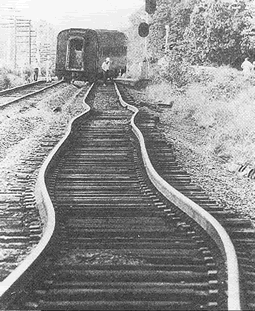

A building that is built to code generally won't incur damage due to thermal expansion or contraction, because they account for the expected response based on considerations for the climate region the design is in, and the differential extremes between inside and outside air temperature. Last time I checked fire is not a normal thermal load in a building. Also, the NIST attributes WTC7's vulnerability to it's design - specifically long spanning beams which increase the degree to which the thermal response takes effect.
This stuff bothers me. Are you suggesting that thermal expansion requires a specific threshold to take place? It looks to me like you read part of the NIST report with absolutely no understanding of the sciences you're critiquing the NIST for misappropriating. Wikipedia has a nice article on thermal properties, I suggest you read it.
And you've yet... in all of your curiosity you've never asked the question... why?

Because they base their conclusions on all available evidence. Do I believe that they are 100% accurate? No. But I believe that it's the best explanation that has been given. Can you come up with a better one that is supported by ALL the available evidence?Now in the spirit of debating in good faith, please answer why you accept their conclusions when they admit they did not use any physical evidence.

Now, getting back to rational speculation, 93 was probably headed for the Capitol Building rather than the White House. I'm sure the White House was ruled out as too small of a target, whereas the Capitol Building is more easily identified.
I think that the general conclusion was that WTC7 was not
a unique style of building. Therefore there are other similar steel-franed buildings out there with long beam spans.
To the extent that there are other buildings, they are only at risk if they develop a huge multi-floor fire and the sprinklers don't work and no firemen show up to fight the fire.
That's effectively what happened to WTC7 on 9/11.
Suppose you are wrong and they only develop the small and widely seperated fires that we actually observed in WTC7 on 9/11 ? Are they at risk of sudden catastropic collapse ?
Suppose you are wrong and they only develop the small and widely seperated fires that we actually observed in WTC7 on 9/11 ? Are they at risk of sudden catastropic collapse ?
Because computer simulations provide a reliable basis for drawing conclusions in the scientific analysis of complex systems where physical evidence is not available.