Sorry! No structure of any kind exists where a part C of A can one-way crush down A. A always arrests C! It is a fact!
It may be a fact to an agenda-driven incompetent, but your foolishness has been exposed by the real engineers.

Sorry! No structure of any kind exists where a part C of A can one-way crush down A. A always arrests C! It is a fact!
It may be a fact to an agenda-driven incompetent, but your foolishness has been exposed by the real engineers.
Link!

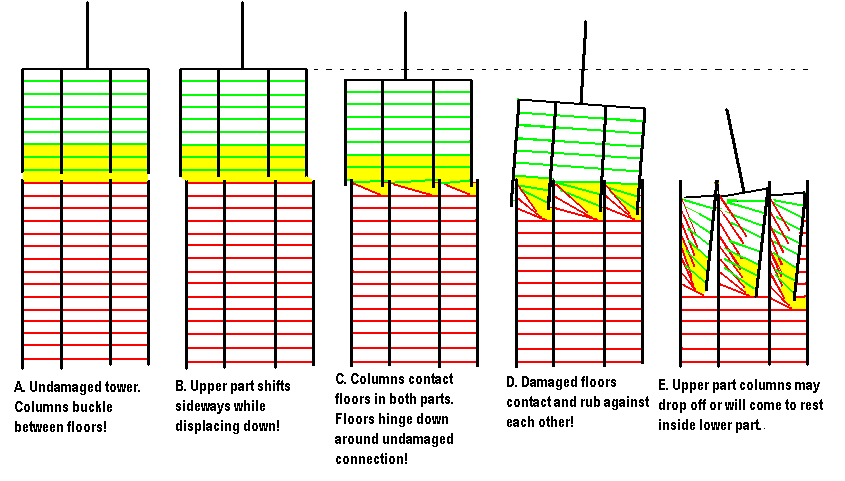
Thanks for comments. The figure is just one simple example what can happen when an upper part C of a structure contacts a similar structure part A below. I show others.

Sorry! No structure of any kind exists where a part C of A can one-way crush down A. A always arrests C! It is a fact!
1. No.
2. They all failed.
3. No.
4. No.
5. Why?
Well, let's apply a little parsimony here:
Either the towers collapsed by some mysterious mechanism that makes no sense and left no evidence, or...
You are wrong.
It's a no-brainer, as far as I'm concerned.
Mysterious mechanism? No sense? Why not old-fashioned controlled demolition? It is always used to get rid of structures as they cannot be one-way crushed down. Keep it simple. Do not invent a new phenomenon as cause that have never been verified by science.
Imagine if you could one-way crush down structure by gravity by a bit of itself. It would be a very unsafe environment. I am not wrong in this respect.

Thanks for comments. The figure is just one simple example what can happen when an upper part C of a structure contacts a similar structure part A below. I show others.
Your ringed details inside the structures evidently show internal vertical elements, e.g. failed, strong core columns, contacting horizontal, weak elements, e.g. floors; it is thus suggested that the strong elements damages/cuts/punches through the weak elements.
If you look carefully, you see how the strong elements of lower part A damages weak elements, the green floors in upper part C! Hopefully you agree that this is a realistic result! That is the main purpose of the figure!
However, Bazant, the world famous expert of the subject, suggests that the bottom horizontal element of part C (floor #97 in WTC 1) is not damaged (sic!) at impact and that this thin element destroys the strong A columns below, then compress the A columns into rubble (part B) that protects part C. Parts B and C then continue to destroy A. All nonsense of course.
NIST suggest that part C applies potential energy, PE, on A at impact and that A lacks strain energy, SE, to absorb this PE, so that global collapse ensues. PE>SE=global collapse according NIST.
NIST unfortunately forgets that A also applies energy/forces on C at impact and that C can absorb even less strain energy than A. This should show up as jolt of C! C being decelerated by A. A provides resistance!
Thus A will immediately start to destroy C at impact. As the PE applied by C is very small - see my paper you quote from - that PE will soon be transformed into local failures (heat) and friction between displaced elements in contact (more heat) of C and A and the local failures should be arrested within ONE second. C should stop up on top of A.
A one way crush down by C of A is not possible under any circumstances.
Mysterious mechanism? No sense? Why not old-fashioned controlled demolition?
Keep it simple. Do not invent a new phenomenon as cause that have never been verified by science.
Imagine if you could one-way crush down structure by gravity by a bit of itself. It would be a very unsafe environment. I am not wrong in this respect.
your diagram stinks
and i dont like it
and it is WTC 1 (tv mast)
it represents the goings on inside your head
nothing in the real world collapses like that
if you get 20 floors of building occupying 10 floors now WITH NO SUPPORT!
thats gonna blow out the sides
the unsupported "walls" or "columns" could never hold that back
as the walls shear more damage will happen below (progressively)
not only that how can the entire left side of the building in your drawing just fall off without damaging the structure below
it cant
only in cartoons (poorly drawn ones at that)
you fail
horrendously
yet again
If you look carefully on the diagram, you see how the strong elements of lower part A damages weak elements, the green floors in upper part C! Hopefully you agree that this is a realistic result! That is the main purpose of the figure!
However, Bazant, the world famous expert of the subject, suggests that the bottom horizontal element of part C (green floor #97 in WTC 1) is not damaged (sic!) at impact and that this thin, weak element destroys the strong A columns below, then compress the A columns into rubble (part B) that protects part C. Parts B and C then continue to destroy A. All nonsense of course.
You see, a composite structure consists of strong and weak elements + plenty of open space in between. When a part C of this structure collides due to gravity with part A of same structure, the strong elements damage the weak elements. Everything in the real world is damaged like that.
Therefore a one-way crush down of A by C and gravity is not possible. Bazant is thus wrong.

not even close to realistic
sorry try again

You said they had none.
I say they have. Retract your false statement from earlier and stop moving goalposts. You are adding qualifiers to change your initial claims instead of admitting it was an incorrect claim. Very childish. They had steel which has evidence of reaching around 800 and 1000 deg C. You know it and so do I.
I guess you are not a thermite man then? Just bog standard CD with high explosives?
No, I am asking you if it was you who said they had seen a documentary previously in which you claimed something was admitted when in fact you made it up. If it was not you I will retract.

The NIST has no evidence whatsoever of any steel reaching 800 to 1000 degress C. They only have a few pieces which reached 600 degrees C and the rest never got above 250 degrees C.
Care to wager Tony? Tread carefully though as you should know this.
Are you the guy who said they saw someone admitting something in a documentary and this documnetary does not actually exist?

It's closer to "realistice".
Are you talking about Leslie Robertson discussing the fact that he didn't think the fuel was considered in the analysis done for aircraft impact on the Twin Towers? If you are there is a clip of him saying it in 911 Mysteries.
As for the steel temperatures you want to say that the NIST has physical evidence of steel reaching 800 to 1000 degrees C and I say they don't if you exclude the couple of pieces that Jonathan Barnett analyzed for the FEMA report in Appendix C. One of those pieces was also from WTC 7. Which would have been the only piece of steel saved from WTC 7.
I am saying that out of the 236 pieces that the NIST got from the Towers only a few pieces had experienced temperatures above 250 degrees C and none above 600 degrees C.
You see, a composite structure consists of strong and weak elements + plenty of open space in between. When a part C of this structure collides due to gravity with part A of same structure, the strong elements damage the weak elements. Everything in the real world is damaged like that.
Therefore a one-way crush down of A by C and gravity is not possible. Bazant is thus wrong.
Heiwa's site said:All videos of the destruction show that the upper part in fact telescopes into or shortens itself for 2-4 seconds, while the steel structure below is still intact!