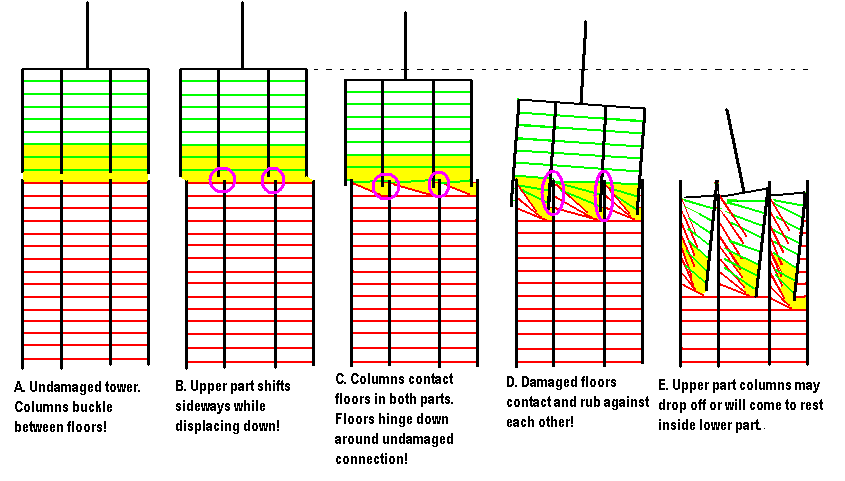
Let's get granular so you can explain something to me. We'll use your "accurate" diagram as a visual aid that I have marked up.
[qimg]http://i238.photobucket.com/albums/ff290/gamolon/WTC1slicea2.gif[/qimg]
I can agree with your representation of the extreme right and left of your diagram that the entire row of those perimeter columns, coming inside/outside as a whole would indeed shear the concrete floors from there respective connections.
What you fail to show correctly OR explain is the points I circle in purple in the diagram above. You are representing one or two perimeter columns that you suggest as sprearing through the concrete floor and cracking it lengthwise into nice long slabs. That's not possible since there where about 60 perimeter columns per side. How can a 208' wall of about 60 perimeter columns slam onto the very edge of a reinforced concrete floor and not bend or shear the floor truss connection down?
How can you show the middle two lines in your diagram as spearing through the concrete floor and there were 60 columns in the wall?
How can you expect a 208' long wall of about 60 perimeter columns (including the weight all the floors above) to come smashing down on the extreme edge of the concrete floor slab below and expect the 30 "L" shaped truss connections welded to the SIDE of the peimeter columns to arrest that downward collapse? I mean hontestly? The "L" shaped truss connection was about 6" deep?
Your red floors would not seperate like you show in the diagram above.
Your diagram is extremely incorrect.
Thanks for comments. The figure is just one simple example what can happen when an upper part C of a structure contacts a similar structure part A below. I show others.
Your ringed details inside the structures evidently show
internal vertical elements, e.g. failed, strong core columns, contacting horizontal, weak elements, e.g. floors; it is thus suggested that the strong elements damages/cuts/punches through the weak elements.
If you look carefully, you see how the strong elements of lower part A damages weak elements, the
green floors in upper part C! Hopefully you agree that this is a realistic result!
That is the main purpose of the figure!
However, Bazant, the world famous expert of the subject, suggests that the bottom horizontal element of part C (floor #97 in WTC 1) is not damaged (sic!) at impact and that this thin element destroys the strong A columns below, then compress the A columns into rubble (part B) that protects part C. Parts B and C then continue to destroy A. All nonsense of course.
NIST suggest that part C applies potential energy, PE, on A at impact and that A lacks strain energy, SE, to absorb this PE, so that global collapse ensues. PE>SE=global collapse according NIST.
NIST unfortunately forgets that A also applies energy/forces on C at impact and that C can absorb even less strain energy than A. This should show up as jolt of C! C being decelerated by A. A provides resistance!
Thus A will immediately start to destroy C at impact. As the PE applied by C is very small - see my paper you quote from - that PE will soon be transformed into local failures (heat) and friction between displaced elements in contact (more heat) of C and A and the local failures should be arrested within ONE second. C should stop up on top of A.
A one way crush down by C of A is not possible under any circumstances.