Why a one-way Crush down is not possible

Status
Not open for further replies.
The only thing that is falling prior impact is part C. When part C impacts part A and applies its energy, forces develop, etc, etc. It seems we all agree to that.
What happens then? Does C break away parts from A that become debris? Or does A break away parts from C that become debris.

Yes, it may happen, even if most damaged elements will not break away but hang on to parts C and A.

So, do you suggest that the few elements that become free - free debris - start to drop and destroy A??

Can you give any example of that?

What elements of C and A will be detached and then drop and contact some other elements of A?

Suggest you make a model and demonstrate your suggestion that debris from a structure will destroy the same structure. Or you have some real examples?

Looking at videos of WTC 1 it seems big sections of upper part C perimeter wall columns - 30 m wide, 8 floors high = big debris - are ejected outside the structure below and drop to ground.


The thirteen falling floors crush the floor below. Then fourteen falling floors crush the floor below. Then fifteen falling floors crush the floor below. And so on until there is no building. It all happens very quickly, as millions of us saw on 9/11/01.

Nobody with a degree in engineering can be as obtuse as you seem to be.
 
Heiwa if all or most of the core columns had failed in part A would the collapse have proceeded just as we saw on television ?

Core columns! Both upper structural assembly part C and lower structural assembly part A have core columns as vertical support elements. They are the strongest elements of the structure. The floors hangs on the core columns. Without core columns the core ... or the Towers ... would not exist.

Now, let's assume that the core columns between parts C and A fail. Result? The part C core structure drops down and impacts part A. What elements of A do the C core column elements contact then?

I would assume it is the top A floor or they drop into elevator shafts and contact nothing. If they contact the top A floor, I assume they punch holes in it.

Another question to be asked is; what C elements do the A core columns contact?

Probably the C bottom floor unless they end up in an elevator shaft and contacts nothing.

So, when C drops on A, strong elements (core columns) contact weak elements (floors) or nothing (elevator shafts).

Why anything would collapse from top down - C one-way crushing down A - is beyond my understanding. It cannot happen!

I only see on videos (of WTC 1) what happens to the outside walls - the perimeter columns! Big sections - 30 m wide, 8 floors high of the upper part C (above floor 96) - are ejected outside part A at the beginning ... and drops to ground. Thus, big parts of C - the outside walls, very strong - do not contact part A at all during the alleged collapse.

According Bazant & Co the upper part C remains intact all the time during 'collapse'. Part C is crushed-up 10-15 seconds later when it contacts a heap of rubble - part B. This and many other strange things associated with the BLGB model are described in my paper to ASCE/JEM that, I assume, will soon be published.
 
A. Layman's terms. Energy (Nm) is just Force (N) displacing a Distance (m).

I probably would have defined it in more mathematical terms to be precise (like talking about work and force and potential/kinetic energy and their respective definitions) but I'll let it stand as is cause I'm really not trying to nitpick here....

C. Yes, the forces (!) are transmitted through both structures C and A. If anything breaks you have to consider it; the force will be transmitted somewhere else.

I think this is where you go wrong...I don't think you are correctly considering "if anything breaks".....

If something "breaks" I would assume the force would not only break it but also "push" (i.e. accelerate) the piece it "broke". We can get nitpicky here about how much of the force goes into "breaking" the piece, accelerating it, heating it up, producing sound waves, etc...

But I think (hope) you see my point....you don't seem to be taking the "breaking" aspect into account here...

D. Correct. Same applies to C and the forces A applies on C.

Sure...but keep in mind that one section (C) is falling due to gravity while the other section (A) is not. This is very significant.

E. Hm! Mackey assumes part C is only one material point M and forgets that C is an assembly of material points/elements/connections.

Could you show me where Mackey assumes this? So far I haven't noticed any conceptual or mathematical errors in anything I have seen from Mackey...

F. No! How can you suggest that? A is similar to C - just bigger and stronger! Remember A carried C before impact. C could never carry A..

I am hesitant to use the word "stronger" since it seems too "loose" of a term...by "loose" I mean inexact.

I agree that the structure "C" could not "carry" the structure "A", but I fail to see how that implies that C could not destroy A while it is falling and impacting A.....

G. A will suffer local failures like C. Plenty of energy applied is absorbed that way.

I agree that C will suffer some local failures as well.....but C is no longer connected to the ground and is falling through the air...

I would think some of the energy would also be absorbed by breaking parts of A and pushing them down....

H. ??? Unclear. Very unclear. Do you suggest that C knocks off a piece of A and that this piece of A starts to destroy the remainder of A. Please clarify.

I'm suggesting that the pieces that get knocked off start accelerating due to gravity (and possibly due to the 'push' from C when they were broken off) and add to the destructive force of C....

So it's a progressive collapse....progressive destruction....

I. Free? C is in contact with A and A is in contact with C. It is similar to intercourse ... or wrestling.

I believe I clarified what I meant when I wrote "free"...

1. Not structurally connected
2. In free fall due to gravity

J. Whatever. A and C apply forces on one another.

Sure they do.....but to repeat what I said (and this is relevant to my previous comment)....
"Just because A exerts some force on C as C destroys parts of A doesn't mean that we can say that C is now structurally connected to A."


K. Of course. C could not drop on A or ground without gravity. Ground!! What would happen if C missed A and dropped on ground? Wouldn't C get damaged? Or would C one-way crush down ground? Actually, when C impacts A, C impacts ground as A is connected to ground.

I never implied that C doesn't get damaged during the collapse....

L. Just check JREF! I have demonstrated many cases/structures; pizza boxes, lemons, rubber balls, ships, sponges, &c.

WHAT THE HELL?

WHAT THE F*&^ DID YOU JUST SAY?

PIZZA BOXES? LEMONS? RUBBER BALLS? SHIPS? SPONGES?

You "demonstrated" that pizza boxes, lemons, rubber balls, or sponges can't fall due to a progressive collapse after being hit with an airliner and catching on fire?

Really? Cmon man......the structures you use for an engineering anaylsis and comparison are cardboard and fruit? Are you freaking serious?

It's good to know that if I'm ever in a building made out of lemons or pizza boxes that I am safe from a progressive collapse...

M. None! WTC 1, 2 and 7 were all destroyed by controlled demolitions.

None is right...

You used fruit and cardboard.....

N. Of course. My paper debunking Bazant is, I am told (by ASCE + editor Ross Corotis), getting published in ASCE Journal of Engineering Mechanics soon.

O. See N.

I will be interested to see what responses it receives....

Thanks for your post. It seems you have missed a lot, e.g. that a part C of a structure A cannot one-way crush down A (C = 1/10 A) under any circumstances. So the 911 WTC destructions could not have been produced by an upper part (C) dropping on a lower part (A) connected to ground.

Well I have to admit...I was unconvinced of your conclusions until you mentioned the lemons....

One can't refute a structural analysis using fruit....

 
Last edited:
Why anything would collapse from top down - C one-way crushing down A - is beyond my understanding. It cannot happen!

Let's say you build an intricate sandcastle about six feet tall. You get the sand just wet enough that you are able to build it up, in columns, layer by layer. The result is sturdy enough that it can withstand a pretty stiff wind, but of course would collapse if someone pushed it over.

This is a fair scaled-down analogue to a skyscraper. Of course, you can't push a skyscraper over, but that's just because a person isn't comparable in size to a skyscraper as he is to our hypothetical sandcastle.

Now say you take the top foot and a half of this structure and lift it a few inches. You drop it.

According to your beliefs, it is IMPOSSIBLE for this upper section to cause the lower section to collapse by gravity alone.

Remember, it's a structure. You have said that your theory applies to any structure and the building materials are irrelevant. So, do you still say it could not collapse? Or are you going to invoke special pleading?
 
Core columns! Both upper structural assembly part C and lower structural assembly part A have core columns as vertical support elements. They are the strongest elements of the structure. The floors hangs on the core columns. Without core columns the core ... or the Towers ... would not exist.
Agreed that the core columns are the strongest elements in the tower when subject to a unform vertical load. The splice consists of a simple stack joint: so the columns have nominal lateral capacity and nominal buckling capacity if the buckling length contains the splice.

Now, let's assume that the core columns between parts C and A fail. Result? The part C core structure drops down and impacts part A. What elements of A do the C core column elements contact then?

I would assume it is the top A floor or they drop into elevator shafts and contact nothing. If they contact the top A floor, I assume they punch holes in it.
I agree, indeed you would expect that they would remove all the floor steel that connects to the column, from the column.
Another question to be asked is; what C elements do the A core columns contact?

Probably the C bottom floor unless they end up in an elevator shaft and contacts nothing.
I agree, indeed you would expect that they would remove all the floor steel that connects to the column, from the column.

So, when C drops on A, strong elements (core columns) contact weak elements (floors) or nothing (elevator shafts).
Ok so we have agreed that the columns are likely to have the floors stripped away from them by the falling mass. Now the lower column is unrestrained and when the floor mass from the level above eventually causes a small lateral thrust at the column splice, then that joint fails.
if you look at the debris pile you see lots of straight elements, no blast debris, little bending, just lots of straight elements.
We have previously explained to you why the perimeter did not contribute. So do you start to get it?

Why anything would collapse from top down - C one-way crushing down A - is beyond my understanding. It cannot happen!
I am not sure how to explain it in ship terms, but I liked the bullet analagoy. So take a small mass, a shell (without explosives) and shoot it at a building or a ship; then the relative masses are not really important. What is important is if the small mass destroys anything that the bigg mass needs to survive...such as columns splices or in the case of a ship, it's water-tightness.
I only see on videos (of WTC 1) what happens to the outside walls - the perimeter columns! Big sections - 30 m wide, 8 floors high of the upper part C (above floor 96) - are ejected outside part A at the beginning ... and drops to ground. Thus, big parts of C - the outside walls, very strong - do not contact part A at all during the alleged collapse.
Correct thats what happens when C hits A, if it doesnt quite hit straight on. The collapse blows out the perimeter, so it doesnt contribute to the resistance. If you look at the collapse mechanism you will see lots of indicaation of internal air pressure blowing out the perimeter walls, so that they do not contribute to resisting the vertical impact energy. Its the unzipping, banana skin effect.
According Bazant & Co the upper part C remains intact all the time during 'collapse'. Part C is crushed-up 10-15 seconds later when it contacts a heap of rubble - part B. This and many other strange things associated with the BLGB model are described in my paper to ASCE/JEM that, I assume, will soon be published.
You keep forgetting its not a solid body and that lots of energy was absorbed by the collapse. The time of collapse for WTC2 is measured at about 14.5 seconds, which means that it collapsed at 40%g, which in turn means that 60% of the potential energy was absorbed in the impact.

And Bazant got one thing right, that the rest of the world agrees with... (apart from a few ship scientists, road designers, fresh graduates and 2 story building experts); there is no indication of CD.

Come on Heiwa, be brave and admit that perhaps you are wrong. I would guess that your paper assumes that all the columns buckled and contributed to resistance and we know that they didn't. If all the columns had no splices and had contributed to resisting the collapse then I would agree that the collapse would be impossible. But then that would be a similar argument to "if I had a brother then I am sure he would play the piano."
t.
 
According to your beliefs, it is IMPOSSIBLE for this upper section to cause the lower section to collapse by gravity alone.

Remember, it's a structure. You have said that your theory applies to any structure and the building materials are irrelevant. So, do you still say it could not collapse? Or are you going to invoke special pleading?

Yes, it is impossible for an upper part C of any structure to one-way crush down the lower part A. See post #1. And by the way; as soon as part C impacts A after free fall, C cannot free fall any longer. A arrests C one way or another, e.g. by bouncing it off or damaging it. Happens everytime ... except 911.
 
Last edited:
Come on Heiwa, be brave and admit that perhaps you are wrong. I would guess that your paper assumes that all the columns buckled and contributed to resistance and we know that they didn't. If all the columns had no splices and had contributed to resisting the collapse then I would agree that the collapse would be impossible. But then that would be a similar argument to "if I had a brother then I am sure he would play the piano."
t.

Prove me wrong for any structure, e.g. with splices. See The Heiwa Challenge thread for details.
 
Yes, it is impossible for an upper part C of any structure to one-way crush down the lower part A. See post #1. And by the way; as soon as part C impacts A after free fall, C cannot free fall any longer. A arrests C one way or another, e.g. by bouncing it off or damaging it. Happens everytime ... except 911.


When the real engineers at the ASCE journal expose your idiocy as the real engineers on this forum have done so often, do you intend to scream that they're all shills and religious fundamentalists? It is important that you go on record. I have asked you to make a wager with me on the reception your nonsensical paper gets. Typically, you ran away. Let's establish that nothing anybody says can pentrate your colossal ignorance and incompetence.
 
Yes, it is impossible for an upper part C of any structure to one-way crush down the lower part A. See post #1. And by the way; as soon as part C impacts A after free fall, C cannot free fall any longer. A arrests C one way or another, e.g. by bouncing it off or damaging it. Happens everytime ... except 911.


You always lose because you're incompetent and too mulishly arrogant to admit your blunders.

Thirteen floors crush ONE floor. Then fourteen floors crush ONE floor. Then fifteen floors crush ONE floor...

Only you and your mindless parrot fail to grasp this FACT.
 
Ok so we have agreed that the columns are likely to have the floors stripped away from them by the falling mass.

Have we? What falling mass are you talking about? Upper part C? It consists of many small masses, most of which are remote from interface C/A. And all these C masses are connected to one another. You have to specify what mass you are talking about.

No, it seems we agreed that the A columns would destroy the C bottom floor (it has a mass) and maybe some C floors above (more masses) at impact.
Note that the A columns are not moving, while the C floors are. So if the C floors cannot destroy the A columns, what would damage, buckle?, the A columns?

You know, the A columns are like swords fixed on ground and then some stupid fool, you ?, throw himself on the sword and get slashed. Not recommended though.
 
Heiwa,

Wouldn't the columns be expected to fail at their weakest point?? Please tell me, wouldn't that point be the splice plate where the two pieces are joined together??

Correct me....if I am wrong......
 
Have we? What falling mass are you talking about? Upper part C? It consists of many small masses, most of which are remote from interface C/A. And all these C masses are connected to one another. You have to specify what mass you are talking about.

No, it seems we agreed that the A columns would destroy the C bottom floor (it has a mass) and maybe some C floors above (more masses) at impact.
Note that the A columns are not moving, while the C floors are. So if the C floors cannot destroy the A columns, what would damage, buckle?, the A columns?

You know, the A columns are like swords fixed on ground and then some stupid fool, you ?, throw himself on the sword and get slashed. Not recommended though.

Hey Heiwa, haveyou presented your claims to Leslie Robertson and maybe get his opinion on what you are saying?

I have written him in the past and have gotten responses from him. He seems to be a good guy.

Why don't you send his firm an email? The conatct information is on the LERA website. There is a specific address to Sawteen See who is handling all questions about the towers and 9/11.

I recently wrote him and had a couple of email exchanges concerning the tower.
 
Someone please explain something to me.

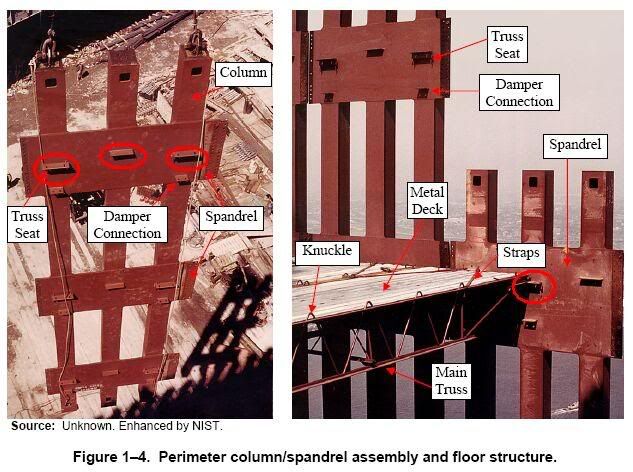
Here is a photo of the some of connections to the perimeter columns for the floor trusses.
1-4_perimeter-column-1.jpg


If the mass of the upper floors collapsed, wouldn't it be these truss connections that would get the brunt of the weight? Menaing that yes the columns would hold straight up, but the individual connections would fail?

If I drove a perimeter column into the ground and welded an "L" shaped connection to it and then hit the top face of the "L" with a sledgehammer, where would the highest stress point be? Wouldn't the top of the "L" shaped connection either bend downward or shear off?
 
And by the way; as soon as part C impacts A after free fall, C cannot free fall any longer. A arrests C one way or another, e.g. by bouncing it off or damaging it.

It seems like you're using a false dichotomy here. Either it falls at free-fall or it's arrested completely. This isn't your position, is it?

If I were solving this as a calculus problem, I would not be able to treat the mass of the two parts of the building as constants. To do so would be to turn it into a simple algebra problem, and this doesn't help solve such real-world conumdrums.

Instead, I would have to take into account the fact that the mass of the stationary part of the building as well as the mass of the mobile, fragmenting part, is constantly fluctuating. As the mobile "part" (actually a collection of mobile parts) gets bigger, the stationary part gets smaller, until the system reaches equilibrium and the collapse stops.

Is this the way you approached the problem? Because it doesn't sound like it is.

Happens everytime ... except 911.

Can you give us some examples?
 
The building graphic conatined here is completely bogus.

http://heiwaco.tripod.com/mac5.htm

The columns were not BELOW the floors supporting them. There were connections ATTACHED to the inside face of the perimeter columns and core columns.

Heiwa, wouldn't this make your point that columns should have arrested the collapse moot becasue the forces would have acted upon the connections on the columns either bending them downward or shearing them off?
 
Aggle,

Yes, you are absolutely correct, that piece of steel would have done a few things.

1-The bolts that went through it to attach the truss to it would have snapped
2-the welds that (I am guessing there were welds) were holding the truss on would have failed
3-The L bracket that is most likely welded, would have completely sheared off, or at the very least, bent enough to provide no support whatsoever to the truss.
 
Heiwa,

This paragraph from your site here, http://heiwaco.tripod.com/mac5.htm, is garbage.

Heiwa's website said:
Section C consists of 14 horizontal elements/floors, each with mass m as section A, stacked on top of each other with vertical support elements in between of height h. Total mass of C is 14 m. It is 52 meters tall.

The support elements were not "in between" the floors. The perimter columns were around the outside of the floors while the core columns were on the inside edge of the floors.

That's like me taking two slices of bread on top of one another, laying a slice of ham right up against the two slices, then claiming that the ham is in between the two slices of bread.
 
Aggle,

Yes, you are absolutely correct, that piece of steel would have done a few things.

1-The bolts that went through it to attach the truss to it would have snapped
2-the welds that (I am guessing there were welds) were holding the truss on would have failed
3-The L bracket that is most likely welded, would have completely sheared off, or at the very least, bent enough to provide no support whatsoever to the truss.

Which is why, I'm assuming, we see perimeter columns fall away from the collapse as the mass continued downward. The mass sheared the floors from their connections to the perimeter columns on it's way down and pushed the columns outward.

Is this a correct assessment?
 
A. It seems like you're using a false dichotomy here. Either it falls at free-fall or it's arrested completely. This isn't your position, is it?

B. If I were solving this as a calculus problem, I would not be able to treat the mass of the two parts of the building as constants. To do so would be to turn it into a simple algebra problem, and this doesn't help solve such real-world conumdrums.

C. Instead, I would have to take into account the fact that the mass of the stationary part of the building as well as the mass of the mobile, fragmenting part, is constantly fluctuating. As the mobile "part" (actually a collection of mobile parts) gets bigger, the stationary part gets smaller, until the system reaches equilibrium and the collapse stops.

D. Is this the way you approached the problem? Because it doesn't sound like it is.


E. Can you give us some examples?

A. No! Part C is assumed to drop/free fall only prior impact with part A. Evidently C cannot continue to free fall afterwards. What happens afterwards - local deformations, local failures is what we discuss here.

B. What happens after impact is a dynamic problem! The number of elements with masses and connections are always constant but you have to keep track where they are. Software exists to study this.

C. The only things that fluctuate are the internal, dynamic forces in parts C and A after impact. Mass cannot fluctuate! So just study these forces and how they displace the elements or break elements/connections locally. After a while the forces become static! Arrest has occurred.

D. See C.

E. There are many examples of similar structures in collision one being dropped on another, e.g. my famous Pizza box experiment. No one-way crush down there. Top box C just bounces on boxes A. You see, part C cannot one-way crush down A for any structure. See The Heiwa Challenge thread where every JREF participant has failed completely to prove me wrong.
 
Status
Not open for further replies.

Back
Top Bottom