• Security incident: ISF was recently accessed by intruders. Please change your password, and change it anywhere else you used it. Read more

Australia

Unusual to find a Brown there...

Here's a picture I think sums up Australia in the Great War:

CobbersFromelles6.JPG
 
My daughter was gardening today and disturbed a rough skin water tiger, she held it down with a short garden fork, called me so dispatched it with my pocket knife. They are a very toxic snake but safe when you cut the head off. Lucky she is quick.They are protected but not at our place.
 
To cold in Melbourne for pythons, Victoria has black snakes (not real dangerous) brown,tiger, (dangerous) and a few others really hard to find. eg copper head, bandi bandi, etc Does the list know black snakes are either getting legs or once had them, throw a black snake on the coals and the heat will pop out a couple of protrusions where front legs would be. They love milk,when I was a kid I have seen Dad lure a big black out from under the house with a saucer of milk while he sat in a deck chair with the shot gun. Took about a hour then "Bang" I get the unpaid job of getting snakes out of our neighbours houses every year.
 
To cold in Melbourne for pythons, Victoria has black snakes (not real dangerous) brown,tiger, (dangerous) and a few others really hard to find. eg copper head, bandi bandi, etc Does the list know black snakes are either getting legs or once had them, throw a black snake on the coals and the heat will pop out a couple of protrusions where front legs would be. They love milk,when I was a kid I have seen Dad lure a big black out from under the house with a saucer of milk while he sat in a deck chair with the shot gun. Took about a hour then "Bang" I get the unpaid job of getting snakes out of our neighbours houses every year.

How come we keep getting them near our place then?

There's only one species, yeah, but we still get them.

http://en.wikipedia.org/wiki/Morelia_spilota

All snakes used to have legs (they evolved from lizards), in fact on certain species of pythons you can still see a little spur where the rear legs used to be. Dunno about things popping out though, it must be the heat causing the vestigal legs bones to explode or something like that.
 
Didn't know Victoria had pythons, never seen any down there. Lots in Queensland,had a big one living in my shed which I would feed a fresh parrot every so often to keep her there. Great rat trap. Staple the parrot on a stick hold it near snake named "Squeeze" and the strike would be so fast that the stick would go flying across the shed and squeeze would have the parrot with out me seeing her move. Tried to feed a cold parrot one day squeeze would not touch it so warmed it in the micro-wave(wife was out) but she just nudged it, think the singed feathers put her off. They will bite if annoyed and they have a dirty mouth, old timers say the bite will fester every year at about the same time. Don't know if thats all true. Squeeze was a good 12 ft and had bad toilet habits bigger than human.
 
Didn't know Victoria had pythons, never seen any down there. Lots in Queensland,had a big one living in my shed which I would feed a fresh parrot every so often to keep her there. Great rat trap. Staple the parrot on a stick hold it near snake named "Squeeze" and the strike would be so fast that the stick would go flying across the shed and squeeze would have the parrot with out me seeing her move. Tried to feed a cold parrot one day squeeze would not touch it so warmed it in the micro-wave(wife was out) but she just nudged it, think the singed feathers put her off. They will bite if annoyed and they have a dirty mouth, old timers say the bite will fester every year at about the same time. Don't know if thats all true. Squeeze was a good 12 ft and had bad toilet habits bigger than human.

Ours don't get that big!

A big carpet python here would be 9 foot, and they're damn uncommon at even that length. 6 foot is more the usual size.
 
Ours don't get that big!

A big carpet python here would be 9 foot, and they're damn uncommon at even that length. 6 foot is more the usual size.

Back in the day Sydney used to have a lot of carpet pythons. Used to be the only defense against the larger rats and such that used to live around produce markets etc

I can not recall the last time I heard of one in the city - would have to be all the way back to the 70's
 
I mention this because I often here negative comments about the French in a number of areas, but one thing you can really say about them. They dont forget when you have helped them out
odd, in my experience the reverse is true, think about this, we (English) weren't officially invited to the french d day celebrations because the french wanted to keep them a strictly franco-american celebration

:eek:
 
odd, in my experience the reverse is true, think about this, we (English) weren't officially invited to the french d day celebrations because the french wanted to keep them a strictly franco-american celebration

:eek:

I don't confuse the mercurial shifting of attitude by a politican, with what a group of people feel in their hearts
 
Didn't know Victoria had pythons, never seen any down there. Lots in Queensland,had a big one living in my shed which I would feed a fresh parrot every so often to keep her there. Great rat trap. Staple the parrot on a stick hold it near snake named "Squeeze" and the strike would be so fast that the stick would go flying across the shed and squeeze would have the parrot with out me seeing her move. Tried to feed a cold parrot one day squeeze would not touch it so warmed it in the micro-wave(wife was out) but she just nudged it, think the singed feathers put her off. They will bite if annoyed and they have a dirty mouth, old timers say the bite will fester every year at about the same time. Don't know if thats all true. Squeeze was a good 12 ft and had bad toilet habits bigger than human.

I've been surprised by the near-total lack of snakes here. I live about 200 metres from a really serious railway line and I assumed that there would be snakes living on the mice and rats that live on the spillage from passing grain trains. That was certainly the case when I lived near the Western line in Queensland, and, as I recall, similar to the situation around the Sydney suburban network where I used to play as a kid. In Sydney, I imagine the chain was based on discarded food scraps and the like, rather than grain, but in any case, there were lots and lots of rats and snakes. Carpet pythons and brown snakes mostly. Fun to catch and release, but we had to keep them secret from our hysterical suburban mothers, who would require any and all snakes to be killed on sight. Ignorant savages.

Anyway, my theory about this place being snake heaven was all wrong, since they seem to put lids on the trains or something, and no grain gets spilled. In over 20 years, I've never seen a single rat and only one snake on the railway reserve. It was an Olive Python, which I'd never expect to see here normally, so I think it was probably an escaped pet. Apart from that there are occasional smallish brown snakes about in Summer, but very few compared to the numbers I used to see in Queensland.

As a completely amateur observer, it seems to me in a cool to cold climate like we have here, the poor Joe Blakes would be suffering at the paws of the damned foxes, which seem to be everywhere lately. Rule 22 has been applied numerous times, but it's a losing battle I fear, without some help from the Government.

Thanks for the story about microwaving the parrot for the the snake's dinner. I can always count on you for a gem! I would have loved to have seen it.

I'm not sure about infections from python bites, but it wouldn't surprise me when you consider how bad a bite from a Goanna can be. Those buggers will have your leg off if an infected bite isn't treated.

I got bitten by a few little pythons when I was a kid, but they hardly, if at all, broke the skin, and I never had any infection problems. Their teeth seem to hook backwards and they cant really get a good stab at you like a venemous snake does, but still, it hurts. I imagine a 12-footer would give you a bite to remember, with or without the infection.

Cheers Mate,

Dave
 
Great to have you back Dave as you are the whizz on detail. Cold here tonight in QLD and all the "Joe Blakes" are sleeping. A few dingo's around hope to apply rule 308. Four rabbit traps in a circle with a half buried staked down dead something or chook will bring a fox, but stand on a sheet of plastic while setting traps and water lightly over set traps(watering can) to rid scent. Back in the good old days we had a fox problem taking lambs so traps and poison. One way to make sure of getting a fox(because they will chew paws off to excape) is to rap stricknen soaked rag around the jaws of the trap and they poison themselves trying to chew free. Sounds a bit rough but it's them or little lambs. Bit late checking traps one morning only to find a fox that had been caught by all four feet and chewing his forth foot off and excape on the stumps, what a will to live. Two foxes will work together one distracts the ewe while the other rushes in to kill the young lamb. The old pink powder sorts them out. As a kid spent a lot of Sundays in the bush with a fox whistle and 22. Gov bounty was 7 shillings and 6 pence for a fox scalp and so was the cost of a packet of bullets. Cheers
 
Great to have you back Dave as you are the whizz on detail. Cold here tonight in QLD and all the "Joe Blakes" are sleeping.


There's been cold snaps everywhere lately, it seems. Alice Springs had its coldest May day ever this year, and Melbourne has been icy, off and on. I wish all these experts working on the global warming problem could figure out a way to make it just happen in Winter.

Since I posted here last time about the local lack of snakes I've been thinking about it a bit more, and it really does seem curious. I'm going to ask around a bit and see if anyone else has seen any.


A few dingos; around hope to apply rule 308.


It seems you can't be too careful. Here's a report from the Brisbane Courier Mail, published just yesterday. It has a picture that should silence most of the tree-huggers who say this sort of thing doesn't happen.

Attacks raise fears of dingoes mauling children

A Vicious attack by a pair of young dingoes on a newborn calf has raised fears that children living nearby could become the animals' next targets.

The attack happened only 200m from new homes in the suburban hamlet of Kawana Forest, near Caloundra, an area with young families.


That's not going to end well.


Four rabbit traps in a circle with a half buried staked down dead something or chook will bring a fox, but stand on a sheet of plastic while setting traps and water lightly over set traps(watering can) to rid scent. Back in the good old days we had a fox problem taking lambs so traps and poison. One way to make sure of getting a fox(because they will chew paws off to excape) is to rap stricknen soaked rag around the jaws of the trap and they poison themselves trying to chew free. Sounds a bit rough but it's them or little lambs. Bit late checking traps one morning only to find a fox that had been caught by all four feet and chewing his forth foot off and excape on the stumps, what a will to live.


Yeah, I've seen what you're talking about. Years ago we used to trap lots of bunnies and foxes along the fence line of the Army base at Bandiana. We'd set the traps before dawn but we couldn't clear them until after work, and quite often we'd come across bits of fox that didn't take part in the main escape. As you say, they have an enormous will to carry on at all costs, and I find it hard not to respect.

As for the current situation, I can't use traps at all here. There's pets and kids all over the place, and while I'd be prepared to accept a bit of collateral damage, you know how people are about their pets sometimes, so I have to play it safe.


Two foxes will work together one distracts the ewe while the other rushes in to kill the young lamb.


This is the same sort of behaviour that you see with the dog/dingo hybrids that are causing problems for farmers. It seems to be getting worse, for my money.


The old pink powder sorts them out. As a kid spent a lot of Sundays in the bush with a fox whistle and 22. Gov bounty was 7 shillings and 6 pence for a fox scalp and so was the cost of a packet of bullets. Cheers


:) We operated on a similar economy in the early 1970s. Foxes paid for the ammo we used and all the bunnies were lovely profit at 50 cents a pair. Of course, we were only really doing it as a public service, but the pocket money was an acceptable bonus.


Cheers Mate,

Dave


:bunpan
 
Well Dave seems we have bored the hell out of the rest of the thread with the rabbit, dingo and fox stories. So here is a true account of how wild and rough the mountain areas were just a few generations back. Harrietville about 1913 a old fat Chinaman died out on the high plains,word came in and two locals were sent on horses with pack horse to bring the body back. Some days later they came down the mountain into town with the body and my father was there as a kid. The body was wraped up in a blanket and the local undertaker from Bright was there to recieve the body. The undertaker said "I thought that this was a big man?" as the blanket wraped body was quite slim and light. My father heard one of the riders say "Yer he was bloated and too heavy so we gutted him". End of story.
 
Well Dave seems we have bored the hell out of the rest of the thread with the rabbit, dingo and fox stories.
On the contrary, Old Bob, I've been reading along. Just don't have any similar experiences to share (or with the war stories either), so I haven't said anything. I am curious what Akhenaten finds out about snakes.
 
Well Dave seems we have bored the hell out of the rest of the thread with the rabbit, dingo and fox stories. So here is a true account of how wild and rough the mountain areas were just a few generations back. Harrietville about 1913 a old fat Chinaman died out on the high plains,word came in and two locals were sent on horses with pack horse to bring the body back. Some days later they came down the mountain into town with the body and my father was there as a kid. The body was wraped up in a blanket and the local undertaker from Bright was there to recieve the body. The undertaker said "I thought that this was a big man?" as the blanket wraped body was quite slim and light. My father heard one of the riders say "Yer he was bloated and too heavy so we gutted him". End of story.


Wait 'til we start telling Bunyip and Yowie stories mate. They'll be here in droves, like flies at a barbie.

Thanks for the story. A beaut, as usual. Here's one in return, that my Dad told me about when I was a kid. I didn't believe him at first.

Australian Broadcasting Commission - Dimensions in Time (Episode 12)

(from transcript) said:
It’s 1935, Anzac Day. A shark on display at Coogee Aquarium disgorges a human arm which sets off a series of events too improbable for crime fiction. A medical examination of the arm reveals it was cut from the missing body with a knife, and the focus of the investigation turns to murder. This incredible story takes place among the backdrop of Sydney’s criminal underworld and proves that truth really is stranger than fiction


Mandy Pearson (journalist) said:
The discovery of the arm caused a media sensation.

A vital clue to its identity was a tattoo of two boxers shaping up to fight. After reading one report in a Sydney newspaper, Edwin Smith contacted police claiming the arm belonged to his brother who had been missing for several weeks. Because of the well-preserved state of the arm police managed to obtain some fingerprints. These provided a match confirming the arm had in fact belonged to Jim Smith, former boxer and small-time criminal. But there was another gruesome aspect to the discovery of the arm. Medical examinations revealed it had not been bitten off by the shark but had been removed from the body by a knife, and not in a surgical procedure. Now it was a murder investigation.


Take that, CBS! We had CSI: Sydney in 1935! Another first for the Great Southern Land.


Cheers, fellow investigators,

Dave


ETA: Dammit. I forgot the good part. How they got fingerprints off the spare arm.

They skinned it, and one of the coppers inserted his hand into the skin, like a glove, and made the prints. Cool, eh?
 
Last edited:
On the contrary, Old Bob, I've been reading along. Just don't have any similar experiences to share (or with the war stories either), so I haven't said anything. I am curious what Akhenaten finds out about snakes.


That's very nice of you, and quite heartening. Thank you. I'll bet you DO have some stories though. Don't forget that not EVERYTHING in this thread needs to be verified, so there's a bit of "artistic" licence granted ;)

Anyway, it's snake time! I'll start with two of our most popular garden varieties, since others have mentioned them already.


Eastern Brown Snake

SnakeBrown.jpg

© Snake Catchers Brisbane


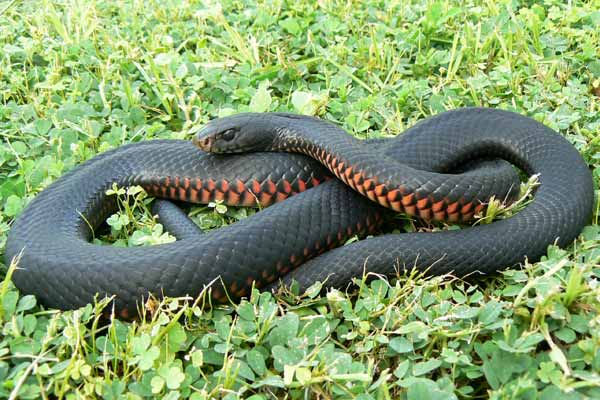
Red-bellied Black Snake

SnakeRBBlack.jpg

© Wildlife Qld


Distribution Map

SnakeMap.jpg

© Imhotep's Maps for Chaps - all your cartographic needs in one convenient location. Pharaoh shops here!


As you can see from the maps above, the range of the Red-bellied Black snake lies totally within the range of the Eastern Brown Snake. You might think that would cause some problems, given that both are known to eat other snakes.

The fact is though, that they don't usually bump into each other, and from what I've observed it's because they have slightly different preferences for habitat.

The area depicted on the right-hand map contains most of what passes in Australia for mountains, including what we call the Great Dividing Range. In most areas, however, it's not so much a mountain range as a dissected plateau. As such, it contains at least two distinct habitats; the plateau itself and the valleys and gorges of various watercourses.

Up on top of the plateau, it's hot and dry in Summer, cool and dry in Winter. Open sclerophyl forest mainly. Down in the valleys, it's generally moist for most of the year, and the temperature range is much less severe. A lot of temperate rainforest

As a side note, they've re-created this effect on a small scale in the Botanical Gardens in Canberra. Arthwollipot is probably a more recent visitor than I, and may have pics to share. (hint :))

Anyway, back to the snakes.

In Summer, snakes can be found just about anywhere, but I've noticed that if you're following a creekline and you're right down near the water, you're far more likely to encounter a Black than a Brown, while up on top of the ridges and in the more open areas of the plateau, the situation is reversed. In both areas, the prey available to opportunists like snakes is fairly similar, with the notable exception of frogs, which are (perhaps obviously) more common near the water.

In Winter, Brown Snakes become fairly inactive, but you can still find Black Snakes doing their thing down in the moist, warmish leaf litter.

It seems to me that the slightly warmer temperatures and available food are things that give the Black Snake some advantages in Winter, as well as keeping them within their niche. I can't say what it is that keeps the Browns where they are, but whatever the mechanism, it seems to have been in place long enough that even the colours the two species have evolved reflect their preferred environments - brown for the open, sandy uplands and black for the dark, shadowed valleys.

Having made these observations, I have to point out that urban growth is stuffing things up as usual. I made the point that snakes are opportunists, and like others of their ilk, such as foxes, dingoes and seagulls, they have discovered that people will provide all kinds of things for them to eat. So they've moved in with us.

Here's an interesting titbit from the CSL Antivenom Handbook


Brown snakes are common throughout mainland Australia, in essentially all habitats, including urban areas. They are not present in Tasmania or the islands off the southern coast of Australia, such as Kangaroo Island (SA). They are relatively common in some urban and metropolitan areas. Hundreds of brown snakes are removed from houses and other properties each year in some capital cities and >10% of these snakes are found inside the house!


Where I lived as a kid, south of Sydney, NSW, this item would more likely have referred to Red-bellied Black Snakes.

What I mean to say, when saying that urbanisation has stuffed things up, is not that it's harmed the snakes at all, but it's mixed up their distribution because they both seem equally happy to move in wherever we go. Yay! (?) I think something similar is going on with the Currawongs, but that's for another post.


Sciency Stuff


Eastern Brown Snake


Kingdom: Animalia

Phylum: Chordata

Class: Reptilia

Order: Squamata

Suborder: Serpentes

Family: Elapidae

Genus: Pseudonaja

Species: P. textilis


Fun Fact

CSL Antivenom Handbook


The venom is multicomponent and includes powerful presynaptic neurotoxins, procoagulants and possibly both cardiotoxins and direct nephrotoxins. There is no myolytic activity. The venom of the common brown snake is the second most potent snake venom in the world.

Apparently the most potent venom comes from Taipans. Guess where they come from.


Red-Bellied Black Snake


Kingdom: Animalia

Phylum: Chordata

Class: Reptilia

Order: Squamata

Suborder: Serpentes

Family: Elapidae

Genus: Pseudechis

Species: P. porphyriacus


Fun Fact

Wikipedia


Although the Red-bellied Black Snake has the most toxic venom of the genus pseudechis, bites from Red-bellied Black Snakes are rarely lethal because of immediate medical attention. Tiger Snake antivenom is used to treat bites from red-bellied black snakes. While black snake antivenom can be used, tiger snake antivenom can be used at a lower dose. The smaller dose is cheaper to produce, and is less likely to cause a reaction in the patient.


That's convenient. How lucky we are to have lots of Tiger Snakes.


Cheerssssss,

Dave

 
Last edited:

ISF - Join now!

Every member here is approved by hand. No bots, no spam, just people who care about evidence and honest debate.

Membership is free!

Create your free account

Back
Top Bottom