• Security incident: ISF was recently accessed by intruders. Please change your password, and change it anywhere else you used it. Read more

Forum birdwatching 2009

I've sent the list to EHocking this weekend, so we're moving closer to actually getting something done. I also have about 15-20 species to add to the Swedish list, but will do that this evening.
(to be fair - again on Wednesday!!) But yes, something is being done - Families and Orders first. In the meantime, some photos from S.Africa.

26614a1f03c777877.jpg


Jackass Penguin (18 May, Cape Point)​


26614a1f0434a9dd9.jpg

Cape Bunting.​


26614a1f044de7999.jpg

Red-winged Starlings​

26614a1f0d0419603.jpg


Starling showing the red wing a little better​

26614a1f0a0eec611.jpg

Rock Pigeons​
 
Last edited:
May 29, 2009 in the foothills west of Denver, Colorado, USA.

Williamson's Sapsucker Sphyrapicus thyroideus
Violet-green Swallow Tachycineta thalassina
 
I was almost dive-bombed yesterday afternoon by a raven, yelling its head off.
I couldn't determine why, until I saw a -small- raven walking on the street.
One never sees small ravens!
They're always the same big birds.
This one looked somewhat bedraggled, and the source of that revealed itself as a mockingbird attacking it.
It had very limited flying ability.
It finally took refuge underneath an SUV, where I last saw it.
 
Disclaimer. I'm rotten at birdsong recognition.

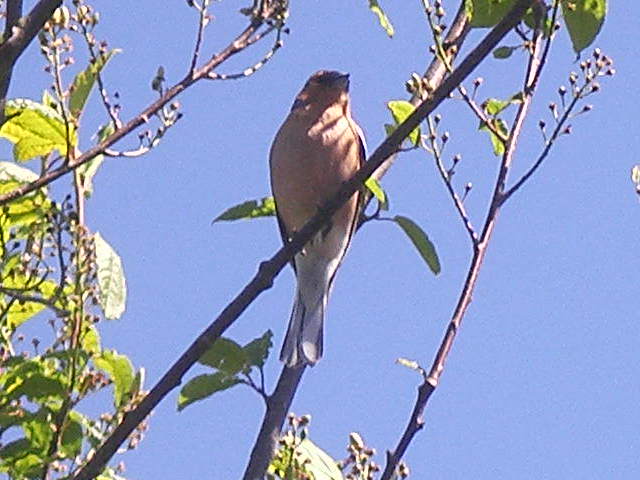
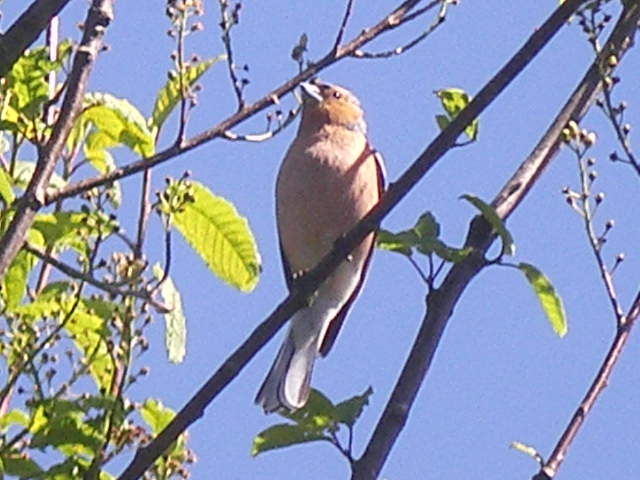
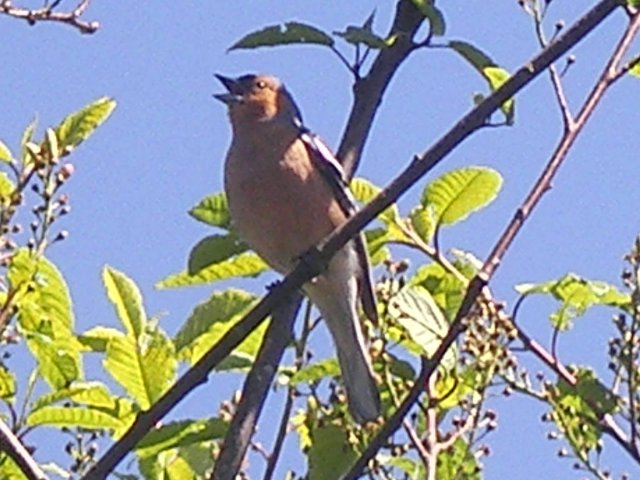
On Saturday, I heard the most beautiful song coming from a tree in next door's garden. Something sort of pinkish was singing its little heart out. Due to misjudging the distance I initially thought it was bigger than it really was, and tried to get some photos to identify it.

chaff1.jpg


chaff3.jpg


chaff4.jpg


Just a little chaffinch, but so pretty and so talented.

Rolfe.
 
The local ravens were making some noise.
Then I saw what had attracted their attention.
This guy has moved into the neighborhood.
 

Attachments

  • jrBobcatII-01.jpg
    jrBobcatII-01.jpg
    88.8 KB · Views: 0
  • jrBobcatII-02.jpg
    jrBobcatII-02.jpg
    95.6 KB · Views: 0

That's Lesser Egret Egretta garzetta. You don' have them in the UK either, do you? I think they're magnificent birds. Apart from size and shape (1), during breeding the this crest is the best sign of a Lesser.

However, I am very much an "impression birdwatcher", and use what the bird "feels like" quite a lot. This has the advantage of usually being able to determine the species quickly, but it's very hard to describe what you base a certain judgement on... To me, Little Egret is like a Common Gull, whereas Great Egret is like a Herring Gull. There's some kind of parallel that can be drawn between them, both when it comes to comparative size and the fact that both Great Egret and Herring Gull are much more "angular" than their lesser cousins. The egret in your picture has this petit, almost cute face, which is quite unlike the Great Egret that often looks a bit more... stern and surprised, sort of... Like I said, it's difficult to explain it, but it's very easy to use ^^.


Where's this article from? (2)

I've been surprised by the extra species that have shown up since I got the bird feeding station. I had a lot of tits (blue, great and coal) anyway, and chaffinches and sparrows and other stuff, but lots more have appeared, to the point where I seem to be seeing a lot fewer tits than I was.

Do you (or anyone else) ever get birds of prey at your bird feeders? I know sparrowhawks are somewhat common at feeding stations here, though only in the countryside. But this winter, for the second year in a row, a lady just south of Gothenburg has had a Buzzard sitting at her garden fence, watching the proceedings. I can't remember if it ever actually attacked anything, but the lady had quite a large feeding station with ducks and gulls and pheasants as regular guests as well.

I seem to recall that the highest species count on a bird feeding station (counted throughout time) is about 100 species in Sweden, from a feeding station north of Uppsala somewhere. That's quite impressive, but I think they feed all year round, so teh numbers are a bit skewed.

Shag with 2 shagettes

Are shagettes to shags what modettes are to mods?

Guillemots

Any Brünnich's in there?^^

Also: the second tern picture is wonderful. I love terns. We caught quite a lot at night two years ago, and if you catch them by night, and then bring them into a bright room, they don't try to fly away. So while banding them, you can easily place them on the bench next to you, and they will sit there for as long as you need them to, without even trying to walk away. They will bite you when they can, and they will criticise everything you do, loudly, but they will not move, unless you put another tern nearby and they decide to have a little fight. I have lots of pictures of this, including ones sitting on people's heads and so on. Amazing birds. Much more aggressive and prone to flying when you catch them during daytime.

The local ravens were making some noise.
Then I saw what had attracted their attention.
This guy has moved into the neighborhood.

Oh my! That's so awesome! Is that a... what do you call them... Bobcat?

I've added reports by CrikeyBob, Rolfe, bruto, Kestrel, jamrat, sphenisc, EHocking, Lothian and I Ratant, as well asthe following of my own:

Gothenburg, 21/5:
Green Sandpiper Tringa glareola
Sand Martin Riparia riparia
House Martin Delichon urbica
Sedge warbler Acrocephalus schoenbaenus
Marsh Warbler Acrocephalus palustris
Greater White-throat Sylvia communis
Reed Warbler Acrocephalus scirpaceus

Öckerö, North of Gothenburg, 22/5:
Common Tern Sterna hirundo
Arctic Skua Stercorarius parasiticus
Thrush Nightingale Luscinia luscinia
Black Guillemot Cepphus grylle
Cuckoo Cuculus canorus
Bluethroat Luscinia svecica

Gothenburg, 23/5:
Stock Dove Columba oenas
Garden Warbler Sylvia borin
Goldfinch Carduelis carduelis
Grasshopper Warbler Locustella naevia
Water Rail Rallus aquaticus

Gothenburg, 24/5:
Yellow Wagtail Motacilla flava thunbergi

Lastly:
I'll be going to Dorset for a few days this summer with some friends. Anyone have any knowledge of this are, and could tell me somewhere I could lure my bird-uninterested friends (a chemist, a physicist, an economist and a hippe) to? That's where you have all your Cirl Buntings and Dartford warblers, isn't it?

---
(1) Which are sometimes the best criteria, at least when you have them mixed with Intermediate Egret like in Japan.
(2) Also: I had totally forgotten to send you your prize since last year. I brought it to work early on and it ended up underneath a pile of dinosaur articles, and I forgot all about it. But now I have fished them out after being forced to clean my desk, and I'll buy an envelope for them this afternoon! Terribly sorry the delay...
 
Incidentally, I am adding all order and family names at the moment, and te aim is now to have the list up by the end of the week, depending on if Eric is out and about somewhere or not. As soon as possible, at least.

Did we decide something about Larus? I have quite a lot of Chroicephalus, Leucophaeus and so on, but it seems I have not been consistent. Do we call everything Larus, or shall I split them?

Further:
Nguembock et al., 2009 (Mol. Phyl. Evol. 51, 169-181) has made a molecular revision of Carduelis and Serinus, with the following taxonomic recommendations:
- Carduelis chloris, C. sinica, C. ambigua and C. spinoides form a distinct group that is far separates from the type of the genus, Carduelis carduelis. They recommend using Chloris as genus name.
- C. hornemanni and C. flammea group together, also outside C. carduelis, and is sister group to the Crossbills Loxia sp.. They recommend using the older name Acanthis for these, as well as Linaria for C. cannabina and Spinus for C. spinus, both of which also fall outside the Carduelis carduelis group.
- South American Carduelis species are moved to genus Sporagra. This includes Carduelis psaltria, which is on our list.
- Serinus is also divided. As the majority of this clade is well outside out list, I will only mention that the two canaries EHocking saw in South Africa is here recommended to be moved to genus Chloroptila.

There are some other rearrangements, and -- notably -- Carduelis flavirostris is missing from their analysis (possibly an Linaria, but over all, these are quite understandable changes, I think. Shall we incorporate these changes? They are too new to ahve found their way into checklists of course (being published about three weeks ago...), but much of this makes sense. Opinions?
 
Watching the ravens dive-bomb the bobcat, I was reminded of a cat that adopted us at Flight Test in 1991.
It lived in Building 602, the Flight Test Hangar which could accomodate two Tristars on each side.
There were birds nesting in the rafters, 80 feet above the floor, with no way for something like a cat to get there. (And barn owls too!)
So the cat had the birds come to it!
It would sit out in the middle of the floor, and the alarmed birds would swoop down on it.
At the decisive moment, the cat would pluck one of the birds out of the air.
Over time, it could easily get both of a nesting pair, which would leave any young they might have in the nest to starve to death.
I wonder if the bobcat would take a raven and eat it.
I've seen dead ravens be completely ignored by other ravens, which usually scavenge everything that dies around here.
 
Gnatcatcher harassing a raven...
 

Attachments

  • jrRaven-Catcher-01.jpg
    jrRaven-Catcher-01.jpg
    47.2 KB · Views: 0
  • jrRaven-Catcher-02.jpg
    jrRaven-Catcher-02.jpg
    39.9 KB · Views: 1
Do you (or anyone else) ever get birds of prey at your bird feeders? I know sparrowhawks are somewhat common at feeding stations here, though only in the countryside.

I live in the 'country' on Oahu, a quaint little town called Wai'anae. I've had a screech owl take a nesting dove out of a tree right next to my bedroom window one evening. I heard it call, the next moment it came crashing down and took the dove. The sound of it's wings was quite loud.

Birds of prey are quite smart. That said, my son and I are gonna hike up Mauna Kea this summer. About 21 miles through native forest, scrubland, and then alpine. My son's girlfriend, who is a native bird specialist, is gonna find it quite surreal to see me try and bait a hawk with a toy mouse. I think it will work, we'll see. (Keep this to yourself, but while in Alaska I caught a cod fish, humanely killed it, and waved it towards some circling eagles at least a 1000 ft. up near a mountaintop in Juneau. I then threw the fish back in the water, instantly an eagle whistled and dove on it. It went completely underwater and then flapped itself out and up.)
 
Yes, I know.....

Nice picture though.

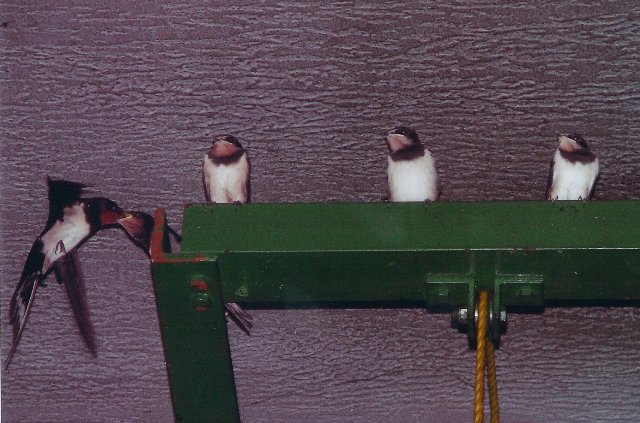
Yes. Swallows are wonderful. There's so many happy summer memories attached to them, for me. We used to go tenting every year on Öland, quite near Ottenby Bird Observatory, when I was a kid, and around the communal shower rooms, the ice cream stand, the small grocery store -- everywhere Barn Swallows were nesting! Sadly they've rebuilt the whole place now, and since all animals by definition are unhygienic, they're actively dissuading the swallows from nesting under the drainpipes and roofs.

Holding House Martins is like holding small mice. They will try to crawl away from you, and their feet are just like mouse feet.

Birds of prey are quite smart. That said, my son and I are gonna hike up Mauna Kea this summer. About 21 miles through native forest, scrubland, and then alpine. My son's girlfriend, who is a native bird specialist, is gonna find it quite surreal to see me try and bait a hawk with a toy mouse. I think it will work, we'll see. (Keep this to yourself, but while in Alaska I caught a cod fish, humanely killed it, and waved it towards some circling eagles at least a 1000 ft. up near a mountaintop in Juneau. I then threw the fish back in the water, instantly an eagle whistled and dove on it. It went completely underwater and then flapped itself out and up.)

We tried to bait falcons with mice and kites with salmon in Japan last year, but they never wanted any part of it. The kites sometimes sat on a telephone pole just beside the salmon we had placed in open view in the middle of a bike road, but not even once did they swoop down to take it. And there were as many as 2000 kites flying past some days, so we had plenty of opportunity... but we were outsmarted by scavengers.

Incidentally, I have uploaded some of my pictures to Photobucket. Here's the only one I have of a swallow, I think.

I wrote yesterday about how calm terns can be. Well, these terns show that excellently. They can easily be placed to one side, and will watch the proceedings, but complain about everything you do. Nothing is ever good enough for terns. However, they are sometimes very tolerant, or even extremely tolerant.

After banding (which takes place during the night), we just place the terns on a bench outside the lab. They generally remain there until sunrise. After a productive night, there may be 30-40 terns there, of several species. The largest diversity we had 2007 when I was there last was five: Black Tern, Little Tern, Arctic Tern, Common tern, and Sandwich Tern. However, they also catch Caspian Tern. The highest diversity I've ever seen was in Australia last year, with Black Tern, Lesser Crested Tern, Greater Crested Tern, Caspian Tern, Roseate Tern, Arctic Tern, Sandwich tern and Little Tern in the same flocks...

This calmness when you bring night-caught birds in is quite common. This Eider also didn't fly away, but walked around a lot. Duck generally don't fly indoors, though, but they usually don't like being placed upside down (for instance when you're looking for lice on the chest and undersides of the wings). They can be incredibly cute.

This Black-headed Gull is also night-caught, and didn't complain as much as some of the day-caught ones I've handled have. It's much more uncommon for smaller birds to be this calm, but did manage to get this picture of a Goldcrest. Likely his calmness is more from exhaustion than from actual calmness, though...

Lastly, here are two nice birds from the Swedish North:
Red-necked Phalarope (female)
Long-tailed Skua
Both nested near the field station we had last year in Padjelanta, but their nests were plundered by red foxes, and the birds didn't remain long in the area after that...

And one more from Ottenby:
Rough-legged Buzzard
This is a notable picture, not only because it has a Rough-legged Buzzard in it, but also because the bearded man in the background is Carl Edelstam, one of the quite few Ornithology Mystics, or whatever you want to call them, in Sweden. He's also a firm believer in homoeopathy and in some kind of universal scientific conspiracy to suppress his "research".

I'll try to get a few more pictures uploaded during the weekend. I filled about 12 GB of pictures during my trips to Japan, Australia and Thailand last year, and have loads of more pictures of Swedish birds as well. Any requests?

 

ISF - Join now!

Every member here is approved by hand. No bots, no spam, just people who care about evidence and honest debate.

Membership is free!

Create your free account

Back
Top Bottom