Merged Thread to Discuss The Excellent Analysis of Jones latest paper

where to get wtc paint sample

Just a walk in the park with a pen knife for some scrapings and a vial to put your paint chip in.
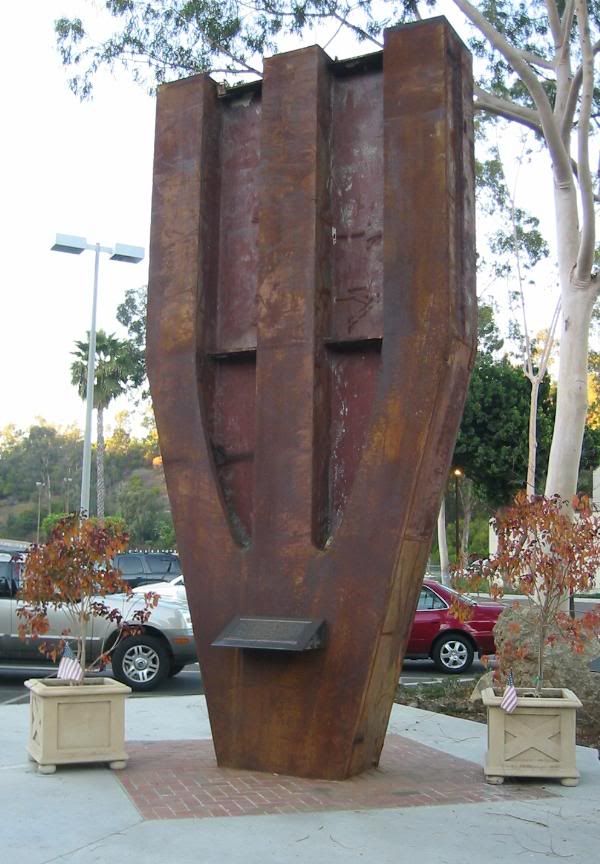
http://www.waymarking.com/waymarks/WM11BD
76404732-5b2e-4add-8a14-00f06d3ec93.jpg
 
Last edited:
Just a walk in the park with a pen knife for some scrapings and a vial to put your paint chip in.
http://www.waymarking.com/waymarks/WM11BD
[qimg]http://i294.photobucket.com/albums/mm89/AWSmith1955/76404732-5b2e-4add-8a14-00f06d3ec93.jpg[/qimg]

There is in Manhattan an I-beam from WTC as a new monument.
It's on Church a block or two above Vesey, on the east side by the church. It's reachable for the purposes of getting a sample.

There is a plaque but I didn't get a chance to read it.
 
Hi all....Im new to this forum so forgive me if this has already been discussed....

Im not quite sure I understand the point of the "resistance" test....they give the equation for resistivity (RA/L) and then tested the red material saying its resistivity was too high....

How many samples did they take for the measurement?
How many different red chips did they test?
What kinds of paint are they comparing this to?
Are they comparing the sample to brand new paint or paint that has been aged?
Could there be contaminates in this .5mm * .5mm are of "red material" that could create a lower than expected resistivity?

There are so many details missing from this test...it seems difficult to gather any data at all from it.

I would never conduct a resistivity test with so little specifics given...its seems like a very poor test indeed.

Does anyone have more information on this test they conducted?

Thanks.
 
Molten iron (many microspheres are almost pure iron or iron oxyde) is a proof of extremely high temps: 1400°C.
To reach these temps you need to concentrate the heat released by a reaction in a small volume.

- The reaction of a given volume V of Thermite gives enough energy to ideally melt ~ 2V of iron
(16kJ/cc for thermite; 7.8kJ/cc to melt iron: (470 J/(°C.kg) x 1500°C + 270000J/kg) x 8000/1O^6 kg/cc)

- The reaction of a given volume V of Coal (carbon) gives enough energy to ideally melt ~ 10V of iron
(79kJ/cc i.e ~ 5x more than thermite)

But each C atom needs an oxygen molecule from the air thus a volume V of Carbon needs
32/12 (ratio of molar masses ) times 2267/1.43 (ratio of densities) times 5 (20% of oxygen in the air) = ~ 20000 V of air.

Therefore when a very small organic or pure carbon particle burns in the air, its energy is released very fast (because it is very small i.e big S/V ratio ) but this energy is released in a huge volume ~ 20000 V so a tiny iron particle (volume V also) around can only get ~1/20000 of this total energy. So it cannot reach the temps able to melt it (see above) . Thus for quite obvious reasons coal or any organic stuff that needs the air oxygen can only melt iron when the heat is accumulated in time and concentrated in space as in a blast furnace.

Let us investigate the extreme case of an organic and iron microparticles confined together into a very small chamber (comparable to their size) and submitted to an air flow ~ thousands of V on a very short time scale (because you must be faster than the dissipative effects which are also very effective for such microparticles ).
But then the particles must also retain much of the heat which is hardly believable ( the air flow would at the same time produce energy lost at high rates). So even this extreme scenario is untenable.

Therefore i see no way to reach the temps of molten iron for such a reaction at the microscopic scale. The reductant and oxydiser (good english ?) must be together in the chips allowing the heat to be released concentrated in a small volume as for a thermitic reaction: high density of energy needed! organic stuff +oxygen = very low energy density because huge volume!

I really need no more to be convinced that the chips are highly energetics by themselves and knowing their composition and the composition of the residuals the evidence is clearly for a Fe2O3 +Al thermitic reaction.


Fred

Very interesting post. I myself had suggested, in one of the physforum.com 911 mega-threads, that most of the heat generated by the WTC fires was lost via venting through broken windows.

However, in large fires, you have major heat transfer through radiation. Counteracting that, in terms of radiative head absorbed by a column, is radiative heat absorbed by smoke.

The problem is really horribly complex. I attended a lecture once on advanced computer analysis of a flame, and they even created a genetic algorithm for one piece of the problem.

Anyway, the point is made that simplistic comparisons to more energy-dense materials like paper, are silly. Do you mind if I copy your post, verbatim, to the911forum.freeforums.org?
 
I haven't been able to study the paper thoroughly yet but just wanted to make one point about the DSC analysis.

10 degrees celcius per minute as heating rate strikes me as way too fast for a sample of unknown substance. Especially as it is not conducted in inert atmosphere and there is (as far as I understand) an unknown organic matrix.

In my lab we analyse samples for ignition temperature on a daily basis. Now it is normal to use 10 degrees per minute as heating rate in industrial labs as the one I'm connected to. But for more accurate measurments it's recommended to go as low as 0,5 degrees per minute. But you don't have time for that on a daily basis for obvious reasons.

I'll see if I got time to study it more.
 
Thus for quite obvious reasons coal or any organic stuff that needs the air oxygen can only melt iron when the heat is accumulated in time and concentrated in space as in a blast furnace.

Well that would go for liquified iron, however "molten" is usually used as a colloqial term describing something that is starting to lose its initial integrity and change throuh heat, bending or behaving like cookie-dough, licorice etc.
It's something any swordsmith could traditionally expect if leaving the sword too long in the burning coals et al. If they did, and then struck that hammer on that steel, or iron, you could at times get something of an explosion were parts of the material were released with force like projectiled dripplets.

I'm not a building though, just a smithy.
 
Do you mind if I copy your post, verbatim, to the911forum.freeforums.org?

of course you can copy it , if it helps or if someone else can find the bug in what i say i'll be interested...

the complications are expected when you want to reach an accurate picture of what is going on, not when the energy densities are orders of magnitude below the necessary threshold...

fred
 
I've still got a few questions regarding the 'thermitic material' in the red/grey chips. I'd appreciate any specific answers to them!

1) Does anyone know what the ignition temp of nanothermites or nanothermite sol-gels are? Kevin Ryan claims that the red/grey chips combusted at the same temperature as those.

2) Jones et al. are claiming that the formation of 'iron-rich' spheres' after ignition of the chips proves that combustion temperature was at least 1400 C. Can anyone provide good evidence to disprove that claim?

3) methyl ethyl ketone was used as a solvent to demonstrate the difference between ordinary paints and the red/grey chips. According to Steven Jones, while paint samples did dissolve, the chips did not. But apparently there was some dissolution of the chips after all, as the materials did separate out to a degree - how does one interpret such behavior?

4) The (mass?) of red/grey chips is approx. = .1% of dust in samples collected. Any good ideas what the total amount of the chip material might have been? I know the WTC dust contained many different materials, according to the USGS 'plaster, paint, foam, glass fibers and fragments, fiberglass, cement, vermiculite (used as a fire retardant instead of asbestos), chrysotile (asbestos), cotton fibers and lint, tarry and charred wood, and soot.' (Chemical and Engineering News, 2003 http://pubs.acs.org/cen/NCW/8142aerosols.html )

The article above cites 'more than 1 million tons of dust enveloped lower Manhattan'. I'm not sure how accurate that figure is, but .1% of that would be 1000 tons! That's a huge amount of material, certainly not plausible for nanothermite as envisioned by Jones et al.

 
The lack of chemical knowledge by Jones, et. al. is astounding. The use of a solvent such as MEK instead of methylene chloride, DMF, or DMF-DMSO to attack the organic matrix further confirms that no chemists were involved in the analyses. Couple that with the ridiculous conductivity test [have conductivity meter, need work] and one can see why no real journal would publish this trash.
 
2) Jones et al. are claiming that the formation of 'iron-rich' spheres' after ignition of the chips proves that combustion temperature was at least 1400 C. Can anyone provide good evidence to disprove that claim?
To form spheres like those described by Jones the material should have been exposed to temperatures close to or above the melting point. Correct me if I'm wrong, but Jones et al never showed that the spheres were not present before the combustion. This is something they perhaps should address.

4) The (mass?) of red/grey chips is approx. = .1% of dust in samples collected. Any good ideas what the total amount of the chip material might have been?
It's impossible to tell from this paper. With the totally random and undocumented sampling procedure you can't tell wether these samples are representative or not.
 
To form spheres like those described by Jones the material should have been exposed to temperatures close to or above the melting point. Correct me if I'm wrong, but Jones et al never showed that the spheres were not present before the combustion. This is something they perhaps should address.


It's impossible to tell from this paper. With the totally random and undocumented sampling procedure you can't tell wether these samples are representative or not.


I've been a member of this forum for two months. I came in when the discussion about Jones's paint chips was just getting started. One thing we can do here is post a reminder every month that Jones and his accomplices have not yet seen fit to submit their samples to any independent lab for testing. April has passed, and May has passed. I would bet that we will be ticking off the months far into the future.
 
Not that I am a defender of the Jones paper, as I think it is incredibly poor in terms of its scientific content, approach, or lack there of, but from the paper, page 19 (journal page#):

In the post-DSC residue, charred-porous material and
numerous microspheres and spheroids were observed.
Many
of these were analyzed, and it was found that some were
iron-rich, which appear shiny and silvery in the optical microscope,
and some were silicon-rich, which appear transparent
or translucent when viewed with white light; see photographs
taken using a Nikon microscope (Fig. 20).
The abundant iron-rich spheres are of particular interest
in this study; none were observed in these particular chips
prior to DSC-heating.
Spheres rich in iron already demonstrate
the occurrence of very high temperatures, well above
the 700 °C temperature reached in the DSC, in view of the
high melting point of iron and iron oxide [5]. Such high temperatures
indicate that a chemical reaction occurred.

So according to them, the spheres were not there (in the chips, they do not say anything about them being the dust or not) prior to heating.

TAM:)
 
Not that I am a defender of the Jones paper, as I think it is incredibly poor in terms of its scientific content, approach, or lack there of, but from the paper, page 19 (journal page#):


So according to them, the spheres were not there (in the chips, they do not say anything about them being the dust or not) prior to heating.

TAM:)

This is true, but if we presume they were indeed formed during heating, then Sunstealer's observation that the spheres are rather heterogenous must be taken into account. The reason for that is because the melting point would probably be considerably lower than it would be had the spheres been truly homogenous iron.

From my point of view, though, I'd like some corroboration that the spheres were not already present and simply not easily observable in the dust. I know that sounds suspicious, but given most of the authors prior works, it's a fair challenge. If it turns out that they truly were not present previously, then I'd like to see some further analysis of said spheres, not mere assertions built on the former Jones paper.
 
This is true, but if we presume they were indeed formed during heating, then Sunstealer's observation that the spheres are rather heterogenous must be taken into account. The reason for that is because the melting point would probably be considerably lower than it would be had the spheres been truly homogenous iron.

From my point of view, though, I'd like some corroboration that the spheres were not already present and simply not easily observable in the dust. I know that sounds suspicious, but given most of the authors prior works, it's a fair challenge. If it turns out that they truly were not present previously, then I'd like to see some further analysis of said spheres, not mere assertions built on the former Jones paper.

100% agree. As a matter of fact, I feel all of his paper and it's results are suspect, and unproven, until verified by a TRULY INDEPENDENT (no contact or relationship with Jones or any of the paper's authors) lab. What is amazing, is the silence about this paper now.

TAM:)
 
I have spent much time trying to find again the kind of bi-layered red/grey staff i had shown in my presentation...in vain !
I could only find numerous red only chips which most probably have nothing to do with the grey/red chips of Harrit and co photos. These do not seem to produce any
iron microsphere below 500°C (actually not big enough to be seen with the optical microscope, i'll try the electronic microscopy soon) and they crush when i try to catch them with my needle while i was told that the genuine chips are much more resistant...

Since according the authors the proportion of the "genuine chips" in the samples is large, i suspect there is something wrong with my samples: either falsified or not representative... or:
It's also possible that i have lost the most interesting material when i first extracted a few monthes ago the more magnetic particles : the one i extract now are less magnetic (for instance i see much less iron microspheres than i did) and only a much more powerful magnet allows me to extract them.

I would need another sample!

i have a third one which i did not pay enough attention because it was collected with a vacuum cleaner in an appartment (so great contamination by other staff than WTC dust). In this sample i can see many dark grey staffs with irregular red spots but these are so tiny particles that i can hardly extract them for testing in my small furnace. I'm going to try again...


Fred
 
My suggestion Fred/Henry, in the name of science.

Get samples from someone independent of Jones. I am sure there are a number of other sources out there who have samples of WTC dust. If what Jones says is true, the red/grey chips should be found in any of the samples, in some quantity.

Just a suggestion.

TAM:)
 
My suggestion Fred/Henry, in the name of science.

Get samples from someone independent of Jones. I am sure there are a number of other sources out there who have samples of WTC dust. If what Jones says is true, the red/grey chips should be found in any of the samples, in some quantity.

Just a suggestion.

TAM:)

But my samples are not from Jones as far as i have understood. Each were sent independently (a different person) from the others. The common denominator is a tract in NY asking people if they have dust to send it for a scientific investigation related to health issues...
 
So you received multiple samples, from multiple sources, not from Jones? Were the samples from the same people who sent Jones his samples?

My point is this. There are other labs, other institutions, who have conducted numerous tests on WTC dust. They are, in all likelihood, completely independent of Jones and the people he obtained his samples from. There for, to insure COMPLETE Independence from Jones, in terms of sample sourcing, the best thing would be to contact one of these researchers/labs, and ask for a sample of their collected dust.

If the red/grey chips show up in their samples, you can at least make a claim that these samples are found consistently through ALL WTC dust samples, not just those from Jones (or those who sent him the samples). If the red/grey chips are not found in these independent samples, then you have to wonder, BIG TIME, why the chips would be in Jones samples, and not in independent samples.

TAM:)
 
I've been a member of this forum for two months. I came in when the discussion about Jones's paint chips was just getting started. One thing we can do here is post a reminder every month that Jones and his accomplices have not yet seen fit to submit their samples to any independent lab for testing. April has passed, and May has passed. I would bet that we will be ticking off the months far into the future.

Dont expect anything anytime soon....

To be honest Im still trying to figure out WTF was the "resistivity" test supposed to prove...

I couldn't stop laughing when I read that particular paragraph in the Jones paper....what a load of crap.
 

Back
Top Bottom