
-
Security incident: ISF was recently accessed by intruders. Please change your password, and change it anywhere else you used it. Read more
You are using an out of date browser. It may not display this or other websites correctly.
You should upgrade or use an alternative browser.
You should upgrade or use an alternative browser.
Moderated Steel structures cannot globally collapse due to gravity alone
- Thread starter Heiwa
- Start date
ozeco41
Philosopher

So, it seems we all agree that Steel structures cannot globally collapse due to gravity alone. Good!
That should be self evident and not subject to any disputation.

So, it seems we all agree that Steel structures cannot globally collapse due to gravity alone. Good!
At the risk of stating the obvious, how about:
"Properly designed steel structures will not collapse due to gravity alone."
Improperly designed structures can collapse, locally or globally, depending on the details of of the "improper design".
Flying a fuel laden commercial jet into a structure can move it from the "properly designed" to the "improperly designed" category in a relatively short amount of time."
That ought to about cover it...
tk
At the risk of stating the obvious, how about:
"Properly designed steel structures will not collapse due to gravity alone."
Improperly designed structures can collapse, locally or globally, depending on the details of of the "improper design".
Flying a fuel laden commercial jet into a structure can move it from the "properly designed" to the "improperly designed" category in a relatively short amount of time."
That ought to about cover it...
tk
Not really! In the WTC 1 case the upper part C was undamaged and so was also the lower part A of same structure. The plane had caused some local failures in between parts C and A. And we are told that intact part C dropped and then one-way crushed down part A. That this is not posssible is the topic of this thread.
Energy available is a good measure why one-way crush down of WTC 1 is not possible. Take the first storey crush down. How much energy is available? Say it is 606 kWh, when upper part C drops free fall >3.7 m! How much energy is used first to compress the building and then to crush various material in the impact zone into rubble? And how much is used to accelerate this rubble to same speed as the upper part?
One storey has mass 3 760 tons. To accelerate it to 20 m/s requires 209 kWh.
So there is only 397 kWh left to compress a top storey structure and to to crush things.
Say that 209 kWh was used to compress the building structure parts C and A elastically after drop and at first impact until something breaks. This compression (energy absorption) will evidently decelerate the upper part C.
So only 188 kWh remains to crush things (the uppermost storey of part A)
We know a good car recycling factory requires abt. 36.8 kWh/ton to shred a car. Thus the energy available to crush one upper storey of WTC corresponds to the energy to shred 5.1 cars!
However one WTC storey has the mass of 3 760 one ton cars!
If you think you can crush 3 760 tons of steel and concrete using only 188 kWh or only 0.05 kWh/ton, then just prove that.
In all may calculations and models (pizza boxes, lemons, sponges, &c) it would appear that there is too little energy by gravity just to initiate any destruction. The same result applies to WTC 1.
This is THE reason why a part C of any structure cannot crush down the remainder part A of same structure by gravity (C<1/10A).
But as I always say! Suggest a structure, e.g. a composite one, where a little part C can one-way crush down bigger part A due to gravity only.
ozeco41
Philosopher
Yes. The final point could be "...especially when the original design is vulnerable to such trauma..." -- but I cannot think of a cute way to say it.At the risk of stating the obvious, how about:
"Properly designed steel structures will not collapse due to gravity alone."
Improperly designed structures can collapse, locally or globally, depending on the details of of the "improper design".
Flying a fuel laden commercial jet into a structure can move it from the "properly designed" to the "improperly designed" category in a relatively short amount of time."
That ought to about cover it...
tk
The other factor could be "Any tall building which has the top section clearly marked "C" and the bottom sectionj clearly marked "A" will be subject to different rules"


Not really! In the WTC 1 case the upper part C was undamaged and so was also the lower part A of same structure. The plane had caused some local failures in between parts C and A. And we are told that intact part C dropped and then one-way crushed down part A. That this is not posssible is the topic of this thread.
Energy available is a good measure why one-way crush down of WTC 1 is not possible. Take the first storey crush down. How much energy is available? Say it is 606 kWh, when upper part C drops free fall >3.7 m! How much energy is used first to compress the building and then to crush various material in the impact zone into rubble? And how much is used to accelerate this rubble to same speed as the upper part?
One storey has mass 3 760 tons. To accelerate it to 20 m/s requires 209 kWh.
So there is only 397 kWh left to compress a top storey structure and to to crush things.
Say that 209 kWh was used to compress the building structure parts C and A elastically after drop and at first impact until something breaks. This compression (energy absorption) will evidently decelerate the upper part C.
So only 188 kWh remains to crush things (the uppermost storey of part A)
We know a good car recycling factory requires abt. 36.8 kWh/ton to shred a car. Thus the energy available to crush one upper storey of WTC corresponds to the energy to shred 5.1 cars!
However one WTC storey has the mass of 3 760 one ton cars!
If you think you can crush 3 760 tons of steel and concrete using only 188 kWh or only 0.05 kWh/ton, then just prove that.
In all may calculations and models (pizza boxes, lemons, sponges, &c) it would appear that there is too little energy by gravity just to initiate any destruction. The same result applies to WTC 1.
This is THE reason why a part C of any structure cannot crush down the remainder part A of same structure by gravity (C<1/10A).
But as I always say! Suggest a structure, e.g. a composite one, where a little part C can one-way crush down bigger part A due to gravity only.
Heiwa - Gravity is a constant. You don't get to subtract from it. Your theory would allow the WTC rubble to be balanced on a toothpick provided all energy had been expended crushing previous floors. (the bottom floor consists of said toothpick)
leftysergeant
Penultimate Amazing

- Joined
- Jul 13, 2007
- Messages
- 18,863
However one WTC storey has the mass of 3 760 one ton cars!
If you think you can crush 3 760 tons of steel and concrete using only 188 kWh or only 0.05 kWh/ton, then just prove that.
Nobody said you needed to. All you have to do is knock out the floors on one side and start a cascading failure. Force employed need only act upon the floors and their attachments to the colum,ns. NOTHING need crush any column. There is, infact, no indication than any column outside of those in the core at the point of failure failked due to vertical compression.
Now, how much energy does it take to break the floor-to-perimeter-column conections on one floor, and was that energy available?
Any other part of the energy budget is irrelevant.
Heiwa - Gravity is a constant. You don't get to subtract from it. Your theory would allow the WTC rubble to be balanced on a toothpick provided all energy had been expended crushing previous floors. (the bottom floor consists of said toothpick)
No, what we call gravity is just the force on a mass at the surface of Earth. On the surface of any other planet it is different. You don't have to build so strong on the Moon!
But you are right that gravity acts on rubble or pieces of damaged structure so that they fall to ground and remains there.
In the intact structure all the elements were nicely balanced and didn't fall down. And you can be sure that if ONE element falls down due to gravity, it will not affect the remaining structure. The gravity force will just displace the loose element to ground. The gravity force is too small to do any harm. Of course, the falling element may contact other elements in the structure when dropping and contact forces develop develop but again, they are too small and short lived to damage the structure.
You see, Steel structures cannot globally collapse due to gravity alone.
Conclusion:
All the visual facts confirm the solely gravity collapse of the Towers.
All the visual facts refute the use of explosives/thermite in the collapse of the Towers.
---------------------------------------------------------------------------------------------------------
You can't reason someone out of something he was never reasoned into. - Swift
Solely gravity collapsze? Look at WTC 1! WTC 2 is same.
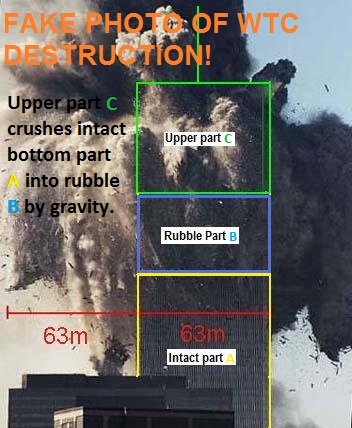
According NIST the upper part C is supposed to drop on and apply kinetic energy on lower part A that A cannot absorb due to lack of strain energy (strength), so that A is collapsing during 10-15 seconds!
According Bazant & Co the upper part C is supposed to drop and to one-way crush down lower part A into a compressed, compacted rubble layer part B(azant) that destroys A also during 10-15 seconds.
But gravity cannot produce this fountain of debris we see throwing debris in all directions!
Actually, a small top part of any structure cannot destroy the lower strcutural part due to a small drop and gravity. The small top part would remain up top ... arrested by the lower structure.
What you see is just simple, top down, controlled demolition of the tower!
leftysergeant
Penultimate Amazing
- Joined
- Jul 13, 2007
- Messages
- 18,863
But gravity cannot produce this fountain of debris we see throwing debris in all directions!
How did you reach such an absurd conclusion? I see no real difference between the dust plumes from the tower to the dust that forms in any CD, aside from the fact that there is a hell of a lot more drywall powder in it.
Actually, a small top part of any structure cannot destroy the lower strcutural part due to a small drop and gravity. The small top part would remain up top ... arrested by the lower structure.
Not consistant with the history of progressive catastrophic collapses of structures. Totally inconsistant with Ronan Point, Windsor Tower, Bouwkunde and Balzac-Vitry.
No collpase has, to the best of my recollection, ever arrested until it met a structural feature utterly different from that which first failed. In all but the Windsor Tower collapse, the arresting feature was the ground floor. In the Windsor Tower, it was the mechanical floor halfway up the structure.
Solely gravity collapsze? Look at WTC 1! WTC 2 is same.
[qimg]http://heiwaco.tripod.com/WTC.jpg[/qimg]
According NIST the upper part C is supposed to drop on and apply kinetic energy on lower part A that A cannot absorb due to lack of strain energy (strength), so that A is collapsing during 10-15 seconds!
According Bazant & Co the upper part C is supposed to drop and to one-way crush down lower part A into a compressed, compacted rubble layer part B(azant) that destroys A also during 10-15 seconds.
Exactly as demonstrated here:
http://www.youtube.com/watch?v=syzKBBB_THE
But gravity cannot produce this fountain of debris we see throwing debris in all directions!
Not only can it do so, but it can do so relatively quietly.
You should already know that explosives required to take a building down are EXTREMELY loud, and do all of their damage in a pinpoint area. To have explosives with enough energy to throw tons of steel in an outward direction, it's going to be even louder. It would deafen everyone in lower manhatten, the shockwave would shatter windows over many blocks and millions of peices of debris would be fired in every direction like bullets injuring people on the ground.
Actually, a small top part of any structure cannot destroy the lower strcutural part due to a small drop and gravity. The small top part would remain up top ... arrested by the lower structure.
I've seen demolitions were they just blow out the supports on the ground floor, and the whole building basically disintegrates on contact with the ground even though it's a short fall. You'd think with your line of thinking, the floors would at some point stop disintegrating and you'd have at least half the building intact on the ground in this scenario. It just doesn't happen... outside of Turkey that is.
I've seen demolitions were they just blow out the supports on the ground floor, and the whole building basically disintegrates on contact with the ground even though it's a short fall. You'd think with your line of thinking, the floors would at some point stop disintegrating and you'd have at least half the building intact on the ground in this scenario. It just doesn't happen... outside of Turkey that is.
Exactly - in controlled demolition you blow out the supports on the ground, etc. Sounds like WTC 7! Upper part is destroyed. As Chandler points out in his latest video (topic) also happens to upper part of WTC 2 (starting on west side). Then there are the strange 'rockets' flying out from the building at high speed (also topic) that somebody above suggests are thin aluminium cladding pieces previously attached to other thin aluminium cladding sheets + perimeter columns. I think they are lose devices that should have assisted in the controlled demolition of WTC 2. Nobody has heard of aluminium cladding rockets, etc.
leftysergeant
Penultimate Amazing
- Joined
- Jul 13, 2007
- Messages
- 18,863
Then there are the strange 'rockets' flying out from the building at high speed (also topic) that somebody above suggests are thin aluminium cladding pieces previously attached to other thin aluminium cladding sheets + perimeter columns.
Because that is what they are. They are big strips of aluminum propelled outward by the force of moving air. They change direction when they meet air resistance greater than the force of the moving air that expelled them.
I think they are lose devices that should have assisted in the controlled demolition of WTC 2. Nobody has heard of aluminium cladding rockets, etc.
Of what possible use would a rocket of any sort be in demolitions?
You don't know anyhting about the sorts of devices used in demolitions, do you? That would be the only explanation I can think of for some of the strange things you believe you are seeing.
And the mistake that both you and Chandler make is that you somehow see the dust plumes as being explosively-driven, rather than gravity-driven.
Hog snot!
Explosives will not drive a smooth stream. It would come in pulses. The plumes do not pulsate.
Look at the smoke rising out of the middle, up the cores. It looks like any other smoke column I have seen at a fire. It does not pulsate. It flows smoothly. Were there demolition charges strong enough to do any serious damage going off on even every floor, let alone the every third floor or so that you postulate, it would be driven in pulses.
MASSIVE fail to both of you.
Exactly - in controlled demolition you blow out the supports on the ground, etc. Sounds like WTC 7!
What is the difference between all floors of a building being destroyed due to contact with the ground and all floors of a building being destroyed due to contact with... the building?
If you are right about the WTC, then in demolitions were only ground level supports are removed, there should not result in complete disintegration of all the buildings floors. The disintegration should be arrested, right?
Upper part is destroyed. As Chandler points out in his latest video (topic) also happens to upper part of WTC 2 (starting on west side). Then there are the strange 'rockets' flying out from the building at high speed (also topic) that somebody above suggests are thin aluminium cladding pieces previously attached to other thin aluminium cladding sheets + perimeter columns. I think they are lose devices that should have assisted in the controlled demolition of WTC 2. Nobody has heard of aluminium cladding rockets, etc.
No booms, no explosives.
Go to within a mile of a demolition one day and you will understand this.
If I were you and I would give up the whole bomb theory and persue other ways a building can be brought down without explosives. ie. silently.
What is the difference between all floors of a building being destroyed due to contact with the ground and all floors of a building being destroyed due to contact with... the building?
Well, if you drop floors on the ground, I assume the floors will get damaged in contact with ground as they are weaker than the ground.
If you drop a floor on another similar floor, I can assure you both get damaged.
This is one reason why a steel structure cannot globally collapse due to gravity alone. You follow?
releaseeabode
Banned
- Joined
- May 4, 2009
- Messages
- 85
Tom!
Bazant (in BLGB paper Appendix we now have same copy of) suggests:
Since the initial crush-up phase terminates at very small axial deformation, it must be concluded that the simplifying hypothesis of one-way crushing is perfectly justified and causes only an imperceptible difference in results.
This is not in accordance with my axiom. One way crushing does not happen anywhere in any structure, where a upper part C of it contacts a lower part A of same, identical structure after gravity drop.
One way crushing is just another excuse to keep upper part C rigid. As it is not the case equation (1) of the BLGB paper is not valid.
Or for my kid audience. When part C drops and contacts part A, it does not produce a rubble part B only of part A as assumed by Bazant. Part B is also rubble of part C.
Replace rubble part B by what it is: local failures of structure of parts C and A and you understand.
So with this adjustments part C will be destroyed before part A exactly as per my axiom.
My personal favourites are...
Bazant connects B to C to use the momentum from C during crushdown but, disconnects B from C to allow B to accelerate away from C and reduce the Crush up force.
Bazant allows B to compact but doesn't allow a similar compaction of debris in front of B which B then has to destroy to progress. All the accretion of mass is made favourable to progression of collapse.
Bazant effectively uses "pancake collapse" for his analysis and calls it "progressive collapse" in the text. Takes no account of the underlying structure of the towers.
Having an amount of energy available in a mass is not the same as being able to apply that energy to do useful work with sufficient power. Bazant accretes energetic mass to B and applies the sum of that energy instantaneously.
Bazant is interesting but, no more applicable to WTC than Heiwa's simplified model. Doesn't mean a conspiracy of demolitions is any more valid but it does mean that some on here need to jump in the elevators and move down a few floors from their ivory towers.
Well, if you drop floors on the ground, I assume the floors will get damaged in contact with ground as they are weaker than the ground.
If you drop a floor on another similar floor, I can assure you both get damaged.
This is one reason why a steel structure cannot globally collapse due to gravity alone. You follow?
Not really following. So if one floor (let's call it G) dropping on another floor (H) damages both. What happens to the floor below H which we'll call J? Isn't J now saddled with trying to support it's own mass, plus the pass of G+H?
Not really following. So if one floor (let's call it G) dropping on another floor (H) damages both. What happens to the floor below H which we'll call J? Isn't J now saddled with trying to support it's own mass, plus the pass of G+H?
???? G destroys H and H destroys G, while J is looking on. How can H/G then destroy J???? Gravity? Do a proper design/model of G, H and J and any supports in between and do a simple energy balance, structural damage analysis, etc, etc.
And remember the Björkman axiom:
A smaller part of an isotropic or composite 3-D structure, when dropped on and impacting a greater part of same structure by gravity, cannot one-way crush down the greater part of the structure.
In your case G is the smaller part and H+J is the bigger one and there are supports in between. Now show how G (small part) can destroy H+J (big part) and the supports in between.
Is 1 > 2 ?
MIKILLINI
Incromulent Logic

- Joined
- May 3, 2007
- Messages
- 2,979
Well, if you drop floors on the ground, I assume the floors will get damaged in contact with ground as they are weaker than the ground.
If you drop a floor on another similar floor, I can assure you both get damaged.
This is one reason why a steel structure cannot globally collapse due to gravity alone. You follow?
Now if I drop 13 floors on one floor, the one floor is subject to be more damaged than the 13 floors, correct?