• Security incident: ISF was recently accessed by intruders. Please change your password, and change it anywhere else you used it. Read more

Merged Thread to Discuss The Excellent Analysis of Jones latest paper

There has been a distinct quiet on this paper over the last few days. Some of it, in this thread, is due to the moderated status, but overall on this forum, those who came out of he woodwork seem to have gone back in...curious.

Metamars, the only one in defense of Jones in this thread, has moved on to other things (application of thermite) rather than the crux of the paper.

It would be curious to see if similar is going on across the board (at other sites).

TAM:)
 
If you read my 3 large posts you'll see that I allude to the fact that the samples in Jones paper are not all one and the same and also that they can't all be from the same source.

It is possible that they all came from the towers. The paint on my desk is different from the paint on your desk is different from the paint on the core columns.

There are literally thousands of sources for paint in NY. The only thing that makes me think that samples a) to d) came from the WTC buildings is that samples a) to d) match and they were found in 4 separate places.

What do you want to bet that Jonesie missed some chips that were not red?
 
If you read my 3 large posts you'll see that I allude to the fact that the samples in Jones paper are not all one and the same and also that they can't all be from the same source.

There are literally thousands of sources for paint in NY. The only thing that makes me think that samples a) to d) came from the WTC buildings is that samples a) to d) match and they were found in 4 separate places.

I have no idea why they didn't screen for paint during characterisation of samples removed from the dust samples. Maybe they did but they don't say.

Since the samples were collected under less than strict conditions we do not really know that they came from the Towers or if they did what contaminates might be present either introduced by accident or deliberately by Jones.

In fact he could have concocted the samples completely for all anyone knows.
 
I point out again that DSC in an air stream will show combustion. The peak could be the carbonaceous binder burning in air. Thermite is a redox reaction and to show anything like it would require DSC in an inert stream, such as Argon.
I can't see anywhere in the paper with regards to the DSC test that the tests were carried out in an oxygen atmosphere. Usually these test are performed with an inert gas such as argon or nitrogen. It would negate the test to perform it in air, which is blindingly obvious and I cannot believe anyone would be that stupid.

Can anyone point to the set up they used in order to show that these samples were tested in an air/oxygen atmosphere?
 
Since the samples were collected under less than strict conditions we do not really know that they came from the Towers or if they did what contaminates might be present either introduced by accident or deliberately by Jones.

In fact he could have concocted the samples completely for all anyone knows.

While I think he is a snake oil salesman of the highest degree, I would hope that he was not that fraudulent.

However, what I would like to see, is a description, on a microscopic scale, of other dust samples. It is highly improbable, if not near impossible, that these 4 samples of Jones would contain these mysterious chips, and no other samples collected and analyzed by others, would contain similar "chips".

Ultimately, other labs should be involved, and the descriptions from other analysis, in particular of any "paint chips" they may have found (as is described in many an abstract from other analysis), be scrutinized, and compared to Jones results.

If anyone has access to any of the dust analysis articles found on Google scholar, would they be so kind as to peruse the article, and where possible, paraphrase or quote here in this thread, the results, in particular descriptions of the dust contents (especially any paint or other chips).

TAM:)
 
Question: Is barium nitrate in nano thermite? Did Jones find barium nitrate?
 
I can't see anywhere in the paper with regards to the DSC test that the tests were carried out in an oxygen atmosphere. Usually these test are performed with an inert gas such as argon or nitrogen. It would negate the test to perform it in air, which is blindingly obvious and I cannot believe anyone would be that stupid.

Can anyone point to the set up they used in order to show that these samples were tested in an air/oxygen atmosphere?

Well, if the setup isn't contained in the article itself, that doesn't speak well of the paper or its reviewers. Is testing in an inert gas so standard that it goes without saying?
 
The only thing that makes me think that samples a) to d) came from the WTC buildings is that samples a) to d) match and they were found in 4 separate places.

Thanks for the reply. Yes I agree not all the samples seem to match, suggesting some or none may be thermite.

I'm responding more to their claims, not as much to your observations. In that case, I can't help but think that this current paper is totally insufficient in terms of proving any alternative hypothesis on the collapses.

They still have a long way to go if they want to prove that a thinly-applied coating of this stuff could cause a very rapid collapse; let alone how much would have been applied and where. I suspect the last three points are going to be impossible to address adequately, and will only be accepted by a tiny fringe of conspiracy nuts.

Maybe this will turn out to be analogous to homeopathy, where the smaller and more diluted the amount is, the more powerful the effect.:idea:

hmm, I wonder if the placebo effect works on buildings...
 
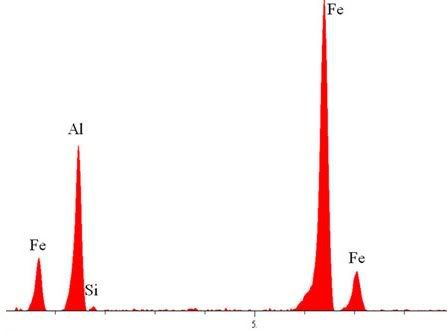
While it is a different paint, the EDS on figure 6 looks remarkably similar to the paint spectrum in this article. (Paint chip underside sample)
http://www.plant-maintenance.com/articles/failure_analysis_paint_coating.pdf

Certainly contamination of the local elements and type of paint will have large factors, but interesting none the less. See Figure 6 on PDF page 22, then compare with Jones paper on PDF Figure 6 on page 7. The Fe and the O seem very close. The AL and Si also strike me as interesting.

Note the Sulfur (S) and Chloride (CL) are likely from the local environment as stated here
http://www.matcoinc.com/?type=art&id=2365&
 
These guys ran the DSC in a flow of air with more than enough to burn anything burnable. Fires always show a nice exotherm.

Jones paper, Page 10, left column, lines 3-10:
The DSC tests were conducted with a linear heating rate of 10 °C per minute up to a temperature of 700 °C. During heating, the samples were contained in alumina pans and air was allowed to flow at 55 milliliters per minute during the heating.
 
There's something that puzzles me about DSC plots. Perhaps because I'm not familiar with it.

In DSC you are heating a sample to a temperature, and see how much energy it is abosrbing or releasing. In the plots, the data is from the very start is either zero or in the "positive" side of the y-axis. So is the exothermic peak. This would mean that the sample is either "not absorbing" or "releasing" some energy from the very start of the analysis. Now, how can any material rise its temperature without absorbing any energy at all?? Or is it igniting from the very start??

Now, if you look at graph 29 (pag 25), there's a comparison between sample 2?(b?) and a xerogel with ultra fine grain thermite. This sample shows absorption during the heating unitil it gets to the exothermic peak, when it show release of energy. Now, it does make some more sense for me.

Look now at the DTA graphs of NIST NCSTAR 1-3C (Fig. D-6, pag 444). I know DTA is not the same than DSC, but are similar things. When heating the sample, it is absorbing energy (all data is in the negative y-axis). The exothermic peak reduces the amount of absorbed energy needed to increase temeprature: it is releasing energy, but the overall effect is to absorb less energy from the environment, because some is already supplied by its internal exothermic process. But the final balance of energy shows absorption. When cooling the sample, it is releasing energy, and hence, the data is in the positive y-axis side of the graph. It makes sense for me.

That's what I would expect for the Jones' samples : to see absorption of heat when rising temperature, and then, if there really is some ignition, a real release of temperature. Something like the xergoel he compares with.

So, my interpretation is that the DSC data has substracted a "baseline": the energy that is absorbed from the environment, to leave only the excess heat absorbed or "not absorbed" compared to the reference sample(*). So, DSC data does show an exothermic process in the sample, but it is not clear whether the global energy balance is a release of energy (ignition) or just that it absorbs less energy than the referencie sample (beacuse it is supplied by the internal exothermic process).

So, now. Does it make any sense, or am I totally lost?:confused:


(*) I don't mean any kind of manipulation, but that this data is usually presented this way.
 
These guys ran the DSC in a flow of air with more than enough to burn anything burnable. Fires always show a nice exotherm.

Jones paper, Page 10, left column, lines 3-10:
The DSC tests were conducted with a linear heating rate of 10 °C per minute up to a temperature of 700 °C. During heating, the samples were contained in alumina pans and air was allowed to flow at 55 milliliters per minute during the heating.
Thanks, I missed that even though I searched this dog's breakfast of a paper.

Well that just about does it for me - these people are either completely inept and incompetent or they completely fail to understand the thermite reaction or they are utterly, utterly dishonest - maybe they are all three.

I just keep holding my head in my hands because I just cannot believe that anyone would be so stupid as to place a material compromising an iron oxide layer attached to a red layer containing aluminosilicates and Fe2O3 with an unknown Carbon based material, into a DSC, combust it and then claim a thermite reaction has taken place. :jaw-dropp

Game over - and truthers believe this <rule 10>? This paper wouldn't pass the criteria for publishing in the Beano let alone anything reputable.

There has been a distinct quiet on this paper over the last few days. Some of it, in this thread, is due to the moderated status, but overall on this forum, those who came out of he woodwork seem to have gone back in...curious.
Funny that. The original thread ran to 40+ pages. I guess even truthers know they can't defend this appalling paper.
 
This paper will follow the same course as the previous one the published in Bentham.

I think they published with Bentham as a last resort. When no serious journals would publish it (I assume the tried) they had to find somewhere to publish, and as luck would have it, one of Bentham's 300 OA journals was relevant, and "peer reviewed" (loose terminology) to boot.

I suspect this paper will hit a few independent blog sites, a few local level papers, but will not garnish them any degree of publicity nationally, either in the media, or the scientific community.

TAM:)
 
While I think he is a snake oil salesman of the highest degree, I would hope that he was not that fraudulent.

However, what I would like to see, is a description, on a microscopic scale, of other dust samples. It is highly improbable, if not near impossible, that these 4 samples of Jones would contain these mysterious chips, and no other samples collected and analyzed by others, would contain similar "chips".

Ultimately, other labs should be involved, and the descriptions from other analysis, in particular of any "paint chips" they may have found (as is described in many an abstract from other analysis), be scrutinized, and compared to Jones results.

If anyone has access to any of the dust analysis articles found on Google scholar, would they be so kind as to peruse the article, and where possible, paraphrase or quote here in this thread, the results, in particular descriptions of the dust contents (especially any paint or other chips).

TAM:)

Well that's the thing. If you don't follow accepted protocol you open yourself to all kinds of accusations. Jones's track record doesn't inspire much confidence either.

No I don't think he fabricated the samples, mainly because he doesn't have the expertise to do so. Just saying that any referee should have thrown this paper out on first principles.
 
Game over - and truthers believe this <rule 10>? This paper wouldn't pass the criteria for publishing in the Beano let alone anything reputable.

Funny that. The original thread ran to 40+ pages. I guess even truthers know they can't defend this appalling paper.


That could be. Perhaps they were hoping the real skeptics might finally buy into this witch hunt. But they quickly realized that this paper raises more questions than it answers.

Edited by Gaspode: 
Edited for topic
 
Last edited by a moderator:
If a chemical reaction occurs within the sample itself then the EDS will show exactly the same spectrum as before

Exactly the same? Where is the proof of this? Please show us some examples.

XRD will show the difference.

XRD? You mean X-ray diffraction? What exactly are you trying to say here with "show the difference"?

Edited by Cuddles: 
Edited for topic for moderated thread.
 
Last edited by a moderator:
This paper will follow the same course as the previous one the published in Bentham.

I think they published with Bentham as a last resort. When no serious journals would publish it (I assume the tried) they had to find somewhere to publish, and as luck would have it, one of Bentham's 300 OA journals was relevant, and "peer reviewed" (loose terminology) to boot.

I suspect this paper will hit a few independent blog sites, a few local level papers, but will not garnish them any degree of publicity nationally, either in the media, or the scientific community.

TAM:)
And that is 911Truth.

The product of Jones red chips looks a lot like an ALUMINIZED steel tube damaged by heat.
steeltubewithAl.jpg

Not thermite, not burnt thermite, just ALUMINIZED STEEL HEATER TUBES suffering damage from heat.

Plus his samples are not consistent for much save debris from the WTC that have rust and Al in them along with other elements you find in glass, steel, paint, clay and other items all found in the WTC without making up this paper about thermite.

We are lucking no one found cookie crumbs in the dust, we would have energy levels 11 times greater than TNT as Jones published a paper on butter extracted from cookie crumbs found at the WTC from 911, 11 times greater energy density than TNT. Now that would be a cool pay to publish paper. "Cookie Crumbs Confirm Inside Job with 11 Times the Energy of TNT".
 

ISF - Join now!

Every member here is approved by hand. No bots, no spam, just people who care about evidence and honest debate.

Membership is free!

Create your free account

Back
Top Bottom