General Characterisation (Visual Characterisation, Gray Layer and Red Layer Analysis).
I've shown that sample "chip Fig 31" does not belong in the data set and asked why this chip wasn't analysed further or removed.
I'm now looking at the red layer data for comparison between samples as part of the characterisation process.
Red Layer Analysis
Below you can see XEDS spectra from samples a) to d) and the sample that is tested with MEK (MEK chip).
As anyone can see, the two sets of spectra are very different in nature. The MEK chip has a far busier profile especially at the lower values of KeV. If we take samples a), b) and d) as the base-level for what should be a spectrum for the red layer (I'll come to c) in a minute) namely C, O, Fe, Al Si, then we can see very clearly that we have additional
labelled peaks of Zn, Cr, Ca, S which are very distinct and a far larger O peak. There is no way anyone can simply dismiss peaks of that intensity as possible contamination with wallboard or gypsum because we also have significant peaks of Zn and Cr.
We should also note, that in Fig 14 there are two other distinct peaks that have not been labelled. There is a peak at 1.3KeV which indicates the presence of Magnesium (Mg) and another at 3.4KeV which indicates the presence of Potassium (K). These should have been picked up upon but were not. Once again, to dismiss such obvious peaks as contamination is to conclude wrongly.
So we now have additions of Zn, Cr, Ca, S, Mg and K. Unless it can be shown that these elements are definitely from contamination then they must be considered as part of the spectra for the MEK chip's red layer.
If that is the case then in no way can the MEK chip be considered as part of the data set that includes samples a) to d). The MEK chip must stand on it's own and therefore the MEK test must stand only for that chip.
In order for this chip to be considered part of the data set that samples a) to d) make up, then a detailed SEM analysis of the red layer must be undertaken so as to show that this chips red layer contains the same particle characteristics as those in samples a) to d). That is it must be shown that there are rhomboidal Fe
2O
3 particles of approximately 0.1µm and >1µm platelets with the same XEDS spectrum as that seen in Fig 11a).
The MEK test is essentially void if used as an indication of what would happen to samples a) to d) if subjected to the same test. The red layer of the MEK chip is not of the same material as that of samples a) to d) (unless shown otherwise).
So lets put in the correct labelling for Fig 14.
What could this red layer be? Why is it different to the other samples?
From
http://wtc.nist.gov/NCSTAR1/PDF/NCST...3C Appxs.pdf (link not working properly

)
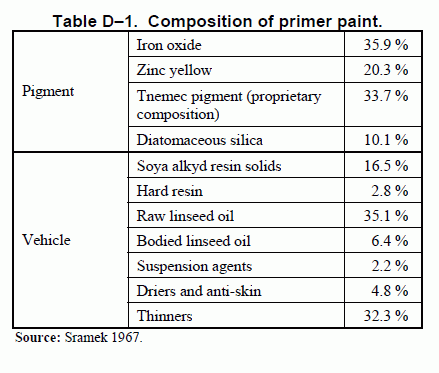
and the Material Safety Data Sheet (MSDS) for Tnemec's Series 010 Red Primer
http://www.tnemec.com/resources/product/msds/m10v.pdf and
http://www.tnemec.com/resources/product/MSDS/F010.pdf show that the composition is
We can see that the above XEDS spectrum for the red layer of the MEK chip shows sufficient data to suggest that the material may contain
Talc - Mg
3Si
4O
10(OH)
2
Zinc Yellow - ZnCrO
4
as well as the common oxides, aluminates and silicates.
I've shown in other posts on other threads how the platelets in Fig 8 and 9 have a large probability of being Kaolinite. Talc on the other hand has a different structure and XEDS data will show a different spectra too.
In order for the MEKS chip to be accepted as part of the data set of samples a) to d), these anomalies must be sorted out. The quickest way of doing this is to examine the MEK chip in the same detail as samples a) to d) - specifically looking at the morphology of the various particle structures and then performing XEDS on each particle to rule out talc as an a component of the red layer. Similarly ZnCrO
4.
My subsequent General characterisation shows that samples a) to d) can be treated as one set, however, "sample Fig 31" cannot be part of that set and nor can the MEK chip which looks increasingly like it has a form of paint separate to the paint observed on chips a) to d). In effect there are 3 different samples in this paper, all of which were extracted using the same method, all of which are claimed to be thermite. I've shown that cannot be possible.