• Quick note - the problem with Youtube videos not embedding on the forum appears to have been fixed, thanks to ZiprHead. If you do still see problems let me know.

Plasma Cosmology - Woo or not

Given 1/r2 has been tested in the laboratory down to mm scales, and the 1/r form only requires masses in a line significantly longer than the distance in question, I would not be at all surprised if it were thoroughly testable in the laboratory, Zeuzzz.

However, I can't think of a good reason why anyone would bother. It's a done deal given the laboratory testing of the 1/r2 form - it's a minor matter of calculus to derive it for a line instead of a point or sphere. There's more important tests of gravity in the laboratory to be working on.


So you dont know of any such experiments? Hopefully Ziggy will be able to back it up with something.

@Ziggy, or Edd. Or anyone really.
So what large scale objects in the universe obey this 1/r law of gravity, instead of the typical 1/r2point mass one? When does this come into effect over the usual inverse square relationship? Can you show a astrophysics paper that uses a 1/r relationship instead of the usual inverse square law? Just to back up your claim.

Same as my last post really;

Originally Posted by Ziggurat
Yes, you can get 1/r forces for line currents and line charges, but you also get 1/r for line masses.
The former italisized part we have tonnes of data to support. The second bolded part of the statement I dont think can be tied down to reality in any way shape or form. You'd need a huge gravitational potential Vg for it to work, which doesn't exist in nature, and I dont think makes this realistic at all.

So, you need to support this claim with evidence. And no, not just conjur up a definition derived from theoretical mathematical principles, a real world example of where line masses in the universe have been observed to obey a 1/r force. Using something which people call the experimental method, to see if what our theories predict follow reality.

The former 1/r relationship for the Biot Savart force law has centuries of direct in situ measurements to back it up, which due to the scale invarient (translationally invarient infact) nature of maxwells equations, and numerous observations from the nanoscale to the stellar and galactic scale, has been shown to hold time and time again with extreme precision.

Do you have any experimental evidence or data that line masses obey 1/r too?
 
Last edited:
(bold added)

Been there, done that, and have had a great many such questions ignored.


Of course they haven;t been ignored. Theres about twenty of you all bundling in after every post I write with millions of questions, attacks, and various queries, and to respond theres only one of me. If I answered every flipping question posed to me I wouldn't have a social life, or even a life for that matter as I wouldn't have enough time to eat or drink. I try to take one line of argument at a time. I'm not ignoring you. Theres only one of me.
 
@Ziggy, or Edd. Or anyone really.
So what large scale objects in the universe obey this 1/r law of gravity, instead of the typical 1/r2point mass one? When does this come into effect over the usual inverse square relationship? Can you show a astrophysics paper that uses a 1/r relationship instead of the usual inverse square law? Just to back up your claim.

None, it's not a useful thing to do. In the cases you have vaguely linear masses on cosmological scales it's easier and more accurate to simply handle it numerically in your simulations than it is to try to approximate it as 1/r - which only really works completely for infinitely long straight infinitely fine filaments.

It's just pointless to do that.

Just divide it up into smaller pointlike masses and do the 1/r2 thing instead.

I don't see how this affects anything under discussion - the same things affect EM forces too.
 
DeiRenDopa said:
(bold added)

Been there, done that, and have had a great many such questions ignored.
Of course they haven;t been ignored. Theres about twenty of you all bundling in after every post I write with millions of questions, attacks, and various queries, and to respond theres only one of me. If I answered every flipping question posed to me I wouldn't have a social life, or even a life for that matter as I wouldn't have enough time to eat or drink. I try to take one line of argument at a time. I'm not ignoring you. Theres only one of me.
Huh? :confused:

In post#2468, you wrote this, in response to PS (bold added):

"Maybe ask me about some of the books or journals I have read on this subject and what they contain, or comment on the publictaions that I linked to above, the ones published in Astrophysics and Space Sciece, the ones that Ziggurat, Sol, or DRD seem uncapable [sic] of respodning [sic] to?"

So, on the one hand, when JREF Forum members do respond to the material you post, you complain of being swamped, but when they miss, or skip, one or two - of the dozens (hundreds?) you present - they are suddenly "uncapable of respodning"?!?
 
That is basically my question: Would we see evidence of filaments in x-rays emitted by filament collisions?

But this leads to another question:
Galaxies move. Thus Perrat's galactic plasma filaments move and at the same velocity. But they move through the intergalactic medium (a plasma Sol88!).
Thus we can probably expect to see x-ray emissions from galactic plasma filaments all the time, e.g. what about the x-rays from the filaments from the Milky Way or galaxies in the Local Group?
 
One comment ...

IIRC, not only does Peratt not make it clear, in his paper(s), the extent to which gravity is simulated, but the actual code he used is not available (AFAIK). This is somewhat surprising, considering that a core feature of science - going back many centuries - is independent verification (or validation). In this case that would mean, at a minimum, taking the code and reproducing the (published) results. More broadly, it would mean taking what he (and his co-authors) published and trying to write code which reproduced his methods. Now maybe Z could claim either, or both, but I doubt he could defend any such claim (except, of course, if he actually published either Peratt's actual code or his own, independently developed, one).
This is not as big a problem as you might think. SPLASH and TRISTAN were fairly standard software in plasma physics. There is source for a 1990 version of TRISTAN here.

I suspect that the reason that Peratt not make it clear, in his paper(s), the extent to which gravity is simulated is that it was understood that gravity was ignored.
 
This is not as big a problem as you might think. SPLASH and TRISTAN were fairly standard software in plasma physics. There is source for a 1990 version of TRISTAN here.

I suspect that the reason that Peratt not make it clear, in his paper(s), the extent to which gravity is simulated is that it was understood that gravity was ignored.
Thanks! :)

I was going on what I remembered, which was that Peratt made some modifications to a standard code (TRISTAN?), and used that modified code for his simulations.

Clearly, I need to re-read the relevant papers, carefully, to be sure that I am not mis-remembering (and/or mis-stating).

Somewhat OT: it seems Peratt did not do any simulations after the initial (pair of?) paper(s), though at least one of his later papers reports simulations. In the meantime, astrophysicists (not plasma physicists) developed codes of their own, and today we have, for example, MHDEnzo ... it's curious that the plasma physicists seem to have not availed themselves of the work of these astrophysicists (or did they?).
 
Goodbye Zeuzzz

Of course they haven;t been ignored. Theres about twenty of you all bundling in after every post I write with millions of questions, attacks, and various queries, and to respond theres only one of me. If I answered every flipping question posed to me I wouldn't have a social life, or even a life for that matter as I wouldn't have enough time to eat or drink. I try to take one line of argument at a time. I'm not ignoring you. Theres only one of me.
Emphasis mine ...
Sorry Tim. I tried to answer your question with numerous papers I think address your question directly, but since I seem to have posted highly relevent material answering your questions people seem to have got annoyed at me. I resign from this thread. And from the forum. Now I've gone maybe this thread can be filled with the science underlying the publications I posted and not Ad Homs, accusations and attacks.
Zeuzz: You don't seem to have responded to this post yet. Do you have any comments?
I don't think he intends to respond, and may not even be reading anymore.
Evidently Mr. Zeuzzz has succumbed to the frustration inherent in caring too much about trying to answer everybody. But it's his own fault. His is a very provocative style, which he should know will evoke maximum reaction. I would say just ignore most of the responses and just bother with the important ones. That's what I do, and it seems to work for me.
 
Theres only one of me.

On one hand, this is a real issue. A biologist popping in to a creationism discussion board might find him or herself in the same position as Zeuzzz is here---one voice on one side against N on the other side.

It could also be a real issue, hypothetically, in the case that all crackpots imagine themselves in: "I've got the skeleton of The Right Theory but not all the details". Imagine, say, Erwin Schrodinger in 1922 trying to explain quantum mechanics to a crowd---and that the crowd could already come up with nonlocality, Bell's Inequality, the Lamb shift, and whatnot as "objections" to which the answers are not obvious. This was more or less the case with early continental drift---its defender didn't have enough information to defend it.

But it's also the expected situation with someone stubbornly promoting indefensible baloney. It was the situation in the longer Bigfoot photo threads; it was the situation in Dutch's ongoing thread.

But we do learn something from Zeuzzz's circumstances here. We learned that:

  • Zeuzzz had no reliable resources to turn to. If you ask me a question about any complex field of mainstream science---well, I know where to find the reliable sources. "Why exactly can't we do lattice QCD at high baryon chemical potential?" is not a question I know the answer to, but:
    1. It would not prompt "Don't hound me, I'm only one man!"
    2. It would not prompt a random Google search unrelated lattice papers
    3. It would prompt a quick scan of Annual Reviews of Nuclear and Particle Science, because the scientists want you to know what they know and that's how they do it.
  • PC relies heavily on a small number of very old papers. The entirety of the data on "electric models of loops from the Sun" seems to be this 100-year-old terella thing. Jeez, I can't think of another experiment, in any field, that hasn't been improved in 100 years. Heck, we routinely restage most of the foundational experiments of physics in undergrad labs. The entirety of "E&M models reproduce the flat galactic rotation curve" seems to be based on a single 1992 simulation by Peratt. The entirety of the "magnetic reconnection doesn't exist" thing seems to come from random quotes from Alfven. Again, if PC had something like a normal scientific background, Zeuzzz should not have felt besieged with this stuff, he'd have had a library of standard citations.
  • We've got three anti-mainstream people "contributing" to the discussion (Sol88, Mozina, and Z.) and exactly zero constructive consensus among them---odd, no?---and also no disagreement. Stop me if I'm wrong, but I don't recall Z. ever posting something like "MM and Sol88, please shut up, you've got the physics wrong." (Correct me if I'm wrong.)
  • PC is not in the position of Schrodinger circa 1922, nor Wegener circa 1916. The theory he's defending is decades old, and its whole attraction was supposed to be that the physics (just E&M, no Big Bang) was already well known. We random JREFers should not have been the first people asking hard questions---and indeed we weren't. The problem really is that the questions don't have good answers ... except "Sorry, PC is rubbish", a perfectly straight answer that Z. didn't want to give.
 
So, you need to support this claim with evidence. And no, not just conjur up a definition derived from theoretical mathematical principles, a real world example of where line masses in the universe have been observed to obey a 1/r force. Using something which people call the experimental method, to see if what our theories predict follow reality.

Den is right: you've missed the quantitative revolution in physics that started with Newton.

The former 1/r relationship for the Biot Savart force law has centuries of direct in situ measurements to back it up, which due to the scale invarient (translationally invarient infact) nature of maxwells equations

No, it's not. You're using terms which you obviously don't understand. Scale invariance and translational invariance are not the same, nor does translational invariance require 1/r force laws for line sources. It's due to the fact that each current element in the line contributes a 1/r2 term, and when integrated over the current line we get a 1/r. Since you're really bad at math, that's a fancy way of saying we add up the contributions from each bit of source. So as I already said, all we need is a 1/r2 dependence for point-like sources, and linearity. Which we have for both electromagnetism and for gravity, and both of those aspects ARE well-tested for both theories. You CANNOT avoid a 1/r dependence for the field of a line source unless one or both of those conditions break down. And they only break down for gravity in very STRONG gravitational fields.

Do you have any experimental evidence or data that line masses obey 1/r too?

Yes: gravity obeys 1/r2 for point-like sources, and it's linear at low fields. We have lots of experimental evidence for both. And that is all that is necessary. Sticking your fingers in your ears and denying what any undergraduate physics student with half a clue would understand quite well is going to impress no one. Well, maybe Sol88 and Michael, but that's nothing to be proud of.
 
There are hunderds of others in the IEEE journals, in Astrophysics and Space Science and other journals.

But unfortunately, these journals are not really the pinnacle of scientific publications.

Zeuzzz said:
There are hundreds more with maths in it. Maybe starting with this one would be a good idea:

Two world systems revisited: a comparison of plasma cosmology and the big bang, Lerner, E. J., IEEE Transactions on Plasma Science, vol. 31, issue 6, pp. 1268-1275 [full text]

Shock! Lots of maths, data and statistics

So, instead of a real discussion, you just throw in another of your thousands or hundreds of publications and will beleaguer us just as long till we give up out of exasperation and then you can claim victory for your EU ideas (of which apparently you are not even a supporter, as you claimed a few pages back). Don't mind if I do not join in this game.
 
Last edited:
Unlike anyone else on this forum, I have read Cosmic plasma by Nobel Laurate Hannes Alfven, Physics of the Plasma Universe by Peratt,

[snip]

Now are you going to ask a question that progresses the conversation? Maybe ask me about some of the books or journals I have read on this subject and what they contain, or comment on the publictaions that I linked to above, the ones published in Astrophysics and Space Sciece, the ones that Ziggurat, Sol, or DRD seem uncapable of respodning to? Or do you want to hurl some more abuse at me?

Dear Zeuzzz, just READING it all, does not bring you much. I have (admittedly not completely) read Alfven's books, Peratt's book, and load of more books on spacephysics and plasma(astro)physics, so what.

What fails is your understanding of physics, blatantly showing in all the posts you write here on the board. So, you might have read the books and papers, but I seriously doubt that you have understood it all.
 
No unclarities, if the assumption is they are charged!

This is so much nonsence, what you wrote down here, Sol88, that I don't want to waste my sunny Easter Monday, trying to correct all the mistakes you and Alexeff made.

First learn physics, Sol88, maybe then we can have a real discussion.
 
Reality Check said:
I at least read your responses (unlike Zeuzzz!). Your mention of synchrotron radiation reminded me of something that I have been mulling over.

I do have a question for you as someone whose is knowledgeable about astronomy. And maybe Zeuzzz can think about it too.
Perrat's plasma model needs galactic sized (in width) plasma filaments that are an average of a billion light years long.
Galaxies move and thus the filaments attached to them must also move. This means that galaxies can move through filaments; there can be near misses of galaxies and so collisions between their filaments; galaxies even collide (passing through each other or merging) ensuring that their filaments collide.
In addition galactic clusters that are packed with these galactic plasma filaments also collide (e.g. the Bullet Cluster).
My expectation is that all of these filament collisions cause shock waves and so would be easily seen as x-rays. Thus I would expect that the Bullet Cluster should be full of x-ray emitting galactic plasma filaments.

Am I right and are such x-rays seen?

A couple of small questions for Zeuzzz:
As mentioned - galaxies collide. As far as I can see galaxies on the same filaments can collide.
What happens to the electric current through the filaments?
For example 2 galaxies on the same filaments merge. This short-circuits the current. I would expect all of the galaxies in between the merged ones to at least change their galactic velocity curve(or need dark matter to be created).
Maybe the galaxies even stop spinning (what happens in Perrat's simulation when the current is turned off? - the "galaxies" certainly stop spinning in the plasmoid experiments)!

How do the filaments remain stable as the shock waves from the collisions travel through them?
An interesting set of questions, RC! :)

The first thing to note is that Peratt's model is (strongly) inconsistent with well-established^ astronomical observations of a great many kinds^^; this makes any consideration of your questions ones about a toy universe (or part of such) that we already know does not correspond to the one we live in (except, of course, at the PC word-salad handwaving level).

IIRC, Peratt's plasmas are highly, if not fully, ionised (no neutral atoms or molecules, no uncharged dust, etc), in which only electrons need be considered wrt emission or absorption.

Further, in his model - pace Z, gravitational interactions are ignored (this is an aspect that needs further clarification, but I'm pretty sure gravity is ignored when it comes to galaxy-galaxy or galaxy-filament or filament-filament interactions). One consequence of this assumption is that it is not at all obvious that galaxy-galaxy, galaxy-filament, or filament-filament collisions can occur (it may well be that they cannot, if magnetic reconnection is impossible in his model, for example). So perhaps your question ends there?

Next, Peratt's model rests on the validity of certain scaling relationships ... but IIRC some key ones were either ignored or implicitly rejected. Examples? Well, synchrotron and free-free emission, for example, and - as you say - shocks. I'll explore this in more detail in later posts; it goes to the heart of your questions, concerning observables.

But perhaps we should take a step back and look at what the relevant astronomical observations are? Of galaxy clusters I mean, as we've already covered the key points concerning galaxies. Stay tuned! :)

One more aspect: do you remember Anaconda? the second point he wanted to focus discussion on? It had to do with double layers and electromagnetic acceleration, and it's highly relevant to your questions. Why? Because there's a whole other set of observations that may be very pertinent ... cosmic rays (can you see why?).

(to be continued)

^ in the sense of there being multiple, independent datasets which are published (and, in general, available for download from online catalogues). One giant caveat does need to be entered: if you implicitly or explicitly reject so many parts of standard, textbook physics (as MM and Sol88 do), then almost all of these observations need to be re-analysed within the framework of the physics that is accepted ... no surprise that this would be a massive undertaking! However, there is a critical corollary: unless and until such work is done, then the astronomical observations cannot be used for any purpose. Insofaras Z rejects some parts of textbook plasma physics (e.g. magnetic reconnection), his comments can also, on the whole, be set aside as little more than meaningless noise.
^^ some of which we've covered in this thread, and similar ones, but many (most?) of which we haven't begun to examine, not least because I, for one, am still waiting for Z to respond to some basic, must-answer-first questions on this topic
A little delayed - Easter provides a nice opportunity for a looong weekend! - but I hope you're still interested RC (even if Z - and Sol88? - has departed in the interim).

Let's start with Evolution of the plasma universe. I - Double radio galaxies, quasars, and extragalactic jets, Peratt's 1986 paper that seems to contain the key concepts and reports most of the results (you can download a copy from one of the sources Z - and others - have given, if you don't have access to the IEEE site yourself).

As the title suggests, this paper is about the formation, and evolution, of "double radio galaxies, quasars and extragalactic jets" (duh!)

In Peratt's model of the universe^ (or at least a very large part of the observable universe), these three classes of astronomical object arise when two "galactic-sized Birkeland currents" interact; crudely, the currents are filaments, and they exhibit long-range attraction but short-range repulsion. Their interaction produces double-lobed radio sources with synchrotron radiation SEDs and plasma compression. As the interaction proceeds, elliptical and/or "dust-lane" peculiar galaxies" are created at the centre (spiral galaxy formation is the subject of the second 1986 paper - I'll look at that later); the shape (morphology) of the emission regions, the SEDs of various parts of space where the interaction is happening, and the total "radio flux observed" change as the interaction proceeds.

To model these interactions, Peratt uses SPLASH and TRISTAN, which he says have been benchmarked against plasma experiments in the lab and observations of (Earth) magnetospheric phenomena (among others).

The start of part B in section VI (Scaling Simulations to Galactic Dimensions) is quite interesting; Peratt lists some six items that are required. One of the six is "the gravitational force" ... but the simulations reported in this paper do not include it.

So, wrt the first of Peratt's two papers, the general answers to your questions are as follows (no particular order):

* galaxies do not move independently of filaments; various EM forces on filaments are the root cause of relative galaxy-galaxy motion

* galaxies form when filaments interact (collide) - the interaction produces an intense burst of synchrotron radiation (in a double lobed structure, typically) and later a galaxy forms at the centre

* shocks are not modelled

* clusters are not modelled.

It is important to remember that the universe Peratt is modelling is not the one we live in (while Peratt may have shown some consistency between his model and some astronomical observations, of selected objects, the narrowness of the scope of his tests is astonishing^^), so in one way it is irrelevant what the astronomical observations of galaxy clusters are (across the entire EM spectrum) ... even if Peratt had modelled them.

Oh, and a somewhat curious note: remember that to EU proponents Arp is a hero, not least because of his work purporting to show that quasars are 'local', and that galactic redshifts are not a reliable indicators of distance (per the Hubble relationship)? Well, the success of this Peratt paper in explaining "the total magnitude of the radio flux observed" (one of Peratt's own requirements of the model) depends centrally on the "double radio galaxies" (and, later, quasars) being at their Hubble flow distances! :eye-poppi Strange it is that EU/PC proponents neglect to mention this ... perhaps a reflection of their critical thinking skills? or their weak grasp of astronomy?

Next, paper II, and a look at astronomical observations of galaxy clusters.

^ the last sentence before section III of this paper: "The remainder of this paper is concerned with what the signatures of existence would be to an observer situated within a nonhomogenous plasma universe consisting of galactic-sized Birkeland currents."
^^ but perhaps not surprising; for consistency with the totality of astronomical observations, Peratt would have some very difficult questions to answer, such as the nature of stars, how they form, what powers them ... and how it's possible to have billions of multi-billion year old stars in a galaxy that should have formed only a few tens of millions of years ago!

 
Last edited:
Galaxy clusters, some observations

Continuing from my last post, a brief examination of the observational evidence for Peratt-style filaments.

To date, thousands of galaxy clusters have been imaged, in wavebands from the gamma to the radio. While resolution remains poor in some wavebands (especially the gamma ones), the existence of extended, or difuse^ cluster emission is well-established, and the general characteristics of such emission fairly concisely described.

I'll look at just three wavebands: x-ray, optical/visual, and radio; between them these can provide strong tests of Peratt-style filament hypotheses.

First, the optical.

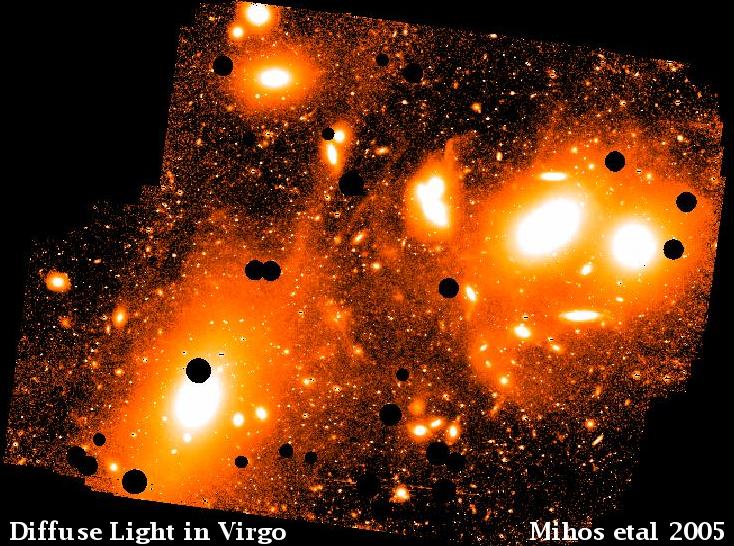
Here is what the Virgo cluster (the one nearest to us) looks like:

VirgoICL.jpg


This is from Diffuse Light in the Virgo Cluster, which reports work by Mihos et al.

In brief, in the optical waveband, the 'intra-cluster light' is from stars, most of which got there as a result of galaxy interactions. Here is a recent paper on this topic (the references in it are a great resource).

Next, the x-ray.

The Coma cluster is the rich galaxy cluster nearest to us (the Virgo cluster is puny by comparison), and has been extensively studied.

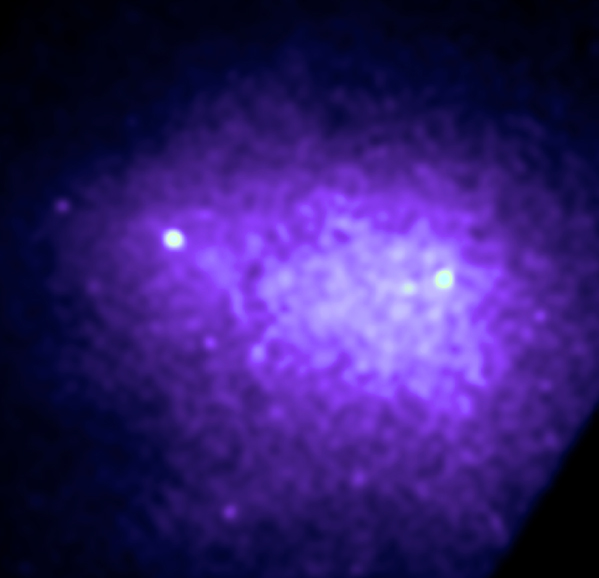
Here is what it looks like at low resolution, with an optical band image overlaid at the centre:

Coma_x.gif


and at higher resolution (Image courtesy of U. Briel, MPE Garching, Germany and ESA)

coma_1_med.jpg


and from Chandra (also higher resolution):

0150_xray.jpg


In brief, in the x-ray waveband clusters are centrally concentrated, fairly symmetrical blobs; they are essentially a very hot, very tenuous plasma ... the diffuse x-ray emission is 'thermal'. Here is one paper which discusses the temperature structure of the Coma cluster in detail, and here is a more recent paper on whether there is any diffuse non-thermal x-ray emission from the Coma cluster, from 0.5 to 107 keV.

Finally, the radio.

Observations of extended radio emission in clusters is a 2008 review. Of interest is that where there is extended radio emission (rather uncommon in clusters) it is synchrotron radiation - relativistic electrons moving in magnetic fields. Three types of extended radio sources are described - radio halos, radio mini-halos, and radio relics, with the Coma cluster providing the oldest example of the first (Coma C).

In brief then, there is no sign of any Peratt-style filaments within galaxy clusters, at least in wavebands other than the radio. Extended/diffuse radio emission in clusters is not very common, but when it is observed, it is synchrotron radiation. Evidence, then, for the filaments so popular with PC proponents? No ... and I'll explain why in a later post.

^ as in 'not from point-sources'. Of course, a galaxy could be a point source (it depends on the waveband and the resolution), but at least some of the nearby galaxy clusters have sizes (in degrees/minutes/seconds on the sky) considerably greater than the resolution of the best 'telescopes', in all wavebands
 
Last edited:
I second DD's thanks.
Always a good post from DRD although some replies to certain posters can be a bit rough:p
 
They are only rough if one does not review the history here, there are many threads that certain posters have participated in, they have done the same thing for over two years now. Post and run, assert and never substantiate. Vague llusions and references.

"I am agnostic on fusion as a solar process."

last year certain posters asserted that out of date evidence was the absis of Plasma Cosmology.
 
Peratt's paper II

Continuing the examination of Peratt's papers wrt RC's questions about galactic-sized filaments in (rich) clusters (of galaxies).

Recall that in paper I Peratt described his model, the simulations (using SPLASH and TRISTAN), and the consistency he found between astronomical observations and simulation. It is important to remember that Peratt's model is of the formation and evolution of galaxies, from the interactions between two (or more) galactic-sized filaments in a plasma universe.

Paper II - Evolution of the plasma universe. II - The formation of systems of galaxies (link is to the ADS abstract) - extends the simulation from ~100 million-1 billion years to ~5 billion years, and claims to provide a good description of all classes of galaxies in terms of their morphology (in the optical and radio wavebands), their radio power, and their rotation curves (for spiral galaxies).

Since 1986 Peratt has published several papers which cite one or other (or both) of Paper I or Paper II. While I have not read all of them carefully, it seems that there is little new work reported in any, at least no new simulations; and none seem to cover galaxy clusters^.

One thing I did confirm: I remembered that Peratt modified the pure plasma simulations to incorporate gravity, at least in some respect. Well, I was wrong ... in none of the papers does he state that gravity is incorporated in any simulation whose results he is reporting.

Further, in Paper II (and several subsequent ones) he makes it very clear that massive, essentially (charge) neutral objects (IOW stars) would not have trajectories that are governed by the EM forces that drive the motions of the plasmas in the simulations. This leads to a rather remarkable conclusion: either Peratt did not know that spiral galaxy rotation curves have been derived from starlight or chose to ignore this. Now this itself isn't particularly important, until you recall that spiral galaxy rotation curves are essentially the same, whether derived from starlight, HI emission, the motion of PNe, ...! Of course, given the scope of Paper II, it is perhaps not surprising that this was overlooked, especially as it was published in a journal whose reviewers would not be expected to know much about astronomy. However, that none of Peratt's subsequent papers which mention spiral galaxy rotation curves even hint at it either is quite remarkable. In fact, I don't know how he has continued to get away with it.

So, does Paper II provide any clues as to how RC's questions can be answered? In a word, no.

* galaxies do not move independently of filaments; various EM forces on filaments are the root cause of relative galaxy-galaxy motion

* galaxies form when filaments interact (collide) - at timescales of ~1 to 5 billion years, all observed galaxy types form; in particular, there is an evolution of a galaxy from a double-lobed radio galaxy/quasar to radio-quiet QSO to peculiar and Seyfert galaxies to normal and barred spirals, with ellipticals and lenticulars making an appearance along the way

* shocks are not modelled

* clusters are not modelled.

Next, and last, a more detailed look at the synchrotron emission from clusters, in the radio waveband, so see if anything resembling Peratt's galactic-sized filaments can be found.

^ interestingly, nearly all of them mention the need for the cosmic circuits to be closed - i.e. the filaments need to connect up, somehow, to form closed circuits; however, there is no hint of how and where this occurs, nor of what powers the giant circuits, nor ...
 
Last edited:

Back
Top Bottom