• Quick note - the problem with Youtube videos not embedding on the forum appears to have been fixed, thanks to ZiprHead. If you do still see problems let me know.

Plasma Cosmology - Woo or not

That website is nothing to do with plasma cosmology. Its by the guy that runs the thundbolts crap. He doesn't have a clue about physics, as his articles demonstrate, he uses the term plasma cosmology to try to add credence to some of the electric universe garbage and try to sell as many books as possible. If you want to see plasma cosmology stuff then look in the peer reviewed journal articles at the IEEE, Peratts book Physics of the Plasma Universe (available at all good universities) Cosmic plasma by Hannes Alfven, or any other publication. Your making me sound like a broken record! And still you dont do what I ask, every time.

Look here: http://www.plasma-universe.com/index.php/Plasma_Universe_resources#Journals

And on the IEEE site for their journals; http://ieeexplore.ieee.org/xpl/RecentIssue.jsp?punumber=27

HAPPY READING

Please dont quote any more stuff from dubious watered down websites.


Not really representative, again.


So gravity obeys a similar geometric law as EM? as in, amperes law around a wire (1/r)? Do you have a reference? How on Earth could this have ever been measured.

Could tie in very nicely indeed with a certain someones theory of galaxy formation.


Your looking at something written by a PC proponent thats been watered down for the general public, and claiming this is 'core claim' they are making. Its a website, look at the peer reviewed material underlying it which goes into far more detail. Crickey.

And I'm sorry but it categorically does obey a longer forvce law in this case (Biot Savart force law in this case). Sure, magnetoststics and electroctstaics obey 1/r^2 like gravity, but not in the case of filamentary attraction in specific circumstances.

You are right in what you say btw "Once that separation distance is significantly larger than the length, it won't obey 1/r force laws anymore", but this really doesn't matter, as in the case we are talking about a model where the separation distance is not significantly larger than the length. The filaments in question are called filaments for a reason. So his assertion is completely true. And will remain so. Which you would know if you had the slightest compregention of plasma cosmology. Still no-ones emailed me to ask for the PDF of Peratts physics of the plasma universe. Until people read this much cited and respected material and comment on its veracity, this converstaion is going to go round and roound in circles.

I dont know how many flipping time I'm going to say this, but PLEASE look at the peer reviewed publictaions in highly respected journals and not short snippets from websites.

Start with these two: Advances in Numerical Modeling of Astrophysical and Space Plasma, A. L. Peratt, 1997, Astrophysics and Space Science, Volume 242, Numbers 1-2 / March, 1996 [full text]


Advances in Numerical Modeling of Astrophysical and Space Plasma, Part II Astrophysical Force Laws on the Large Scale. A. L. Peratt, Astrophysics and Space Science, Vol246, 1998 [full text]


When you've found out all the hand waving, wrong aspects, crackpot parts, and mistakes, please contact the Journal of Astrophysics and Space Science and ask them to retract the paper. In the stutaion that major mistakes have been made, they DO make retratcions, it has happened before. I remember Science retartcing a couple of old papers recently due to them being wrong.


The last publication can also be vewied in Plasma physics: proceedings of the 1997 Latin American workshop : VII LAWPP 97, held in Caracas, Venezuela, January 20-31, 1997, available in HardBack in all good universities, and continaing Peratts plasma cosmology material. Look on this page for the google book (page 51): http://books.google.co.uk/books?hl=...BFCc&sig=uuEQVHDy8fiuBD-37H7BBrQKFgM#PPA50,M1


And this one may be a good idea aswell: Electric space: Evolution of the plasma universe Astrophysics and Space Science, Volume 244, Issue 1-2, pp. 89-103 1997


There are hunderds of others in the IEEE journals, in Astrophysics and Space Science and other journals.

SO STOP CONFUSING EU SPECULATIVE UNPUBLISHED NONSENSE FOR PLASMA COSMOLOGY. Theres a scientific process and a peer review process for a very good reason.

Nuff said. Wan't even going to post anymore today. But this just screamed at me to outline where your going all wrong. Will anyone ever listen when I tell them the difference between plasma cosmology in journals, and just speculative EU material thats been masked under the more authorative material of plasma cosmology? I hope so. One day. Its a dream I have. Nearly 60 pages of posts and no-one seems to have got it yet!
(no need for bold to be added!)

Let's see now ...

There is a paper, with W. Thornhill listed as author, published in IEEE Transactions on Plasma Science, and we are reliably informed - by a certain Z - that its reviewers have impeccable scientific credentials (they include Peratt). The paper - which is quite difficult to get - contains an exposition of something a certain JREF Forum member (whose handle starts with the letter Z) recently called "largely crap and highly specualative". Curiously, it was the very same Z who introduced this paper to this thread! :eye-poppi And who was it who wrote, very recently "Will anyone ever listen when I tell them the difference between plasma cosmology in journals, and just speculative EU material thats been masked under the more authorative material of plasma cosmology?"

Why I do think it's the very same person who claimed that a document (conference presentation), by Peratt and Scott (and others?), on how ancient stone carvings were clear evidence of high-energy (atmospheric) plasma phenomena (and so concrete evidence in support of the woo-ist of EU woo ideas?), was a peer-reviewed paper! :jaw-dropp

So, it seems that the record of your posts in this thread is pretty clear, Z ... lots of dodging, flipping, squirming, and generally behaving like a troll.

Oh, and Peratt? Wasn't his paper (papers?) on the formation of spiral galaxies, and an explanation of their rotation curves (no need for CDM) presented - by you - and discussed?

Ditto some papers by Lerner.

And so on.

Can you remind me, please, Z, just who is it that seems to have not 'got it' yet?
 
So would every other papaer on plasma or EM in space. Which is why I later retracted from Peratts vague defintion.
You did?

Would that be when you introduced Lerner's definition? The one that makes it crystal clear that PC is the very definition of scientific woo?
 
There is a paper, with W. Thornhill listed as author, published in IEEE Transactions on Plasma Science, and we are reliably informed - by a certain Z - that its reviewers have impeccable scientific credentials (they include Peratt). The paper - which is quite difficult to get - contains an exposition of something a certain JREF Forum member (whose handle starts with the letter Z) recently called "largely crap and highly specualative". Curiously, it was the very same Z who introduced this paper to this thread! :eye-poppi And who was it who wrote, very recently "Will anyone ever listen when I tell them the difference between plasma cosmology in journals, and just speculative EU material thats been masked under the more authorative material of plasma cosmology?"


That publication from Thornhill is an enigma. I suspect theres a very good reason why the reviewers let it in despite its dubious and hand waving content. Something that ties into Peratts galaxy formation models. They've put a lot on the line letting that be published.

I see Thornhill to stronomy as what John Anthony West is to Egyptology. He has no formal education in this area, but yet has an uncanny knack of thinking outside the box and noting observations that could be highly relevant, much to the disdain of the trained experts in this field. Anthony west was the first to note the sound geological reasons for extensive water erosion on the sphinx dating it at far older ages than conventional theories. It was dismissed by conventional egyptologists not because it was scientifically unsound, but because of his lacking credentials. Here was someone from way out of left field, with a compelling theory, backed up by tonnes of data, numerous geologists too (now) and undermining much of conventional opinion. Same with Thornhill. His ideas are either going to be amazingly sucessful and continued to be worked on, or they will be fully disproved. The IEEE certainly took a huge risk publishing his paper. One thiings for sure its certainly an interesting read, even if its lacking any definitive model. Its a completely unique and new way of looking at something once thought set in stone.

Why I do think it's the very same person who claimed that a document (conference presentation), by Peratt and Scott (and others?), on how ancient stone carvings were clear evidence of high-energy (atmospheric) plasma phenomena (and so concrete evidence in support of the woo-ist of EU woo ideas?), was a peer-reviewed paper! :jaw-dropp


You haven't the slightest clue about that material, as you have just demonstrated. The point of that work is the amazingly striking similarities between dozens of seemingly comepltely separate ancient artworks all over the world that had no way of contacting each other and the auroral phenomenon they could have all seen to make their artwork the same. Thats a VERY BREIF description. The problem of why such separate groups of ancient tribes have largely the same exact art is an entirely mainstream mystery also in many other journals. Peratt et al are merely one more group that have proposed an explanation. If you would like I can start a thread about this material; it doesn't belong here, your derailing this thread, again, and making arguments from ignorance, again.

Oh, and Peratt? Wasn't his paper (papers?) on the formation of spiral galaxies, and an explanation of their rotation curves (no need for CDM) presented - by you - and discussed?

Ditto some papers by Lerner.

And so on.

Can you remind me, please, Z, just who is it that seems to have not 'got it' yet?


Because the majority of people here have neither "got it" either. What usually happens is someone points out a grammatical error, a slight problem with one or two equations, and thus uses the logical fallacy that due to this the entire paper is wrong, and their entire premise and main points can be ignored based on this logival fallacy.


*this post porbably makes no sense and has terrible spelling and grammer. I'm tired, hungover, and going to bed. So take it seriously at your peril
 
So gravity obeys a similar geometric law as EM?

Well, duh.

as in, amperes law around a wire (1/r)? Do you have a reference? How on Earth could this have ever been measured.

For both current wires, for gravitational line sources, AND for line charges, it comes from integrating a 1/r2 field due to each point-like source over the entire line of source. You don't even have to measure it, it's a necessary result of a 1/r2 field for a point source. And it's a bog-standard textbook problem too.

Could tie in very nicely indeed with a certain someones theory of galaxy formation. Gravitational attraction of 1/r between filaments of considerable mass, without the need for dark matter!

Nope. Galaxies are flattened disks, not lines, so it rather obviously doesn't work that way.

And I'm sorry but it categorically does obey a longer range force law than gravity in this case like Peratt says (Biot Savart force law). Sure, magnetoststics and electroctstaics obey 1/r^2 like gravity, but not in the case of large scale filamentary attraction, which is a unique force unto itself.

No. Again: 1/r only works when the lines are much larger than their separation, but in such a case, that 1/r applies to the gravitational attraction between the lines too. So it's absolutely false. It's a lie, aimed at the gullible who don't know where those equations come from. Apparently you're in that group.

You are right in what you say btw "Once that separation distance is significantly larger than the length, it won't obey 1/r force laws anymore", but this really doesn't matter, as in the case we are talking about a model where the separation distance is not significantly larger than the length.

In which case, their gravitational attraction will also scale as 1/r. Making his claim simply false.

The filaments in question are called filaments for a reason. So his assertion is completely true. And will remain so. Which you would know if you had the slightest comprehention of plasma cosmology.

The lie, and the reason it's a lie, are completely independent of whether we're talking about plasma cosmology or anything else. the conditions which would provide a 1/r force for electromagnetic interaction will also give a 1/r force for gravity. Conditions which produce a 1/r2 force for gravity will at best produce a 1/r2 force for electricity (and only a 1/r3 force for magnetism). It doesn't matter which conditions you're talking about: a direct comparison will always produces force laws for gravity which are at least as long range as for electromagnetism. So rather than demonstrating that I don't understand plasma cosmology, this has only demonstrated that you don't understand electromagnetism.

Nuff said. Wan't even going to post anymore today. But this just screamed at me to outline where your going all wrong. Will anyone ever listen when I tell them the difference between plasma cosmology in journals, and just speculative EU material thats been masked under the more authorative material of plasma cosmology? I hope so. One day. Its a dream I have. Nearly 60 pages of posts and still no-one seems to have got it yet!

Except I DID rip into exactly one such paper, the one you referenced in post #2432. tusenfem also responded, but my response is #2451. I haven't seen you respond yet. That' paper at least has math, but the math is complete junk.
 
Well, duh.


For both current wires, for gravitational line sources, AND for line charges, it comes from integrating a 1/r2 field due to each point-like source over the entire line of source. You don't even have to measure it, it's a necessary result of a 1/r2 field for a point source. And it's a bog-standard textbook problem too.


Nope. Galaxies are flattened disks, not lines, so it rather obviously doesn't work that way.


No. Again: 1/r only works when the lines are much larger than their separation, but in such a case, that 1/r applies to the gravitational attraction between the lines too. So it's absolutely false. It's a lie, aimed at the gullible who don't know where those equations come from. Apparently you're in that group.


In which case, their gravitational attraction will also scale as 1/r. Making his claim simply false.


The lie, and the reason it's a lie, are completely independent of whether we're talking about plasma cosmology or anything else. the conditions which would provide a 1/r force for electromagnetic interaction will also give a 1/r force for gravity. Conditions which produce a 1/r2 force for gravity will at best produce a 1/r2 force for electricity (and only a 1/r3 force for magnetism). It doesn't matter which conditions you're talking about: a direct comparison will always produces force laws for gravity which are at least as long range as for electromagnetism. So rather than demonstrating that I don't understand plasma cosmology, this has only demonstrated that you don't understand electromagnetism.


Except I DID rip into exactly one such paper, the one you referenced in post #2432. tusenfem also responded, but my response is #2451. I haven't seen you respond yet. That' paper at least has math, but the math is complete junk.


Sorry, but you still obviously haven't read the papers yet. Or physics of the plasma universe. Get back to me when you have, and make sure to get you letter to the Journal of Astronomy and Astrophysics ready so they can retract Peratts work.


Except I DID rip into exactly one such paper, the one you referenced in post #2432. tusenfem also responded, but my response is #2451. I haven't seen you respond yet. That' paper at least has math, but the math is complete junk.


Whoop de doo. Theres issues with the maths in one of the hundreds of relevant papers. Maybe why its not been cited much. Not the case with physics of the plasma universe (peratt). And the hundreds of other ones that you refuse (or lack sufficiant priveleges) to look at. Its hardly a core apsect of PC. But unipolar induction does have a place in magnetic field generation in space in general, and alfvens ideas on galaxy rotation, and the axis of evil*, and other aspects. All of which do probably not make the mistakes Alexeff makes. But we'll see what he says in responce to your critisisms when he contacts me back, he's been very open before when I talked to him. He might even sign up here to back up his work.

http://bigbangneverhappened.org/ (click 2007 year end report on the left to see the following)
*D. More anisotropy

Conventional cosmology hypothesizes that the universe, on a large scale, is isotropic. Yet this year, evidence has shown large-scale anisotropies in measurements other than that of the CBR. Michael J. Longo showed that spiral galaxies tend to spiral more in one direction than another, possibly implying a large scale magnetic field in region some 350 Mpc across. The alignment of the spins seems to point in direction close to that defined by anisotropies in the CBR.

There is also an asymmetry in the Hubble expansion, or in the velocities of galaxies within an even large volume, some 600 Mpc or more across. First Megan L. McClure and C. C. Dyer, and then Dominik J. Schwarz and Bastian Weinhorst used supernova data to find that the Hubble constant is about 10% lower in some directions than in others, implying either an asymmetry in the process that creates the Hubble redshift, or velocities for galaxies of up to 3,000 km/sec.

Is the Cosmic "Axis of Evil" due to a Large-Scale Magnetic Field?

Authors: Michael J. Longo

http://arxiv.org/abs/astro-ph/0703694v2

Does the Universe Have a Handedness?

Authors: Michael J. Longo

http://arxiv.org/abs/astro-ph/0703325v2


Anisotropy in the Hubble constant as observed in the HST Extragalactic Distance Scale Key Project results

Authors: M. L. McClure, C. C. Dyer

http://arxiv.org/abs/astro-ph/0703556v1

(An)isotropy of the Hubble diagram: comparing hemispheres

Authors: Dominik J. Schwarz, Bastian Weinhorst

arXiv:0706.0165v1 [astro-ph]


Bah. Over and out.
 
Last edited:
[...]

But unipolar induction does have a place in magnetic field generation in space in general, and alfvens ideas on galaxy rotation, and the axis of evil*, and other aspects. All of which do probably not make the mistakes Alexeff makes. [...]

*D. More anisotropy

Conventional cosmology hypothesizes that the universe, on a large scale, is isotropic. Yet this year, evidence has shown large-scale anisotropies in measurements other than that of the CBR. Michael J. Longo showed that spiral galaxies tend to spiral more in one direction than another, possibly implying a large scale magnetic field in region some 350 Mpc across. The alignment of the spins seems to point in direction close to that defined by anisotropies in the CBR.

There is also an asymmetry in the Hubble expansion, or in the velocities of galaxies within an even large volume, some 600 Mpc or more across. First Megan L. McClure and C. C. Dyer, and then Dominik J. Schwarz and Bastian Weinhorst used supernova data to find that the Hubble constant is about 10% lower in some directions than in others, implying either an asymmetry in the process that creates the Hubble redshift, or velocities for galaxies of up to 3,000 km/sec.

Is the Cosmic "Axis of Evil" due to a Large-Scale Magnetic Field?

Authors: Michael J. Longo

http://arxiv.org/abs/astro-ph/0703694v2

Does the Universe Have a Handedness?

Authors: Michael J. Longo

http://arxiv.org/abs/astro-ph/0703325v2


Anisotropy in the Hubble constant as observed in the HST Extragalactic Distance Scale Key Project results

Authors: M. L. McClure, C. C. Dyer

http://arxiv.org/abs/astro-ph/0703556v1

(An)isotropy of the Hubble diagram: comparing hemispheres

Authors: Dominik J. Schwarz, Bastian Weinhorst

arXiv:0706.0165v1 [astro-ph]


Bah. Over and out.
Curiously, when DRD responded to this set of papers, as posted by Z earlier in this thread, Z was silent ...

... just as he was silent wrt dozens of other responses, by DRD and others, to what he posted ...
 
Zeuzzz is unqualified and totally out of his league in these matters. We learned on another thread that he claims to be a mere undergraduate. What a joke! Here he is debating his crackpot unorthodox opinions will experts, while challenging the physics and cosmology developed by great minds over the last 100 years. It's too bad that those of us that have a genuine interest in cosmology end up being sidetracked by an arrogant adolescent having a good time poking sticks in everyone's face.
 
Zeuzzz is unqualified and totally out of his league in these matters. We learned on another thread that he claims to be a mere undergraduate. What a joke! Here he is debating his crackpot unorthodox opinions will experts, while challenging the physics and cosmology developed by great minds over the last 100 years. It's too bad that those of us that have a genuine interest in cosmology end up being sidetracked by an arrogant adolescent having a good time poking sticks in everyone's face.


So many logical fallacies I dont know where to begin. Ageism for one. Ad Hominems galore. I've said many times in this thread that I'm a student studying physics, PerpetualStudent. No-one apart from you suddenly "learned" anything in another thread. You seem to be suffering from myopia and have worked yourself into a minor myopic stupour of late, whereas the rose tinted glasses used for your previous posts made them seem much more tepid, rational and level headed. Where did you loose your cool? Quote me and I'll reply. What do you want to know? You want to know about me? The good old argument from authority? Well, I'm 22 years old, I'm engaged to my fiancee, and am just about to have a degree in physics in a couple of months when my thesis is complete. However, (seemingly) Unlike anyone else on this forum, I have read Cosmic plasma by Nobel Laurate Hannes Alfven, Physics of the Plasma Universe by Peratt, Astrophysics a New Approach by Wolfgang Kundt, The Big Bang Never Happnened by Eric Lerner, All of the IEEE special editions on Cosmic Plasma relevant to plasma cosmology (Astrophysics and Space Science 227 (1995) Special issue dedicated to Professor Hannes Alfvén on the occasion of his 80th birthday, 30 May 1988, IEEE Transction on Plasma Science - Laser & Particle Beams Vol.6 Part 3. August 1988, 1st Special Issue on Space and Cosmic Plasma # Vol 17 No 2 (Apr 1989), 2nd Special Issue on Space and Cosmic Plasma, Golden anniversary of magnetic storms and the aurora, # Vol 18 No 1 (Feb 1990), 3rd Special Issue on Space and Cosmic Plasma Proceedings of the IEEE International Conference on Plasma Cosmology (First Workshop on Plasma Cosmology), La Jolla, California, USA, 20-22 February 1989 # Vol 20 No 6 (Dec 1992), 4th Special Issue on Space and Cosmic Plasma, Plasma experiments in the laboratory and in space. # Vol 28 No 6 (Dec 2000), 5th Special Issue on Space and Cosmic Plasma (Space Weather) # v29 n2 Selected articles (2001), v31 n5 Selected articles (2002) # Vol 31 No 6 (Dec 2004) 6th Special Issue on Space and Cosmic Plasma, # v33 n5 Selected articles (2005), Vol 35 No 4 Part 1 (Aug 2007) 7th Special Issue on Space and Cosmic Plasma)

Though admittedly I kinda glossed over the earlier ones.... :)

Now are you going to ask a question that progresses the conversation? Maybe ask me about some of the books or journals I have read on this subject and what they contain, or comment on the publictaions that I linked to above, the ones published in Astrophysics and Space Sciece, the ones that Ziggurat, Sol, or DRD seem uncapable of respodning to? Or do you want to hurl some more abuse at me?

Its your choice. But you wont get any abuse back.

My advise: put your rose tinted glasses back on.
 
Last edited:
In which case, their gravitational attraction will also scale as 1/r. Making his claim simply false.


Making which claim simply false? I think you've kind of debunked yourself in these last few posts Ziggy.

Gravity was included in his simulation. Which you would know if you had read his book. Want the PDF yet? Or you too stubborn to ask me? You've also admitted here that I was correct above, the Biot-Savart force law in the Bennet pinch condition used by Peratt DOES obey the longest acting force law in the universe, as the separation distance is not significantly larger than the length, and was done in fully dimensional 3-D space.

Have you got any experimental evidence that gravity can obey an analogous law to amperes law? that it can also show a 1/r attraction? Because there is a wealth of extremely well documented experimental evidence (as outlined By Peratt in his books) that the 1/r relationship for the Biot Savart force law holds for very large scales.

Also, there is the crucial difference in that gravity is an exclusively attractive field, so your argument doesn't really hold any water. In the large plasma filaments there is a short range repulsive component to the interaction, which is primarily (along with gravity) what causes the dense core to form between the two plasma filaments and gives it the unique morphology.

I very much doubt there is any evidence to suggest gravity can behave the same; it has no repulsive component.
 
Last edited:
Gravity was included in his simulation. Which you would know if you had read his book. Want the PDF yet? Or you too stubborn to ask me?
I am not too stubborn so I wll ask for Ziggurat:

Can you give a quote and a citation from Peratt's book where he states that his 1985 computer simulation used both electromagnetic and gravitational forces?

As far as I can see he used the SPLASH and TRISTRAN simulation codes and these simulate plasma using EM forces only. This is supported by the fact that he mentions that his plasma model in the simulation can be transformed to a mass model. This implies that his model is either a plasma model or a mass model but not both.


Another couple of questions about the "Advances in Numerical Modeling of Astrophysical and Space Plasma" papers published in 1997 (12 years after his original paper):
  • Why is there no sign of the use of these improvements to improve his simulation? In other words why has Peratt not improved his original work and made it beyond critism? Or for that matter why have no other scientists duplicated his original experiment? Or why has some graduate student not seen an easy way to a PhD and run the original simulation with the improved code?
  • Which of the papers shows the inclusion of gravitational forces along with EM forces?
ETA:
You may not know much about TRISTRAN so here is a link to a chapter by Oscar Bunnemann (a pioneer in plasma simulations). Notice the absence of gravity. N.B. the "particles" in the simulation probably have mass ('me' may be the mass of an electron) but there is no gravitaitonal force mentioned.
 
Last edited:
Hi Zeuzzz,

While you state there are hundreds of papers on Plasma Cosmology, how about you pick one that is relevant , hmmmkay?

So far when pressed you have not been able to present one that is relevant to cosmology and makes sense.

Take that nonsense about the electric stars and the H-R diagram, did you ever finish that debate.

No you presented a very weak idea that did not rise to the level of theory and then you ran away.

Just as you never actually defended the 'semi-rigid' structure of galaxies created by E-M fields.

That is a problem Zeuzzz, you say these ideas exist, yet when pressed you haven't presented one that actually means anything.

So how about presenting one of these papers that has something meaningful to talk about ?

I as always, await you actually presenting a model that works and makes sense.

Thanks

David

And just in case you forgot

Model
Predictions
Data

And for FSM's sake please avois stupid misplaced anthropology by pikers without a clue.
The point of that work is the amazingly striking similarities between dozens of seemingly comepltely separate ancient artworks all over the world that had no way of contacting each other and the auroral phenomenon they could have all seen to make their artwork the same. Thats a VERY BREIF description. The problem of why such separate groups of ancient tribes have largely the same exact art is an entirely mainstream mystery also in many other journals.
Is an outrageous, stupid and uniformed statement. I suggest you retract it before I start a thread that shows how social science works and how some people are just ignorant beyond belief. I could also call my father and have him tear it a new one too.
 
Curiously, when DRD responded to this set of papers, as posted by Z earlier in this thread, Z was silent ...

... just as he was silent wrt dozens of other responses, by DRD and others, to what he posted ...
I at least read your responses (unlike Zeuzzz!). Your mention of synchrotron radiation reminded me of something that I have been mulling over.

I do have a question for you as someone whose is knowledgeable about astronomy. And maybe Zeuzzz can think about it too.
Perrat's plasma model needs galactic sized (in width) plasma filaments that are an average of a billion light years long.
Galaxies move and thus the filaments attached to them must also move. This means that galaxies can move through filaments; there can be near misses of galaxies and so collisions between their filaments; galaxies even collide (passing through each other or merging) ensuring that their filaments collide.
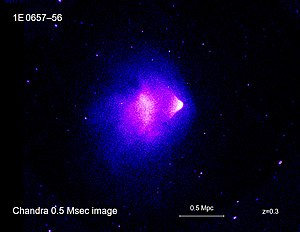
In addition galactic clusters that are packed with these galactic plasma filaments also collide (e.g. the Bullet Cluster).
My expectation is that all of these filament collisions cause shock waves and so would be easily seen as x-rays. Thus I would expect that the Bullet Cluster should be full of x-ray emitting galactic plasma filaments.

Am I right and are such x-rays seen?

A couple of small questions for Zeuzzz:
As mentioned - galaxies collide. As far as I can see galaxies on the same filaments can collide.
What happens to the electric current through the filaments?
For example 2 galaxies on the same filaments merge. This short-circuits the current. I would expect all of the galaxies in between the merged ones to at least change their galactic velocity curve(or need dark matter to be created).
Maybe the galaxies even stop spinning (what happens in Perrat's simulation when the current is turned off? - the "galaxies" certainly stop spinning in the plasmoid experiments:D)!

How do the filaments remain stable as the shock waves from the collisions travel through them?
 
Hi Zeuzzz,

While you state there are hundreds of papers on Plasma Cosmology, how about you pick one that is relevant , hmmmkay?

So far when pressed you have not been able to present one that is relevant to cosmology and makes sense.

Take that nonsense about the electric stars and the H-R diagram, did you ever finish that debate.

No you presented a very weak idea that did not rise to the level of theory and then you ran away.

Just as you never actually defended the 'semi-rigid' structure of galaxies created by E-M fields.


And just in case you forgot

Model
Predictions
Data

Hang on where get'n caught up in the game of maths tennis again, :boggled: so lets get back to basics shall we,like cosmology/electric crater scars!

Tusenfem wrote post 2241
Okay, I have no problems with the graph. That is what it is, and I have seen it in classes at university.

Ok so you agree on the graph and it's been seen in a Uni, to parse again;

Okay, stop it here for a moment. Equation (3) comes, when I read it correctly from J = σ E, with E the electric field. Now, it is stated that the current must be created by the rotation of the planet. Well, one could do this, if the planet is charged and rotating, you will have a current. However, that is not what Alexeff is doing, no, he takes the motional electric field and states that E = v × B. Nice, but not appropriate, because there is no B. This is where a referee should have jumped in (but being published in IEEE the referees don't have up much with plasma physical equations).

So, in order to get a current one needs an ambient magnetic field, so B in equation 2 and B in equation 3 are not the same magnetic fields!

Ahhh my friend you are cunning, the problem you have is you assume the planet was NOT "born, already charged and spinning, after all most of the "stuff" we observe in a solar system and indeed the Universe (Which is cosmology) does indeed spin and posses some form of charge, which in an ambient magnetized plasma WILL generate electric currents which will then generate magnetic fields which then generate electric currents, which will then generate magnetic fields which then generate electric currents, will then generate magnetic fields which then generate electric currents, which will then generate magnetic fields which then generate electric currents....et cetera you get the idea, Shirley!

Snip
Yeah, I would say this is ambiguous, because if you take out B on both sides, you find a nice expression for the radius of a star/planet/galaxy:

R2 = ( μ0σω )-1

wowie!
you got it bro! :D


Once more, what magnetic field??? Alexeff is assuming an a priory magnetic field in which the planet is embedded!

It appears correct, Tusenfem, thats exactly what Alexeff had in mind, remember a cornerstone of EU/PC is matter was created/destroyed of electrical pinch's/discharges so they SHOULD retain some electrical/magnetic anomalies, as observed!

However, do we know that the planet is charged? Where is the initial assumption that there is charge on the planet? I did not see any, maybe Zeuzzz forgot to copy that part of the model?

What do you bang on about man? It is assumed there is a charge on the planet/moon, asteroid, comet, Stars, molecular cloud, super nova remnants galaxies, "black holes", AGN's et cetera

The assumption is, everything is charged, well 99.99% at least! :cool:

And then the last step is just writing the E = v × B velocity (deduced from E/B) to ωR. All good and fine, but only works if the rotation axis of the charged planet is parallel to the background field.

What like Io? or Ganymede, Mercury? maybe Mars or Venus? Remember if your maths is going to work, x B is constantly changing! you know like a time varying magnetic field with spinning magnetized sphere's embedded!

Naturally, one could just look at the magnetic field of a spinning charged sphere, which would be easier that all this ambiguous stuff here, and probably easily looked up in Jackson (which I don't have at home, where I am now).
Ohh I see you did get it, 'cos naturally thats where one would look :rolleyes:

Is Jackson a reference manual? If the maths is easer but essentially the same then lets all use that!

Like I had mentioned in post 2423
Originally Posted by Sol88 View Post
So we have a time varying magnetic field inducing currents in a conductive iron core over laid by a good dielectric material and nothing happens on the surface?
Why?
What do you want to happen on the surface? you want it to sparkle with charge or something? Please understand, induced magnetic fields thrive on the possibility for currentx to flow in a conductor and not on things charging. I am totally at a loss why you thing induction and charging are related.

And if that conductors is also spinning in a magnetized plasma? Seems the induced magnetosphere it can create, "sticks" out, into the solar wind (a quasi neutral magnetized plasma flow) more, which can "trap" more plasma increasing the density and making the plasma the conductor is spinning in, more effective generator/motor under some sort feed back harmonic resonance thing! Cool! :cool:

Ohhh... and just for fun lets wrap that conductor in a dielectric, while it rotating and orbiting inside a time varying magnetic field!

Bet ya some interesting "stuff" would happen, 'cos as you state
Originally Posted by Sol88 View Post
they are (Saturn & Jupiter) in much respects the Sun for their moon systems
disturbingly, in some way you make a bit of sense here

more than you let on mate!

snip

Well, indeed in this calculation R falls out of the ratio. However, this "calculation" is so riddled in unclarities from the start, that it is hard to know whether this has any significance on the graph or not.

No unclarities, if the assumption is they are charged!
 
Last edited:
I at least read your responses (unlike Zeuzzz!). Your mention of synchrotron radiation reminded me of something that I have been mulling over.

I do have a question for you as someone whose is knowledgeable about astronomy. And maybe Zeuzzz can think about it too.
Perrat's plasma model needs galactic sized (in width) plasma filaments that are an average of a billion light years long.
Galaxies move and thus the filaments attached to them must also move. This means that galaxies can move through filaments; there can be near misses of galaxies and so collisions between their filaments; galaxies even collide (passing through each other or merging) ensuring that their filaments collide.
In addition galactic clusters that are packed with these galactic plasma filaments also collide (e.g. the Bullet Cluster).
My expectation is that all of these filament collisions cause shock waves and so would be easily seen as x-rays. Thus I would expect that the Bullet Cluster should be full of x-ray emitting galactic plasma filaments.

Am I right and are such x-rays seen?

A couple of small questions for Zeuzzz:
As mentioned - galaxies collide. As far as I can see galaxies on the same filaments can collide.
What happens to the electric current through the filaments?
For example 2 galaxies on the same filaments merge. This short-circuits the current. I would expect all of the galaxies in between the merged ones to at least change their galactic velocity curve(or need dark matter to be created).
Maybe the galaxies even stop spinning (what happens in Perrat's simulation when the current is turned off? - the "galaxies" certainly stop spinning in the plasmoid experiments:D)!

How do the filaments remain stable as the shock waves from the collisions travel through them?

Cluster should be full of x-ray emitting galactic plasma filaments.

Am I right and are such x-rays seen?

can we resolve down to individual filiments scale at that distance? or would we see them as a fog or cloud?
300px-Bullet_cluster.jpg
http://en.wikipedia.org/wiki/Chandra_X-ray_Observatory

what happens in Perrat's simulation when the current is turned off? - the "galaxies" certainly stop spinning in the plasmoid experiments

Mmmm indeed, what happens when you break the current in a magnetically coupled environment?
 
I at least read your responses (unlike Zeuzzz!). Your mention of synchrotron radiation reminded me of something that I have been mulling over.

I do have a question for you as someone whose is knowledgeable about astronomy. And maybe Zeuzzz can think about it too.
Perrat's plasma model needs galactic sized (in width) plasma filaments that are an average of a billion light years long.
Galaxies move and thus the filaments attached to them must also move. This means that galaxies can move through filaments; there can be near misses of galaxies and so collisions between their filaments; galaxies even collide (passing through each other or merging) ensuring that their filaments collide.
In addition galactic clusters that are packed with these galactic plasma filaments also collide (e.g. the Bullet Cluster).
My expectation is that all of these filament collisions cause shock waves and so would be easily seen as x-rays. Thus I would expect that the Bullet Cluster should be full of x-ray emitting galactic plasma filaments.

Am I right and are such x-rays seen?

A couple of small questions for Zeuzzz:
As mentioned - galaxies collide. As far as I can see galaxies on the same filaments can collide.
What happens to the electric current through the filaments?
For example 2 galaxies on the same filaments merge. This short-circuits the current. I would expect all of the galaxies in between the merged ones to at least change their galactic velocity curve(or need dark matter to be created).
Maybe the galaxies even stop spinning (what happens in Perrat's simulation when the current is turned off? - the "galaxies" certainly stop spinning in the plasmoid experiments:D)!

How do the filaments remain stable as the shock waves from the collisions travel through them?
An interesting set of questions, RC! :)

The first thing to note is that Peratt's model is (strongly) inconsistent with well-established^ astronomical observations of a great many kinds^^; this makes any consideration of your questions ones about a toy universe (or part of such) that we already know does not correspond to the one we live in (except, of course, at the PC word-salad handwaving level).

IIRC, Peratt's plasmas are highly, if not fully, ionised (no neutral atoms or molecules, no uncharged dust, etc), in which only electrons need be considered wrt emission or absorption.

Further, in his model - pace Z, gravitational interactions are ignored (this is an aspect that needs further clarification, but I'm pretty sure gravity is ignored when it comes to galaxy-galaxy or galaxy-filament or filament-filament interactions). One consequence of this assumption is that it is not at all obvious that galaxy-galaxy, galaxy-filament, or filament-filament collisions can occur (it may well be that they cannot, if magnetic reconnection is impossible in his model, for example). So perhaps your question ends there?

Next, Peratt's model rests on the validity of certain scaling relationships ... but IIRC some key ones were either ignored or implicitly rejected. Examples? Well, synchrotron and free-free emission, for example, and - as you say - shocks. I'll explore this in more detail in later posts; it goes to the heart of your questions, concerning observables.

But perhaps we should take a step back and look at what the relevant astronomical observations are? Of galaxy clusters I mean, as we've already covered the key points concerning galaxies. Stay tuned! :)

One more aspect: do you remember Anaconda? the second point he wanted to focus discussion on? It had to do with double layers and electromagnetic acceleration, and it's highly relevant to your questions. Why? Because there's a whole other set of observations that may be very pertinent ... cosmic rays (can you see why?).

(to be continued)

^ in the sense of there being multiple, independent datasets which are published (and, in general, available for download from online catalogues). One giant caveat does need to be entered: if you implicitly or explicitly reject so many parts of standard, textbook physics (as MM and Sol88 do), then almost all of these observations need to be re-analysed within the framework of the physics that is accepted ... no surprise that this would be a massive undertaking! However, there is a critical corollary: unless and until such work is done, then the astronomical observations cannot be used for any purpose. Insofaras Z rejects some parts of textbook plasma physics (e.g. magnetic reconnection), his comments can also, on the whole, be set aside as little more than meaningless noise.
^^ some of which we've covered in this thread, and similar ones, but many (most?) of which we haven't begun to examine, not least because I, for one, am still waiting for Z to respond to some basic, must-answer-first questions on this topic
 
I am not too stubborn so I wll ask for Ziggurat:

Can you give a quote and a citation from Peratt's book where he states that his 1985 computer simulation used both electromagnetic and gravitational forces?

As far as I can see he used the SPLASH and TRISTRAN simulation codes and these simulate plasma using EM forces only. This is supported by the fact that he mentions that his plasma model in the simulation can be transformed to a mass model. This implies that his model is either a plasma model or a mass model but not both.


Another couple of questions about the "Advances in Numerical Modeling of Astrophysical and Space Plasma" papers published in 1997 (12 years after his original paper):
  • Why is there no sign of the use of these improvements to improve his simulation? In other words why has Peratt not improved his original work and made it beyond critism? Or for that matter why have no other scientists duplicated his original experiment? Or why has some graduate student not seen an easy way to a PhD and run the original simulation with the improved code?
  • Which of the papers shows the inclusion of gravitational forces along with EM forces?
ETA:
You may not know much about TRISTRAN so here is a link to a chapter by Oscar Bunnemann (a pioneer in plasma simulations). Notice the absence of gravity. N.B. the "particles" in the simulation probably have mass ('me' may be the mass of an electron) but there is no gravitaitonal force mentioned.
One comment ...

IIRC, not only does Peratt not make it clear, in his paper(s), the extent to which gravity is simulated, but the actual code he used is not available (AFAIK). This is somewhat surprising, considering that a core feature of science - going back many centuries - is independent verification (or validation). In this case that would mean, at a minimum, taking the code and reproducing the (published) results. More broadly, it would mean taking what he (and his co-authors) published and trying to write code which reproduced his methods. Now maybe Z could claim either, or both, but I doubt he could defend any such claim (except, of course, if he actually published either Peratt's actual code or his own, independently developed, one).
 
Making which claim simply false? I think you've kind of debunked yourself in these last few posts Ziggy.

First off, the quote I gave was unattributed on the web page it actually came from. Secondly, the claim I quoted is TOTALLY false. Once again: electromagnetism does NOT obey a longer-range force law than gravity. Both produce 1/r2 force for point-like sources at best (I say that because depending on the configuration, electromagnetism can be shorter range, but gravity is never shorter range than 1/r2. Yes, you can get 1/r forces for line currents and line charges, but you also get 1/r for line masses. And if you've got a line current or line charge, you've obviously got a line mass too. So gravity is never, ever, ever shorter range than electromagnetism. The reverse, however, is NOT true: magnetic dipoles, for example, produce 1/r3 fields.

Gravity was included in his simulation. Which you would know if you had read his book.

Which is completely irrelevant to the validity of the quote I was commenting on. Which you would know if you were paying any attention.

Want the PDF yet? Or you too stubborn to ask me? You've also admitted here that I was correct above, the Biot-Savart force law in the Bennet pinch condition used by Peratt DOES obey the longest acting force law in the universe

This too is false. First off, it's only 1/r if the length is much longer than the separation distance, which never holds forever. It is only a "near-field" force law (get far enough away and it will drop to 1/r2 or worse), so it's deceptive to even call it "longest acting force". Secondly, the same 1/r form applies to gravity from a line mass, which a line current will also be, so there's nothing special or unique about it, and nothing that separates it from gravity. Thirdly, even if you want to just talk about the mathematical form of the equation and ignore the range at which it's valid, it's NOT the "longest-acting force law in the universe". For sheet currents, sheet charges, and sheet masses, the force doesn't fall off with distance at all (but as with the 1/r law, this still only applies in the near-field limit).

Have you got any experimental evidence that gravity can obey an analogous law to amperes law? that it can also show a 1/r attraction?

Yes: the fact that it obeys a 1/r2 law for point-like masses, and in the low-field limit is linear. Therefore it must be 1/r for line masses in the near-field. The ONLY way to get anything different is to break either 1/r2 or linearity, which gravity only does when it's exceptionally strong, which isn't the direction you're trying to break it in.

Because there is a wealth of extremely well documented experimental evidence (as outlined By Peratt in his books) that the 1/r relationship for the Biot Savart force law holds for very large scales.

Well of course it does: just like with gravity, when you start with a 1/r2 law for point-like sources and you integrate over a line of sources, you get a 1/r force.

Also, there is the crucial difference in that gravity is an exclusively attractive field

Indeed: that's why magnetic and electric dipoles follow 1/r3 force laws (with quadrupoles, octopoles, etc following even shorter range laws). The fact that electromagnetism can be both attractive and repulsive means that it's usually shorter range than gravity. You aren't helping your argument any.

I very much doubt there is any evidence to suggest gravity can behave the same; it has no repulsive component.

Which is irrelevant to the question of the effective range of gravity versus electromagnetism. But thanks for trying to move the goalpost.
 
Yes, you can get 1/r forces for line currents and line charges, but you also get 1/r for line masses.


The former italisized part we have tonnes of data to support. The second bolded part of the statement I dont think can be tied down to reality in any way shape or form. You'd need a huge gravitational potential Vg for it to work, which doesn't exist in nature, and I dont think makes this realistic at all.

So, you need to support this claim with evidence. And no, not just conjur up a definition derived from theoretical mathematical principles, a real world example of where line masses in the universe have been observed to obey a 1/r force. Using something which people call the experimental method, to see if what our theories predict follow reality.

The former 1/r relationship for the Biot Savart force law has centuries of direct in situ measurements to back it up, which due to the scale invarient (translationally invarient infact) nature of maxwells equations, and numerous observations from the nanoscale to the stellar and galactic scale, has been shown to hold time and time again with extreme precision.

Do you have any experimental evidence or data that line masses obey 1/r too?
 
Last edited:
Given 1/r2 has been tested in the laboratory down to mm scales, and the 1/r form only requires masses in a line significantly longer than the distance in question, I would not be at all surprised if it were thoroughly testable in the laboratory, Zeuzzz.

However, I can't think of a good reason why anyone would bother. It's a done deal given the laboratory testing of the 1/r2 form - it's a minor matter of calculus to derive it for a line instead of a point or sphere. There's more important tests of gravity in the laboratory to be working on.
 
So many logical fallacies I dont know where to begin. Ageism for one. Ad Hominems galore. I've said many times in this thread that I'm a student studying physics, PerpetualStudent. No-one apart from you suddenly "learned" anything in another thread. You seem to be suffering from myopia and have worked yourself into a minor myopic stupour of late, whereas the rose tinted glasses used for your previous posts made them seem much more tepid, rational and level headed. Where did you loose your cool? Quote me and I'll reply. What do you want to know? You want to know about me? The good old argument from authority? Well, I'm 22 years old, I'm engaged to my fiancee, and am just about to have a degree in physics in a couple of months when my thesis is complete. However, (seemingly) Unlike anyone else on this forum, I have read Cosmic plasma by Nobel Laurate Hannes Alfven, Physics of the Plasma Universe by Peratt, Astrophysics a New Approach by Wolfgang Kundt, The Big Bang Never Happnened by Eric Lerner, All of the IEEE special editions on Cosmic Plasma relevant to plasma cosmology (Astrophysics and Space Science 227 (1995) Special issue dedicated to Professor Hannes Alfvén on the occasion of his 80th birthday, 30 May 1988, IEEE Transction on Plasma Science - Laser & Particle Beams Vol.6 Part 3. August 1988, 1st Special Issue on Space and Cosmic Plasma # Vol 17 No 2 (Apr 1989), 2nd Special Issue on Space and Cosmic Plasma, Golden anniversary of magnetic storms and the aurora, # Vol 18 No 1 (Feb 1990), 3rd Special Issue on Space and Cosmic Plasma Proceedings of the IEEE International Conference on Plasma Cosmology (First Workshop on Plasma Cosmology), La Jolla, California, USA, 20-22 February 1989 # Vol 20 No 6 (Dec 1992), 4th Special Issue on Space and Cosmic Plasma, Plasma experiments in the laboratory and in space. # Vol 28 No 6 (Dec 2000), 5th Special Issue on Space and Cosmic Plasma (Space Weather) # v29 n2 Selected articles (2001), v31 n5 Selected articles (2002) # Vol 31 No 6 (Dec 2004) 6th Special Issue on Space and Cosmic Plasma, # v33 n5 Selected articles (2005), Vol 35 No 4 Part 1 (Aug 2007) 7th Special Issue on Space and Cosmic Plasma)

Though admittedly I kinda glossed over the earlier ones.... :)

Now are you going to ask a question that progresses the conversation? Maybe ask me about some of the books or journals I have read on this subject and what they contain, or comment on the publictaions that I linked to above, the ones published in Astrophysics and Space Sciece, the ones that Ziggurat, Sol, or DRD seem uncapable of respodning to? Or do you want to hurl some more abuse at me?

Its your choice. But you wont get any abuse back.

My advise: put your rose tinted glasses back on.
(bold added)

Been there, done that, and have had a great many such questions ignored.

Remember this post of mine, on 28 March 2009, in another thread Z?

DRD said:
Z said:
DRD said:
c) there are dozens, perhaps hundreds, of direct questions, directly pertinent to the material that you posted in that thread, that you have walked away from.
Please go to that thread, and list at least 12 of these then. And I'll reply when I've the time.
Up to 12 June, 2008, I referenced ~35 posts which contain unanswered questions (in that thread); these may be found here, here, here, and here.

You certainly attempted to answer some of these, and of course there were many more questions (that also remain unanswered), about material you posted, after 12 June 2008.
(extract)

Here's your reply, in full:
Z said:
DRD said:
Up to 12 June, 2008, I referenced ~35 posts which contain unanswered questions (in that thread); these may be found here, here, here, and here.
Well many I think I've already anwered. But I'll have another crack at them tommorrow if you insist. Only skimming the forum here today, just leaving the odd annoying comment here and there.

So thats about 50 questions, find 50 more and I'm gonna have to cripple myself and serve me up a nice foot pie.
(bold added).

Now "tomorrow" would be 29, or perhaps 30, March.

Today is 10, or perhaps 11, April.

So what gives Z? Do you honestly, genuinely want to engage in a conversation? Or are you here merely to drop spam bombs from time to time?

(to be continued, maybe)
 

Back
Top Bottom