• Quick note - the problem with Youtube videos not embedding on the forum appears to have been fixed, thanks to ZiprHead. If you do still see problems let me know.

Plasma Cosmology - Woo or not

So we have a time varying magnetic field inducing currents in a conductive iron core over laid by a good dielectric material and nothing happens on the surface?

Why?

If I did that down here in the lab I'd get a zap for sure using nothing but Maxwell, Faraday, Gauss and/or any other LAW you'd care to throw in wrt EM!

I mean it's in your own paper, Ganymede, Callisto and Europa are do'n it inside their parents magnetosphere, whats different about Mercury?

And bugger me (not an invitation Tusenfem) Io's got it going on big time, one big long ZaP! but safer to call them Volcanoes eh!! :confused:

What happens when Ganymede, Callisto and Europa move "downwind" of Jupiter, where like earth, there should be some funky reconnection events going on?

why not call a spade a spade!

Are we at a stalemate then wrt Mercury?

Shall we move onto our Moon and asteroids/comets, where there is no mathematically difficult magnetosphere to worry about?

PS Tusenfem how big do you think the impactor was that created the Colaris basin or indeed the "spider crater" or how fast was it going?

Or are you going to regurgitate mainstream mantra and say it was long ago by something big going real fast?
 
Ok let get to it!

you do the math and calculate the size and speed of the impactor and I'll do the same for the electric discharge scenario.

Deal?

Is that your theory?

It is your theory, your claim, that an electrical discharge made the crater,

the burden of proof is on you to support your theory.

Duh.

Sorry Sol88 but this just makes you look really weak, make your case or rest it.

Maybe it was an electrical discharge is not a case.

The case for impact craters is rather compelling, start with the one in Arizona for example.
 
So we have a time varying magnetic field inducing currents in a conductive iron core over laid by a good dielectric material and nothing happens on the surface?

Why?

What do you want to happen on the surface? you want it to sparkle with charge or something? Please understand, induced magnetic fields thrive on the possibility for currentx to flow in a conductor and not on things charging. I am totally at a loss why you thing induction and charging are related.

If I did that down here in the lab I'd get a zap for sure using nothing but Maxwell, Faraday, Gauss and/or any other LAW you'd care to throw in wrt EM!

NO you would not! This just does not make sense! Do you get zapped when you walk through the security gate at the airport and you have forgotten to take out your keys out of your pockets? NO, you don't, and neither will the surface (dielectric) get charged or whatever.

I mean it's in your own paper, Ganymede, Callisto and Europa are do'n it inside their parents magnetosphere, whats different about Mercury?

Yes, currents are flowing in circles around the moons in conducting layers under the surface of the moons. And there is NO difference at Mercury, there also currents are flowing but there is no charge separation going on there because of induction. Maybe a bit because of the UV radiation from the Sun, but I doubt it will be as significant as at the Moon.

And bugger me (not an invitation Tusenfem) Io's got it going on big time, one big long ZaP! but safer to call them Volcanoes eh!!

Ehhhh yeah, because we have like pictures and other kinds of measurements that show that it is indeed volcanism and not ZaP!s because none of the characteristic electromagnetic waves that would be emitted by those ZaP!s (whistler mode waves) are observed near Io. ZaP! that in your mind.

What happens when Ganymede, Callisto and Europa move "downwind" of Jupiter, where like earth, there should be some funky reconnection events going on?

What "downwind" are you talking about? At Callisto and Europa there is no reconnection for obvious reasons. At Ganymede there is reconnection upstream and downstream of the moon, because Ganymede's magnetic field is oppositely directed with respect to Jupiter's magnetic field.

why not call a spade a spade!

A spade is a spade, whatever that may mean in this case.

Are we at a stalemate then wrt Mercury?

As you have not made any sense in what you want to happen at Mercury, because you don't understand the processes and the only thing you can do is throw an arbitrary Maxwell equation to us, then we might as well stop this discussion about Mercury (or any other object, because you are as clueless there as you are at Mercury).

Shall we move onto our Moon and asteroids/comets, where there is no mathematically difficult magnetosphere to worry about?

The magnetosphere is not the problem, Sol88, the problem is that you have no idea about math.

PS Tusenfem how big do you think the impactor was that created the Colaris basin or indeed the "spider crater" or how fast was it going?

How should I know, I am a plasma astrophysicist, there are others that can answer this better than I.

Or are you going to regurgitate mainstream mantra and say it was long ago by something big going real fast?

Well, for obvious reasons, it cannot have been moving slowly.
 
Shall we move onto our Moon and asteroids/comets, where there is no mathematically difficult magnetosphere to worry about?
We do not need to worry about the "mathematically difficult magnetosphere". It shields Mercury from the solar wind. Thus it reduces any possible charging of Mercury and makes any electric discharges smaller than they would be without it.
By ignoring it we know that we will calculate bigger electric discharges than are actually possible on Mercury.

From ben m's post which you cannot understand, ignoring the shielding of the magnetosphere:
The largest charge we can expect Mercury to pick up from the Solar Wind is a few kilovolts, giving it a few hundred Joules of energy.

But let us assume that the solar wind has never been measured and actually transfers a gigavolt to Mercury. That is a million (1,000,000) times what is thought to be physically possible without magnetosphere shielding. If we added in magnetosphere shielding it might be another 100 or 1000 times too big.

Then:
Let's see, how much *energy* do you store when you pack 200,000 C into a gigavolt potential? 2 x 10^14 joules ... about 50 kT of TNT, or something in the ballpark of the Nagasaki atomic bomb.

This is still 3 orders of magnitude smaller than needed to create the spider crater and even more orders of magnitude smaller than that needed to create the Caloris Basin.

The conclusion is that if we give your electric discharge idea the benefits of:
  1. Removing the shielding effect of the magnetosphere.
  2. Using values that are a million times greater than physically possible.
we still get energies that are 1000 times too small to create the spider crater.

But if you want we can go onto the Moon. It is 71% smaller than Mercury and so has a 71% lower capacitance. Pick your favorite non-impact crater and give us the numbers.
The conclusion will be that if we give your electric discharge idea the benefits of:
  1. Removing the shielding effect of the magnetosphere (easy since there is no magnetosphere ).
  2. Using values that are a million times greater than physically possible.
we still get energies that can only create craters ~71 meters across.

PS Tusenfem how big do you think the impactor was that created the Colaris basin or indeed the "spider crater" or how fast was it going?

Or are you going to regurgitate mainstream mantra and say it was long ago by something big going real fast?
Actually the Caloris Basin was created by either something large going slow or something small going fast (or something medium sized going an avarge velocity) between 3.8 and 3.9 billion years ago.

Repeating the calculation below for the Caloris Basin gives an even worse result for your idea:
The conclusion is that if we give your electric discharge idea the benefits of:
  1. Removing the shielding effect of the magnetosphere.
  2. Using values that are a million times greater than physically possible.
we still get energies that are 38,000 times too small to create the spider crater.

I will play along with the troll for a second.

Sol88, if you hypothesize that the planet Mercury was once charged up---like a great big capacitor---and that a runaway *discharge* created an arc, and the arc was responsible for the spider-like formation in the Caloris basin ... well, let's do some MATH.

Let's hypothesize that we can charge Mercury up. Just plug in a big jumper cable, or shoot a highly-charged wind at it, or ... something. One way or another, we'll hypothesize that we can build up an electrostatic voltage on the whole planet. How much excess charge can we pack on while doing this?

As an isolated sphere, Mercury's capacitance is about 0.2 millifarads. That's, um, not very much. A *gigavolt* static potential would carry only 200,000 Coulombs (about one car battery). I want to emphasize that a gigavolt is a very, very high potential. There is no way to charge something up to a gigavolt by bathing it in a kilovolt-energy solar wind.

Let's see, how much *energy* do you store when you pack 200,000 C into a gigavolt potential? 2 x 10^14 joules ... about 50 kT of TNT, or something in the ballpark of the Nagasaki atomic bomb.

Therefore, we have (unfortunately) lots of experience with the craters formed by 50 kT energy releases. They're a 100 meters in diameter and a few meters deep---underground explosions might excavate only a hundred meter or so cavity. Moving rock around takes lots of energy.

So what do we find on Mercury? A hole 40,000 meters in diameter.

Sol88, your "arc welder" hypothesis requires energy to be stored somewhere. The largest charge we can expect Mercury to pick up from the Solar Wind is a few kilovolts, giving it a few hundred Joules of energy---whereupon your Giant Arc Discharge Into Space could perhaps occur, but it would barely heat up a cup of tea, much less excavate a 40,000 meter crater.

How much energy do you think you need for the crater, Sol88? How will you charge up an isolated capacitor to the (apparently required) ten teravolts? You can't. Since Mercury could never have been this highly charged, it's never had anything like enough stored electrostatic energy to excavate a crater with an arc discharge. You casually invented an Giant Cosmic Welding Torch, Sol88, but you forgot to find somewhere to plug it in.

You're welcome to do the same calculation under the (equally stupid) assumption that Mercury had (like Earth) a dielectric atmosphere with an internal mechanical charge conveyor. You will have to learn electrostatics to do so.
 
Ben M wrote

why no mention of charge on the surface of your isolated-sphere?

Have you ever made a simple film canister capacitor and touched the outside plate after charging it? ZAP!!!

Have you ever made a spherical capacitor, charged it, then discharged it?

like the one below

http://hyperphysics.phy-astr.gsu.edu/Hbase/electric/imgele/csph.gif

and Mercury

http://www.stp.isas.jaxa.jp/mercury/images/Mercury_mag.jpg credit ESA
The answer to the first question is simple: By definition a charged isolated-sphere has charge on its surface so there is no need to mention it.

ben m answered ths second question before but I will repeat it:
Spherical capacitors (i.e. a pair of spheres, one inside the other) discharge between the 2 spheres. There is no discharge on the surface of the outer sphere. Evoking earthquakes as you did will not help your idea since that makes the numbers even worse:
EarthquakeWP
It is estimated that only 10 percent or less of an earthquake's total energy is radiated as seismic energy. Most of the earthquake's energy is used to power the earthquake fracture growth or is converted into heat generated by friction.
 
Last edited:
Sol88:

It appears that ben m and Reality Check have provided a conclusive basis for dismissing your electric theory for Mercury's spider crater. Unless you can find a flaw in their reasoning or a huge mistake in their calculations, the debate is over. We are left with an impact (or impacts) of asteroids and/or comets as the only possible answer.
Game over!
 
I will play along with the troll for a second.

Sol88, if you hypothesize that the planet Mercury was once charged up---like a great big capacitor---and that a runaway *discharge* created an arc, and the arc was responsible for the spider-like formation in the Caloris basin ... well, let's do some MATH.

Let's hypothesize that we can charge Mercury up. Just plug in a big jumper cable, or shoot a highly-charged wind at it, or ... something. One way or another, we'll hypothesize that we can build up an electrostatic voltage on the whole planet. How much excess charge can we pack on while doing this?

As an isolated sphere, Mercury's capacitance is about 0.2 millifarads. That's, um, not very much. A *gigavolt* static potential would carry only 200,000 Coulombs (about one car battery). I want to emphasize that a gigavolt is a very, very high potential. There is no way to charge something up to a gigavolt by bathing it in a kilovolt-energy solar wind.

Let's see, how much *energy* do you store when you pack 200,000 C into a gigavolt potential? 2 x 10^14 joules ... about 50 kT of TNT, or something in the ballpark of the Nagasaki atomic bomb.

Therefore, we have (unfortunately) lots of experience with the craters formed by 50 kT energy releases. They're a 100 meters in diameter and a few meters deep---underground explosions might excavate only a hundred meter or so cavity. Moving rock around takes lots of energy.

So what do we find on Mercury? A hole 40,000 meters in diameter.

Sol88, your "arc welder" hypothesis requires energy to be stored somewhere. The largest charge we can expect Mercury to pick up from the Solar Wind is a few kilovolts, giving it a few hundred Joules of energy---whereupon your Giant Arc Discharge Into Space could perhaps occur, but it would barely heat up a cup of tea, much less excavate a 40,000 meter crater.

How much energy do you think you need for the crater, Sol88? How will you charge up an isolated capacitor to the (apparently required) ten teravolts? You can't. Since Mercury could never have been this highly charged, it's never had anything like enough stored electrostatic energy to excavate a crater with an arc discharge. You casually invented an Giant Cosmic Welding Torch, Sol88, but you forgot to find somewhere to plug it in.

You're welcome to do the same calculation under the (equally stupid) assumption that Mercury had (like Earth) a dielectric atmosphere with an internal mechanical charge conveyor. You will have to learn electrostatics to do so.

Ahhh try using this instead
gaupoi2.gif
 
Sol88:

It appears that ben m and Reality Check have provided a conclusive basis for dismissing your electric theory for Mercury's spider crater. Unless you can find a flaw in their reasoning or a huge mistake in their calculations, the debate is over. We are left with an impact (or impacts) of asteroids and/or comets as the only possible answer.
Game over!

Mistakes found! :rolleyes:

There is no way to charge something up to a gigavolt by bathing it in a kilovolt-energy solar wind.
LINK
Not only can fast CMEs strongly influence the earth, but also slow CMEs can influence the earth, and its influences are more frequent and cannot be neglected. (iii) Most of high-energetic solar proton events with E≥10 MeV can lead to geomagnetic storms, but most of the medium and weak geomagnetic storms result from low-energetic solar proton events that are caused by CMEs. (iv) Both the electron pulsation events and geomagnetic storms are the link effects of high- and low-energetic solar proton events, but the occurrence of electron pulsation event are generally prior to the geomagnetic storm

As an isolated sphere,
No a conducting sphere!

A gigavolt potential across the surface area of Mercury (74,800,000 km2) would be a lot! gather all that charge into one break out point and ZAP!

Game on!!

Ps it's far too difficult for even you PS to work out, 'cos it's way beyond me :)

most of the maths, even Tusenfem, would agree is extremely difficult bordering on impossible, without using generalizations, assumptions and simplifications!
 
Last edited:
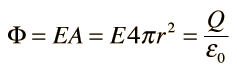
Ahhh try using this instead [qimg]http://hyperphysics.phy-astr.gsu.edu/Hbase/electric/imgele/gaupoi2.gif[/qimg]

You want us to try calculating the electric flux over an infinite flat plane? I'll pass on that, thanks, it's not relevant. You go ahead.
 
Just hold your horses everyone. :h1:

With all this talk of dubious hidden dynamo models of planetary magnetic fields and convective fluid motion based ideas, there is a totally alterantive hypothesis for the origin of these magnetic fields (and even [though not really considered suffieciently yet] one that could explain the magnetic field of the sun and galaxies at large, based on similar ideas to that of Alfvens in them acting as large farday generators/unipolar inductors*), all of which published in peer reviewed plasma cosmology journals (mostly, though by no means exclusively, the 2007 Special Issue on Cosmic Plasma). One day I wonder if anyones ever going to read all the peer reviewed materials in their journals, and Peratts book, And Alfvens, and other relenvent materials, so they actually know what they are talking about. The only two that I recall being discussed is Thronhills (largely crap and highly specualative [Though still interesting!]) paper on the Z-pinch morphology of electric stars, and Scotts still un-disproved, though admiteddly nitpicky, publication on the properties of magenetic fields and plasma in the cosmos.

Then maybe everyones heated arguments from ignorance can start to have some substance. No-ones claiming to have omnipotent knowledge. The material is all there in the IEEE journals for people to read, review and cite. Its just underappreciated and hard to acees for those that dont have the privelages.

http://ieeexplore.ieee.org/Xplore/l...l5/11181/36024/01707329.pdf&authDecision=-203
Van Allen has experimentally observed[1] that the magnetic moments of the planets and stars are proportional to their angular momentum over some 12 orders of magnitude. “This graph is purely empirical and is regarded with disdain by theorists of planetary magnetism.”—Van Allen. In this paper, I develop a model that both predicts the proportionality between magnetic moment and angular momentum and also fits the experimental results with no adjustable parameters. The model is based on the fact that each rotating planet and star is immersed in a nonrotating conducting plasma cloud, which constitutes a Faraday electrical generator. This Faraday generator is assumed to be the primary source of the magnetic field, in contrast to present models that assume that the flow of magma in the planets’ cores is responsible.


[1]
2220149dea71ebaf6f.jpg


Image, Credit, IEEE Tranactions on Plasma Science, 2007

The following italisized test is Credit of: "The Van Allen Hypothesis—The Origin of the Magnetic Fields of the, Planets and Stars", Alexeff, Igor, IEEE Transactions on Plasma Science, vol. 35, issue 4, pp. 748-750 http://adsabs.harvard.edu/abs/2007ITPS...35..748A

"We now develop a very simplified model of the mechanism of magnetic field generation, glossing over details in integration in order to present the basic details of the model. Consider Maxwell’s equations. The magnetic field is generated by a current

∇×B = μ0J. (1)

The magnetic field is operated on by a differential operator. The exact nature of the operator is not known at present, but the basic spatial distance in the differentiation process is obviously the celestial body’s radius R. Hence

B/R = μ0J. (2)

Next, the current must be generated by the rotation of the planet

J = σVB = σωRB. (3)

Equating the two expressions produces a result that is ambiguous in B

B/R = μ0σωRB (4)

However I note that the current flow from the equator of the celestial body is across the magnetic field in plasma, and Bohm conduction is appropriate. Bohm conduction will be discussed in more detail later [....]

J = σE = eneν = ene(E/B) = eneωR. (5)

The net result is as follows:

B = μ0eneωR2. (6)

Thus, the magnetic field of the planet is proportional to the permeability of space, the charge of the electron, the electron density of the surrounding medium, the angular velocity of rotation, and the square of the radius.

Now, the magnetic moment M is defined as the total flux multiplied by the distance between the magnetic poles. Using a simple cylindrical model, as shown in Fig. 2, We find,

[latex]M=\mu_0en_e{\omega}R^2(2{\pi}R^3)=2{{\pi}\mu_0}en_e{\omega}R^5[/latex] (7)

Next, consider the angular momentum L of a massM at radius R from the axis

L = MVR = MωR2. (8)

For a rotating cylindrical body, as shown in Fig. 2, I must integrate over the volume and assume a mass density m

[latex]L={\pi}m{\omega}R^5.[/latex] (9)

Thus, the ratio of magnetic moment M to angular momentum L does not depend on R or ω

M/L = (2μ0ene)/m (10)

The remarkable result is that these simple calculations reproduce the correct proportionality ratio between magnetic moment L and angular momentum M over 12 orders of magnitude.

The magnitude of the ratio M/L is evaluated as follows. The only variables are the electron density and the mass density. For the electron density, I choose the limiting density in interstellar space [4], 1 electron/cm3. This should produce a value of M/L at or below the experimental value. For the mass density, I choose the mass density of water, approximately 1 g/cm3. This should approximate the mass density of most celestial bodies. The net result is that not only are the magnetic moment M and the angular momentum L proportional to each other, but the agreement is reasonably correct with respect to the magnitude of the experimental data obtained by Van Allen. The previous equation yields a ratio of M/L of 5 exp−22 (about exp−21), while the value found by Van Allen from his graph is between exp−15 to exp−16. This appears to be a large discrepancy, but note that my calculation is in MKS units, while Van Allen’s are in CGS. (As a check, compute the angular momentum of the Earth.) Converting Van Allen’s results to MKS introduces a correction of exp−3, so his values become exp−18 to exp−19.

The final discrepancy is on the order of two to three orders of magnitude, but this is small compared to the agreement in slope over 12 orders of magnitude (Fig. 1). Also, the use of the limiting value of electron density in interstellar space yields the lowest possible limit for the value of M/L. In addition, the use of the density of hydrogen as a major component of some celestial bodies rather than that of water would also increase the agreement between the two values. Some values of the ratio of M/L are anomalously low. These include the values for Venus and the Moon. Discussions with one of my past students [5] reveal that the previously discussed ratio is the maximum possible value. The derivation is lacking the temporal behavior of M/L. The value can stay constant, decrease to zero, and even reverse. Note that no values of M/L are anomalously high, which further supports the model.

A. Detailed Discussion of “Bohm Conductivity”

This theory refers to “Bohm conduction.” Bohm conduction refers to electrical conduction [......]
"

Again, Credit: "The Van Allen Hypothesis—The Origin of the Magnetic Fields of the, Planets and Stars", Alexeff, Igor, IEEE Transactions on Plasma Science, vol. 35, issue 4, pp. 748-750 http://adsabs.harvard.edu/abs/2007ITPS...35..748A


Just thought I'd throw a but more data into the deabte, data that plasma cosmogology journals seem to be confronting, and traditional journals ignoring. So... just a brief spanner into the works :p

Not to discredit the work of any others that have contributed above, but this is certainly an extra alternative plasma characteristic based model worthy of consdieration.

...carry on.


* http://www.plasma-universe.com/index.php/Faraday_disk

A Unipolar inductor usually refers to a device in which a rotating metal disk rotating in a magnetic field, generates an electric current. The metal disk can be any conductor, including a rotating plasma. It is also known as a homopolar generator, unipolar generator, acyclic generator, disk dynamo, or Faraday disk.

Astrophysical unipolar inductors

Unipolar inductors occur in astrophysics where a conductor rotates through a magnetic field, for example, the movement of the highly conductive plasma in a cosmic body's ionosphere through its magnetic field. In their book, Cosmical Electrodynamics, Hannes Alfvén and Carl-Gunne Fälthammar write:

"Since cosmical clouds of ionized gas are generally magnetized, their motion produces induced electric fields [..] For example the motion of the magnetized interplanetary plasma produces electric fields that are essential for the production of aurora and magnetic storms" [..]
".. the rotation of a conductor in a magnetic field produces an electric field in the system at rest. This phenomenon is well known from laboratory experiments and is usually called 'homopolar ' or 'unipolar' induction. [3]

Unipolar inductors have been associated with the aurorae on Uranus,[[4]] binary stars,[5] [6] black holes,[7] [8] pulsars (neutron stars),[2] galaxies,[9] the Jupiter Io system,[10] [11] the Moon,[12] [13] the Solar Wind,[14] sunspots,[15] [16] in the Venusian magnetic tail.[17], the Earth,[18], and comets.[19] [20]

1. ^ Hannes Alfvén, "Keynote Address (1987) Double Layers in Astrophysics, Proceedings of a Workshop held in Huntsville, Ala., 17-19 Mar. 1986. Edited by Alton C. Williams and Tauna W. Moorehead. NASA Conference Publication, #2469" (Record | Full text) FULL TEXT
2. ^ a b Ruderman, M. A. & Sutherland, P. G., "Theory of pulsars - Polar caps, sparks, and coherent microwave radiation" FULL TEXT (1975) Astrophysical Journal, vol. 196, Feb. 15, 1975, pt. 1, p. 51-72. PEER REVIEWED
3. ^ Hannes Alfvén and Carl-Gunne Fälthammar, Cosmical Electrodynamics (1963) 2nd Edition, Oxford University Press. See sec. 1.3.1. Induced electric field in uniformly moving matter. ACADEMIC BOOK
4. ^ Hill, T. W.; Dessler, A. J.; Rassbach, M. E., "Aurora on Uranus - A Faraday disc dynamo mechanism" (1983) Planetary and Space Science (ISSN 0032-0633), vol. 31, Oct. 1983, p. 1187-1198 PEER REVIEWED
5. ^ Hannes Alfvén, "Sur l'origine de la radiation cosmique" {[full}} (On the origin of cosmic radiation)" Comptes Rendus, 204, pp.1180-1181 (1937) PEER REVIEWED
6. ^ Hakala, Pasi et al, "Spin up in RX J0806+15: the shortest period binary" FULL TEXT (2003) Monthly Notice of the Royal Astronomical Society, Volume 343, Issue 1, pp. L10-L14
7. ^ Burns, M. L.; Lovelace, R. V. E., "Theory of electron-positron showers in double radio sources" FULL TEXT (1982) Astrophysical Journal, Part 1, vol. 262, Nov. 1, 1982, p. 87-99 PEER REVIEWED
8. ^ Shatskii, A. A., "Unipolar Induction of a Magnetized Accretion Disk around a Black Hole"FULL TEXT, (2003) Astronomy Letters, vol. 29, p. 153-157
9. ^ Per Carlqvist, "Cosmic electric currents and the generalized Bennett relation"FULL TEXT (1988) Astrophysics and Space Science (ISSN 0004-640X), vol. 144, no. 1-2, May 1988, p. 73-84. PEER REVIEWED
10. ^ Goldreich, P.; Lynden-Bell, D., "Io, a jovian unipolar inductor"FULL TEXT (1969) Astrophys. J., vol. 156, p. 59-78 (1969) PEER REVIEWED
11. ^ Strobel, Darrell F.; et al, "Hubble Space Telescope Space Telescope Imaging Spectrograph Search for an Atmosphere on Callisto: A Jovian Unipolar Inductor" (2002) The Astrophysical Journal, Volume 581, Issue 1, pp. L51-L54 PEER REVIEWED
12. ^ "Sonett, C. P.; Colburn, D. S., "Establishment of a Lunar Unipolar Generator and Associated Shock and Wake by the Solar Wind" (1967) Nature, vol. 216, 340-343 PEER REVIEWED
13. ^ Schwartz, K.; Sonett, C. P.; Colburn, D. S., "Unipolar Induction in the Moon and a Lunar Limb Shock Mechanism"FULL TEXT in The Moon, Vol. 1, p.7 PEER REVIEWED
14. ^ Srnka, L. J., "Sheath-limited unipolar induction in the solar wind"FULL TEXT (1975) Astrophysics and Space Science, vol. 36, Aug. 1975, p. 177-204 PEER REVIEWED
15. ^ Yang, Hai-Shou, "A force - free field theory of solar flares I. Unipolar sunspots" Chinese Astronomy and Astrophysics, Volume 5, Issue 1, p. 77-83 PEER REVIEWED
16. ^ Osherovich, V. A.; Garcia, H. A., "Electric current in a unipolar sunspot with an untwisted field" (1990) Geophysical Research Letters (ISSN 0094-8276), vol. 17, Nov. 1990, p. 2273-2276 PEER REVIEWED
17. ^ Eroshenko, E. G., "Unipolar induction effects in the Venusian magnetic tail" (1979) Kosmicheskie Issledovaniia, vol. 17, Jan.-Feb. 1979, p. 93-10
18. ^ F J Lowes "The Earth as a unipolar generator" (1978) J. Phys. D: Appl. Phys. 11 765-768 PEER REVIEWED
19. ^ Minami, S.; White, R. S. "An acceleration mechanism for cometary plasma tails" (1986) Geophysical Research Letters (ISSN 0094-8276), vol. 13, Aug. 1986, p. 849-852. PEER REVIEWED
20. ^ Podgornyi, I. M.; Dubinin, E. M.; Israilevich, P. L.; Skolnikova, S. I. "Plasma dynamics in type-1 comet tails" (1984) Komety i Meteory (ISSN 0568-6199), no. 35, 1984, p. 30-34. In Russian PEER REVIEWED

 
Last edited:
Zeuzzz,

:eusa_clap: :eusa_clap:

:jaw-dropp

Sweet mate sweet, but I fear it maybe just too simple for our maths fiends who are always looking to make it more complex that it needs to be!


But great find anyway, solidifies a lot of ideas that have been bouncing around in my head for awhile now. :cool:

Any way of accessing those papers without becoming a member?

It would also make much more sense of Tusenfam's paper on Ganymede, after reading that.

The best thing about EU/PC is its simplicity and scalability! And there is nothing more simple than a homopolar motor/generator!

Again kudos Zuezzz! :)
 
Last edited:
Just hold your horses everyone. :h1:

My reading of this: so you want to guess at a relationship between angular momentum and magnetic field. You pick an ansatz, say L = A*Iw^gamma, and say "maybe I can figure out A and gamma".

The authors do some basic dimensional analysis in order to get more or less the correct exponent gamma for the L = A*Iw^gamma. This is nicely done, and well within a long and respectable astrophysics tradition of correctly guessing such exponents.

Then the authors try to get the *prefactor* A. They pick some random quantities---the electron density of interstellar space?!?---and combine them to get something with the desired dimensions. They get it *wrong* by three orders of magnitude, unsurprisingly IMO.

Then they do something really wrong---they take the *good* agreement in the exponent, and use it as a defense of the unrelated model that gave them A. That's unjustified: the A model just failed miserably (by two or three orders of magnitude) and has not been supported by one whiff of data or analysis; the plasma-model-specific details that seem to be the paper's focus drop out from the gamma calculation, which, being just dimensional analysis, is probably expected for almost all models (dynamos and whatnot). Again, the plasma-specific stuff contributes only to the part of the calculation, the prefactor, that's wrong by a huge factor.
 
Mistakes found! :rolleyes:

LINK
Not only can fast CMEs strongly influence the earth, but also slow CMEs can influence the earth, and its influences are more frequent and cannot be neglected. (iii) Most of high-energetic solar proton events with E≥10 MeV can lead to geomagnetic storms, but most of the medium and weak geomagnetic storms result from low-energetic solar proton events that are caused by CMEs. (iv) Both the electron pulsation events and geomagnetic storms are the link effects of high- and low-energetic solar proton events, but the occurrence of electron pulsation event are generally prior to the geomagnetic storm
"high-energetic solar proton events with E>MeV" is talking about the energy in electron-volts of protons, i.e. how fast they are going.

To make it clear: eV = electron-volts (an energy) not a voltage.

So this is not "Mistakes found" :D.
 
ben_m said:
The philosopher H. G. Frankfurt defined "Bull****ing" as the case, distinct from truth-telling and from lying, where the speaker doesn't care what the truth-value of their statements is.

To all appearances, Sol doesn't care that he's quoted paragraph on (effectively) how Mercury's rock is a good conductor and used it to argue that it's an insulator. He doesn't care that he's quoted a divergenceless electric field and announced that it induces a charge, which is the opposite. He doesn't care whether the capacitance of the core-surface system is bigger, or smaller, or of the same order as the free-sphere capacitance ... he doesn't know what any of this means and he doesn't seem to care.

And:

Ben_m said:
Sol, you're Googling for things without understanding them.

So can we agree [...]

:rolleyes:
 
The conclusion is that if we give your electric discharge idea the benefits of:
  1. Removing the shielding effect of the magnetosphere.
  2. Using values that are a million times greater than physically possible.
we still get energies that are 1000 times too small to create the spider crater.

Ouch. This should nail it, but then Zeuzzz goes into overdrive and then Sol, having apparently NOT read RC's post (or understood it, he didn't answer anyway):

Sol88 said:
The best thing about EU/PC is its simplicity and scalability! And there is nothing more simple than a homopolar motor/generator!

Again kudos Zuezzz!

Translation: "Ah! At least one person agrees with me! Now I can sleep soundly again. Those scofftics tried to place a shadow of doubt in my mind but now I can breathe a sigh of relief."
 
Zeuzzz,
Sweet mate sweet, but I fear it maybe just too simple for our maths fiends who are always looking to make it more complex that it needs to be!
This is from a person who spouted posts of math in regard to electric discharges on Mercury that was much more complex that it needs to be!

Sol88: Are you still ignoring the rather simple maths that shows that craters cannot be created by electric discharges?
 

Back
Top Bottom