• Quick note - the problem with Youtube videos not embedding on the forum appears to have been fixed, thanks to ZiprHead. If you do still see problems let me know.

Plasma Cosmology - Woo or not

So from the LIST

1. 99% of matter in the observable Universe is plasma.
6. A flow of charged particles is an electric current.
7. Electric currents generate magnetic fields.
9. Dust can behave as plasma.

We could logical explain mainstreams dark matter problem, with standard text book PLASMA physics, as we all agreed on in the list.

Charles M. Snell1 and Anthony L. Peratt1
(1) Los Alamos National Laboratory, Los Alamos, New Mexico, USAVia springerlink
Abstract The rotation velocity of a simulated plasma galaxy is compared to the rotation curves of Sc type spiral galaxies. Both show lsquoflatrsquo rotation curves with velocities of the order of several hundred kilometers per second, modified by E × B instabilities. Maps of the strength and distribution of galactic magnetic fields and neutral hydrogen regions, as-well-as as predictions by particle-in-cell simulations run in the late 1970s, are compared to Effelsberg observations.
Agreement between simulation and observation is best when the simulation galaxy masses are identical to the observational masses of spiral galaxies. No dark matter is needed.
Do you get it DeiRenDopa??? :eye-poppi

Standard text book plasma physics

So yes I agree there is a "missing mass" with standard Newtonian, General and special relativity physics, but NOT with plasma physics!

End of DARK matter story in relation to this thread :cool:

Or are you Saying Snell and Perratt by implication Alfven are incorrect on the assumption of PLASMA behavior?

Please try and allay my confusion here!
Here is my first question:

Have you read the paper, Sol88?

In the original, the last sentence is not bold; in the original, E and B are bold ("E x B", rather than "E x B")*.

Here is my second question:

Why did you change the bolding, Sol88?

* actually, I cannot tell if the "x" is bold in the original or not
 
Last edited:
Point 3 gravitational lensing like dark matter is fictional and completely made up! You need dark matter to create a Grav lens and a grav lens to detect dark matter!
Wrong as usual Sol88: All matter can create a gravitational lens. The use of gravitational lensing is a standard astromonical technique.
 
DeiRenDopa wrote
Here is my first question:

Have you read the paper, Sol88?

In the original, the last sentence is not bold; in the original, E and B are bold ("E x B", rather than "E x B")*.

Here is my second question:

Why did you change the bolding, Sol88?

* actually, I cannot tell if the "x" is bold in the original or not

No, I bolded "NO DARK MATTER IS NEEDED" only!
 
Reality Check wrote:
Wrong as usual Sol88: All matter can create a gravitational lens. The use of gravitational lensing is a standard astromonical technique.

And how much mass do you need for this effect to become apparent?

What if you observe gravitational lensing and there is not enough visible mass to account for it?

You reality check stated
All matter can create a gravitational lens
All matter? does the moon gravitationally lens the Sun or other stars? Does my fridge magnet gravitational lens the fridge behind it?

Is gravitational lensing a property of gravity or mass? Is gravity a constant? How do you work out the mass of a galaxy?
 
Reality Check wrote:

And how much mass do you need for this effect to become apparent?

That depends on how sensitive your measurements are. It's observable with the sun, which is not dark matter. I'm not sure what the lower limit is.

You reality check stated All matter? does the moon gravitationally lens the Sun or other stars?

Yes, but not much. The larger the mass, the more lensing. The moon has much less mass than the sun, which in turn has much less mass than a galaxy.

Does my fridge magnet gravitational lens the fridge behind it?

Yes, but not enough to detect. This should not surprise you: can you feel the gravitational attraction between yourself and your refrigerator magnet? Of course not: it's too small. But it's still there.

Is gravitational lensing a property of gravity or mass?

It's an effect (not a property) of gravity, which is caused by mass.

Is gravity a constant?

Of course not. That's why astronauts weigh less on the moon. Really, this is grade school science: are you honestly not aware of that?

How do you work out the mass of a galaxy?

By looking at the orbital rates of material inside the galaxy. Which is basically the same way we work out the mass of the sun.
 
DeiRenDopa wrote
Here is my first question:

Have you read the paper, Sol88?

In the original, the last sentence is not bold; in the original, E and B are bold ("E x B", rather than "E x B")*.

Here is my second question:

Why did you change the bolding, Sol88?

* actually, I cannot tell if the "x" is bold in the original or not
No, I bolded "NO DARK MATTER IS NEEDED" only!
In which post did DRD write this, Sol88?

Do you remember the commitment you made?

In post#1788 - that I quoted - you stated: "Standard text book plasma physics"

Yet here, in this more recent post of yours that I am quoting, you state that you have not read the paper.

May I ask how you arrived at the conclusion (stated in your previous post, #1788), if you have not read the paper?

ETA: why did you change the bold on "E" and "B", in the original, to the default type font?
 
Last edited:
Sol88 said:
Reality Check wrote:

And how much mass do you need for this effect to become apparent?
That depends on how sensitive your measurements are. It's observable with the sun, which is not dark matter. I'm not sure what the lower limit is.

You reality check stated All matter? does the moon gravitationally lens the Sun or other stars?

Yes, but not much. The larger the mass, the more lensing. The moon has much less mass than the sun, which in turn has much less mass than a galaxy.

[...]
GAIA will be able to detect - and measure, for the more massive objects - the light deflection (bending) of all planets in our solar system, as well as the Moon, Titan, the Galilean moons of Jupiter, ... Of course, it will not be pointed sufficiently close to Mercury or Venus to measure the bending due to their mass, but the bending due to the Sun will be detectable over the whole sky (as it is today, via VLBI observations of quasars).

Here is a webpage that contains a neat animation of the expected bending of the various objects, as they move through the sky (as seen by GAIA).
 
DeiRenDopa, Sol invictus, Reality check, I have a question for you.


Could you'se explain to me how gravity works?

Because the problem I have is I'm not quite understanding how it works, now I've read a bit about gravity on the net, but the info seems to have a lot of grey areas. :(

Can you help me understand it to your level of knowledge?
 
DRD wrote
Here is a webpage that contains a neat animation of the expected bending of the various objects, as they move through the sky (as seen by GAIA).

Cool, pictures!! I like pretty pictures :D

Here are some nice pictures that I found!

First plasma filaments forming a galaxy.

Peratt-galaxy-simulation.gif


Galaxy formation

Peratt's galaxy formation simulation animated.
Peratt's galaxy formation simulation: Simulation of plasma in two adjacent Birkeland filaments of width 35 kpc and separation 80 kpc. The axial extent of the simulation is only 10 kpc, so the formation of a 3-d disk is not demonstrated by this calculation.

Galaxy formation in the Plasma Universe is modeled as two adjacent interacting Birkeland filaments. The simulation produces a flat rotation curve, but no hypothetical dark matter is needed, as required by the conventional model of galaxy formation.

The simulations derive from the work of Winston H. Bostick who obtained similar results from interacting plasmoids.[1] [2]

In the early 1980s Anthony L. Peratt, a student of Alfvén's, used supercomputer facilities at Maxwell Laboratories and later at Los Alamos National Laboratory to simulate Alfvén and Fälthammar's concept of galaxies being formed by primordial clouds of plasma spinning in a magnetic filament.[3]

The simulation began with two spherical clouds of plasma trapped in parallel magnetic filaments, each carrying a current of around 1018 amperes. The clouds spin around each other until a spiral shape emerges. Peratt concluded that the shapes seen in the simulation appeared similar to observed galaxy shapes, and posited a morphological sequence that corresponded to Halton Arp's ideas that galaxies formed out of quasars ejected from AGN.[4] Perrat's spirals had qualitatively flat rotation curves.

And talking about filaments

Remember point 8 from the list

8. Plasma with an electric current flowing through it can
• “self” organize.
• Become filamentary
• Form Cellular structures (double layer)
• Bennett Pinch (Z-pinch and Theta pinch)
• Form very complex instabilities and behavior

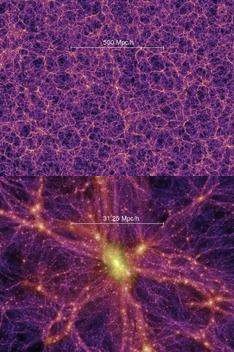
millennium_movie.jpg


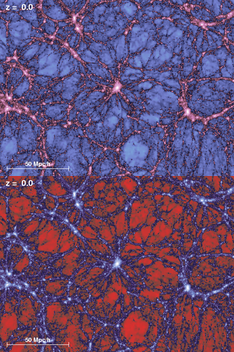
lcdmmovie.png


Gravity???????
 
Last edited:
My Revised EU/PC assumptions

1. 99% of matter in the observable Universe is plasma.
2. Plasma is composed of charged particles, mainly negative electrons and positive protons or - & +
3. Charge separation can occur, generating Electric fields.
4. Charged particles are accelerated in an electric field.
5. Plasma is an excellent electrical conductor.
6. A flow of charged particles is an electric current.
7. Electric currents generate magnetic fields.
8. Plasma with an electric current flowing through it can
• “self” organize.
• Become filamentary
• Form Cellular structures (double layer)
• Bennett Pinch (Z-pinch and Theta pinch)
• Form very complex instabilities and behavior

9. Dust can behave as plasma.
10. Plasma can be scientifically studied in the lab and in the Universe
11. Plasma can be observed in the lab and in the Universe.
12. Plasma exchanging energy is observable across the known Electromagnetic spectrum.
13. A flow of electrons spiraling along a magnetic field line is a Field Aligned Current, a FAC
14. Magnetic fields influence charged particles.
15. We observe vast magnetic fields in the plasma filled Universe.
May I ask you questions about this post of yours, Sol88?

If I may, will you try to answer them in a logical manner?
 
DeiRenDopa, Sol invictus, Reality check, I have a question for you.


Could you'se explain to me how gravity works?

Because the problem I have is I'm not quite understanding how it works, now I've read a bit about gravity on the net, but the info seems to have a lot of grey areas. :(

Can you help me understand it to your level of knowledge?
I'm glad that you have asked this question.

The best answer I can give you is similar to a suggestion that I made in post #1753 of this thread (which was just echoing an earlier suggestion of tusenfem's); namely, get yourself a science degree, from a good university, with a major in General Relativity.

My suggestion acknowledges your request, and is based on my assumption of sol invictus' understanding of gravity, per the hundreds (or more) of posts he's written here, in this section of the JREF Forum, that contain content relevant to gravity.
 
DRD wrote

Cool, pictures!! I like pretty pictures :D

Here are some nice pictures that I found!

First plasma filaments forming a galaxy.

[qimg]http://www.plasma-universe.com/images/1/16/Peratt-galaxy-simulation.gif[/qimg]


And talking about filaments

Remember point 8 from the list


[qimg]http://www.mpa-garching.mpg.de/galform/data_vis/millennium_movie.jpg[/qimg]

[qimg]http://www.mpa-garching.mpg.de/galform/data_vis/lcdmmovie.png[/qimg]

Gravity???????
What is the source of the animation in this post of yours, Sol88?

What is the source of the images in this post of yours, Sol88?

Do you remember my earlier post where I advised you to cite your sources, when copying something directly?

IIRC, I also said that I thought that this forum has a rule about doing so, and that it is my understanding that you can be banned for persistently breaking this rule.
 
An image of a computer simulation from Peratts totally debunked theory.
Can you read Sol88:

A summary of the flaws in Peratt's galactic model:
  • None of the at least 200 billion filaments that are 35 kpc wide and an average of 350 Mpc long have been detected (2 filaments per galaxy, at least 100 billion galaxies in the observable universe).
  • The model totally fails apart if dark matter is actually observed. Dark matter has actually been observed twice (see my signature).
  • Peratt compares his simulation images (positions of particles or mass distributions) to optical images. His images go to zero mass density between the arms. There is possibly an unstated cutoff value used since the images are in black and white. The arms in spiral galaxies are actually only 10-20% more dense than the gaps. They look empty in optical images because the arms are much brighter than the gaps. Therefore Peratts images should not have gaps.
  • He starts the simulation with the filaments already there. Where were they before and what formed them?
  • No mention of gravity or mass used in the SPLASH plasma particle-in-cell simulation descriptions. It may be implicit in the use of the word "particle" or not. Peratt implies gravity is not included by stating that the plasma equations in his model can be transformed to mass equations, i.e. a plasma model or a mass model but not a plasma+mass model.

ETA: A simple fact for you: The density of matter in the gaps between the arms in a spiral galaxy is 10-20% less than the density of matter of the arms. The only reason that the gaps look empty is because the spiral arms are much brighter than the gaps because they are full of bright, young stars.
Note that the original simulation was of the mass in the filaments (you may want to read Peratts original papers sometime).
Now look at your pretty picture. This has that there is no matter between the arms. This directly contradicts the actual facts. That picture alone debunks Peratts theory.
Peratts theory is a central part of Plasma Cosmology.

Thank you Sol88 for demonstrating that Plasma Cosmology is wrong! Continue with your good work. I am sure that you will present many more facts that make PC even more wrong.

Once again: Can you read Sol88?
These images come from a computer simulation that uses the Lambda-CDM model - no plasma cosmology non-science is involved. You are just showing your ignorance by citing evidence for the Lambda-CDM model in a PC thread.

Did you not even notice the lcdm part of the last image name (lcdmmovie.jpg)?

And you are still being an idiot about citations.
The Millennium Simulation Project is the source for the images.
The Millennium Run used more than 10 billion particles to trace the evolution of the matter distribution in a cubic region of the Universe over 2 billion light-years on a side. It kept busy the principal supercomputer at the Max Planck Society's Supercomputing Centre in Garching, Germany for more than a month. By applying sophisticated modelling techniques to the 25 Tbytes of stored output, Virgo scientists have been able to recreate evolutionary histories both for the 20 million or so galaxies which populate this enormous volume and for the supermassive black holes which occasionally power quasars at their hearts. By comparing such simulated data to large observational surveys, one can clarify the physical processes underlying the buildup of real galaxies and black holes.
 
Last edited:
Boys, boys,boys(Girls?)! Get'n a little hot under the feet, is it! :D

Lets start with DRD

DRD wrote
I'm glad that you have asked this question.

The best answer I can give you is similar to a suggestion that I made in post #1753 of this thread (which was just echoing an earlier suggestion of tusenfem's); namely, get yourself a science degree, from a good university, with a major in General Relativity.

My suggestion acknowledges your request, and is based on my assumption of sol invictus' understanding of gravity, per the hundreds (or more) of posts he's written here, in this section of the JREF Forum, that contain content relevant to gravity.

In response to Sol88's question
DeiRenDopa, Sol invictus, Reality check, I have a question for you.


Could you'se explain to me how gravity works?

my bold
Good scientific approach there DRD! :rolleyes:

No takers? Maybe you could throw in a link to a post you think is relevant to the question!

Or better yet pony up your own thoughts DeiRenDopa, instead just the typical mainstream Rote learning as would happen if I was unfortunate enough to have to go to Uni to understand the maths be behind an incorrect theory!!!
 
Last edited:
DRD wrote
What is the source of the animation in this post of yours, Sol88?

What is the source of the images in this post of yours, Sol88?

Do you remember my earlier post where I advised you to cite your sources, when copying something directly?

IIRC, I also said that I thought that this forum has a rule about doing so, and that it is my understanding that you can be banned for persistently breaking this rule.

Did you follow the links?
 
further REALITY check wrote :
A summary of the flaws in Peratt's galactic model:

1 None of the at least 200 billion filaments that are 35 kpc wide and an average of 350 Mpc long have been detected (2 filaments per galaxy, at least 100 billion galaxies in the observable universe).
2 The model totally fails apart if dark matter is actually observed. Dark matter has actually been observed twice (see my signature).
3 Peratt compares his simulation images (positions of particles or mass distributions) to optical images. His images go to zero mass density between the arms. There is possibly an unstated cutoff value used since the images are in black and white. The arms in spiral galaxies are actually only 10-20% more dense than the gaps. They look empty in optical images because the arms are much brighter than the gaps. Therefore Peratts images should not have gaps.
4 He starts the simulation with the filaments already there. Where were they before and what formed them?
5 No mention of gravity or mass used in the SPLASH plasma particle-in-cell simulation descriptions. It may be implicit in the use of the word "particle" or not. Peratt implies gravity is not included by stating that the plasma equations in his model can be transformed to mass equations, i.e. a plasma model or a mass model but not a plasma+mass model.

Number added for clarity.

1) Reality check care to take your foot out of your mouth long enough to have a look at the millennium run simulation! Tell me what do you see?

2) Dark matter is fictions! Though as you'll note some of the millennium run simulations are modeled on nothing more then DARK matter and guess what the morphology "looks" like inter connected FILAMENTS!! :jaw-dropp Or do you have another explination on what they are?

3) Not quite sure of what you are ranting on about here, what is between the gaps under mainstream thinking?

4) Ahh the old chicken and egg conundrum! And very easy to answer, though I could just as well ask you, what came before the "big bang"?

5)
Precisely! And when the gravitational force is as close to zero as doesn’t matter, in comparison to the electric force, you must be very careful (as any high school student knows) to not divide by zero, otherwise you introduce infinities
, and note the millennium run simulations made no mention of plasma, though they did mention particles, but particles of what?

Quote from an excellent article by Wal Thornhill on his website HOLOSCIENCE

Thank you Sol88 for demonstrating that Plasma Cosmology is wrong! Continue with your good work. I am sure that you will present many more facts that make PC even more wrong.
See above article.

More on the article later, some juicy tid bits to discuss there :)

And you are still being an idiot about citations.

Sorry just cut and pasted the address, which was not the main millennium run page.
 
Last edited:
So Sol88,

I take it you have left the field when trying to discuss the PC/EU alternatives to DM?

Despite your insistence

1. Plasma is not Dark Matter, nor can it account for the gravitational effects that are observed.


a. Plasma emits and interacts with the EM very well. So it is not 'dark'.
b. Perrat's model does not address the galaxy rotation curves, it does address how neutral hydrogen would behave:
-What charge would a star need to be accelerated to the visible/observed level, under the PC/EU model?
-Given that the magnetic field of our galaxy is known.

Now, I note that you have dodged these questions and pretended I did not ask them.

You have said that under PC/EU there is no need for dark matter, so I am asking you to explain how the model works.

You have made the claim and I am asking for the particulars. Then we can move on to other parts of PC/EU model.


BTW: I am not a disco boy, I am a 'country' dancer and caller, squares and contras.
YeeHaw!
 
Boys, boys,boys(Girls?)! Get'n a little hot under the feet, is it! :D

Lets start with DRD

DRD wrote
I'm glad that you have asked this question.

The best answer I can give you is similar to a suggestion that I made in post #1753 of this thread (which was just echoing an earlier suggestion of tusenfem's); namely, get yourself a science degree, from a good university, with a major in General Relativity.

My suggestion acknowledges your request, and is based on my assumption of sol invictus' understanding of gravity, per the hundreds (or more) of posts he's written here, in this section of the JREF Forum, that contain content relevant to gravity.
In response to Sol88's question
DeiRenDopa, Sol invictus, Reality check, I have a question for you.


Could you'se explain to me how gravity works?
my bold
Good scientific approach there DRD! :rolleyes:

No takers? Maybe you could throw in a link to a post you think is relevant to the question!

Or better yet pony up your own thoughts DeiRenDopa, instead just the typical mainstream Rote learning as would happen if I was unfortunate enough to have to go to Uni to understand the maths be behind an incorrect theory!!!
Sol88,

In post #1849, you wrote this:
DeiRenDopa, Sol invictus, Reality check, I have a question for you.


Could you'se explain to me how gravity works?

Because the problem I have is I'm not quite understanding how it works, now I've read a bit about gravity on the net, but the info seems to have a lot of grey areas.

Can you help me understand it to your level of knowledge?
I have added some bold.

In my reply to your post, I tried to answer your question "Can you help me understand it to your level of knowledge?"

In this post of yours, that I am quoting, you omitted this question of yours; may I ask why?

After all, if you did not want anyone to answer it, why did you ask it?

Now, as to "No takers? Maybe you could throw in a link to a post you think is relevant to the question!" ... I do not know if there are any online course on General Relativity, but even if I did know of any, I would not recommend them to you, because it seems clear that you lack a grasp of the areas of mathematics that would be required to undertake such a course

Now, as to "Or better yet pony up your own thoughts DeiRenDopa, instead just the typical mainstream Rote learning as would happen if I was unfortunate enough to have to go to Uni" ... I do not know which universities you have familiarity with (perhaps you could say a few words?), but I think you'd be hard pressed to make a case that any university, in any department, relies upon rote learning.

Now, as to "to understand the maths be behind an incorrect theory!!!" ... I assume you are referring to General Relativity (please confirm); if so, then you may be interested to know that a great deal of "the maths be behind" it is the same as the math behind plasma physics (of the "standard text book" kind, that you mentioned in post #1788).

At a later time, I would like to ask you about what appears to be a grossly ignorant claim (i.e. that GR is an incorrect theory in contemporary physics).
 
Last edited:

Back
Top Bottom