You are ignoring the reality that molten steel [not aluminum] is flowing from the building.
No, I was simply trying to reconcile that hypothesis with the fact that the rest of the building, the trusses, the columns, the exterior fasads and columns are not dripping along with it, which they would have been had the temp been at 2400 degrees celsius.
However, if your argument is that the molten material is steel from the interior columns, making its way and running up, around and below all the rubble material on its way to the 82nd floor-corner... well, thermite does not produce rivers of molten steel flowing away to any notable degree, let alone the amounts needed to produce even a few segments to the distant corner of the building, certainly not without the building coming down prior to any such impossible thermite-induced flow.
Absolutely not. Because of it's reflectivity, aluminum does not glow orange to yellow in daylight.
NIST acknowledged this in their FAQ
"Pure liquid aluminum would be expected to appear silvery. However, the molten metal was very likely mixed with large amounts of hot, partially burned, solid organic materials (e.g., furniture, carpets, partitions and computers) which can display an orange glow, much like logs burning in a fireplace. The apparent color also would have been affected by slag formation on the surface."
They made the ridiculous assumption that organic materials had mixed with the aluminum. This has never happened nor has it been demonstrated that it could happen in a scientific experiment. Try it sometime. Organic materials will carbonize upon contact with molten Aluminum and will not mix with it.
Pure liquid aluminum appears silvery at its melting-temp, but aluminum alloys mixed with other molten material, such as plastics and glass and other impurities can easily produce a very bright orange and yellow glow to it. Try visit a foundry there-of. There is a colour spectrum to aluminum material as well, it isn't just silvery.
I've worked with metal for enough years to know, without having it confirmed by metal-workers all over the world (which they do indeed confirm) that aluminum has a very real display of colour-spectrum through higher temperatures.
On the contrary, it looks like molten steel
Of course you think so, because it has a glow.

You are denying what was reported by firefighters.You don't know what you are talking about. You are just making stuff up because you refuse to accept what was reported by numerous credible witnesses.
No, I do not deny that most people in general, including firefighters, would have an easier time simply blurting out "steel" as opposed to make a proper and necessary examination required to determine its componental nature. It is expected that when people see metal'esque material dripping they think "steel". Heck, I work in smithing and I usually encouter this kind of mix-up, for example with customers coming on to the floor saying; "Hey, could you move that piece of steel from the way, I need to get to the furnace", while in fact the material was not steel but raw iron or even aluminum pieces to be shipped.
If people who buy this stuff can't tell which is which when browsing away briefly, when it is solidified, how can we expect people to have the metallurgic expertise required to determine "steel" from all other potential and expected metal mixes and alloys?
"A study of the 1991 Oakland fire that burned 3,000 homes revealed the presence of melted copper in over 80% of the burned structures,
and what appeared to be melted steel in over 90% of the burned structures. With respect to steel, looks can be deceiving. What appears to be melted may be merely oxidized. Interpret melted metals, particularly steel, with caution, and interpret the temperatures you infer from these melted metals with extreme caution."
http://www.atslab.com/fire/PDF/MeltedSteel.pdf
Also, there is no way for "pools of steel" to have been present by force of thermite/thermate, since the steel would've cooled off quite quickly after the incindiery effect came immediately. Containing thermite would also be impossible for the piles, since it burns up within a matter of seconds.
The steel itself would not be able, despite how isolated in the piles, to remain in pools liquified without an additional exterior heat-source keeping it that way in the piles.
This is another unpresidented, unproven assumption.
As opposed to your further-down-the-road-of-probability off the wall arguments? On the contrary, we do know that the effects of chemical effects (such as sulfur) in eutetic combination with heat and iron can give steel melting processes at lower temperatures.
What? You seriously consider Jones' "dust samples" of Fe-spheres to not only reliably extracted from the given hot-spots at GZ but also actual anomilies confirming melted steel?
Now you are calling Mark Loizeaux a liar based on your assumption that they would not scoop up the molten metal because it would ruin the buckets.
In fact, that's exactly what they did. Mark is not lying, you are denying.
In a project of this size and scope, a few destroyed buckets are just part of the cost of doing business.
As for the hydraulics. Note that the nearest hydraulic seal is far from the molten steel. Obviously they would be cooling the bucket and arm down with water after every scoop or grab.
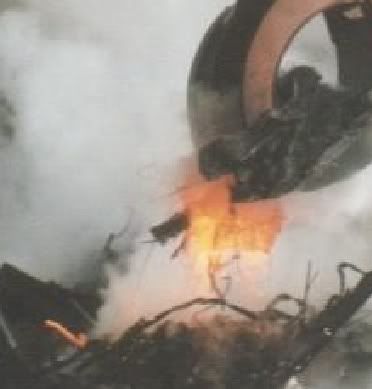
The given picture shows an excavator grabbing non molten material (otherwise it would be impossible for it to actually grip it and keep it) with some glowing metal'esque material.
First of all, it's not dripping or dipped out of or by the bucket, but rather some material has latched onto other non-glowing material. To suggest this is steel makes little sense since a single handful piece of steel could not be that hot while the other attached steel material being dark cool to the colour, unless there was a recent and brief concentrated heat source on just a few selected pieces in intertwined with unaffected steel.
Secondly, the material is not determinable to have been steel and considering the above alone, it would more likely have been other material with lower glow-temps in the midst of the steel, hence the differences in colour of the gripped material.
However, let's say for argument's sake the material in the formentioned picture shows a grip pulling up material where there's flaging parts of steel departing from glowing steel directly attached to much cooler steel, it doesn't prove thermite usage nor how the thermite charges produced steel remaining glowing in this small piece all along while being next to steel unaffected by the heat by comparison.
Also, heat always flows from higher temperatures to lower temperatures, it would be unrealistic to argue it was containable in those piles to keep actual steel liquified for 8 weeks in large pools or rivers (or even glowing yellow). Had the temps contained it been so high as to keep steel liquified and pouring from elsewhere adding to it, it
would've molten every other material compound and it would've been a mixture of metals and carbonized material and so forth, further negating that it could be visibly "steel" differentiated by the naked eye from other metals.
Heck, coal fires alone can and have produced higher temps than so even.
Some additional info:
A Metallurgical Examination and Simulation of the Oxidation and Sulfidation of the World Trade Center Structural Steel (WPI Seminar, September, 2003. Presented by Erin Sullivan.)
Abstract
To simulate the extreme wastage experienced by WTC building 7 structural steel during the fires experienced on September 11, 2001, A36 steel was reacted with powder FeS/FeO/SiO2/C in an open air furnace environment at 900C and 1100C. Initial investigations of the WTC structural steel revealed an apparent liquid "slag" attack and penetration down grain boundaries by liquid iron oxides and sulfides. The current laboratory simulation results show grain boundary penetration by a liquid slag at higher temperatures regardless of powder reactants applied to the steel samples. Eutectic structures within the Fe-S-O and Fe-Si-O systems were observed along with elemental segregation within the near surface microstructure. In all cases, grain boundary penetration appears to be strongly influenced by the addition of alloying elements and contaminants.