• Security incident: ISF was recently accessed by intruders. Please change your password, and change it anywhere else you used it. Read more

THE PHYSICS OF FLIGHT; a thread for CIT

No one answered my question.

How does this thing achieve yaw?

[qimg]http://cache.gizmodo.com/assets/resources/2008/04/B2_bomber1.jpg[/qimg]

Are you kidding? With no vertical surfaces, getting it to yaw is a breeze. Getting it to stop, now...

IIRC, the elevons can be split so that they make a wedge shape, and the differential drag yaws the airplane.
 
No one answered my question.

How does this thing achieve yaw?


At least it has ailerons (sort of)!

Aircraft designers learned many years ago how to get around conventional control surfaces. Look at the delta wing aircraft with no ailerons!

I'd guess R. Mackey knows more about this design, but I'll offer a few comments until he chimes in with specifics.

First, all of the modern center line thrust jet aircraft are virtually flown "feet on the floor" anyway. Rudder is virtually ignored. The T-38, for example, requires virtually no rudder input at all, except on take off and landing and the rare occasion of an engine out and even then it's not very much. Even for rapid roll, high G turns, rudder is not required.

Like rwguinn, I suspect the B-2 has spoilers on top of the wing to assist in roll control. The elevons you can see on the wing extend symmetrically for pitch control and asymmetrically for roll control. The Flight Control System, which is computer controlled based (partially) on pilot input is miraculous.

The computers are not as sophisticated as one would think, but the firmware/software is quite sophisticated.
 
Last edited:
At least it has ailerons!

Aircraft designers learned many years ago how to get around conventional control surfaces. Look at the delta wing aircraft with no ailerons!

I'd guess R. Mackey knows more about this design, but I'll offer a few comments until he chimes in with specifics.

First, all of the modern center line thrust jet aircraft are virtually flown "feet on the floor" anyway. Rudder is virtually ignored. The T-38, for example, requires virtually no rudder input at all, except on take off and landing and the rare occasion of an engine out and even then it's not very much. Even for rapid roll, high G turns, rudder is not required.

Like rwguinn, I suspect the B-2 has spoilers on top of the wing to assist in roll control. The elevons you can see on the wing extend symmetrically for pitch control and asymmetrically for roll control. The Flight Control System, which is computer controlled based (partially) on pilot input is miraculous.

The computers are not as sophisticated as one would think, but the firmware/software is quite sophisticated.
While it probably does have spoilers, The "Split elevon" as described by Tjw is correct for speed brakes. The elevons are split horizontally, like on the STS. You can deploy the upper half up and lower half down as a "speed brake"
You can see them deployed in the crash video (No, I don't have a link) on one side.
 
A brief Googling provides this quote from here:
The leading edge of the wing has an internal structure that helps it absorb radar energy. The outermost wing segment features a "rudderon" or "deceleron", a vertically-split airbrake / rudder that simultaneously opens up and down. To act as an airbrake, both the decelerons are opened, while to act as a rudder only one is. This clever gimmick goes back to the original Northrop flying wings. There is an elevon inboard of the deceleron on the outermost segment of each wing, and then two elevons further inboard, on the next segment. Finally, there is a single control surface for pitch control on the "beavertail" at the center end of the aircraft, giving a total of nine control surfaces.

The decelerons have to be opened about five degrees before they are effective, and in normal cruising flight they are left slightly open. However, this undermines stealth, so when the bomber is in combat, it uses differential engine thrust for yaw control.
 
No one answered my question.

How does this thing achieve yaw?
Differential airbrakes.
Deploy them on one side only, you yaw to that side.
(SWAG on my part--it's the only way I can see to do it)
Wow. Can you imagine the computers in that thing. No wonder it costs over a billion dollars.
At least it has ailerons (sort of)!

Aircraft designers learned many years ago how to get around conventional control surfaces. Look at the delta wing aircraft with no ailerons!

I'd guess R. Mackey knows more about this design, but I'll offer a few comments until he chimes in with specifics.

Like rwguinn, I suspect the B-2 has spoilers on top of the wing to assist in roll control. The elevons you can see on the wing extend symmetrically for pitch control and asymmetrically for roll control. The Flight Control System, which is computer controlled based (partially) on pilot input is miraculous.

The computers are not as sophisticated as one would think, but the firmware/software is quite sophisticated.

:D You guys overestimate me... I haven't done any work on the B-2 Spirit, though I've seen them flying often.

Your suspicions are all correct. Yaw control is achieved via split rudders -- the ailerons have independent upper and lower surfaces. The aircraft can thereby induce drag at the wingtips, and this is how it yaws and maintains yaw stability.

The split rudder is really its own brand of control surface. In some respects it resembles a simple aileron, but in others its more like a spoiler in that it deliberately induces a controlled flow separation.

Yaw stability is also the biggest challenge. Compare the B-2 to earlier flying wings -- these development aircraft relied on vertical surfaces, despite the dreams of Jack Northrop for a truly clean aircraft. In the early versions, the engines and their housings acted as vertical stabilizers, required to get cooling air over the piston engines. When the later versions mounted jets, actual vertical stabilizers were added, and even this wasn't always enough.

A third possibility, sometimes used in the development vehicles, was differential thrust. One tries to avoid that in a large aircraft, however, since it leads to inefficiency and isn't as responsive as control surfaces. Nonetheless, the generally more massive flying wing design lends itself to mounting the engines wide, since there's relatively little penalty in terms of increased yaw moment.

In the case of the B-2, however, Northrop's "clean" ideal was a design requirement, not merely an aesthetic. Engines above and below the planform, large vertical stabilizers, etc. are anathema to low observability. This led to much higher demands on the split rudders -- even the earliest development aircraft had them, but the old design was inherently more stable, and a pilot could use them without electronic assistance. The new aircraft, on the other hand, needs to adjust them almost constantly to keep itself well inside its stability box. So high rate flight computers send minute corrections to the split rudders constantly, enforcing a straight track. Fortunately, the aircraft is rather large and massive, so a small excursion doesn't instantly lead to a roll and spin. Its size and inertia mean there is time to return before getting into an uncontrollable spin or stall condition.

The flight computers are not particularly complicated, but the air data sensors are. An uncommanded yaw needs to be sensed with more accuracy and at a higher rate. This places emphasis on inertial reference and actual air probes; the latter also have to be "stealthy" as they protrude outside the aicraft, and this is one of the more complex challenges of the entire vehicle.

These sensors are expensive. So are the advanced materials, and the low observability features are highly maintenance intensive. Other than that, however, the basic principles are fairly straightforward. Northrop's original dream was a good one, simply ahead of available technology. For its intended mission and requirements, the B-2 is a jolly good aircraft.

 
Erm...
Damn....
I hate to correct such a sage and oracle....
But Rudders arer vertical. That airplane got Nothin' vertical nowhere, no how...:o
 
I've also seen them referred to as "split flaps." Depends on your background. If you focus on location, they're flaps. If you focus on function, they're rudders. I'll accept either without complaint if there are any B-2 crew chiefs in the house -- like I said, I haven't worked on it myself, just going by what I've read and heard.

Or we could follow the "combination" tradition. In delta-wing aircraft, we encounter "elevons," i.e. combination elevators and ailerons. There are also "flaperons" that serve as ailerons and landing flaps. The B-2's surfaces could be rightly called "rudderons," though nobody does.

Or why stop there? How about "elevudderons?" Or there's the flap function, and spoiler/slat function as well, and that gives us "eleflapudderoilerons." :D

All kidding aside, the vehicle also has a "beavertail" that is the closest it has to a true elevator and ordinary flaps. The outsized landing gear doors are also aerodynamically significant during takeoff and landing. Finally, there are supplemental inlet doors that open at low speed, and these have some effect on airflow over the leading edge. Very complex, unconventional design, almost demanding its own terminology.
 
.. Rudder is virtually ignored. The T-38, for example, requires virtually no rudder input at all, except on take off and landing and the rare occasion of an engine out and even then it's not very much. Even for rapid roll, high G turns, rudder is not required.
...
So true; the rudder was best for your wingman, student pilot Capt Pounds an F-4 backseater in UPT, he will need the ruder when he is doing a straight ahead aggressive rejoin and his massive overtake will need, speed brakes, full rudder, and ailerons as he passes you with his T-38 rocket sideways. He was in fast after he fell in from ahead.
 
So true; the rudder was best for your wingman, student pilot Capt Pounds an F-4 backseater in UPT, he will need the ruder when he is doing a straight ahead aggressive rejoin and his massive overtake will need, speed brakes, full rudder, and ailerons as he passes you with his T-38 rocket sideways. He was in fast after he fell in from ahead.

Had one of those at Lakenheath, but the wingman didn't miss. Two expensive aircraft in the drink!
 
So true; the rudder was best for your wingman, student pilot Capt Pounds an F-4 backseater in UPT, he will need the ruder when he is doing a straight ahead aggressive rejoin and his massive overtake will need, speed brakes, full rudder, and ailerons as he passes you with his T-38 rocket sideways. He was in fast after he fell in from ahead.

Had one of those at Lakenheath, but the wingman didn't miss. Two expensive aircraft in the drink!


I'll just have to assume you two know what you're talking about, and hope for a translation for us regular guy slobs......
 
I'll just have to assume you two know what you're talking about, and hope for a translation for us regular guy slobs......

He started it! :p

We were discussing the use of rudder for yaw control. Then I mentioned that rudder is not normally a huge requirement for today's center line thrust aircraft giving the T-38 as an example. Then Beachnut chimed in with a personal story about an aggressive rejoin he experienced in pilot training (a rejoin is kinda of like an intercept) during which the wingman overshot the leader. However, he tried to stop the overshoot by yawing the aircraft, which didn't work causing the wingman to pass in front of the leader. OK, so far?

Following that my comment was regarding a similar type formation rejoin in which the two aircraft collided both crashing into the Dornoch Firth (North Sea).

Phew!!!!!!
 
So true; the rudder was best for your wingman, student pilot Capt Pounds an F-4 backseater in UPT, he will need the ruder when he is doing a straight ahead aggressive rejoin and his massive overtake will need, speed brakes, full rudder, and ailerons as he passes you with his T-38 rocket sideways. He was in fast after he fell in from ahead.

Had one of those at Lakenheath, but the wingman didn't miss. Two expensive aircraft in the drink!

I'll just have to assume you two know what you're talking about, and hope for a translation for us regular guy slobs......

Okay, here's a translation from a glider guider:

Jet airplanes are pretty clean, they don't necessarily slow down real fast when you reduce power.
When you're joining up to fly formation with another airplane, you have to remember that airplanes ain't got no brakes.
Speed brakes add drag, but it may not be enough. A bootful of rudder will get the airplane yawed. Going sideways through the air adds a lot of drag, but it also will cause the airplane to begin rolling. (Depending on the airplane, this can be a large or small effect.) So you have to add opposite aileron to oppose this tendency.
Being cross-controlled like this (rudder trying to turn left, ailerons trying to roll right, or the reverse) while going straight ahead is called a "slip".
Weirdly, if you do the same thing while turning, it can be either a slip or a skid.

So his wingman misjudged his speed while joining up, and had to add a lot of drag. He overshot, and as he went by he was grossly uncoordinated. Then had to wait for the lead airplane to catch up, but was able to move in close fairly quickly after that.

Glider guiders also routinely fly formation, but we add to the interest level by tying the two aircraft together with a rope.

ETA: took too long!
 
Last edited:
I'll just have to assume you two know what you're talking about, and hope for a translation for us regular guy slobs......

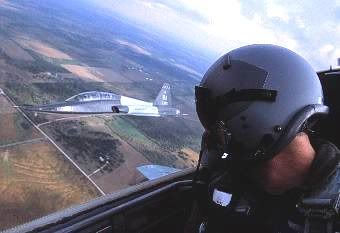
Sorry for the pilot talk. For one year, in what used but be called UPT (Undergraduate Pilot Training) we learned jargon that makes it hard to describe what we did. (use to be called UPT, Undergraduate Pilot Training were we flew T-37 and T-38 aircraft for a year)

T38form.jpg


Flying formation, when planes need to rejoin (reform the formation) after being separated for some task we would use a turning or straight ahead rejoin. The turning rejoin is fast if you can sustain a turn while rejoining the formation. In a turn the plane rejoining to lead (leading aircraft) will just cut inside the turn (use cutoff) and maintain "a line" to the rejoin position; like on the road if you are on a wide curve, the car in the inside beats the car on the outside when at the same speed.
On a straight ahead rejoin the number two aircraft has to use speed alone, no cutoff, to effect the rejoin. If the number two aircraft has too much speed he will over shoot, not a passing grade. The rejoin I mentioned was done by the top student in our section, he had a 100 knots or more of overtake, we could see him speeding into position, he had to deployed his speed-brakes (the square plates in front of the wheel-well doors) (these are panel that come down, or up on some planes, and slow the aircraft, different designs on different planes), plus he used full rudder and opposite aileron to slip the plane sideways to increase the drag. He passed us 50 feet or 100 feet and kept us in sight by looking over his canopy rail which was visible to us due to his extreme slip maneuver, his plane was sideways.

Reheat knows of an accident where the plane rejoining fast missed his potion and hit the lead aircraft. You have to aim for your position and avoid aiming at the lead aircraft, or you could hit your leader.

Think of a rejoin in aircraft just like catching your friends walking ahead of you. If they are on a turning path and you can cut inside you can effect a rejoin quickly with cutoff and speed, but if they are leaving straight away, you must increase your pace.
Walking or running into position with your friend is easy to slow down usually, in planes slowing down takes planning to be prompt and efficient.

I will look for a side slip photo.

Boone 870 found a good side slip. A plane trying to land and get down quick.
 
Last edited:
Last edited:
Sorry for the pilot talk. For one year, in what used but be called UPT (Undergraduate Pilot Training) we learned jargon that makes it hard to describe what we did. (use to be called UPT, Undergraduate Pilot Training were we flew T-37 and T-38 aircraft for a year)

[qimg]http://i286.photobucket.com/albums/ll116/tjkb/T38form.jpg[/qimg]

Flying formation, when planes need to rejoin (reform the formation) after being separated for some task we would use a turning or straight ahead rejoin. The turning rejoin is fast if you can sustain a turn while rejoining the formation. In a turn the plane rejoining to lead (leading aircraft) will just cut inside the turn (use cutoff) and maintain "a line" to the rejoin position; like on the road if you are on a wide curve, the car in the inside beats the car on the outside when at the same speed.
On a straight ahead rejoin the number two aircraft has to use speed alone, no cutoff, to effect the rejoin. If the number two aircraft has too much speed he will over shoot, not a passing grade. The rejoin I mentioned was done by the top student in our section, he had a 100 knots or more of overtake, we could see him speeding into position, he had to deployed his speed-brakes [qimg]http://i286.photobucket.com/albums/ll116/tjkb/T38SB.jpg[/qimg] (the square plates in front of the wheel-well doors) (these are panel that come down, or up on some planes, and slow the aircraft, different designs on different planes), plus he used full rudder and opposite aileron to slip the plane sideways to increase the drag. He passed us 50 feet or 100 feet and kept us in sight by looking over his canopy rail which was visible to us due to his extreme slip maneuver, his plane was sideways.

Reheat knows of an accident where the plane rejoining fast missed his potion and hit the lead aircraft. You have to aim for your position and avoid aiming at the lead aircraft, or you could hit your leader.

Think of a rejoin in aircraft just like catching your friends walking ahead of you. If they are on a turning path and you can cut inside you can effect a rejoin quickly with cutoff and speed, but if they are leaving straight away, you must increase your pace.
Walking or running into position with your friend is easy to slow down usually, in planes slowing down takes planning to be prompt and efficient.

I will look for a side slip photo.

Boone 870 found a good side slip. A plane trying to land and get down quick.

Those look like MiGs. You're a damn commie beachnut! No wonder you're an establishment apologist.:p
 
Last edited:
Those look like MiGs. You're a damn commie beachnut! No wonder you're an establishment apologists.:p
In a Tom Cruise movie.

My T-38 (not my T-38, our T-38s) was/were white. (See avatar, me posing with look likes MIG)
 
Last edited:

ISF - Join now!

Every member here is approved by hand. No bots, no spam, just people who care about evidence and honest debate.

Membership is free!

Create your free account

Back
Top Bottom