Ed Forum birdwatching 2008

RedIbis, I'll pass on a bit of advice I received here: Add an F-stop or two when the background is bright. It will save you having to brightening it up later and ending up with that grainy look.
(Of course you may already know that but didn't have time. Those nesting birds usually don't hang around long)
 
RedIbis, I'll pass on a bit of advice I received here: Add an F-stop or two when the background is bright. It will save you having to brightening it up later and ending up with that grainy look.
(Of course you may already know that but didn't have time. Those nesting birds usually don't hang around long)

I welcome all suggestions! I am very new to photography. I thought graininess was caused by high ISO, so I kept it at 100.

I usually just keep the F stop in a safe range and keep the shutter speed on the high side around 300 so that the bird's movements don't show up blurry.

If I understand you correctly, adding an F stop by lowering the number will keep some of the noise out.

Also, I'm sure that the image is grainy because I am cropping a very small object in the frame, and brightening, sharpening, etc to get any of the details out of the bird for identification rather than aesthetic quality.

Even with a 300mm lens, it's tough to get close enough to get a good shot.

Again, thank you for the advice, and please keep it coming. I expect to take thousands of bad pictures before I get a few good ones. Even with digital it's a brand new science for me.
 
I welcome all suggestions! I am very new to photography.

Likewise, so perhaps I'm not the best person to respond. Nevertheless...

I usually just keep the F stop in a safe range
If the backgound is bright, your subject (bird) will appear dark and therefore lacking in detail. If you open up the diaphragm by upping the F-stop, the background will be even brighter (which doesn't matter), but the subject will also be brighter, therefore showing more detail (which is what you want).

and keep the shutter speed on the high side around 300 so that the bird's movements don't show up blurry.
With a subject that doesn't move, the shutter speed should be roughtly the reciprocal of 1 1/2 times the focal length of the lens (ie if the focal length is 300, the shutter speed should be roughly 1/450 sec). If the subject is moving the shutter speed should obviously be a lot quicker. And, if you have a tripod, the shutter speed can be a lot slower.

If I understand you correctly, adding an F stop by lowering the number will keep some of the noise out.
Sorry, I don't know what that means :o

I thought graininess was caused by high ISO, so I kept it at 100.
Also, I'm sure that the image is grainy because I am cropping a very small object in the frame, and brightening, sharpening, etc to get any of the details out of the bird for identification rather than aesthetic quality.
Graininess will mitigate against identification (although there are some posters here that can identify almost any bird from any pic!)
Factors that increase graininess:
- Increasing the ISO number.
- Cropping the original photo.
- Increasing the brightness of the original photo.

Even with a 300mm lens, it's tough to get close enough to get a good shot.
A doubling lens would help (it converts a 300mm lens into a 600mm lens), but you would probably need a tripod as well.
(I have a tripod, but I have not yet had time to purchase a doubling lens as suggested to me recently in this thread)

Again, thank you for the advice, and please keep it coming. I expect to take thousands of bad pictures before I get a few good ones. Even with digital it's a brand new science for me.
Join the club.
I hope others will correct any errors and/or add a few hints.
 
Last edited:
Great pics, RedIbis!

On a sadder note, Caramel got a coal tit this morning. Now we do have a superabundance of the things, but even so....

I think I'm going to have to ration his time out of doors. He's getting too good at this. I love watching the birds at the feeder and I'm very reluctant to stop feeding them.

Rolfe.

PS. My avatar is a detail from a larger picture of a tabby cat just failing to get his claws on what looks like either a starling or a blackbird. It's called "Lost Chance". Caramel isn't losing enough chances, I fear.
 
I'm sure there's a pic somewhere. They're the commonest birds at my feeder.

Merikans, think black-capped chickadee, except slightly chunkier and with a head striped like a badger.

Rolfe.
 
Coal tit....black tit...gangrenous tit?

...poor pussy-cat. :(

Oh well, I guess she has a few more at least.

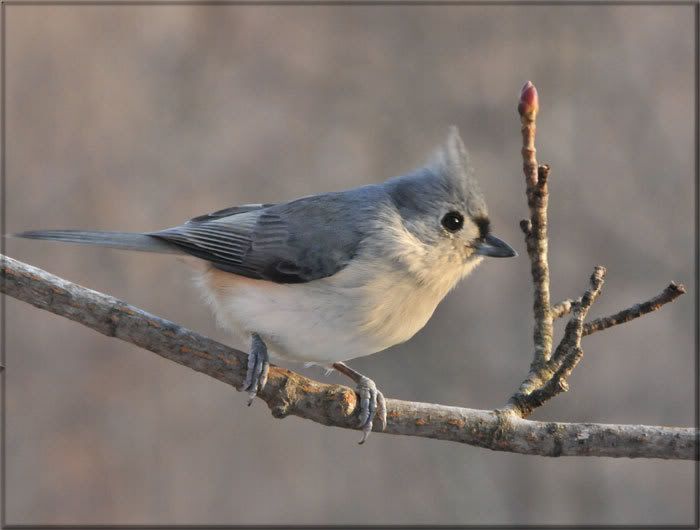
I'll bet Pussy-cat would like a tufted titmouse.

tufted-titmouse.jpg

 
Likewise, so perhaps I'm not the best person to respond. Nevertheless...

If the backgound is bright, your subject (bird) will appear dark and therefore lacking in detail. If you open up the diaphragm by upping the F-stop, the background will be even brighter (which doesn't matter), but the subject will also be brighter, therefore showing more detail (which is what you want).

With a subject that doesn't move, the shutter speed should be roughtly the reciprocal of 1 1/2 times the focal length of the lens (ie if the focal length is 300, the shutter speed should be roughly 1/450 sec). If the subject is moving the shutter speed should obviously be a lot quicker. And, if you have a tripod, the shutter speed can be a lot slower.

Sorry, I don't know what that means :o

Graininess will mitigate against identification (although there are some posters here that can identify almost any bird from any pic!)
Factors that increase graininess:
- Increasing the ISO number.
- Cropping the original photo.
- Increasing the brightness of the original photo.

A doubling lens would help (it converts a 300mm lens into a 600mm lens), but you would probably need a tripod as well.
(I have a tripod, but I have not yet had time to purchase a doubling lens as suggested to me recently in this thread)

Join the club.
I hope others will correct any errors and/or add a few hints.

Great info! The ratio of focal length to shutter speed sounds vaguely familiar. I look forward to trying all this out soon on my next bird hunt. A good tripod is next on my purchase list. Thanks again, Billy
 
Unidentified Birds

I only have a guess on these two. I shot the pictures from quite a distance. Theses little birds spooked easy. Any feedback would be greatly appreciated.

Black and White Warbler?

BlackandWhiteWarbler-UnID.jpg


Yellow Breasted Chat?

YellowBreastedChat-UnID.jpg
 
I only have a guess on these two. I shot the pictures from quite a distance. Theses little birds spooked easy. Any feedback would be greatly appreciated.

Black and White Warbler?

Yellow Breasted Chat?

B & W Warbler - spot on.

The "chat" is more tricky - the initial impression based on the head shape might suggest a swallow or martin. Large eye placed near the front of the head, flat cap with a distinct forehead and tiny bill, c.f. Cliff Swallow

However the legs are way too long for any hirundine, the strong backlight is probably making the bill look small than it actually is, and if the head is turned slightly away from us then this will accentuate the effect and the eye will appear further forward than in a side-on view. So ignoring all that :) , what else is there to go on?

The distribution of white on the belly, orange breast and blue mantle looks quite useful. Hunting around produced the Bluebird
http://www.bluebird-electric.net/bluebird.htm.

Points against it are the fact that, in your picture, the white breast doesn't seem to form a peak into the orange area at the centre of the breast, and the orange area extends too far onto the cheek. On the other hand the white edge near the carpal joint of the wing looks good and the jizz is pretty good for a thrush/chat.
 
Got out for the first time in months.

Nothing new for the list, but I did find a Northern Flicker Colaptes auratus willing to pose for a photo.

 
Hooded Merganser : Fife, Scotland 14/11/08 Probable escape - but I'm getting to the time of year when my listing gets less fussy. :)
 
FINALLY, a new bird for my list, and it looks maybe for the list in general:

A snowy owl (nyctea scandiaca).

I had never seen one of these before in the wild, and they're not supposed to be common this far south. My wife spotted it on top of a telephone pole, and we turned the car around, and looked at it for a while. No question about what it was. That's a big owl!

edit to add, this was near Whiting, Vermont, if anyone is keeping tabs.
 
Last edited:
Wow! Excellent, Bruto!

I saw one a few years ago, swooping into and out of the light of my headlights. No mistaking what it was, once I regained control of my bowels. It is indeed a big owl--it's even bigger when heading for your windshield!
 
The Northern Flicker is underrated in the birder world. I love seeing this beauty. It's bigger than most woodpeckers and shows that bright yellow spot on its lower back when it takes flight.

The rump patch is white on the Red Shafted variety of Northern Flickers common in this area.

It's also one of my favorite birds. Large, showy, playful and noisy.
 

Back
Top Bottom