Nope. CRC, parity, etc. require the full word to be received and checked
before writing to CPM. Values stored in CPM are time stamped along
with the corresponding parameters.
And what time stamp is applied? Who generates the time stamp?
This has no effect on delays
upstream.
Since this has been explained to you literally dozens of times, I don't expect an acknowledgement from you at this stage, so instead, I reiterate:
Losses of the last few seconds are common in FDRs. The events of AA 77 are not unusual in this respect, no matter how they happened.
What damage? The data written to CPM is already secure and verified.
Power to the FDAU is not lost instantly upon impact, but even then
the Alititude shows too high at :45.
"What Damage:"
NTSB said:
The SSFDR was examined upon receipt. The recorder displayed evidence of impact, fire, and smoke damage. [...]
Only validated parameters are included in the plots and tabluar data in this report. A list of these parameters is in Attachments I-1 to I-4. The remaining parameters either were not recorded properly or were not confirmed to have been recorded properly, and were not included in this report.
Source
The list of unrecovered parameters outweighs the recovered parameters by about two to one. There are some reasons for this, i.e. most unrecoverable measurements are discretes and phase-specific, however there is some evidence of damage to the recording module itself. Nonetheless, this is but one
possible mechanism, and one that cannot be ruled out.
Again, we know ...:45 is before impact, because, as you yourself point out, it was too high at that instant. This is consistent with my explanation.
This also suggests that the NTSB's "estimate" of impact time was merely read off from the above figure. This is quite similar to the
9/11 Commission report's (incorrect) impact times, which were taken directly from radar returns, and turn out to be off by about ten seconds.
Unless we can verify that the NTSB really meant its figure to be good to +/- 1 second, this figure is not precise enough to use it as you are using it. I've explained this to you several times today.
Nope. You can't wipe out certain seconds, or words, or parameters.
The FDR is rated up to 3400 G's and temperatures well above jet fuel.
Yes, one can. Particularly in an impact.
"Jet Fuel" is not a temperature. Also, systems do not always perform up to their rated spec...
And, once again, we must treat
the data we have. There is
no point arguing that we should have data that we do not.
As explained, the Flash memory itself requires address lines and electricity
applied for an extended period of time to erase the contents.
Sudden impacts, or loss of power do not contribute to the erease process
of EEPROM.
Wrong. If you are writing to an EEPROM when your voltage spikes or flatlines, you damage the EEPROM. Loss of power can lead to a latch, but a spike is the worse case. This results in excessive charging, leading to a short in the EEPROM itself. You can also get sympathetic charging in nearby cells. If an entire subframe was being written at this time, it would not be even faintly unusual for significant data damage.
And it doesn't take much. Kill a single bit in the sync words, and you've just invalidated an entire subframe.
Since the FDR records in four-second frames, and the data outage we're considering here is on the order of four to six seconds, you cannot possibly pretend that such mechanisms are impossible. Particularly since losses of similar data are, once again, seen in several other crashes as well.
Spikes: Regulated by circuitry usually in the form of filter capacitors, inductors and/or regulator IC's.
Loss of power while writing would reject the word/frame. Due to the fact
that the data reached CPM, was recovered, contiguous and intelligble,
the 'power loss' theory is not acceptable.
In a collision, you are practically guaranteed to get arcing across multiple power and data systems. All those capacitors suddenly get mashed onto their circuit boards in ways they were never intended. Batteries short. Rectifiers fail. Regulator IC's arc and short.
You're basically pretending that everything would work perfectly and then fail safe. Not a good assumption.
The simple fact that you held onto a theory that claimed the data was
six seconds prior to impact also contradicts your current claim of
impact vs. data written.
The FDR runs out before impact. This is not theory, it's fact. I'm holding on to it because that's what the data says. Again, I don't see the contradiction.
No, you did not'
NTSB states impact at :45
Your theories (as explained above) do not make sense based on the information.
Seem to make sense to me.
Remember this?
It DOES end before impact? But you just told us there's no reason for it?

You're confusing yourself. The data does stop. There is data loss associated with the data stoppage, due to mechanisms as explained to you numerous times. Had there been no impact, the data would not have stopped, and there would be no loss.
No contradiction.
Here's a hint:
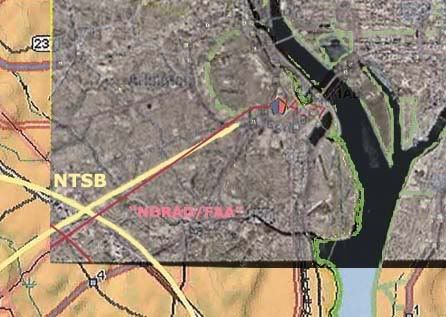
the turn started about 3.5 miles southwest
Not good enough. Either explain your alleged contradiction, or drop it. I can't tell how
you are confused if you won't explain it.