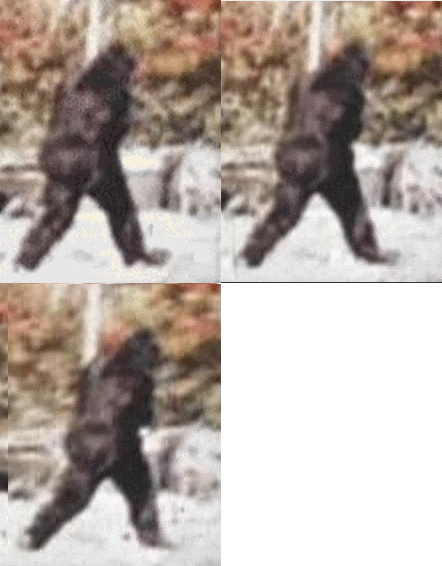
Odinn:
"This one is not quite as easy to discredit as some of the other features. What is the physical action of the costume foot at work here? I do not think these are shadows. The apparent flexing of the foot is an anomaly. Maybe Bill Munns has some thoughts on how a costume foot might do this."
These are my original notes of Jan. 9 on foot mechanics:
"FOOT MECHANICS
I have heard of three various concepts of putting mechanics into feet, which are 1. to pump fluid/air into muscle simulation areas of a suit. 2. to use a mechanism to bend the toes of enlarged prosthetic feet for a more natural walk cycle. and 3. to use mechanics to pull the toes of an enlarged prosthetic foot down to fascilitate making big footprints with the mime's feet while walking.
The first I mentioned in a thread in answer to a question about fluid pumps in the feet to help make muscle dynamics in a suit look better, but I am repeating the answer here.
When "The Howling" came out (1980), everybody in the business was trying to do everything with bladders, every producer wanted them (bragging rights), and nobody ever got anything working well with fluid bladders, just air bladders. It's the flow rate through a tube, plus tube length. We did a lot of blood tube stuff for bleeding wounds, cut veins "spurting" blood, etc. at the time.
You couldn't put a very big fluid resivoir in the foot to step on,and it would have to be shaped like a rigid hydraulic cylinder, not just a loose pouch or bag, because you must guarantee the fluid, once "stepped on" would flow only into the tube, not just expand the bag in a sideways direction in the shoe, the tube up to the "muscle" would slows down the reactive time (internal friction in the tube), and the rigid fur would overpower the fluid pressure, so the bladder would expand sideways or down back toward the mime's body, not outward. Bladders of any kind only worked well under thin foam latex prosthetics, because the foam has great elasticity and stretched so easily, so the bladder could expand it. No such luck for the fur areas.
The second concept is to give the larger prosthetic foot a more natural look, by allowing the appearance of toes pulling up during the walk cycle. Absent this, the prosthetic toes extending beyond the real foot inside simply stick straight out and do nothing. I've heard of a simple level mechanism driven by pressure on the heel to curl up the toes, or pressure on the ball of the foot. I have never seen an engineering drawing, much less a working mechanism of either, and in contemplating both, I haven't seen any effective way to actually impliment this.
The third device uses some weight of the body on a part of the real foot to force a mechanism in the prosthetic toes to pull downward, to "grip" the ground better, to make a better footprint (since the prosthetic toes, if rigid, would greatly increase the risk of the mime stumbling, and if flexible, would negate any prospect the prosthetic foot could make a strong toe print in the walking process. It's very flexibility that would fascilitiate the mime's walking would pervent it from making an footprint.) I have never seen an engineering drawing, much less a working mechanism of either, and in contemplating both, I haven't seen any effective way to actually impliment this idea either.
All these elements may have been theorized by proponents of suits to explain how a larger prosthetic foot could either A). pump fluid to make suit muscles bulge; or . make the big foot prosthetic move more naturally, or C). make the prosthetic foot capable of accomplishing the big footprints.
I have yet to see any of these accomplished in a working mechanism, to accomplish one of the three results, and I cannot imagine a mechanism that might accomplish two or three of these things. So if an argument for a suit is advanced, and it includes any description to a foot mechanism doing any of these things, I would expect to see a working mechanism before I would give any creedance to the claim."
(end original notes)
The basic challenge to any foot mechanics is that the toes bending or straightening, or any "mid-tarsal break" argued for, is that the bending/straightening of the foot is on a different cycle of action from the ground pressure of the foot with weight on it, so a self contained mechanism using foot pressure on the ground does not get the bend/unbend motion timed correctly.
That means an external mechanism controller would likely be needed, which tends to complicate the whole thing, because natural walk cycles and foot joint bends are so automatic as to be almost unconscious. So any operator trying to consciously operate a flexing foot, mechanical complications aside, has a programming challenge not easily resolved.
So my response to any argument for foot bending devices would be to ask, "show me the mechanism" in at least a schematic design drawing, something indicating joints, linkage, actuator mechanisms and controller mechanisms. It may be as simple as springs and connecting rod levers, but I'd still like to see it diagrammed, if someone argued for it.
Bill



 ...
...