Ed Forum birdwatching 2008

Carrion or Hooded?


Not actually sure, trying to make up my mind. The bird book isn't that clear, and the damn things don't hold still for long. Carrion, I think.

However, what was swiping the fat block yesterday was actually a jackdaw, Corvus monedula. I'm being had for a sucker here. And not just by the crow family. The finches are positively fighting to get on the feeders, and the coal tits are really messy eaters, never heard of "waste not want not" as far as I can see. This is going to be an expensive hobby.

The greenfinch came back yesterday too. It had been raining for over 48 hours pretty much without a break, so maybe the feeders were the easy option.

Rolfe.
 
Not actually sure, trying to make up my mind. The bird book isn't that clear, and the damn things don't hold still for long. Carrion, I think.

Ok.

This is going to be an expensive hobby.

Hahaha, well bird-feeding has no upper limit in how much it can cost^^. I know a couple of Finnish birdwatchers here in town who voluntarily take it upon themselves to feed birds at the Botanical Garden, and they generally spend between 10000-20000 SEK (1000-2000 euro) every year, depending on the weather. It's a great feeding station, though, with perhaps 30 different species every winter.

My father has a much smaller one, and he probably spends a few thousand crowns on it as well. I'll go in and support one I'll be using for catching birds this winter with my project money, but that, too, is one which does not have an upper limit.

A few pics from the same:

Great pictures! Is it common on that island to see that many birds, especially that many herons and egrets?

Also: you reported a meadowlark. As I understand it, you have both a Western and an Eastern, both of which could be found along the Texas coast during the autumn. Do you know which one you saw?
 
I think it is [a Wattle bird], but I can't tell which species it is. Little Wattlebird Anthocheara chrysoptera?

I'm not sure, but I think that is correct.
I should be back there this week-end, so I'll try for a better shot.
I think I need a tripod and a telephoto lens, but that would mean a backpack. :(
 
I'm not sure, but I think that is correct.
I should be back there this week-end, so I'll try for a better shot.
I think I need a tripod and a telephoto lens, but that would mean a backpack. :(
The tele lens is tough to replace but instead of a tripod try a monopod. Many of them make good walking sticks and a monopod is better for the quick action of birds. I have a few walking sticks I made out of saplings. I chose saplings with a forked branch at the right height to support my camera.
 
I think it is, but I can't tell which species it is. Little Wattlebird Anthocheara chrysoptera?

Here's my thoughts on the bird (I've no previous experience of the group.)

There are four species of wattlebird, Yellow, Western, Red and Little.
Western is confined to Western Australia, Yellow to Tasmania - Mt Evelyn is in South-East Australia so that cuts it down to two.

The typically quoted features of Red are red eyes, distinctive red wattles either side of the neck and white streaks on the chest and belly, which reveals a bright yellow patch towards the tail. None of these are visible in the picture - the eyecolour is obviously dark but I can't tell any more than that.

Looking for features we can see :

Firstly Red Wattlebird

http://www.csse.monash.edu.au/~carlo/SB/Red-Wattlebird-1997-1S.jpg

Note the discrete pale patch on the cheeks, bounded on the lower edge by a dark moustachial stripe and the pale margin to the tertials
[the uppermost flight feathers on the wing], and the pale spots on the tips of the primaries [the other visible flight feathers]

http://en.wikipedia.org/wiki/Image:1A_AustNativeBird0021.JPG

Again the primary spots are obvious, there are some pale margins to the tertials, though they look more worn than in the previous picture. The pale cheek is again a discrete patch, and the tail feathers show pale tips.

Little Wattlebird

http://farm1.static.flickr.com/93/273470049_c3e6bc3957.jpg?v=0

Note the lack of white tail tips and the profusion of white streaks lacking a distinct edge where it meets the slightly darker chin.

http://farm2.static.flickr.com/1352/1002853798_8afdfff6be.jpg?v=0

Here the cheek streaks continue to the narrow dark strip on the upper throat but with no dark moustachial stripe, and the wings are very plain, with only one primary showing a significant spot.

Compare with BillyJoe's pic http://i34.tinypic.com/xpu6hl.jpg

All together, I think it's a Red Wattlebird Anthochaera carunculata.

Please take the backpack, BillyJoe, and this time get the bird face on!
 
... instead of a tripod try a monopod. Many of them make good walking sticks and a monopod is better for the quick action of birds. I have a few walking sticks I made out of saplings. I chose saplings with a forked branch at the right height to support my camera.

I prefer to take nothing, not even food or drink, but unfortunately a camera is a necessity if I am to bring back some pictures. I am loathe to take any more luggage than that, but maybe I'll make the odd exception. I did get a telephoto zoom lens with my camera and my wife has a small lightweight tripod. Although a forked stick sounds like a good idea for taking action shots of birds I think I'll concentrate on birds sitting quitely in trees for the moment. Also, I've never used a walking stick in my life!
 
All together, I think it's a Red Wattlebird Anthochaera carunculata.

I saw more of that bird than appears in that photo and I think you are correct.

Please take the backpack, BillyJoe...

Goddamn. My first purpose is the trip. I tend to go places where I can do some steep hill climbing, clambering over rocks, and some down hill runs. Backpacks tend to like only to go for a walk. :(

...and this time get the bird face on!

I asked him last time - and nicely too - but he did not seem to understand Australian.
 
Great pictures!
Thanks. There are many here with better equipment than me, but I find the key is to take a lot of pictures (thank you, digital age) and throw away most of them.


Is it common on that island to see that many birds, especially that many herons and egrets?
Quite common. We see practically every kind of heron and egret year-round here in the Houston area. The Reddish egret is strictly coastal, though, so I don't get to see it as often, which is a shame. They are so much fun to watch, because they essentially chase their prey through the water, high stepping and flapping madly.


Also: you reported a meadowlark. As I understand it, you have both a Western and an Eastern, both of which could be found along the Texas coast during the autumn. Do you know which one you saw?
Probably Eastern, but as sphenisc says, they're hard to tell apart. I'm not sure they're really separate species.

I must say though, that I think the Texas Gulf Coast has the greatest number and variety of birds of any place in the US. The further south you go, the greater the variety, as their migration paths get funneled through the isthemus.

It's a good thing too, because Houston doesn't have much else to recommend it, nature-wise. No mountains. Beaches are more muddy than sandy with no surf to speak of. Hardwood forests are rare and sparse. So I'm very grateful for all the feathered dinosaurs we have around here.

Yesterday, the wild budgie came back to my birdfeeder. I actually walked outside and he just sat and looked at me (steadily chomping seed). I know we have a breeding population, but I suspect this guy may be an escapee.
 
It's a good thing too, because Houston doesn't have much else to recommend it, nature-wise. No mountains. Beaches are more muddy than sandy with no surf to speak of. Hardwood forests are rare and sparse. So I'm very grateful for all the feathered dinosaurs we have around here.

[THREAD DRIFT]
I grew up in the Houston area (18 years there), and I disagree. True, no mountains, muddy beaches, no real hardwood forests, but that doesn't exclude nature. You just have to like coastal wetlands. Tons of birds, reptiles, mammals, some marsupials, fish, and insects. I have many fond memories of camping there and all the wildlife. I have been living in Arizona for 8 years and have come to appreciate the nature of an area for what it is. True, in Arizona, we have mountains and deserts, but the wildlife is sparse (it only takes me about 5 minutes to name almost all of the wildlife of the Sonoran Desert, and I have seen almost all of it. I couldn't even begin to name all of the wildlife I have seen in the Houston area.) Anyways, as far as nature of the Houston area goes, it has less geographical change, but more biological change. [/THREAD DRIFT]

OK, back on topic. I have yet to get a good picture of the birds I have seen here. I only have a 12 MPixel point-and-shoot camera though. I will try Tricky's suggestion of take a ton of pictures and hope I get a good one to keep. :D
 
I leave on Thursday

First of all, I want to point out that I really liked BillyJoe's picture of the Black Cockatoo. The other one is so familiar from TV and so on, but I don't know if I've ever seen much of the black one before.

Second, I am leaving on Thursday for Japan. After being in Chiba for a week, I'll head as far north as is possible without leaving the country, to Wakkanai on Hokkaido. I am hoping this means I may have a chance on Steller's Eagle and Harlequin Duck, but I may be too early in the season... I will be there during the height of migration for many passerines, though, and as I understand it, we'll also catch a lot of ducks, cuckoos, woodpeckers, and whatnot.

I then go to Furen-ko, which I believe is in southern Hokkaido, then to Niigata for Fukushimagata, then to Miyagi for Tori-no-Umi (Sea of Birds!!!), then back to Niigata, and then finally to Australia, then London. This will be an awesome trip! I will be back in Sweden "permanently" around the 20th of December, and then leave immediately for my parents' place, then Austria. So I'll only be back to add stuff of my own to the list in the middle of January or so.

Tomorrow, however, I will probably not have time to check in, as there are a million things to do at work (damn you, procrastination!:a2:), and a million friends to say bye to. So I hope you all have a nice autumn, with lots of being out in nature. I will do my best to add another 200 species or so on my trips, which I hope will be no problem. That'd mean that we'd be somewhere around 800 or so, and EHocking has said that he might add a few as well. 1000 is not unreachable!^^

Anyway, I wish you all the best. I may be reachable on my mail occasionally, but by no means regularly. That's the back side of the wilderness^^. EHocking and some others here (sphenisc?) has my email-address if anyone needs it for some reason.

Oh, and I'll take A LOT of pictures^^. If nothing else, I am sort of required to take a picture of every individual I get lice from, which hopefully will mean a few hundred of those alone, not counting other birds. And I still have 50-odd pictures from Sweden to send to EHockinhg, so maybe I'll actually take time to do that when I get back as well. I should be finished well before the final collapse of the Universe, I guess.

So: take care and have fun!

 
[THREAD DRIFT]
I grew up in the Houston area (18 years there), and I disagree. True, no mountains, muddy beaches, no real hardwood forests, but that doesn't exclude nature. You just have to like coastal wetlands. Tons of birds, reptiles, mammals, some marsupials, fish, and insects. I have many fond memories of camping there and all the wildlife. I have been living in Arizona for 8 years and have come to appreciate the nature of an area for what it is. True, in Arizona, we have mountains and deserts, but the wildlife is sparse (it only takes me about 5 minutes to name almost all of the wildlife of the Sonoran Desert, and I have seen almost all of it. I couldn't even begin to name all of the wildlife I have seen in the Houston area.) Anyways, as far as nature of the Houston area goes, it has less geographical change, but more biological change. [/THREAD DRIFT]
Yeah, really you're right. We do have a lot of wildlife. I really like the wide variety of snakes we get here. Still, I miss mountains. I'd settle for a few hills.

OK, back on topic. I have yet to get a good picture of the birds I have seen here. I only have a 12 MPixel point-and-shoot camera though. I will try Tricky's suggestion of take a ton of pictures and hope I get a good one to keep. :D
I have the same thing, except only 7.5 MPixels. And I just use the automatic settings mostly.

One thing you should do is to always take a breath and hold it before you snap the picture. It minimizes lens motion.
 
It's been suggested that I post here. I'm not a birder, but I do tend to take photos of birds. So here we go.

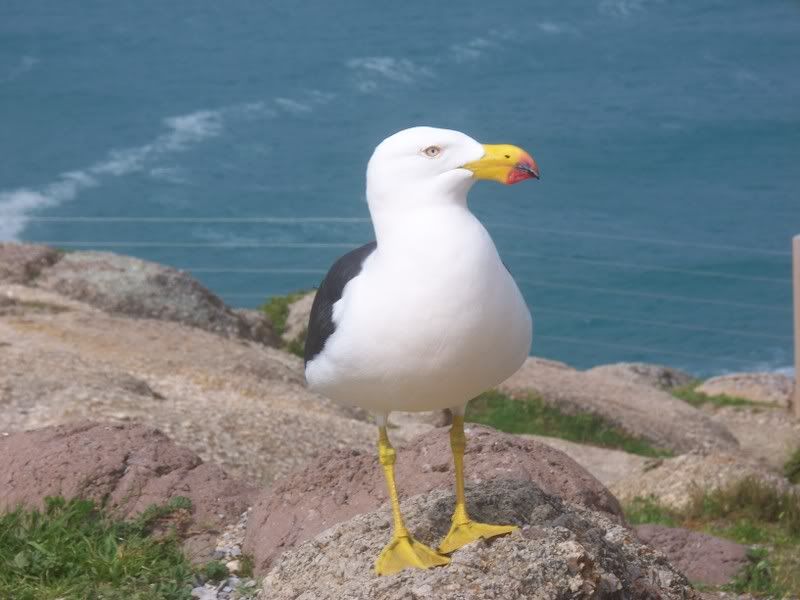
I am reliably informed that this is a Pacific Gull, Larus pacificus, probably a male:
100_0927.jpg


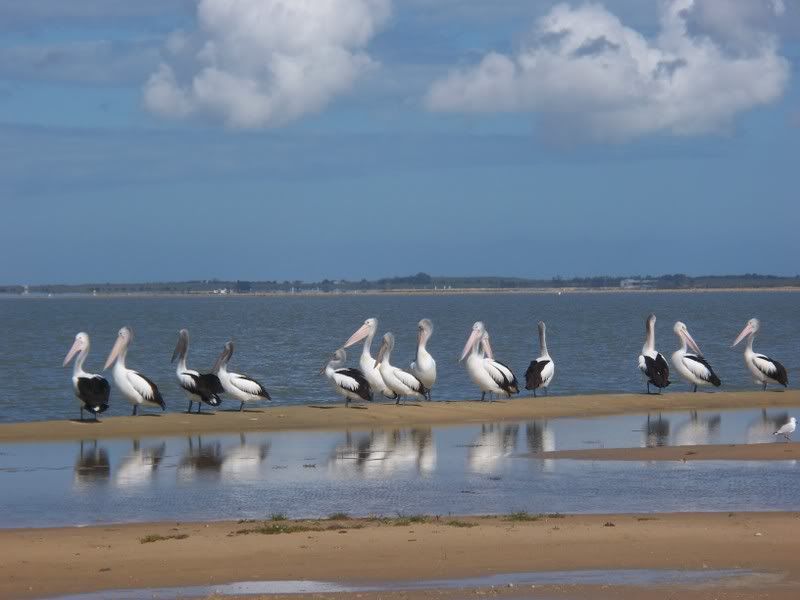
And then of course there's the pelicans...
100_1263.jpg
 
Pelicans doing very precision flight work last weekend.
These usually come by later in the year, from the north.
This bunch was going north.
 

Attachments

  • IMGP2488r.JPG
    IMGP2488r.JPG
    117.9 KB · Views: 1
It's been suggested that I post here. I'm not a birder, but I do tend to take photos of birds. So here we go.

I am reliably informed that this is a Pacific Gull, Larus pacificus, probably a male.

And then of course there's the pelicans...

The Pacific Gull looks like a real bruiser - are they as aggressive as they look?

There's also a Silver Gull on the far right of the pelican picture, which isn't on the Australia List yet.
 
I prefer to take nothing, not even food or drink, ....
.
Vital necessities!
Cellphone! I used to not have one, but now I won't go anywhere without it.
Sheriff, Fire Department numbers in the phone book.
Drink! Dehydration sneaks up on you and ruins the day's enjoyment if it gets too bad.
Monopod-walking stick. Where I walk there's cougars and bears. And steep inclines which a stick helps with.
 
Ok, with EHocking about to intrude on my Greece (*sigh*)... I was looking through my other pics... and it seems I can provide evidence for two, perhaps three (depending on the birders here) species in Bulgaria. Nothing new (domestic pigeon, yellow-legged gull) unless I am mistaken... but a whole new country (at least until I alert Hipparchia and she starts putting me to shame).

So anyway, my question is, does it really matter at all if I can add another country, even with just a couple of common birds that are already on the list? Or would that just be silly? (And yes, I know that the entire endeavor is already silly, or important, or whatever, it is what it is, and I am new at the game.)
 
The Pacific Gull looks like a real bruiser - are they as aggressive as they look?
This one wasn't especially aggressive - but far from standoffish too.

There's also a Silver Gull on the far right of the pelican picture, which isn't on the Australia List yet.
Those bastards!?? Rats with wings. You can see them everywhere. I'm surprised it isn't on the list.
 

Back
Top Bottom