The Bible is a mixture of myths from various sources and historical (as well as semi-historical) accounts with varied amounts of fiction, written by many individuals. Some places cited at the Bible are real, some people were real, some accounts are of real facts. The Book of Mormon comes from a single source - J. Smith. The book of Mormon adds to the Bible an extra big layer of claims that are not supported by evidence. The core of these claims is tested every time archeologists work at North America, every time geneticists check DNA from Native Americans and every time their languages and cultures are studied. So far, no reliable evidences were found. If you want to learn more about it, please use the search function (restrict your search to the Religion and Philosophy subforum). There are a number of very good threads on this subject, with the participation of Mormons.
You just built a false dichotomy.
One thing is to tender some sort of religion or to feel somehow culturally linked to one. The use of poor methodology to defend the veracity of a religious text is a completely different thing. That's the sort of work that can be throw out.
Nope. Saying an individual is using poor methodology and biased analysis is not an
ad hom, since person is not being attacked. My critics are directed towards what I consider to be poor methodology, and this includes taking the literal veracity of a religious text as the immutable starting point and then start looking for reasons to prove it correct (or not wrong). It is an analogy with the way I see his bigfoot research- the starting point (bigfeet are real) is based on belief, not in good reliable evidence and is not subject to change. No, he is not alone, many a footer do the same thing.
He may be an expert, but the evidence (or the lack of) indicates he is wrong when it comes to bigfeet being real.
He examined and scanned all those casts and obtained exactly what? Has he found two with the same "dermals"? Has he found "dermals" which can not be explained as casting artifacts?
He used evidences suspected of being a hoax (PGF and the casts produced by Paterson) as the backbone of his paper. This is weak evidence and poor data handling IMHO.
I see a pattern too. Weak evidence (misidentifications and hoaxes included) accepted as reliable pieces of evidences and being used to build flawed reasonings and conclusions. Belief creating analysis bias. Even in the highly unlikely case of bigfeet being real the methodology he is using will still be poor.
Here's two of them, you will find more of after some Googling if you want.
http://www.cryptomundo.com/cryptozoo-news/bf-me/
http://www.bigfootforums.com/index.php?showtopic=22995&st=33
No. I have "a problem" with religious fundamentalism and pseudoscience.



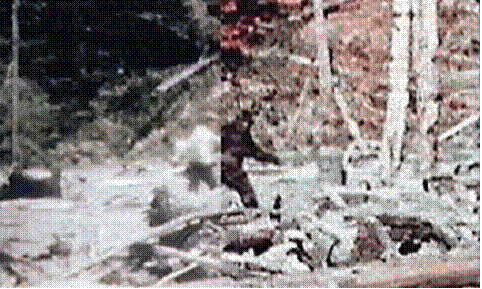


 The very important aspect about that very entertaining interview is that it clearly establishes that Philip Morris is a dishonest individual. He chucked his claim at the PGF for the publicity.