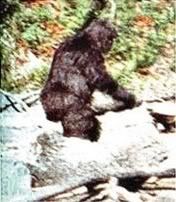
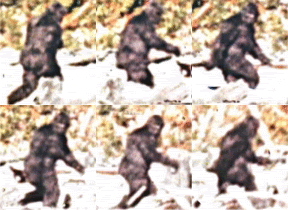
Noll and Caddy are amateurs at analyzing digital image’s, they are also amateurs at analyzing film and what they speculate on should be taken with a grain of salt.
Rick sounds pretty knowledgable here:
"Rick Noll: John Green gave me a copy he had of the Patterson Gimlin film, with the permission of Mrs. Patterson, to take microscopic pictures of each frame. I went there in person to pick it up. Drove to Canada. John was interested in finding those frames where he could get a reasonable estimate of the IM index of the creature. I had to build a transport stage for the film, which was on a reel. I used a 6-megapixel camera to shoot RAW formatted images through a microscope. Since the camera operator (Roger Patterson) was moving through the scene, as was the subject, the film stage had to be moved many many times through the process. It took about two months to get the images.
RAW images are not sharp or color corrected like consumer jpg files are. John Green could not use RAW images, so I just gave him unprocessed jpg files. These are highly compressed images and can contain artifacts from the process.
This was the first part of the job John asked of me. We were then going to select the very best and make film negatives of those images. I stopped short though.
The film I worked with was the same one used in “Sasquatch: Legend Meets Science.” It had been optically blown up at some point by John Green. In order to do better work and stabilize the photographs, I told John that we needed a better copy. I needed more of the background to align between frames.
I went to Mrs. Patterson and asked about this as well. She said that she would look into it but she was also dealing with a new book soon to come out on Roger Patterson and the film, so she had her hands filled right then.
She does have a master copy and was willing to make another, but she would have had to come to Seattle with it and stay until it was made.
Melissa: To your knowledge, has anyone ever worked directly with the actual film itself?
Rick Noll: There is a rumor that Bruce Bonney used the original film to make the 12 Cibachromes that Rene Dahinden wanted made. But that is about it that I know of. I remember that Rene told me that he had to go to California and pick up the film right before the UBC conference in 1978. The book that came out of the conference, “Manlike Monsters on Trial,” used the Cibachromes as plates in it.
I suspect that Bruce Bonney used a product called Scratch-All to hide the scratches in whatever film he used before printing onto the Cibachrome paper. Unfortunately, this also degrades the image clarity. The Cibachromes do not have, or they are highly reduced, the scratches that the film has.
I have also seen some stills taken from the film that have to have been altered by hand, details drawn in artistic interpretation.
Melissa: Please tell us your background and experience with Film and Video.
Rick Noll: I use to own a camera shop and professional photofinishing lab in California and know quite a bit about the process. I had to take Kodak classes in processing and slide duplication. I know all of the pros and cons... what is and is not possible.
Melissa: What is the difference between "stabilization" and a ".gif"?
Rick Noll: Stabilization usually refers to arresting subject or camera movement through a sequence of contiguous image frames in video or film works. A gif file is a format that can simulate video like movement over the Internet without the tremendous file size and resources needed to show an actual video stream."
http://txsasquatch.blogspot.com/2006/12/interview-with-rick-noll.html
But what do I know? I'm just an amateur.
Owen's presentation on the "New Face of Patty" drew at least one comment that he's done his homework.
Just how did Owen and Rick induce the esteemed Dr. Swindler to appear on national TV and deliver information that is just so obviously "woo"?