Well, I did report the ruby-throated hummingbird... the only other I have seen was not in North America! Saw the tiniest hummingbird I have ever seen, in Sofia, Bulgaria. Sorry, was not aware of the birding thread then, so although I watched carefully, I did not observe systematically.

-
Security incident: ISF was recently accessed by intruders. Please change your password, and change it anywhere else you used it. Read more
You are using an out of date browser. It may not display this or other websites correctly.
You should upgrade or use an alternative browser.
You should upgrade or use an alternative browser.
Ed Forum birdwatching 2008
- Thread starter Kotatsu
- Start date
-
- Tags
- birds birdwatching
Kotatsu
Phthirapterist

Well, I did report the ruby-throated hummingbird... the only other I have seen was not in North America! Saw the tiniest hummingbird I have ever seen, in Sofia, Bulgaria. Sorry, was not aware of the birding thread then, so although I watched carefully, I did not observe systematically.
If you saw it in Bulgaria, I would guess it was actually a moth.
EHocking
Penultimate Amazing

Guaranteed that it's a Hummingbird Hawkmoth.I will take your word for it; it was unlike any moth--or any hummingbird--I had ever seen before that.
I posted about a month ago on one I spotted in Spain. I knew about them and the erroneous sightings of Hummingbirds in the UK and Europe, but even then it took a LONG look on my behalf to confirm the antennae...
EHocking
Penultimate Amazing
Yeah - that'll be down to me. I'm just not the taxonomist that Kotatsu is.Hmmm. Well, I get 22 or so as well, and that seems reasonable. I don't know what's wrong in the excel sheet, but I'll check it tonight. ..
Sorry about the extra work, I really hadn't realised how much work it is to translate the thread sightings into our spreadsheet and how much effort Kotatsu puts into this in the background. All I really do is sort into a pivot table and (eventually) write some HTML.
Kudos to Kotatsu for the work he puts in here.
sphenisc
Philosopher

- Joined
- Jul 14, 2004
- Messages
- 6,253
Re: Ringed Plover or Little Ringed Plover?
Diagnostic feature which are generally useless
Palmations (Webbed feet): On Ringed Plover the palmations are only between the outer two toes whereas on Semipalmated (SemiP) they’re between all three main toes.
This shows well in Semipalmated PloverWP, and if you’d waited half a second it might have been in your photograph too.
Diagnostic feature which are occasionally useful
Call: SemiP has a rather thin reedy chu-weet call with a rising inflection. Ringed is a flutier too-ii with a rising inflection.
This are only really useful if you know your common species well, once you’ve listened to several hundred of them and appreciate what the normal call is then it’s possible to pick out individuals which sound different.
Other supporting features which can help confirm ID.
(in very rough descending order of usefulness)
Yellow orbital ring: Almost always visible on SemiP, rarely on Ringed (some males at height of breeding season.)
Bill shape: Bill is smaller and more pointed on SemiP looking “nipped off” at the tip, It’s deeper at the base so the upper edge of the upper mandible can look ever-so-slightly concave. Ringed is longer and more smoothly conical.
Loral area: The black stripe running from the eye to the base of the bill is generally thinner in SemiP. The point where lower edge of the band meets the bill is above the rearmost point of the gape, whereas on Ringed it meets at the gape point.
White patch above eye: Male SemiPs show almost no white above the eye, females, a small flick of white, less than on most Ringed (only adults).
Wing bar: The wing bar on SemiP is narrower and less contrasting than on Ringed Plover.
Breast band: SemiP has a narrower breast-band. (breeding season, adults)
Size, shape: In direct comparison, SemiPs look marginally smaller, and more gracefully built, the head a little more rounded.
‘-------------------
All the visible features in the (excellent) photograph indicate SemiP. The point where the lower edge of the loral stripe meets the bill is the least convincing feature, because, while it appears to be above the gape point, there’s a small fleck of white feathers which disrupts the line of the stripe. This might be a momentary ruffling but it makes it less easy to tell where the actual junction is.
Diagnostic feature which are generally useless
Palmations (Webbed feet): On Ringed Plover the palmations are only between the outer two toes whereas on Semipalmated (SemiP) they’re between all three main toes.
This shows well in Semipalmated PloverWP, and if you’d waited half a second it might have been in your photograph too.
Diagnostic feature which are occasionally useful
Call: SemiP has a rather thin reedy chu-weet call with a rising inflection. Ringed is a flutier too-ii with a rising inflection.
This are only really useful if you know your common species well, once you’ve listened to several hundred of them and appreciate what the normal call is then it’s possible to pick out individuals which sound different.
Other supporting features which can help confirm ID.
(in very rough descending order of usefulness)
Yellow orbital ring: Almost always visible on SemiP, rarely on Ringed (some males at height of breeding season.)
Bill shape: Bill is smaller and more pointed on SemiP looking “nipped off” at the tip, It’s deeper at the base so the upper edge of the upper mandible can look ever-so-slightly concave. Ringed is longer and more smoothly conical.
Loral area: The black stripe running from the eye to the base of the bill is generally thinner in SemiP. The point where lower edge of the band meets the bill is above the rearmost point of the gape, whereas on Ringed it meets at the gape point.
White patch above eye: Male SemiPs show almost no white above the eye, females, a small flick of white, less than on most Ringed (only adults).
Wing bar: The wing bar on SemiP is narrower and less contrasting than on Ringed Plover.
Breast band: SemiP has a narrower breast-band. (breeding season, adults)
Size, shape: In direct comparison, SemiPs look marginally smaller, and more gracefully built, the head a little more rounded.
‘-------------------
All the visible features in the (excellent) photograph indicate SemiP. The point where the lower edge of the loral stripe meets the bill is the least convincing feature, because, while it appears to be above the gape point, there’s a small fleck of white feathers which disrupts the line of the stripe. This might be a momentary ruffling but it makes it less easy to tell where the actual junction is.
Guaranteed that it's a Hummingbird Hawkmoth.
I posted about a month ago on one I spotted in Spain. I knew about them and the erroneous sightings of Hummingbirds in the UK and Europe, but even then it took a LONG look on my behalf to confirm the antennae...
Yup, that's it! Wow... Ok, I feel better about my misidentification now.
Kotatsu
Phthirapterist
I will take your word for it; it was unlike any moth--or any hummingbird--I had ever seen before that.
Well, there are no hummingbirds in the old world. The closest things we have, I believe, are Sunbirds, White-eyes and some similar birds. They are similar only in that they fill similar niches, but they never hover. If you find a hovering hummingbird-like animal in Europe or Asia, it's a moth. I have seen several of them (I have some in my collection), and they really do look like a small bird, so it's an easy mistake. Usually they are night-active, though, which helps a bit, but some species can be found during the day as well, such as the one Eric posted a link to.
Kudos to Kotatsu for the work he puts in here.
Well, it was a lot more difficult before you added that pivot table (and I still don't quite understand how that work^^), and I had to try to remember if a bird had already been seen or not (or look it up, of course). Adding the same bird more than once and try to keep track of the number of orders, families, and species would eventually have been impossible. I believe that what started out as a naïve project on my part has now become so dependent on your pivot tables that I would never have started it if I knew the work involved sometimes^^. I consider myself lucky that only a few people here actually report very large amounts of birds at the same time. If everyone wrote the kinds of lists I wrote for Germany I'd need to hire an assistant.
Speaking of which, I'll be gone for the rest of the year, starting on the 11th of September. Having heard now the two people that have so far worked with the list, is there anyone who'd still volunteer to fill in for me while I am away?
Re: Ringed Plover or Little Ringed Plover?
I suppose you mean "Semipalmated", not "Little Ringed". Nevertheless, a great post! I will have use of this when I go to Canada next year, but I believe there's only Semipalmated in Vancouver...
Speaking of which:
As I will be away for most of the rest of the year, I'd like to ask another question before I leave. The question is: do we continue after New Year's Eve, and if so, how? I have a number of suggestions, of course, but would very much like all kinds of input.
I would say we'd reset the list next year, and start from scratch, of course. This is a one-year-list, more or less, and it would be more or less pointless to continue the same list over more than one year.
However, I'd suggest we have an all-time-list, which is a condensation of the present list, but which could be continued next year, and every other year that the people on the forum feels this is something they'd like to participate in. As we've had a number of very interested participants over the year, I think that it's likely to attract at least a modest number of people in the coming year(s), but such things can naturally never be predicted.
My dream would be to have a feature on the homepage where the bird list of this year is compared with that of next year. We have had that on the local society's homepage, and it was quite interesting to see sometimes. It kept track of the older list and the present list, and compared the species listed. Every day, it compared the species observed the present year with all those observed up until the same date the year before, and then made a small list at the bottom where you could see which species had been seen at that time the year before but not now, and which had been seen the present year but not up until the same date the year before. Naturally, in a global list such as this one (but where are all Europeans outside the UK? And Canadians?), it would depend very much on who is active which year, but it could still be a nice feature.
Another thing I'd like to see for next year (or sooner?) would be a species list where the columns are countries, rather than months as it is on the present list. This would make it possible for people to see that, for instance, Grey Wagtail has been observed in Germany, Sweden and UK, but not in Netherlands, Croatia and Norway. I think I have spoken to EHocking about this before, but I can't remember what he said. I think it would be a nice addition, at least.
Of course, I don't know any programming at all, so maybe these suggestions are infeasible, given that no one is paid for this. However, I'd like to invite comments and perhaps other things people would like to do. I for one could go for inclusion of other vertebrates, if people are interested. I've seen quite a lot of non-avian vertebrates this year, so for me it would have made sense. I'd need to get a new checklist for that, though, or try to get some expert on the list to help out....
I love the Great White Egret/ Greater Yellowlegs shot, and with a 200mm lens! Were you working from a hide or is it all down to heavy cropping?
Thanks, it's heavily cropped from a 12 MP original.
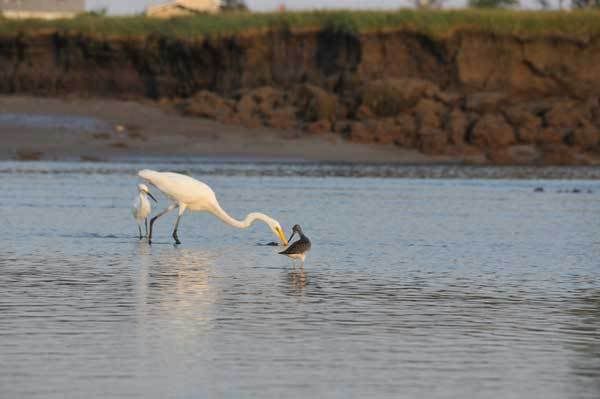
Even with that admission I've got to add that this was the closest I've gotten to these birds and getting there is half the fun. I approached a sand bar in my kayak from upstream while the tide was going out. I let the current drift the kayak onto the bar and then lay quietly for about an hour while these birds got comfortable and came closer & closer.
I'd rather get a great photo of a pigeon than just document a rare sighting but if I hang around here too long I fear that may change.
On the rare sighting note, I did spot a Murre on the beach at the mouth of the river (Whebhannet River, Wells Maine) in mid July. I don't see that on the list yet. I had never seen one before. It was probably ill although it's plumage looked fine and it's eyes were bright. It was letting itself be picked up by a young girl as if it was a puppy. Had a fishing pole with me instead of my camera

sphenisc
Philosopher
- Joined
- Jul 14, 2004
- Messages
- 6,253
Speaking of which, I'll be gone for the rest of the year, starting on the 11th of September. Having heard now the two people that have so far worked with the list, is there anyone who'd still volunteer to fill in for me while I am away?
I'd be happy to look after the Excel side of things, though I'd need some help on how it's transferred to the website.
I suppose you mean "Semipalmated", not "Little Ringed".
I just re-used YoPopa's title, perhaps I should have put in quotes.
Speaking of which:
As I will be away for most of the rest of the year, I'd like to ask another question before I leave. The question is: do we continue after New Year's Eve, and if so, how? I have a number of suggestions, of course, but would very much like all kinds of input.
I would say we'd reset the list next year, and start from scratch, of course. This is a one-year-list, more or less, and it would be more or less pointless to continue the same list over more than one year.
However, I'd suggest we have an all-time-list, which is a condensation of the present list, but which could be continued next year, and every other year that the people on the forum feels this is something they'd like to participate in. As we've had a number of very interested participants over the year, I think that it's likely to attract at least a modest number of people in the coming year(s), but such things can naturally never be predicted.
My dream would be to have a feature on the homepage where the bird list of this year is compared with that of next year. We have had that on the local society's homepage, and it was quite interesting to see sometimes. It kept track of the older list and the present list, and compared the species listed. Every day, it compared the species observed the present year with all those observed up until the same date the year before, and then made a small list at the bottom where you could see which species had been seen at that time the year before but not now, and which had been seen the present year but not up until the same date the year before. Naturally, in a global list such as this one (but where are all Europeans outside the UK? And Canadians?), it would depend very much on who is active which year, but it could still be a nice feature.
Another thing I'd like to see for next year (or sooner?) would be a species list where the columns are countries, rather than months as it is on the present list. This would make it possible for people to see that, for instance, Grey Wagtail has been observed in Germany, Sweden and UK, but not in Netherlands, Croatia and Norway. I think I have spoken to EHocking about this before, but I can't remember what he said. I think it would be a nice addition, at least.
Of course, I don't know any programming at all, so maybe these suggestions are infeasible, given that no one is paid for this. However, I'd like to invite comments and perhaps other things people would like to do. I for one could go for inclusion of other vertebrates, if people are interested. I've seen quite a lot of non-avian vertebrates this year, so for me it would have made sense. I'd need to get a new checklist for that, though, or try to get some expert on the list to help out....
I think there needs to be a distinction between the requirements for the Forum thread, the website and the data management.
I'd suggest that we start a separate "Forum Birdwatching 2009", that this one be renamed "Forum Birdwatching 2008" and that a final list of bird, first observer and first location is included at the end.
I don't think the webpages should get any more complicated, well maybe a page for other vertebrates - but there should be an option to download the data so that anyone can interrogate it.
The webpages should be re-commenced at the start of the year.
In terms of data management a database might be a better idea than simply using Excel, depending on the complexity of the data structure. Excel is fine for the data we have at the moment but if you want to start asking lots of complex questions e.g. "How many passerines, in 2008, have been seen by two or more observers in two or more locations?", then frankly now is the time to make the transition, before things get unwieldy.
I don't think there is going to be much demand for that kind of thing, and frankly anyone who's interested will either do themselves or ask someone on here to explain how/do it for them.
Last edited:
EHocking
Penultimate Amazing
At the moment (as soon as Kotatsu and I get in-synch with our spreadsheets) I'm happy to continue to compile the list for 2008.
I WILL address the suggestions of other ways of listing. I'm using the latest version of Excel and it can save directly as HTML. In fact, I can save the pivot tables as webpages, which gives you the ability to filter/browse the "database" at the web page and make your own lists.
At the very least I will try a test page of this.
At the moment, Excel is not too unwieldly for the simple listing that we're doing. Pursuing this next year, I'd probably continue to collect in Excel ('cos it's more universally known) and hope to create a database behind the webpage.
I've been terribly slack the last month or so. Very busy at work and then lots of travelling on weekends, so little time to get around to updating. Will try tonight, but got some packing to do for the long weekend in England!
Thanks for the offer of help sphenisc, as soon as it gets on top of me, you'll get a PM!.
I WILL address the suggestions of other ways of listing. I'm using the latest version of Excel and it can save directly as HTML. In fact, I can save the pivot tables as webpages, which gives you the ability to filter/browse the "database" at the web page and make your own lists.
At the very least I will try a test page of this.
At the moment, Excel is not too unwieldly for the simple listing that we're doing. Pursuing this next year, I'd probably continue to collect in Excel ('cos it's more universally known) and hope to create a database behind the webpage.
I've been terribly slack the last month or so. Very busy at work and then lots of travelling on weekends, so little time to get around to updating. Will try tonight, but got some packing to do for the long weekend in England!
Thanks for the offer of help sphenisc, as soon as it gets on top of me, you'll get a PM!.
Bunk
Incomplete Idiot

- Joined
- May 23, 2002
- Messages
- 3,209

Does it count as bird watching if I'm just sitting on my deck? Here are my ruby-throated hummingbirds. I put up a feeder this spring that never attracted a bird, even though I could see them in the blooms in my yard and in the woods behind my yard. I finally decided it had to be the feeder and bought a cheap one at home depot and had 3 hummingbirds the first day. I got a second feeder after they got so crowded that I couldn't count them anymore. I probably need a third feeder. They're going through almost a quart of nectar per day.
Look at 'em all behaving nicely and sharing a meal. Most of the time there's mass chaos as they all try to jockey for position, or if seated, a constant attempt to avoid the next dive bomber.
There's seven on this feeder, one is almost completely obscured on the left side behind the nectar reservoir. When I took this photo there were 3 more on the other feeder and two still hovering around trying to decide who to attack, for a grand total of 12. I suspect there's several more than that, but that's the most I've managed to count at once.
P.S. I put this on a thread of it's own before realizing it belonged in the JREF pictures thread and then finding out there's a bird watching thread.

EHocking
Penultimate Amazing
Definitely.Those are obviously moths...
I reckon all his photos are 'shopped. Here's the original.

They look EXACTLY like the moth from the page I linked to earlier in the thread.

Coincidence? I think not.
Last edited:
Ixion
Inquiring Mind

- Joined
- Mar 26, 2008
- Messages
- 2,431
I have never posted to this thread, and generally do not consider myself anything other than a casual birdwatcher, but a recent sighting has gotten me more interested. I don't know if these have already been posted on the thread, but I will include my sightings here.
Here are my first two:
Greater Roadrunner (Geococcyx californianus). I spotted this fellow running across the road yesterday morning (approximately 8 am Arizona time) with a nice juicy insect in his mouth. I have seen him a couple of times before in the same vicinity, so I am recording my most recent sighting.
Cactus Wren (Campylorhynchus brunneicapillus). We have a mating pair that lives in the Saguaro cactus near our apartment. Frequently we see these two snatching insects near our apartment in the early morning. Most recent sighting was last night at approximately 6:30 pm.
Please let me know if I am doing this correctly or if any additional information is needed.
ETA: I will try to take pictures of the birds I see when I hae my camera available.
Here are my first two:
Greater Roadrunner (Geococcyx californianus). I spotted this fellow running across the road yesterday morning (approximately 8 am Arizona time) with a nice juicy insect in his mouth. I have seen him a couple of times before in the same vicinity, so I am recording my most recent sighting.
Cactus Wren (Campylorhynchus brunneicapillus). We have a mating pair that lives in the Saguaro cactus near our apartment. Frequently we see these two snatching insects near our apartment in the early morning. Most recent sighting was last night at approximately 6:30 pm.
Please let me know if I am doing this correctly or if any additional information is needed.
ETA: I will try to take pictures of the birds I see when I hae my camera available.
Last edited:
EHocking
Penultimate Amazing
Welcome Ixion.
Don't worry about levels of expertise, it's only interest in birds that is the common factor here. Don't think anyone's admitted to being a twitcher, though (wiki link for non-Brits).
Yep, you've given us all we need to get your sightings on the list.
English name, Latin name, date, location.
Oh, and the Cactus Wren is our first one - so definitely doing it right!
(The OP has a hope we'll get 1,000 distict species in 2008)
Don't worry about levels of expertise, it's only interest in birds that is the common factor here. Don't think anyone's admitted to being a twitcher, though (wiki link for non-Brits).
Yep, you've given us all we need to get your sightings on the list.
English name, Latin name, date, location.
Oh, and the Cactus Wren is our first one - so definitely doing it right!
(The OP has a hope we'll get 1,000 distict species in 2008)
Bunk
Incomplete Idiot
- Joined
- May 23, 2002
- Messages
- 3,209
Those are obviously moths...
You should see them banging against my porch light at night.
That's some good photoshopping, EHocking, I wish I could whip something out like that.
ETA: I just saw your forum bird watching webpage. Very impressive! I didn't see the ruby throated hummingbird on the list, archilochus colubris, order APODIFORMES - family TROCHILIDAE. It's very common in the eastern U.S. They also seem to like beagles. I'm in Alabama, the photo was taken on 19 August.
Last edited:
EHocking
Penultimate Amazing
I assure you it took only a few minutes - that's to head off the "too much time on your hands brigade" that would probably have me spending a little more time getting the web page updated!You should see them banging against my porch light at night.
That's some good photoshopping, EHocking, I wish I could whip something out like that.
ETA: I just saw your forum bird watching webpage. Very impressive! I didn't see the ruby throated hummingbird on the list, archilochus colubris, order APODIFORMES - family TROCHILIDAE. It's very common in the eastern U.S. They also seem to like beagles. I'm in Alabama, the photo was taken on 19 August.
 See my last comment