• Quick note - the problem with Youtube videos not embedding on the forum appears to have been fixed, thanks to ZiprHead. If you do still see problems let me know.

Plasma Cosmology - Woo or not

DeiRenDopa said:
Why do we need to invent "dark matter," when matter in the plasma state is a known fact?
Um ...

... perhaps because no one has yet come up with an explanation, using "matter in the plasma state", for the many observations, of many different kinds, that lead to the conclusion 'here be CDM'?

If you know of any papers which present such explanations, would you be kind enough to reference them please? I, for one, am most interested in papers which address all classes of such observations, of all classes of objects so observed.

No, papers that address such observations are not freely available for citation on the "internetz"--they cost anywhere from $5.00 to $32.00 apiece :( Yet I am actively researching abstracts along those lines...to be continued...


Back on topic according to the OP.

Going back to the title of this thread, I would suggest that it is not necessarily "woo-ish" to critically examine the roles that magnetism and matter in the plasma state play in the behavior of objects in the cosmos. I agree with the OP that labeling this line of inquiry as "Plasma Cosmology", as if it were a proven theory, is at least dramatic, if not disingenuous. Yet it does not follow that adopting so-called "Plasma Cosmology" as a working hypothesis were necessarily a WOMBAT.

More importantly I would like to raise the question as to how the intervening matter in the plasma state between ourselves and the observed phenomena colors our observations. Turbulence in matter in the liquid state is well documented, ditto in the gaseous state. (If such research has been done concerning the dynamics of matter in the plasma state, then by all means, please point me to it.)
 
Last edited:
I think your confused as to what an an external energy source is. The energy these stars recieve is being recieved externally from the particles flowing into them in the currents, just like alfvens heliospheric current circuit. The electrical power is the new source of energy, which is being recieved externally to the stars.


The problem is that we can easily measure the charged particles and their energy leaving the sun. External currents powering the sun would require higher energy flow into the sun then leave the sun. This calculation has been done on other threads, but where is the stream of charged particles entering the sun sufficient to at least power the solar wind (charged particles leaving the sun) let alone power the sun. Unless you can find an equivalent amount of charged particles entering the sun as the solar wind then you can not even account of an externally powered solar wind let alone an externally powered sun. Having a significantly greater energy density then the solar wind (for an externally powered sun or solar wind) it should be even easier to detect. Since we do not find an excess of either positive or negative charges leaving the sun (direct current application) or the balanced charges of the solar wind periodically pulsating to and fro (alternating current application), this light bulb concept of the sun is flawed in that aspect. The energy of the electrons leaving a light bulb is less then that of when they were impingent upon that light bulb (voltage drop). Based on conservation of energy the energy required to be impingent upon the sun is at least equal to or greater then the energy leaving it. The energy leaving the sun is easily detectable, why isn’t that equal or greater energy required to externally power (entirely or in any significant part) the sun (or solar wind) at least as detectable?
 
No, papers that address such observations are not freely available for citation on the "internetz"--they cost anywhere from $5.00 to $32.00 apiece :( Yet I am actively researching abstracts along those lines...to be continued...

... snip ...
Have you tried arXiv?

There are some astro papers that do not appear as preprints here, but not many; it only goes back to 1992, but that is nearly always far enough back; they are preprints, but most times the differences with the actual published paper are unimportant.

And it's free! :)
 
Back on topic according to the OP.

Going back to the title of this thread, I would suggest that it is not necessarily "woo-ish" to critically examine the roles that magnetism and matter in the plasma state play in the behavior of objects in the cosmos. I agree with the OP that labeling this line of inquiry as "Plasma Cosmology", as if it were a proven theory, is at least dramatic, if not disingenuous. Yet it does not follow that adopting so-called "Plasma Cosmology" as a working hypothesis were necessarily a WOMBAT.

The usual definition of Plasma Cosmology is that of Hannes Olof Gösta Alfvén. This was expanded upon by Anthony Peratt, especially in the area of galaxy formation.

However a different definition of Plasma Cosmology seems to have emerged in this thread. There is no one posting that defines this PC so all I can give you is my interpretation:

Plasma Cosmology is a collection of scientific theories (not one consistent scientific theory) with a common thread. This thread seems to be that the theory either emphasizes the contribution of plasma in the universe or is a steady state cosmological theory. The collection (may) include
  • Peratt's plasma model of galaxy formation.
  • Lerner's model of element formation in galaxies.
  • Tired-light explanation of cosmological redshifts.
  • Intrinsic redshifts from the ejection of quasars from bright galaxies.
  • Other theories which may include the Electric Universe (e.g. electrically powered stars).
This has the nice advantage for PC advocates that this version of PC can never be disproved since it is not a scientific theory. Every theory in the collection has to be proved false individually and new theories are free to be added to the collection at any time.

More importantly I would like to raise the question as to how the intervening matter in the plasma state between ourselves and the observed phenomena colors our observations. Turbulence in matter in the liquid state is well documented, ditto in the gaseous state. (If such research has been done concerning the dynamics of matter in the plasma state, then by all means, please point me to it.)

The dynamics of matter in the plasma state is a well researched area. A Google search gives many results.
I think that any papers about this on the web will be quite technical so I suggest that you look for a textbook on plasma physics.
 
The collection (may) include

* Peratt's plasma model of galaxy formation.
* Lerner's model of element formation in galaxies.
* Tired-light explanation of cosmological redshifts.
* Intrinsic redshifts from the ejection of quasars from bright galaxies.
* Other theories which may include the Electric Universe (e.g. electrically powered stars).
Others presented, or cited, in this thread include:

* Lerner's explanation of the CMB (there's a Peratt one too, but it hasn't been introduced yet)
* Peratt's ideas on quasars/QSOs/radio galaxies/AGNs (only tangentially referenced)
* various ideas on fractal scaling, up to ~tens of Mpc
* something about 'force free filaments' (unclear whether this is a separate idea or an essential part of one or more of the above).

An important part of PC is 'actualistic' vs 'prophetic'; at least this component of PC is explicitly philosophical.

Various meta-features of PC have come to light, including:

* extreme tolerance of internal inconsistencies, inconsistencies between theory and observation, and conflicts with avowed philosophical bases
* strong tendency to employ the logic of false dichotomy
* radical idea on falsification (i.e. one theory can falsify another; observations are not required)
* non-acceptance (outright rejection?) of channels and conventions on publication of research (e.g. peer-review not necessary, sources do not necessarily need to be cited).
 
Going back to the title of this thread, I would suggest that it is not necessarily "woo-ish" to critically examine the roles that magnetism and matter in the plasma state play in the behavior of objects in the cosmos. I agree with the OP that labeling this line of inquiry as "Plasma Cosmology", as if it were a proven theory, is at least dramatic, if not disingenuous. Yet it does not follow that adopting so-called "Plasma Cosmology" as a working hypothesis were necessarily a WOMBAT.


No doubt, that the roles of magnetism and mater in the plasma state play in the behavior of objects in the cosmos, just look at the sun, a big ball of plasma with substantially influential magnetic fields. It is not a matter of labeling PC a proven theory so much that is it even a workable, or self consistent theory within its own tenants. Until plasma cosmologists (and their advocates) can come up to some consensuses of those tenets it is neither workable or a theory but just a WOMBAT (I apologize to all wombats that might see this)

More importantly I would like to raise the question as to how the intervening matter in the plasma state between ourselves and the observed phenomena colors our observations. Turbulence in matter in the liquid state is well documented, ditto in the gaseous state. (If such research has been done concerning the dynamics of matter in the plasma state, then by all means, please point me to it.)


What, so our observations may be deluded based on this “intervening matter in the plasma state”, which we regularly use to produce the microchips you find in your electronic components? Or is it the uncontrolled aspects of turbulence that you refer to? If you want some references in that aspect please look up chaos theory, it is a matter that is being well researched. Otherwise, astrophysical plasmas (lots of space + little plasma) fall under the category of “force free” and “collisionless” plasmas (non maxwellian energy distributions) where that turbulence is more dependent on forces of somewhat less then local origin (or other then the thermal interaction between particles), mostly due to magnetic fields encountered then internally counter generated and sustained within a local region of plasma (also being well researched). Search for any of those terms and, like me, you will find more information then you can easily muddle through
 
Last edited:
Matter in the plasma state tends to emit radiation.

That may be the huge stumbling block of current physics. We don't know that much about plasma in space. Without experiments, we can't really say that all plasmas emit radiation. Then there are the unknowns, like Plasma crystals.

Going back to the title of this thread, I would suggest that it is not necessarily "woo-ish" to critically examine the roles that magnetism and matter in the plasma state play in the behavior of objects in the cosmos.

Indeed, indeed.

More importantly I would like to raise the question as to how the intervening matter in the plasma state between ourselves and the observed phenomena colors our observations.

Now that is an astute observation. While plasma seems to be the focus of many, the other thing involved with plasma cosmology (whatever that actually means), is what moving plasmas do. Then there is the even more difficult thing to observe out there, and that is free electrons and protons. As well as exotic plasmas, of which we know almost nothing yet.
 
That may be the huge stumbling block of current physics. We don't know that much about plasma in space. Without experiments, we can't really say that all plasmas emit radiation. Then there are the unknowns, like Plasma crystals. .


Wow, robison, could you possibly get any more “woo” in your posts.


Who said “all plasmas emit radiation”?

If we are creating and experimenting with it (plasma crystals) it can’t be unknown and it can not be something we know almost nothing about, can it? Although we still can learn a lot form it, hence the experiments.


Do you understand the difference between melting condensed matter and uncondensed matter or free electrons and protons, the former being exotic plasma which we can create to experiment with, as you have shown, the latter being the plasma most Plasma Cosmologists refer to?


http://www.nasa.gov/mission_pages/station/science/experiments/PK-3-Plus.html#overview


There, the electrically charged dust particles arrange in a regular macroscopic crystal lattice. This structure allows for an investigation of the properties of condensed matter on the kinetic level. This means that basic processes, such as melting, can be followed by observing the motion of individual particles. PK-3 will give investigators a better understanding of plasma in space and will determine the critical points for the plasma.

Description
PK-3 Plus is a symmetrical driven radio-frequency plasma discharge with special features for the investigation of complex plasmas under microgravity conditions. As a second generation laboratory, PK-3 Plus provides major new possibilities for these investigations due to its design improvements relative to the first long-term experiment PKE-Nefedov. The PK-3 Plus apparatus allows investigations at neutral gas pressures between 0.05 - 2.5 millibar and radio frequency (rf) power of 0.01 - 1 W. The complex plasma can consist of monodisperse particles in a size range from 1 - 20 micrometers. Up to six particle sizes can be added to the experimental volume. It is possible to change the number of particles, the composition of particles, the plasma conditions and the neutral gas pressure during one experiment. The particle cloud can be excited by an electrical low frequency signal on the electrodes (0.1 - 100 Hz at a maximum amplitude of 50 V) or by a low frequency modulation of the rf-amplitude in different wave forms (sinusoidal, square, pulse, etc.).


Now that is an astute observation. While plasma seems to be the focus of many, the other thing involved with plasma cosmology (whatever that actually means), is what moving plasmas do. Then there is the even more difficult thing to observe out there, and that is free electrons and protons. As well as exotic plasmas, of which we know almost nothing yet.


Crap, all this time we have been looking at free electrons and protons as plasma, now we find “there is the even more difficult thing to observe out there, and that is free electrons and protons”, oh wait, that isn’t more difficult.
 
Last edited:
What, so our observations may be deluded based on this “intervening matter in the plasma state”, which we regularly use to produce the microchips you find in your electronic components?

Patent goat blather. The plasma state of matter at STP is only achievable with massive amounts of energy input. To the best of my knowledge, all of the microchips in my equipment were manufactured at or near STP. And no plasma involved ;) The preponderance of research into the dynamics of plasma has been conducted at or near STP, whilst the bulk of matter in the plasma state exists in the rest of the universe...

Back on topic--or near to it.

Periodically re-examining the quality of our observations is not woo. It is the very essence of the scientific method.
 

Yes, you're confused, indeed.

You seem to be implying that the fusion sun theory is on par with the other ones. I'm sure you're aware of the evidence in favour of it. Do competing theories explain the evidence, also ? And if so, how ?

To which I gave a direct link of various models for electrically powered stars; http://www.internationalskeptics.com/forums/showpost.php?p=3722101&postcount=448

Which you completely ignored

Of course I ignored it: it didn't answer my question.

What makes you and other proponents of this theory think, to start with, that stars are EM-powered ?

TO START WITH. I don't care about the stuff you found later on. I'm looking for the initial event that made you go that way. Crap, a five year-old could've answered that, by now.
 
Every theory in the collection has to be proved false individually and new theories are free to be added to the collection at any time.

Gee, this seems to be just like the concordance cosmology!

Can't recover a flat universe? Add inflation!

Can't easily resolve Hubble constant time dependence? Add dark energy!

Can't easily resolve velocity dispersions on large or small scales? Add non-baryonic dark matter!
 
Commenting on only two of these ...
Gee, this seems to be just like the concordance cosmology!

Can't recover a flat universe? Add inflation!

Can't easily resolve Hubble constant time dependence? Add dark energy!
This one's a grey area (excuse the pun) ...

... it depends on what you mean by 'cosmology'.

Observations of the 'Hubble constant time dependence' (or similar) can certainly be - and should be - a feature in any cosmological model, because, like large-scale structure, it is a 'big' feature of the observed universe.

However, you can tackle the observations (high-z supernovae, for example) without necessarily invoking any cosmological models.

Can't easily resolve velocity dispersions on large or small scales? Add non-baryonic dark matter!
Nah, this is obfuscation, or misunderstanding, or ...

CDM is certainly an important component of ΛCDM models (duh!), and at the cosmological level there's an extraordinary consistency (which I'll address when I get round to the 'cosmology' part of my thread on the observational evidence for CDM).

HOWEVER, you need CDM for objects as small as dwarf galaxies, and as close to home as our own galaxy. And historically the observations of CDM had little to do, directly, with any cosmological models, if only because the observational constraints on the average mass-energy density of the universe were too broad.

I'm a little surprised at seeing you write this Wrangler ... I thought you understood the historical and observational record - re CDM - better than this.

Zeuzzz, or BAC, or robinson, on the other hand ...
 
Gee, this seems to be just like the concordance cosmology!

Can't recover a flat universe? Add inflation!

Can't easily resolve Hubble constant time dependence? Add dark energy!

Can't easily resolve velocity dispersions on large or small scales? Add non-baryonic dark matter!


Perhaps science is not about truth but approximation.
 
Matter in the plasma state tends to emit radiation.

Who said “all plasmas emit radiation”?

From recent observations with our new instruments, it is becoming obvious that we know very little about plasma in space.

We know even less about magnetic fields and electric currents in space. The problem is observing something (that is very far away), that doesn't emit any radiation. We are limited to measuring and viewing secondary effects.

In a weird way, it is the same problem with black holes, that are not "feeding". Without something else interacting with a black hole, it is invisible. Same for plasma, electric currents and magnetic fields, all of which may be connected.

Of course this may be off topic, concerning plasma cosmology, which is still a nebulous topic.
 
From recent observations with our new instruments, it is becoming obvious that we know very little about plasma in space.

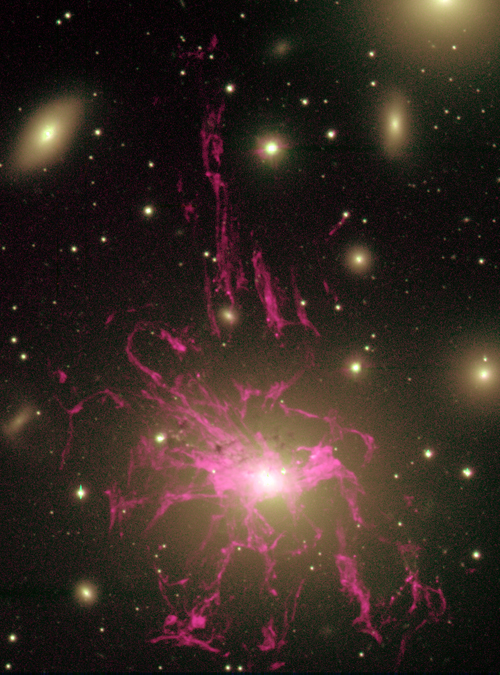
ngc1275_wiyn_big.jpg


As NASA said "How were the unusual gas filaments surrounding galaxy NGC 1275 created? No one is sure." :D
 
I shall respond to robinson's post in a manner he has is clearly fully in favour of ...
From recent observations with our new instruments, it is becoming obvious that we know very little about plasma in space.
That claim is utter nonsense.

We know even less about magnetic fields and electric currents in space. The problem is observing something (that is very far away), that doesn't emit any radiation. We are limited to measuring and viewing secondary effects.
Not true.
In a weird way, it is the same problem with black holes, that are not "feeding". Without something else interacting with a black hole, it is invisible. Same for plasma, electric currents and magnetic fields, all of which may be connected.
Such terrible logic and huge fallacies.
Of course this may be off topic, concerning plasma cosmology, which is still a nebulous topic.
{insert your own fave robinson quote here}
 
I tend to be forgiving of scientist trying to make sense out of our Universe. It is terribly difficult to observe and measure things happening so far away. And so much of what is going on is just not visible.

The same problem occurs right near our own planet. The things in our own Solar System are still mysterious. And we have probes and scopes and all kinds of measuring devices, right there on top of the action.

These cosmic events, that occur millions of light years ago/away, we are only glimpsing a little of what is/was there.
 

Back
Top Bottom