Arp objects, QSOs, Statistics

Originally Posted by Wangler
1) It seems as if a posteriori statistics are used in astronomy perhaps more often than in other technical fields.

However, if we're talking about astronomy and astrophysics, as branches of science, then 1) starts too far from the beginning to be of much help, and so the rest become not so interesting ...

Having a bit of trouble explaining away the calculations I did? ;)

Originally Posted by Wangler
3) With 2) being stated, there are some apparently unique associations between some QSOs and some bright galaxies.

In any case, 3) does not depend on 1) or 2) ... and unless it is much, much more tightly qualified is so boringly, obviously true that we need not waste any more time on it.

Having a bit of trouble explaining away the calculations, DRD? :)

Of course, every 'association' between any set of quasars and any set of galaxies (whether bright or not) is unique! What I think you may have intended to say is something about a general pattern, a relationship between a tightly defined subset of quasars and galaxies.

You are wrong. In the calculation I did, I did not limit myself to a "tightly defined subset of quasars". On the contrary, I used mainstream science's own observations and studies (extensive ones, btw) to estimate the TOTAL number of quasars that might be seen in the sky. I calculated the probability of seeing those two specific cases identified by Arp if one were to examine the ENTIRE population of quasars and galaxies. Furthermore, I made some highly conservative assumptions (from the standpoint of maximizing the likelihood of the observations) regarding the distribution of these quasars around galaxies and quite reasonably treated the probability of finding quasars near specific Karlsson redshifts together in one location. Finally, I did the same thing in calculating the probability of quasars aligning themselves in such numbers along the minor axis of galaxies too. I looked at the probability assuming one could examine the entire population of quasars and galaxies.

Those calculations show that finding either of the two observed cases (and Arp found additional others like them) was exceedingly unlikely even if Arp had (and he did not) examine every single quasar in the sky. The fact that he found so many highly improbable cases after examining only a small fraction of the total quasar/galaxy population only increases the improbability of the mainstream's assumption that high redshift quasars have no relation to low redshift galaxies being correct.

This pattern could be something derived from a theory, such as the non-existent one BAC refers to

Regardless of whether you accept the Narlikar/Arp notion that quasars are ejected from galaxies and increase in mass over time while decreasing in redshift, the Bayes' Theorem calculation I did mathematically proves there is probably another explanation than the mainstream's for these observations. Right now the mainstream isn't even looking at the possibility that quasars have a relationship of some sort to low redshift galaxies. They are doing what you are demonstrating here ... waving their hands ... or worse, simply refusing to discuss calculations and observations like the ones I've presented.

However, the whole chain (above) can be short-circuited by asking two, very simple, questions:

a) what is a 'quasar'?

b) are 'quasars' a homogeneous class of objects?

You are wrong again. In the calculation I did, it doesn't matter what a quasar "is" ... as long as it has a high redshift and is near a low redshift galaxy. It could physically be anything and STILL the probability of finding large groupings of them aligned along the minor axes of low redshift galaxies and with redshifts near specific Karlsson values would be astronomically small under the mainstream theory that they can have no connection whatsoever to those low redshift galaxies. The reason you (and the mainstream) don't want to honestly consider that possibility is that if redshift can be shown not to always equate to distance, then most of Big Bang cosmology's theories regarding the meaning of observations are going to need careful reexamination.
 
how was NGC 3516 selected?

You are handwaving because that doesn't matter as far as my calculation is concerned. The calculation is independent of whether NGC 3516 was found or not. The calculation simply determines the probability of that particular configuration being found amongst the entire population of quasar/galaxies that we could observe assuming the mainstream's theories. And that probability is exceedingly small. So the fact that Arp found that case (and several others like it) after relatively few observations (compared to the total number of quasar/galaxy associations in a sky filled with literally billions of galaxies) should be a warning flag that something may be wrong with the mainstream's theories.

how many 'near NGC 3516 quasars' were known before Chu et al. planned their observations?

Again, that's handwaving because when the quasars were found doesn't affect the calculated probabilities in ANY way and because like or not there are 5 quasars with redshifts suspiciously close to Karlsson values aligned with the minor axis of NGC 3516 and no other objects identified as quasars in the observed field.

how are quasar redshifts distributed, in [0,3]? If they are not distributed equally (to within some bound), then probability calculations need to reflect that non-equal distribution.

I addressed that question. As I said, the frequency of redshifts is not constant over the entire range. Based on recent mainstream sources it looks like it rises from a finite value (about 1/8th of the max) near z=0 to a max at about z=1 to 1.5, then levels off till around z=2.5 to 3.0, where it precipitously drops reaching a value of only 1/40th to 1/50th the maximum at z=0.6. Thus, the low z data points (say below z = 1) are overweighted in my calculation compared to the higher z values in the range 1 to 3. That would affect the overall calculation more significantly if we observed that the separation between observed redshifts and Karlsson values as a percentage of their spacing between Karlsson values remained constant or trended upward or downward. But it doesn't. That spacing as a percentage goes up and down from point to point. Finding this effect is fairly involved but we can at least gage whether ignoring this in the calculation is conservative.

In the case of NGC 3516, observed z = 0.33, 0.69, 0.93, 1.40, 2.10. The Karlsson z = 0.3, 0.6, 0.96, 1.41, 1.96, 2.64. Therefore, the spacings are +0.03, +0.09, -0.03, -0.01, +0.14 which, as a percentage of the distance between the two nearest Karlsson values are 10%, 25%, 8%, 2%, 20%. Thus, the first two values with separations from the Karlsson value of 10% and 25% are overweighted, compared to the ones that have separations of 8%, 2% and 20%. That means in the calculation involving the three quasars with the lowest separations, the two lowest separations are underweighted compared to the highest separation of the three. Meaning that the corrected probability from that calculation would be lower than was calculated. And in the two separate calculations to account for effect of the other two quasars, one of the two is somewhat overweighted but the other may be slightly underweighted. So I assert that incorporating this factor into this particular calculation would LOWER the final probability from the value I determined.

In looking this over for the NGC 5985 case, I find I made a mistake in the previous calculation. The observed z = 0.35, 0.59, 0.81, 1.97, 2.13. The spacings are therefore +0.05, -0.01, -0.15, +0.01, +0.17. In the previous calculation, I used a separation of +0.03 for the last data point instead of +0.17. That effects the calculation in a number of ways, so I'm going to redo the whole calculation before addressing the z distribution evenness issue.

Now we could do the same as before and simply calculate the combinatorial probability of finding the lowest three spacing data points, z= 0.35 (+0.05), 0.59 (-0.01) and 1.97 (+0.01). In that case, the required increment would be 0.10 and the probability would be 1/((30 * 29 * 28)/(3*2*1)) = 2 x 10⁻⁴.

But that might significantly overestimate the probability since two of the data points are within an increment of only 0.02. So what's the combinatorial probability of finding 2 data points with a increment of 0.02? The answer is 1/((150 * 149 )/(2*1)) = 9 x 10⁻⁵. Which is less than the above estimate so let's use it.

Now we add in the effect of the 0.35 (+0.05), 2.13 (+0.17) and 0.81 (-0.15) values. The probability of seeing the 0.35 data point with a increment of 0.10 is about 1/30 = 0.033; the probability of seeing the 0.81 data point with a increment of 0.30 is about 1/10 = 0.1; and the probability of seeing the 2.13 data point with an increment of 0.34 is about 1/8.8 = 0.11. Combined, these would reduce the 9 x 10⁻⁵ probability estimate to only 3 x 10⁻⁸.

Next, we must account for the actual number of quasars that might be seen near galaxies in groups of the size needed to do the above calculations. Previously, I found that the mainstream estimates there should be a total of about 410,000 quasars in the sky. And I then assumed (very conservatively, I think) that only half are near low redshift galaxies. That left us with 205,000 quasars to distribute. Then I assumed (again, very conservatively) that half of these would be distributed in quantities less than five to all the galaxies available, leaving 103,000 that are in groups of 5 near low redshift galaxies. Dividing by 5, the final result was 20,600 galaxies with at least 5 nearby quasars. Multiplying the above probability by 20,600 yields a probability of 5.4 x 10⁻⁵.

It's at this point, however, that I notice another possible complication in my previous procedure. Since about half of the 3 x 10⁻⁸ probability comes from only 2 quasars being together near a galaxy, the number of galaxies that might have 2 quasars is larger (by 2.5 times). Thus, the importance of those 2 quasars could be improperly diminished if I assume 20,600 as the total number of galaxies. Thus, we can expect an UPPER BOUND of 5/2 * 5.4 x 10-5 = 0.000135 for the probability at this stage of the calculation. Let's conservatively use that.

Finally, we add in the fact that all 5 of these objects are aligned with the minor axis. As before, the alignment probability reduces the likelihood by 0.08, giving a final probability value of 0.000135 * 0.08 = 1.1 x 10⁻⁵ for the NGC 5985 case.

(By the way, accounting for an increase in galaxy sample size in the NGC 3516 case because much of the probability only depends on 3 quasars, one can estimate an upper bound probability of 5/3 * 0.0005 (the original probability in that case) = 0.00083 ... a very, very small likelihood of that case turning up at all if we were somehow able to check every single quasar thought to be visible in the sky.

Now let's examine your concern about the z distribution in the NGC 5985 case. The percentage of distance between the two nearest Karlsson z values for the z = 0.35, 0.59, 0.81, 1.97, 2.13 observations are 16%, 3%, 42%, 1%, 25%, respectively. In this case, the 16%, 3% and 42% data points are overweighted, while the 1% and 25% data points are underweighted. In the two quasar calculation (which used z=0.59 and 1.97), the 3% value is somewhat overweighted. This would increase the probability at least a bit ... perhaps a factor of 2? But counteracting this is that fact that the z = 0.35 data point with a very large increment is underweighted. Likewise the z = 0.81 data point with an even bigger increment is also underweighted. But if you like, I'll still give you that factor of 2. In which case, the final probability of seeing NGC 5985, if one could check every single quasar out there, would only be 2 x 10⁻⁵ ... again a VERY small number.

Any way you cut it, DeiRenDopa, this calculation proves that the mainstream's theory about quasars is on shaky ground. They need to reexamine that theory in light of this data or come up with an explanation why redshifts seem to be quantized around certain values and show up with a higher than expected frequency around galaxies along their minor axes. Or one has to illogically believe that Arp was REALLY LUCKY in turning up 2 cases with likelihoods of only 0.0008 and 0.0002 even if all the galaxies in the sky with quasars could be examined (which he didn't come close to doing).

your calculation, on its own, would seem to apply to any set of three numbers in [0,3]

No, the three numbers that turned up aren't just any three numbers, are they. They are all close to values that were determined without any reference to the data in these particular samples. Or so I believe. :)

As I noted earlier, if the range is [0,3], then all the Karlsson values in that range need to be included.

And as I noted in my response, there is nothing in the theory that requires quasars be at all the Karlsson values around any given galaxy at any one time.

Beachooser wrote:
Here's a 2005 study http://www.iop.org/EJ/abstract/1538-3881/129/5/204 that indicates an average density of 8.25 deg-2 based on the SDSS survey then argues it should be corrected upward to 10.2 deg-2 to make it complete. And if you go to the SDSS website (http://www.sdss.jhu.edu/ ) you find they say the effort will observe 100,000 quasars over a 10,000 deg2 area. That also works out to about 10 quasars deg-2. So it looks like I used a number that was 3 times too large in my earlier calculation. In this revised calculation, I will only assume the average quasar density is 10 deg-2. That means the total number of quasars than can be seen from earth is around 410,000.

The Chu et al. paper carefully explains how they chose which objects to observe (in order to measure redshifts); the "average density" of quasars you need to use in this part of your calculation is that which would be obtained if the search method used in Chu et al. were to be used over the whole sky. As there appears to be no effort to explain this, in any quantitative fashion, let alone estimate it, you are left with an unknown.

Let me emphasize that my calculation actually has nothing to do with the Chu et. al. paper. If you don't like the "average density" of quasars that I used for all the quasars in the sky (i.e., 10/deg2), then I'll make you the same offer I made to David. You provide that number and we will just insert it in the calculation and see what we get. I used 10/deg2 because the SDSS study and website says that's the average density. It's why they indicate there are in total about 400,000 quasars in the visible universe. If you want me to use whatever Chu claimed is the average density over the ENTIRE sky, then just tell us what Chu says that is. But be prepared to justify it, if it happens to disagree with the SDSS estimate. After all, the SDSS estimate is based on the most complete study of quasars that is available (you folks kept telling me that) and papers have been published by mainstream astronomers that in fact conclude the SDSS study is very close to complete in it's identification of the quasars that are out there in the section of the sky that was surveyed). If you don't like the assumption that the density of quasars in the quarter of the sky that was surveyed is the same as the density in the three-quarters that was not surveyed ... take it up with the SDSS authors. :) Frankly, I think you are just doing more hand-waving ... now desperate to avoid accepting what is a rather obvious conclusion for this set of calculations. :D
you need at least a measure of the variation in average density (as well as the average density), to make the sorts of estimates this part of calculation aims to do.
No, I don't. The results of my calculation are not affected by the fact that more quasars might be located in one little area of the sky than in another, as long as the average density of the entire sky is 10/deg2. The total number of galaxies with 5 or more quasars (or 2 or 3 in the later calculations) near them will remain the same. Somehow, I think you aren't conceptualizing the true nature of this calculation.
BeAChooser wrote: But the truth is that most quasars do not lie close to galaxies at all (certainly not galaxies where we can discern any detail as is the case in all three examples of interest here) so that's why I later multiplied the calculated probability by 0.10 to account for the assumption that only 10% of quasars lie next to a galaxy. I still think that's probably a reasonable number. But for this calculation, I'm going to give your side the benefit of the doubt and assume that fully half of all quasars are near galaxies. That has to be very conservative. Wouldn't you agree. So now there are 205,000 in the population that we need to distribute amongst galaxies. Making up numbers, and using one's intuition about what's conservative, reasonable, etc, in astronomy is an almost certain way to be wrong.
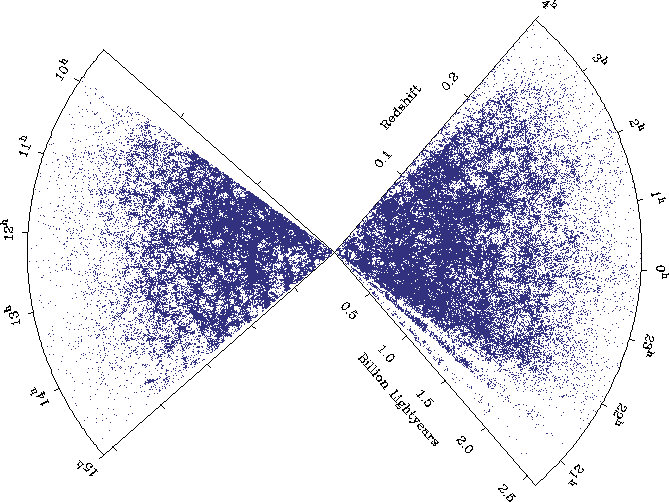
Do you honestly think that more than half of quasars lie near low redshift galaxies? Care to prove that? Do you have ANY basis for thinking that? The fact that Arp could only come up with a limited number of anomalous associations, after studying what must have been thousands of cases, seems proof enough that more than half of quasars must not be near low redshift galaxies from our viewing perspective. But I tell you what, if you have evidence that the percentage is higher than 0.5, then just offer it. Don't be coy. We can factor that into the calculation of probabilities and see what happens. :) Or maybe there's another way we can come up with an estimate of the number of galaxies we need to consider as being near quasars. What we need to know is the number of galaxies that are low redshift ... say within a redshift of about 0.01 (since both of the cases in my calculation have redshifts less than that value). This
galaxies_2dFGRS_big.gif
shows galaxies versus redshift in the 2dF survey. According to the NASA APOD text, there are about 200,000 galaxies in that sample. According to this; http://www.mso.anu.edu.au/2dFGRS/ , the area surveyed was approximately 1500 deg2. Now looking at that plot, I visually estimate that the density is roughly constant out to a z of about 0.15 . The percent area that the z=0.01 zone occupies in the z=0.15 region is PI * (0.01/0.15)2 = .014. Probably a third again as many galaxies lie outside the z=0.15 region in that image. So the number of galaxies within z=0.01 is probably no more than 1 percent of 200,000. So within a 1500 deg2 surface, there would be .01*200,000 = ~ 2000 galaxies. Which means there are about 1-2 galaxies per square degree. According to one source I found, most of the galaxies in near-field surveys are smaller than 30 - 40 arcsec, meaning they occupy only a small fraction of any given square degree field (because one arcsec is 1/3600 of a degree). Another source noted that even in galaxy groups, the distance between member galaxies is typically 3-5 times the diameter of the galaxies. Even the giant Whirlpool galaxy, which was the first to show a spiral form, only has an apparent diameter of 10 arcmin. Even the naked eye Andromeda galaxy, M31, our nearest neighbor only has an apparent diameter of 180 arcmin in it's largest dimension. NGC 3516 has a apparent diameter of only a few arcmin. So with only 10 quasars per square degree of sky on average, it would seem there would be plenty of room for quasars that are not associated with local, low redshift galaxies. Or do you wish to contest this further? :)
Earlier you introduced a paper by L-C&G, which presented some rather concrete numbers of just what you are trying to estimate; why not use what's in that paper?
Are you saying I should use their estimate for the average quasar density per square degree of sky? Or their estimate of what fraction of the quasars are actually within a degree of galaxies? Or their estimate of what fraction are in quasar/galaxy associations with 5 quasars per galaxy? Did they actually estimate any of those numbers? I don't recall seeing it in the paper. If you see those numbers, please point them out to me.
 
A series of posts on questions that remain unanswered.

In other words, a desperate attempt to obfuscate your growing problelm on this thread? Perhaps we should stick to the calculation I offered until you convince everyone there is no problem? If you can't, perhaps then we can focus on identifying a viable alternate solution. :)
 
They also go on to show absorption lines, and reddening of the QSO, both indicative of some sort of matter between us and the QSO.

But they also point out they aren't as much as one would expect if the quasar were on the other side of the galaxy and that a quasar ejected on this side could still be within the bounds of the galaxy and subject to some absorption.

Spiral galaxies are not that dense in their rotational plane, even this close to the nucleus.

That was not the conclusion of the Keel reports that I had tossed at me. Go read them ... even the face on cases had very high A in the arms near the nucleus.

I think that the evidence I see points to the QSO being at the distance indicated by it's redshift.

Then one would think that one of the hundreds of astronomers that DRD claims believes that would see fit to say so in print. :D
 
Then I must have misunderstood your "hosts of gnomes" objection to the dark matter observation in the Bullet Cluster. It was not referring to the dark matter, it was just the one gnome about the distance to the Bullet Cluster as measured by redshift.

Again, another misrepresentation of what I quite clearly stated. That's why I'm not going to go back and address this issue with you, RC. It makes no difference what I actually say, you will just misrepresent it.

I am not an expert in statistics but I will look at your calculation about "improbability of so many redshifts in quasars near certain galaxies that are close to the Karlsson values". It looks plausible at first glance but so many statistical calculations do and many posters seem to disagree with the calculation.

And so far not one of their complaints has stood the test. In fact, the concerns they've raised when I actually tried to address them more carefully have had the effect of lowering the expected probabilities even further. ;)

As for NGC 7319: The quasar looks as if it is shining through the galaxy.

Funny, I cited a number of astronomers who say just the opposite and so far your camp hasn't managed to name even one who has said that's not the case in print. And most definitely not in anything that is peer reviewed. :)

But galaxies are not solid

But as I showed using the Keel papers, they do tend to be optically opaque along the arms and near the nucleus ... where this quasar actually lies.

However it is unlikely to be in front of the galaxy since the Pasquale Galianni, et. al. paper states that the QSO spectrum has absorption lines in it consistent with the gas in the galaxy.

But it's also pointed out that the lines are not as strong as would be expected if it were shining all the way through the galaxy and that even if it were on this side it would likely still have to shine through some of the galaxy's gas.
 
Again, another misrepresentation of what I quite clearly stated. That's why I'm not going to go back and address this issue with you, RC. It makes no difference what I actually say, you will just misrepresent it.
The full posting I "misrepresent" is here and is actually about this topic. The applicable paragraph is:
David and his friends on this forum like to go on and on about dark matter being directly "observed" in the case of the Bullet Cluster ... even though there are a host of gnomes and assumption based calculations implicit in that so-called observation. Yet, the 2003 discovery of a high redshift (z = 2.11) quasar that is visually (in ordinary light) between us and the dense core of a low redshift (z = 0.022) galaxy, NGC 7319, is just dismissed out of hand.
I was under the impression that a host was more than one.

The Keel papers do show that spiral galaxies tend to be optically opaque along the arms and near the nucleus and so this quasar should not be visible. The key word is "tend". We have found optical holes in our own galaxy. It may be that this quasar is visible through such a hole. I am not ruling out that this is a real phenomenon and agree with the authors of the paper that more study is needed.
 
The full posting I "misrepresent" is here and is actually about this topic. The applicable paragraph is:

I was under the impression that a host was more than one.

The Keel papers do show that spiral galaxies tend to be optically opaque along the arms and near the nucleus and so this quasar should not be visible. The key word is "tend". We have found optical holes in our own galaxy. It may be that this quasar is visible through such a hole. I am not ruling out that this is a real phenomenon and agree with the authors of the paper that more study is needed.


You will also notice an outright fabrication by BAC
"David and his friends on this forum like to go on and on about dark matter being directly "observed" in the case of the Bullet Cluster ..." in that this David did not go on about the bullet cluster ( I am not sure I even mentioned the bullet cluster), I did go on about star clusters, one of many unaddressed points.

But you will notice that BAC will just refuse to discuss anything that refutes his arguments and resort to saying that he has and that it is someone else's fault that he can't explain his way out of a wet paper bag.

Such as his response to four long posts about sampling theory, dismissed with a haughty, you are not worth my time to explain my error, when the truth is, he BAC can't refute my examples and so just waves his hand and moves on to his next spam attack.
 
Hi BAC,

I will not be that suprised by whatever lack of respose you give but here are the three posts that do address your and Arp and Burbidges and others bad use of statistics, I am sure you will ignore them just as you do so many things:


But i notce that you are still using the 'rarity of a possibele alignment' to bolster your argument which is addressed here. Why is the possible chance associations you meantion not comparable to the discussion here:
http://www.internationalskeptics.com/forums/showpost.php?p=3595842&postcount=162

And you still haven't addressed representative sampling at all:
http://www.internationalskeptics.com/forums/showpost.php?p=3596372&postcount=163


Nor have you addressed you mistaken use of probability after the fact
http://www.internationalskeptics.com/forums/showpost.php?p=3596661&postcount=165
 
Last edited:
One quick comment,,,

You may beable to pass off one as a mere co-incidence, but, for example, Galaxy NGC 7603 has two definate small quasar like objects clearly at both points in the plasma filament connecting the quasar to the galaxy. Both have very different Redshifts.

Theres a picture of it about twenty seconds into this documentary, with various astronomers talking about it;

http://www.youtube.com/watch?v=EjQVybreSUs

Well you need to address the fact that you haven't shown that it isn't coincidence, addressed here:
http://www.internationalskeptics.com/forums/showpost.php?p=3595842&postcount=162
 
One quick comment,,,

You may beable to pass off one as a mere co-incidence, but, for example, Galaxy NGC 7603 has two definate small quasar like objects clearly at both points in the plasma filament connecting the quasar to the galaxy. Both have very different Redshifts.

Theres a picture of it about twenty seconds into this documentary, with various astronomers talking about it;

http://www.youtube.com/watch?v=EjQVybreSUs
Rather than look at what is probably a one-sided documentary judging by its description I went straight to an applicable paper: The field surrounding NGC 7603: Cosmological or non-cosmological redshifts?

This observation is almost enough to convince me that anomalous redshifts exist and so distances determined from some QSO's are in doubt. I would like an independent observation, preferably at a higher resolution so that any structure of the alleged QSOs can be determined.

IMHO, If this observation is confirmed it will cause as many problems for cosmologies including "intrinsic redshift" as it will for conventional cosmology.
If these 2 quasar-like objects (and NGC 7603B?) were ejected from NGC 7603 in one ejection event then why do the quasar-like objects have different intrinsic redshifts?
If they were ejected in separate events (i.e. have different ages) then why is there an identical direction of ejection?
 
That's not true. I have no problem with baryonic dark matter. I've said that many times.

And it's because certain posters keep mischaracterizing what I actually said that I choose to ignore some of the efforts to debate me on certain threads after basically everything has been said that needs to be said and after I've been repeatedly insulted on those threads. So if I wish to discuss dark matter then I will visit that thread you mentioned. But I would appreciate your confining your remarks on this thread to the matter of redshift and observations that suggest redshift might not equate to distance in all objects. For example, would you like to comment on my calculation regarding the improbability of so many redshifts in quasars near certain galaxies that are close to the Karlsson values? Or do you have something to add regarding NGC 7319 and the quasar that appears to be on this side of it?
.
It may be that your views have been mis-characterised, but I think the record, from your own posts, is pretty clear.

However, as this thread is, supposedly, about your defence of certain Arp et al. papers, with respect to use of statistics, I shall start a separate thread on this topic. For me, that other topic is more interesting anyway ...
 
DeiRenDopa said:
A series of posts on questions that remain unanswered.
In other words, a desperate attempt to obfuscate your growing problelm on this thread? Perhaps we should stick to the calculation I offered until you convince everyone there is no problem? If you can't, perhaps then we can focus on identifying a viable alternate solution. :)
.
I refuse to answer any questions about whether I have stopped beating my significant other or not ... nor will I answer any question about whether I have zero, one, or more significant others.

For what it's worth, there are so many separate sub-threads that I think the time will soon come for a different approach. I hadn't anticipated this one, but it's a good reason why some threads do grow to be so long.

There seem to be just two papers BeAChooser is interested in discussing (those on NGC 3516 and NGC 7319).

Wrangler, I'm no longer sure about.

Dancing David clearly wants to stick to why he started this thread in the first place (and the paper on NGC 3516 would fit nicely within that scope, I think).

And I would like to have the unanswered questions in post 207, 208, and 209 answered.

However, at some point I think we should get onto the question of what a quasar is; if we don't I feel this thread will grow much longer.
 
That's ok. I'm feeling the pressure of tax time too. :D
.
If I may ask, how did you come to conclude that DeiRenDopa is feeling the pressure of tax time?

Or did you intend the "too" to have a general meaning (as in 'so are lots of people, other than BAC')?

Or something else?
 
Galaxies visible to us, through the plane of our own, include the Circinus galaxy, four of the five large galaxies in the Maffei group, and the many found in the various 'zone of avoidance' surveys.

Maybe there should be a separate thread on the transparency of spiral galaxies? Clearly there is some confusion over this.
 
BeAChooser said:
Again, another misrepresentation of what I quite clearly stated. That's why I'm not going to go back and address this issue with you, RC. It makes no difference what I actually say, you will just misrepresent it.
The full posting I "misrepresent" is here and is actually about this topic. The applicable paragraph is:
David and his friends on this forum like to go on and on about dark matter being directly "observed" in the case of the Bullet Cluster ... even though there are a host of gnomes and assumption based calculations implicit in that so-called observation. Yet, the 2003 discovery of a high redshift (z = 2.11) quasar that is visually (in ordinary light) between us and the dense core of a low redshift (z = 0.022) galaxy, NGC 7319, is just dismissed out of hand.

I was under the impression that a host was more than one.

The Keel papers do show that spiral galaxies tend to be optically opaque along the arms and near the nucleus and so this quasar should not be visible. The key word is "tend". We have found optical holes in our own galaxy. It may be that this quasar is visible through such a hole. I am not ruling out that this is a real phenomenon and agree with the authors of the paper that more study is needed.
.
I hadn't read that post, or thread, thanks for the reference.

I thought you were referring to this BAC post, where he says (I added emphasis):
I guess I believe the verdict is out and what makes me uncomfortable with Big Bang is that one phenomena after another is being explained only via bizarre particles, forces, energies and interactions that we haven't been able to demonstrate or see in a lab here on earth. At this point they are purely mathematical constructs.
.

Yet in this thread, and others, there is much ado about an extremely bizzare interaction (or perhaps it's a force or energy?) that no one has been able to demonstrate or see in a lab here on earth ... 'intrinsic redshift'.
 
.
...
Dancing David clearly wants to stick to why he started this thread in the first place (and the paper on NGC 3516 would fit nicely within that scope, I think).

And I would like to have the unanswered questions in post 207, 208, and 209 answered.

However, at some point I think we should get onto the question of what a quasar is; if we don't I feel this thread will grow much longer.

It is okay for the thread to wander, some derailing is inevitable, and I am a big one for it. I just find that it is one of the tactics of BAC and Zeuzzz to jump threads, change topics and avoid discussion of issues.

I think that trying to tackle the issue of what is a QSO and how do we define it, fits right into the thread topic.

the length of the thread is immaterial, i think that aftyer a year of this, i have seen most of what the PC/PU people have to offer on this forum.

The key point is that when you ask them to put the rubber to the road, they disappear.

Like BAC, he won't address the actual statistical issue of sampling.

Now he is dodging into how Bayesian statitics or the Poisson formula are appropriate because of the 'rarity' of the events, which just feeds right into my critique.

there is an assumption of that rarity, there is no demonstration of the rarity, just the wonderland assumption that 'the stuff i want to mean something is meaningful'.

So as usual with The PC/PU posters on the JREF there is just the allsuion of meaning, the vague hints, the possible speculations but when it comes to actual demonstration of the priciples suggested.

Well then there is the thundering silence.

So BAC:

Now we have another unaswered question which will be

1. b. How have you demonstrated the rarity of your alleged ejected QSOs? Which you haven't found any cross eveidence for, are rare? You have to use sampling to do that. So the same hang up as the original question of the thread.

Related question

There should be plenty of other data that would support the ejected QSOs and the mass aquisition other than the anamalous redshifts, where is it? What else would the theory suggest that could be observed. Not just the anamalous red shift and alleged quantization of redshifts, but how about something else? That is not subject to possible sampling error.
 
One quick comment,,,

You may beable to pass off one as a mere co-incidence, but, for example, Galaxy NGC 7603 has two definate small quasar like objects clearly at both points in the plasma filament connecting the quasar to the galaxy. Both have very different Redshifts.

Theres a picture of it about twenty seconds into this documentary, with various astronomers talking about it;

http://www.youtube.com/watch?v=EjQVybreSUs
.
Ah, the hit and run seagull spamster drops another piece of woo! :rolleyes:

May one enquire as to how much of the ElectricUniverse marketing budget you are being paid to spam internet discussion forums such as this one?

Or perhaps you're trying to tell us that you think science (astronomy, cosmology, etc, in this case), if it were done properly, would be conducted entirely by YT video clips?
 
Rather than look at what is probably a one-sided documentary judging by its description I went straight to an applicable paper: The field surrounding NGC 7603: Cosmological or non-cosmological redshifts?

This observation is almost enough to convince me that anomalous redshifts exist and so distances determined from some QSO's are in doubt. I would like an independent observation, preferably at a higher resolution so that any structure of the alleged QSOs can be determined.

IMHO, If this observation is confirmed it will cause as many problems for cosmologies including "intrinsic redshift" as it will for conventional cosmology.
If these 2 quasar-like objects (and NGC 7603B?) were ejected from NGC 7603 in one ejection event then why do the quasar-like objects have different intrinsic redshifts?
If they were ejected in separate events (i.e. have different ages) then why is there an identical direction of ejection?
.

There are a great many other consistency questions that could be asked.

For example, two that I already mentioned, earlier in this thread:

* where are the 'wakes' (such massive objects ploughing through the inter-galactic medium at such high speeds would be expected to leave very bright radio/x-ray/etc wakes)?

* if 'intrinsic redshift' objects are not rare, and if the underlying physical mechanism is variable mass, then how come no 'light' protons (etc) have been observed in the cosmic rays that reach the Earth?

For this particular part of the sky, there's also the question of where the 'transition fossils' are - matter that has a redshift intermediate between that of the putative parent and its various children? This is particularly curious in the case of 'connecting' bridges and filaments ... how come, apparently, not a single atom or molecule has a mass intermediate between parent and child, despite there being a lot of matter that emits and absorbs photons exactly where such transition fossils would be expected to be found?

Finally, the irony of a staunch 'plasma cosmologist' staunchly supporting 'intrinsic redshift' has surely not passed you by, has it? I mean, all that invective heaped upon scientists for using concepts not seen in any earthly lab (dark matter, dark energy, etc), here we have uncritical acceptance, nay advocacy, of a concept equally lacking in anything found in lab experiments! :jaw-dropp
 

Back
Top Bottom
