
-
Security incident: ISF was recently accessed by intruders. Please change your password, and change it anywhere else you used it. Read more
You are using an out of date browser. It may not display this or other websites correctly.
You should upgrade or use an alternative browser.
You should upgrade or use an alternative browser.
Arp objects, QSOs, Statistics
- Thread starter Dancing David
- Start date
BeAChooser
Banned
- Joined
- Jun 20, 2007
- Messages
- 11,716
.
1. http://heasarc.gsfc.nasa.gov/W3Browse/all/veroncat.html
.
1. Part of the formal training that astronomers receive (or should receive) includes what catalogues are and how they can (and cannot) be used. If you actually use data from a catalogue, not only must you cite it, but any reviewer of your preprint is expected to have familiarity with the catalogue, and should point out when you are using it for a purpose for which it is not suitable.
And how exactly does that address NASA's use of the catalog on their website? I see no mention of the warning that it is not to be used for statistical analysis. Was NASA derelict in not reprinting it?
.
.
2. http://arxiv.org/pdf/astro-ph/0611820.pdf "Photometric Selection of QSO Candidates From GALEX Sources, David W. Atlee
and Andrew Gould, 2007"
.
2. Seems to be a perfectly OK use of VCVcat; how did you read this to be otherwise?
Well perhaps that depends on how you define "statistical purposes". Let me quote some excerpts that to me sound like statistical analysis using Veron-Cetty data:
"In addition to our color criteria, we find that the number of GALEX-USNO matches drops rapidly for R ? 19.6, and we therefore limit our catalog to R ? 19.5. Finally, by comparing the Galactic-latitude distribution of our QSO candidates to QSOs found in the Veron catalog (Veron-Cetty 2006), we find that we have very little sensitivity for |b| < 25 ? and therefore do not search for quasars below this limit. We believe this low sensitivity is due to heavy extinction in the FUV -band."
"We match our candidates to the Veron QSOs and 2MASS point sources via the VizieR search engine, requiring that the distance from the matched source to the candidate be less than 5??."
"From the 2692 sources in XMMSL1 (Freyberg et al. 2006), we find 20 that match our QSO candidates. The total probability of these matches predict that ten should be genuine QSOs; ten of these candidates appear in Veron-Cetty (2006), with little information for most of the others. One of candidates identified as a QSO in Veron-Cetty (2006) (USNO 1275-07898737) is unusual; it has an SDSS spectrum but cannot be classified by the automated pipeline."
.
3. http://www.journals.uchicago.edu/doi/abs/10.1086/379006 "On the Cross-Correlation between the Arrival Direction of Ultra–High-Energy Cosmic Rays, BL Lacertae Objects, and EGRET Detections: A New Way to Identify EGRET Sources?, Diego*F.*Torres, Stephen*Reucroft, Olaf*Reimer, Luis*A.*Anchordoqui, 2005"
5. http://www.auger.org/technical_info/...706.1715v1.pdf "Search for correlation of UHECRs and BL Lacs in Pierre Auger Observatory data, Diego Harari, 2007"
.
3. and 5. I haven't read the papers themselves, but the use of VCVcat seems OK for the purposes stated; how did conclude it was not?
So you haven't read the papers but yet you can state that the use is ok for the purposes stated?
 Again, I shall just quote some excerpts that certainly seem to indicate VCVcat data being used for statistical analysis.
From source #3:
"In Figure 1, we plot the position on the sky in galactic coordinates of both the UHECRs and the selected BL Lac objects. There are no positional coincidences between these two samples up to an angular bin greater than 5L Lac objects and any UHECR data set with 33 entries to be Poisson with a mean value of ?4.06. Taking the data at face value, this implies a 2 j deviation effect." From the caption of Figure 1 - "The stars stand for the 22 BL Lac objects from the 9th edition of the Veron-Cetty and Veron (2000) Catalogue of Quasars and Active Galactic Nuclei, with redshifts z > 0.1 or unknown, magnitudes m < 18 and radio flux at 6 GHz (F6 > 0.17 Jy)."
"In a series of recent papers, Tinyakov & Tkachev (2001, 2002, 2003) claim a correlation between the arrival directions of UHECRs and BL Lac objects, a subgroup of the QSO sample previously considered. Specifically, the BL Lac objects chosen were those identified in the (9th edition) Veron-Cetty & Veron (2000) Catalogue of Quasars and Active Galactic Nuclei, with redshifts z > 0.1 or unknown, magnitudes m < 18 and radio flux at 6 GHz (F6 > 0.17 Jy). Only 22 objects fulfill such restrictions. In this analysis, there is no buffer against contamination by mismeasured protons piled up at the GZK energy limit. The cosmic-ray sample of Tinyakov & Tkachev consists of 26 events measured by the Yakutsk experiment with energy greater than 10^^19.38 eV (Afanasiev et al. 1996) and 39 events measured by the AGASA experiment with energy greater than 10^^19.68 eV (Hayashida et al. 2000). The evidence supporting their claim is based on six events reported by the AGASA collaboration (all with average energy <10^^19.9 eV) and two events recorded with the Yakutsk experiment (both with average energy <10^^19.6 eV), which were found to be within 2
"On a similar track, Gorbunov et al. (2002) claimed that a set of gamma-ray–loud BL Lac objects can be selected by intersecting the EGRET and BL Lac object catalogs. The only requirement that Gorbunov et al. considered for a BL Lac object to be physically associated with an EGRET source is that the angular distance between the best estimated position of the pair does not exceed 2R95, where R95 is the 95% CL contour of the EGRET detection. Their claim was based on a positional correlation analysis (using the doubled size for EGRET sources) between the third EGRET catalog (3EG; Hartman et al. 1999) and the objects identified as BL Lac in the Veron-Cetty & Veron (2000) catalogue."
From source #5:
"We test previously reported correlations between UHECRs and subsets of BL Lacs. Note that we test the physical hypothesis of correlation with a particular class of objects at a given angular scale and above a given energy threshold, but the collections of candidate sources are not identical to those in the original reports, because the sky observed by the southern Pierre Auger Observatory is different, and has only a partial overlap. ... snip ...
Test A: 22 BL Lacs from the 9 edition of the catalog of quasars and active nuclei [10], with optical magnitude m < 18, redshift z > 0.1 or unknown, and 6 cm radio flux F6 > 0.17 Jy. ... snip ... Test B: 157 BL Lacs (76 in the f.o.v.) from the 10 th edition of [10] with m < 18. ... snip ... Test D: 204 confirmed BL Lacs (106 in the f.o.v.) from the 10 th edition of [10] with m < 18. Subclasses: a) 157 BL, b) 47 HP. ... snip ... The determination of the statistical significance with which our measurements exclude the hypothesis that the signal present in the HiRes data set (case D) is due to correlations with BL Lacs is a delicate issue. ... snip ... Reference [10] M.-P. Veron-Cetty and P. Veron. A catalogue of quasars and active nuclei. 9th edition: ESO Scientific Report No. 19, 2001; 10th edition: Astron. & Astrophys. 374:92, 2001; 12th edition: Astron. & Astrophys. 455:773, 2006."
That last is very clearly a statistical analysis based on Veron-Cetty data. How would you describe it if it's not?
.
4. http://aps.arxiv.org/pdf/astro-ph/0703280 "Quantum Vacuum and a Matter - Antimatter Cosmology, Frederick Rothwarf and Sisir Roy, 2006"
4. This is a v3 preprint; I expect a reviewer doing her job right would suggest tightening the language a bit; however, the use of VCVcat isn't as so crazily wrong as it was in Bell's paper
The warning regarding VCVcat 12th Edition was not that it's "crazily wrong" but potentially incomplete. And very clearly, the earlier editions of the catalog were far more incomplete than the one Bell used. So perhaps we should throw out as garbage ANY work that relied on any VCVcat edition? Right?
.
6. http://www3.interscience.wiley.com/c...TRY=1&SRETRY=0 "Automated spectral and timing analysis of AGNs, F. Munz, V. Karas, M. Guainazzi, 2006"
.
6. Link didn't work
Curious, it works for me. Oh well.
.
7. http://www.saber.ula.ve/db/ssaber/Ed...pers/isamp.pdf "Dynamic multiple scattering, frequency shift and possible effects on quasars astronomy, Sisir Roy, Malabika Roy, Joydip Ghosh, Menas Kafatos, 2007"
.
7. If the abstract is a fair guide to what's in the paper, then it looks like garbage (i.e. misuse of VCVcat for a purpose it is explicitly unsuitable for)
One down ...
.
8. http://209.85.173.104/search?q=cache...nk&cd=27&gl=us "A Bar Fuels a Super-Massive Black Hole?: Host Galaxies of Narrow-Line Seyfert 1 Galaxies, Kouji Ohta, Kentaro Aoki, Toshihiro Kawaguchi and Gaku Kiuchi, 2006"
.
8. Seems to be a perfectly OK use of VCVcat; how did you read this to be otherwise?
Excerpts:
"We present optical images of nearby 50 narrow-line Seyfert 1 galaxies (NLS1s) which cover all the NLS1s at ... snip ... known at the time of 2001. ... snip ... With these images, we made morphological classification by eye inspection and by quantitative method, and found a high bar frequency of the NLS1s in the optical band ... snip ... The sample size is 2.6 times larger than that of NLS1s (19) studied by Crenshaw et al. (2003). Most of the present sample were taken from “a catalogue of quasars and active galactic nuclei, 10th edition” (Veron-Cetty & Veron 2001) ... snip ... For each object, we calculate an optical continuum luminosity ... snip ... , a black hole mass ... snip ... , and an Eddington ratio, and the values are listed in Table 1. The optical continuum luminosity is derived from the B magnitude given by Veron-Cetty & Veron 2003)"
That looks to me like they were doing some form of statistical analysis based on Cetty-Veron data too ... but maybe you, being a trained astrophysicist will tell us otherwise.

.
9. https://ritdml.rit.edu/dspace/bitstr...cle11-2004.pdf "The host galaxies of luminous quasars, David J. E. Floyd, Marek J. Kukula, James S. Dunlop, Ross J. McLure, Lance Miller, Will J. Percival, Stefi A. Baum and Christopher P. O’Dea, 2006"
.
9. Seems to be a perfectly OK use of VCVcat; how did you read this to be otherwise?
Excerpts:
"THE QUASAR SAMPLE The sample was selected from the quasar catalogue of Veron-Cetty & Veron (1993) and comprises two subsamples, both confined to the redshift range 0.29 < z < 0.43 ... snip ... These two samples allow us to explore an orthogonal direction in the optical luminosity - redshift plane, in contrast to our previous HST studies of quasar hosts (McLure et al. 1999; Kukula et al. 2001; Dunlop et al. 2003) which concentrated on quasars of comparably moderate luminosity (MV > ?25), but spanning a wide range in redshift out to z ? 2 (Fig.1)."
"Quasars in the current study. J2000 co-ordinates were obtained from the Digitised Sky Survey plates maintained by the Space Telescope Science Institute. Redshifts and apparent V magnitudes are from the quasar catalogue of Veron-Cetty & Veron (2000)"
Certainly looks like they did some form of statistical analysis. And yes, those refer to an earlier edition of VCVcat. But my comment about that stands. Your *supposed* concern was that the latest VCVcat is incomplete. Well that earlier catalog must have been far more incomplete. So shouldn't we simply disregard that work ... and for that matter, any work that depends on any version of the VCVcat? For consistency? And wouldn't writing a paper to that effect and publishing it in a mainstream journal be a much more valuable use of your time than studying whether I'm a troll and making threads too long for your liking?
BeAChooser
Banned
- Joined
- Jun 20, 2007
- Messages
- 11,716
Quote:
Of course, spiral arms are not optically thick, not even in the x-ray band, as W. Kell has shown in a series of papers, and as this Chandra PR attests (work based on discovery of a hole by Lockman et al.).
.
Care to show us ANY evidence of ANY object behind the galaxy being seen through that region of the galaxy? Or are you just waving your hands?
.
Would you mind explaining why this is relevant?
You really can't see the relevancy, DRD? Hmmmm.
Surely the relevant question to ask is how transparent spiral arms of galaxies are, in the x-ray and visual wavebands?
Except this object really isn't very far out on a spiral arm. Just take another look at the picture:
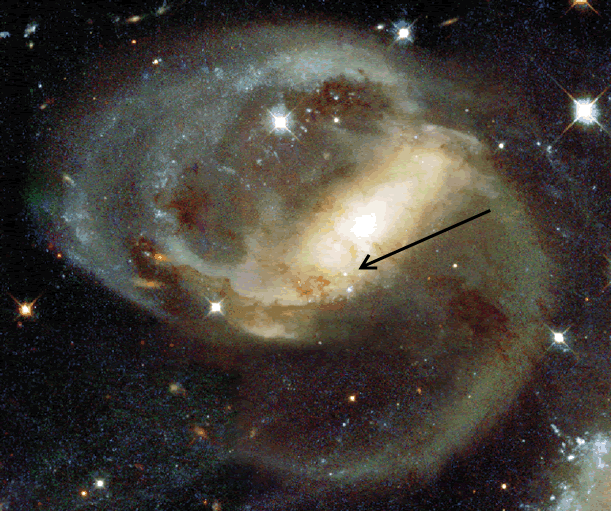
What leads you to believe that region is "transparent"? Afterall, I linked peer reviewed scientific papers by astronomers who conclude it is not. Astronomers who concluded the quasar was almost certainly on this side of NGC 7319 and part of their reasoning was the likely density of obscuring matter. For example, http://www.journals.uchicago.edu/doi/full/10.1086/426886 states "there are no signs of background objects showing through the disk in our HST picture of the inner regions of NGC 7319". Why would this quasar just coincidentally be the only one, DRD?
BeAChooser
Banned
- Joined
- Jun 20, 2007
- Messages
- 11,716
Which five quasars, BAC? The NGC 3516 paper discusses six.
Wrong. The paper I cited on NGC 3516 (http://www.journals.uchicago.edu/doi/abs/10.1086/305779 ) talks about 5 quasars along the minor axis. The object at z = 0.089 is identified this way: "there is a very strong X-ray source that is listed as having a Seyfert spectrum (Veron-Cetty & Veron 1996) with redshift z = 0.089 (about 10 times the redshift of NGC 3516). Optically it is a compact, semistellar object. With its strong X-ray and radio properties, it is closely allied to BL Lac objects and therefore to the transition between quasars and objects with increasing components of stellar populations."
Except that two (of six) quasars do not match the predicted z within 0.1
True, but I was trying to simplify the problem by balancing the fact that 3 (of the five) fall into intervals less than 0.10 in width. But since you apparently aren't satisfied with my simplification, let's take another look at the whole problem.
Let's start by matching each observation with it's corresponding Karlsson value: (0.33,0.30) (0.69,0.60) (0.93,0.96) (1.40,1.41) (2.10,1.96). That means the distance from the Karlsson value in each case is 0.03, 0.09, 0.03, 0.01, 0.14 , respectively. To compare with the 0.10 discretization I used in my calculation, we must double those values: 0.06, 0.18, 0.06, 0.02, 0.28 . Note that 3 (of five) fall within a 0.06 discretization but you are correct that 2 don't fall within a 0.10 interval.
Let's redo the calculation for just those three cases and see what we get, assuming again that the quasars randomly came from a population with an equal distribution of probability between 0 and 3.0. There are 50 possible values in that range given an increment of 0.06. Now looking at this again, I don't think I should have used the permutation formula in the previous calculation. This time let's just use the combination formula ... in other words, let's find the number of possible combinations of those those r values from n possible values.
The formula for that is n!/((n-r)!r!). Thus the probability of seeing those 3 values turn up is 1/(n!/((n-r)!r!). In this case, that works out to 1/(50*49*48/3*2) = 5.1 x 10⁻⁵.
And now let's factor in the unlikelihood that we'd find 2 more quasars near that galaxy that are unusually close to the Karlsson (K) values of 0.60, and 1.96. Surely a conservative estimate for that probability would be to simply find the chance of each specific number turning up given an increment appropriate for that case. For the 0.69 case, for example, where the increment is 0.18 (twice the 0.09) value, over the range 0 to 3.0, there are at least 16 increments. So, the probability of finding that number 1/16 = 0.06. For the 1.96 case, the increment needs to be 0.28 and there are 10 possible values. The probability is 1/10 = 0.10. And finding these z's should be relatively independent of finding the others, so the probabilities should simply multiply together to give a final combined probability.
Therefore, I assert that, to a first order, the probability from the 3 number sequence can be adjusted to account for the unlikelihood of the 2 other quasars by multiplying it by 0.06 * 0.1. And that results in a final combined probability of 5.1 x 10-5 * 0.06 * 0.10 = 3.06 x 10⁻⁷. So to a first order, it appears my initial assumption that an increment of 0.1 used for all of them would balance everything out off by a factor of about 10.
And lest you think the selection of z = 3.0 as the upper bound in my calculation is arbitrary, let me note that I found a mainstream source that said, based on the SDSS study, the number of quasars decreases by a factor of 40 to 50 from z = 2.5 to z = 6.0. Therefore, I think I am justified in using a range of z = 0 - 3.0 in my calculations for quasar z. I will agree that the density of quasars of different z is not uniform over the range. Several of the sources I found indicated that it climbs rather steeply from a value at z = 0 to z = 1.5 and then levels off through z = 3.0. I don't see an easy way to incorporate this fact into the calculation but I don't think it really makes much of a difference since the differences between the Karlsson values and the observed z don't appear to have much of a trend up or down over the range.
However, since you questioned my 0.10 simplification, I'm going to take another look at the rest of the calculation, starting with what I estimated was the total number of quasars in the sky. Recall that I estimated the total number of quasars that can be seen as 1,237,500 ... by multiplying the number of square degrees in the sky (41,250) by 30 quasars per square degree. But is 30 quasars per square degree really a reasonable value to use?
Here's a 2005 study http://www.iop.org/EJ/abstract/1538-3881/129/5/204 that indicates an average density of 8.25 deg-2 based on the SDSS survey then argues it should be corrected upward to 10.2 deg-2 to make it complete. And if you go to the SDSS website (http://www.sdss.jhu.edu/ ) you find they say the effort will observe 100,000 quasars over a 10,000 deg2 area. That also works out to about 10 quasars deg-2. So it looks like I used a number that was 3 times too large in my earlier calculation. In this revised calculation, I will only assume the average quasar density is 10 deg-2. That means the total number of quasars than can be seen from earth is around 410,000.
So now we come to the question of how those 410,000 quasars are distributed, or more precisely, how many galaxies with 5 or more quasars near them can be expected in the total population of galaxies that can be seen. Now recall that in my previous calculation I initially assumed that the all the quasars are located near galaxies and distributed 5 per galaxy until the number of quasars available is exhausted. That resulted in an estimate of 250,000 (~ 1,237,500 /5) galaxies with 5 quasars each. Doing that maximized the total number of galaxies assumed to have 5 quasars which was a conservative approach from the standpoint of not wanting to over estimate the improbability of the observation of NGC 3516.
But the truth is that most quasars do not lie close to galaxies at all (certainly not galaxies where we can discern any detail as is the case in all three examples of interest here) so that's why I later multiplied the calculated probability by 0.10 to account for the assumption that only 10% of quasars lie next to a galaxy. I still think that's probably a reasonable number. But for this calculation, I'm going to give your side the benefit of the doubt and assume that fully half of all quasars are near galaxies. That has to be very conservative. Wouldn't you agree. So now there are 205,000 in the population that we need to distribute amongst galaxies.
It's also apparent that most galaxies that have nearby quasars only have a few quasars ... not 5 or more. I didn't find any source actually quantifying this but we can observe that in Arp's catalog of anomalous quasar/galaxy associations, relatively few of the examples have 5 or more quasars in the field. Therefore, I think it's conservative to assume that only half the quasars are in groups of 5 or more near galaxies. You would agree, right? In fact, I think this is very conservative assumption, otherwise Arp's list of anomalous quasar/galaxy associations would have likely contained far more examples with large numbers of quasars. In any case, I'm going to reduce the number of quasars available to comprise the population of galaxies that have 5 quasars by half ... to 103,000. Now if you divide that number by 5, that means there are at most 20,600 galaxies visible that have 5 quasars in their vicinity.
Therefore where previously I effectively multiplied the probability of any given galaxy having 5 quasars with Karlsson redshifts by 25,000 (1,237,500 / 5 * 0.10), now I'm going to multiply the new probability calculated for NGC 3516 by only 20,600. Doing so produces a probability (for finding the 5 quasars with the specific z's near NGC 3516 amongst the total population of quasars/galaxy associations) of 3.06 x 10-7 * 20,600 = .0063 .
Now let's complete the calculation by again adding in the fact that all 5 objects are aligned rather narrowly along the minor axis. I'll just use the dart board example I used previously, where I found that the probability of throwing 5 darts in a row that land within a 15 degree zone extending from opposite sides of the center of the dart board as being 3.9 x 10⁻⁶ per galaxy. And again, we have to multiply by the number of galaxies with 5 quasars that can be aligned. With only 20,600 such cases possible (conservatively), the probability of finding 5 quasars aligned along the minor axis is therefore 3.9 x 10-6 * 20,600 = 0.08 which makes the total likelihood of encountering this one case if one carefully studied the entire quasar population equal to 0.08 * 0.0063 = ~0.0005 .
That's a very small probability. Yet Arp found such a case after looking, not at all the galaxies that have quasars near them, but by looking at only a tiny fraction of those galaxies. Which makes his observation even more improbable. Perhaps significantly so.
And he not only found that case, he found two others that have large numbers of quasars with values close to the Karlsson values aligned with the minor axis of galaxies. Recall that NGC 5985 had 5 that are lined up along its minor axis with redshifts of 2.13, 1.97, 0.59, 0.81 and 0.35. The corresponding delta to the nearest Karlsson values are 0.03, 0.01, 0.01, 0.15, 0.05. Let's ignore the 0.81 and 0.35 values for the moment and find the probability of encountering the first three values, on a combinatorial basis. With an increment equal to twice the largest delta (i.e., 0.06), that probability is 1/((50 * 49 * 48)/(3*2*1)) = 1/19600 = 5.1 * 10-5.
As in the other case, we still have to add in the effect of the other data two points. Following the same approach as before, the probability of seeing the 0.35 value with an increment of 0.1 is 1/30 = 0.033. The probability of seeing the 0.81 data point with a increment of 0.30 is 1/10 = 0.1.
Therefore, the combined probability for NGC 5985 is 5.1 * 10-5 * 0.033 * 0.1 = 1.683 x 10⁻⁷. Accounting for the actual number of quasars that might be seen near galaxies in groups of 5 and the fact that all these objects are aligned with the minor axis gives a final probability of 1.683 x 10-7 * 20,600 * 0.08 = ~0.0003 .
That's another very small probability. And finding two such improbable associations when Arp didn't look at all that many galaxies/quasars in order to find these cases, is makes this even more improbable.
Any way you look at it, DRD, this finding does not bode well for the theory that quasar redshifts are not quantized and have nothing to do with the galaxies that they are near. And I draw your attention to the use of Bayes' Theorem that I outlined in my earlier post to David (post #151).
I can update that case for the new probabilities calculated above as follows.
Suppose apriori we are really sure that the mainstream theory about quasars and redshift is correct. Let's say Pr0(A) = 0.999, leaving just a little room for doubt. That means Pr0(B) = 0.001. Fair enough?
Next, we "measure" that sequence of 5 redshift values from NGC 3516 that are all aligned with the minor axis of the galaxy. And based on the calculation I did above, the probability of that sequence of values and alignment occurring under the assumption that hypothesis A is correct (PA(xi)) is calculated to be no better than 0.0005. At the same time, we can say that PB(xi) = 0.9995.
Now let's compute Pr1(A) and Pr1(B).
Pr1(A) = (0.999 * 0.0005) / (0.999 * 0.0005 + 0.001 * 0.9995) = 0.33
Pr1(B) = 0.67
In other words, based on that single observation, the probability that your hypothesis is correct has dropped from 99.9% to 33% and the probability that the quasars' redshifts and positions aren't just a matter of random chance has risen from 0.1% to 67%.
That theorem shows that finding these cases significantly reduces the probability that the mainstream hypothesis about quasars is correct. At least enough that it would behoove the mainstream to take a closer look rather than just try to dismiss this out of hand as they have done, and you and David are now trying to do.

and the range you chose is both arbitrary and too large (the highest peak you can consider is 2.1 ... otherwise you have to consider that two other predicted peaks in the range [0,3] were not observed
That's an interesting comment but I don't think it's correct because the theory has it that z is a function of the age of the quasar. There is no requirement in any given case that the galaxy have been producing quasars the entire time, including up till recently. There is therefore no requirement that there be quasars corresponding to each Karlsson value that is possible. Values can be skipped because for some reason the galaxy stopped producing quasars for a time. Or there may be more than one value at a given z because the galaxy was producing more for a time. Or there may not be any high ones because the galaxy stopped producing them at some point. Or perhaps we don't see any higher z quasars because they tend to be much closer to the site where they were produced and are therefore lost in the glare or opacity of the parent galaxy.
I have no idea how you got from 'there are a possible 1,237,500 quasars' to 'there could be at most 250,000 groups of 5 located next to 250,000 different galaxies'; would you mind explaining please?
I think the logic was clear enough in what I wrote earlier but see the revised calculation above. I tried to make it even clearer.
Based on Arpian ideas, what do you predict the redshifts of those 'newly discovered' quasars (and galaxies) will be BeAChooser? Where will they be, in relation to NGC 3516?
Obviously, I would predict they'd tend to be near Karlsson values. Do you have some data to suggest they are not? If not, I don't think this concern has much merit at all and just lengthens the thread further.

And what would you predict for the next ten years, and the ten years after that, and ...?
There is apparently a limit to the total number of quasars. The methodology used in SDSS was designed to produce a relatively complete list of the surveyed region and one of the papers I found concluded that it had succeeded ... with well above 90% completeness in that region. So I don't anticipate new observations that will increase the estimated total quasar count much higher than it already is ... provided the regions that were already surveyed are representative of the whole. Sure, individual quasars will be found in those regions of the sky that weren't previously surveyed but that shouldn't increase total quasar counts.
And for the record, I have no idea whether NGC 3516 lies in an already surveyed region or not. Do you? If so, then by all means tell us the latest data. No need to be coy. That can only serve to make the thread longer and we know how you dislike that.
BeAChooser
Banned
- Joined
- Jun 20, 2007
- Messages
- 11,716
Originally Posted by BeAChooser
Look at it this way, if you have a field of walnut shells with one pea under one of the shells there is a certain probability that you will find a pea if you lift a shell. If that shell contains the pea, do you think the probability of finding a pea if you lift another shell is the same? Apparently so.
This example is not relevant to the issue at hand, in this case it was stated by you that there is one pea under one shell.
So I don’t see how that is analogous.
And therein lies part of your problem, David. But I lack the interest to correct your misunderstanding of the problem.
But lets us say that there is really huge field of shells like a million by a million matrix. And we don’t actually know how many peas are out there.
But in this case, David, we do know the number of peas ... or at least have a good estimate. And the fact that you still don't see that is another reason you've failed to understand the nature of this problem.
have been trained in sampling theory, practiced sampling theory and read a lot of publications regarding sampling theory and research articles using sampling theory.
Don't tell us you work for a pollster?

But Bayesian statitstics just blow my mind. What I have read about them does not seem to indicate they have much use except when the data involves very limited samples.
What do you think we have here, David, but a case with very limited samples of specific types of data.
Just so you know, Bayesian methods are used all the time with rare events. In all the research I have been involved in and read and been trained in, a posteriori statistics are just ruled out of hand and never used.
Well David, I guess that just proves you're not an engineer.

In what areas do you feel that the use of a posteriori statistics is a viable way of analyzing data?
Well obviously, I think the case at hand.
BeAChooser
Banned
- Joined
- Jun 20, 2007
- Messages
- 11,716
WARNING! This is a gratuitous bump!
In case BeAChooser is still with us, and reading this thread: you have not been forgotten!
I, DeiRenDopa, am patiently waiting for you to return and answer the (many) open questions about the stuff that you posted here (no doubt there are others also waiting ...).
Don't worry, DeiRenDopa, I didn't forget you. But some of us have other interests beside studying long threads and trolls.
DeiRenDopa
Master Poster
- Joined
- Feb 25, 2008
- Messages
- 2,582
.Help a noob out.............
"An Internet troll, or simply troll in Internet slang, is someone who posts controversial and usually irrelevant or off-topic messages in an online community, such as an online discussion forum, with the intention of baiting other users into an emotional response or to generally disrupt normal on-topic discussion." (source).
As BAC has returned, and apparently done a lot of research to address questions posed and points raised, I think it's safe to say that he's not a troll ... in this thread.
The fact that he's not (apparently, so far) bothered to do the same in at least two other JREF forum (Science etc section) threads, lends weight to the hypothesis that his posting behaviour in this thread is an abberation ...
DeiRenDopa
Master Poster
- Joined
- Feb 25, 2008
- Messages
- 2,582
DeiRenDopa said:(some parts omitted)
I'm still not at all clear on what you're trying to say here; would you mind clarifying please? Specifically, I am not aware of any "theory that Arp, Narlikar, et al have proposed" which quantitatively accounts for "high redshift x-ray emitting objectnear galaxies [...] improbably quantized and distributed in a [specific] pattern".
Where is that theory published? Where are the specific, quantitative behaviours explicitly derived from that theory?I suggest you look up all the papers and books that Narlikar and his associates have published. There seem to be dozens.
Thanks, and welcome back.
To be honest, I've read a great many of them, these past years, and I don't recall any which address the specific question I asked you.
So if you have a specific paper, or papers, that addresses my question - which is, after all, based solely on (rather outrageous) claims that you (not Arp) made - I think it both safe and prudent to provisionally conclude that there is no such theory.
.
.And I found this recently. It might be of some interest to you:
http://arxiv.org/pdf/physics/0608164 "A Proposed Mechanism for the Intrinsic Redshift and its Preferred Values Purportedly Found in Quasars Based on the Local-Ether Theory Ching-Chuan Su Departmentof Electrical Engineering National Tsinghua University Hsinchu, Taiwan, August 2006, Abstract – Quasars of high redshift may be ejected from a nearby active galaxy of low redshift. This physical association then leads to the suggestion that the redshifts of quasars are not really an indication of their distances. In this investigation, it is argued that the high redshift can be due to the gravitational redshift as an intrinsic redshift. Based on the proposed local-ether theory, this intrinsic redshift is determined solely by the gravitational potential associated specifically with the celestial object in which the emitting sources are placed. During the process with which quasars evolve into ordinary galaxies, the fragmentation of quasars and the formation of stars occur and hence the masses of quasars decrease. Thus their gravitational potentials and hence redshifts become smaller and smaller. This is in accord with the aging of redshift during the evolution process. In some observations, the redshifts of quasars have been found to follow the Karlsson formula to exhibit a series of preferred peaks in their distributions. Based on the quasar fragmentation and the local-ether theory, a new formula is presented to interpret the preferred peaks quantitatively."
Thanks; that should be a fun read.
.
.Oh ... you doing a study on that? Out of curiosity, who is funding your study? Or is that just a personal interest of yours? Is there something about long threads that you don't like? Do they irritate you? Will you be publishing this study in some journal?
I'm pleased that you are interested!
It is entirely personal, I doubt that I'll be publishing it in any journal.
What fascinates me, in this regard, is why some threads, in the explicitly 'Science' sections of discussion forums such as this JREF forum, on astronomy (etc), are so long. I mean, naively I'd expect that once the context, scope, etc were cleared up (say, one page, max), and once the relevant observations and theory/theories were agreed (this means, of course, the key papers; again, maybe no more than two pages), then the discussion should take no more than a page or three, tops, to arrive at an agreement on where the key areas of disagreement are, and what the outline of a research project to test them would look like.
Clearly, this does not happen (sometimes)!
Why?
.
.So is that how you are going to escape explaining the improbabilities surrounding NGC 3516, NGC 5985 and NGC 3628? Label me a "troll" and walk away (so you don't feed the troll)? Maybe I'll do a study on people who use that adhominem as a means of avoiding the issues.The last is, of course, just what a troll does, and I note that many JREF forum regulars have called you just that. If that's so, then it's an obvious conclusion - one reason why threads like this are so long is that people keep feeding the trolls.
Nice one, BAC!
You've reminded me that I need to find what the standard terms are for various kinds of logical fallacies (such as the one that this part of your post comes very close to, it seems) ... did you not read the qualifier (that I bolded)? Did you read it and (deliberately?) choose to ignore it?
BeAChooser
Banned
- Joined
- Jun 20, 2007
- Messages
- 11,716
The fact that he's not (apparently, so far) bothered to do the same in at least two other JREF forum (Science etc section) threads, lends weight to the hypothesis that his posting behaviour in this thread is an abberation ...
And specifically which threads are those, oh great troll seeker? Any chance those are threads where you posted long after they'd been inactive? It's almost as if you wanted to make them even longer. And I thought you didn't like long threads. Silly me. Well watch out, DRD ... you may have to list yourself as a reason threads are getting so long here at JREF. In that paper you are doubtless writing for some erudite journal.
DeiRenDopa
Master Poster
- Joined
- Feb 25, 2008
- Messages
- 2,582
.And how exactly does that address NASA's use of the catalog on their website? I see no mention of the warning that it is not to be used for statistical analysis. Was NASA derelict in not reprinting it?
I can't speak for NASA, nor can I speak for whoever wrote that webpage.
However, if the intended audience was/is professional astronomers, then it isn't necessary ... if only because it's a convention in this branch of science (as far as I know) that one must carefully read the details of how a catalogue was compiled before making use of it ... and the only way to do that is to read the words the people who compiled it were at pains to write, in describing and introducing the catalogue.
Perhaps you work, as a professional, in a different branch of science, where such a convention does not apply?
Perhaps you believe that in doing primary research using a catalogue that it is unnecessary to actually read what those who compiled it have to say about it?
I would like you to have a go at answering these questions; to me they address a somewhat boring but nonetheless integral part of what the doing of science is about.
.
.Well perhaps that depends on how you define "statistical purposes". Let me quote some excerpts that to me sound like statistical analysis using Veron-Cetty data:
"In addition to our color criteria, we find that the number of GALEX-USNO matches drops rapidly for R ? 19.6, and we therefore limit our catalog to R ? 19.5. Finally, by comparing the Galactic-latitude distribution of our QSO candidates to QSOs found in the Veron catalog (Veron-Cetty 2006), we find that we have very little sensitivity for |b| < 25 ? and therefore do not search for quasars below this limit. We believe this low sensitivity is due to heavy extinction in the FUV -band."
I fully agree; you've hit the nail squarely on the head!

In this particular case, it would seem that authors used VCVcat for an entirely satisfactory purpose (statistically speaking) ... unlike Bell.
.
."We match our candidates to the Veron QSOs and 2MASS point sources via the VizieR search engine, requiring that the distance from the matched source to the candidate be less than 5??."
"From the 2692 sources in XMMSL1 (Freyberg et al. 2006), we find 20 that match our QSO candidates. The total probability of these matches predict that ten should be genuine QSOs; ten of these candidates appear in Veron-Cetty (2006), with little information for most of the others. One of candidates identified as a QSO in Veron-Cetty (2006) (USNO 1275-07898737) is unusual; it has an SDSS spectrum but cannot be classified by the automated pipeline."
Ditto ... look at what the authors are using VCVcat for!
.
.So you haven't read the papers but yet you can state that the use is ok for the purposes stated?
From source #3:
"In Figure 1, we plot the position on the sky in galactic coordinates of both the UHECRs and the selected BL Lac objects. There are no positional coincidences between these two samples up to an angular bin greater than 5L Lac objects and any UHECR data set with 33 entries to be Poisson with a mean value of ?4.06. Taking the data at face value, this implies a 2 j deviation effect." From the caption of Figure 1 - "The stars stand for the 22 BL Lac objects from the 9th edition of the Veron-Cetty and Veron (2000) Catalogue of Quasars and Active Galactic Nuclei, with redshifts z > 0.1 or unknown, magnitudes m < 18 and radio flux at 6 GHz (F6 > 0.17 Jy)."
"In a series of recent papers, Tinyakov & Tkachev (2001, 2002, 2003) claim a correlation between the arrival directions of UHECRs and BL Lac objects, a subgroup of the QSO sample previously considered. Specifically, the BL Lac objects chosen were those identified in the (9th edition) Veron-Cetty & Veron (2000) Catalogue of Quasars and Active Galactic Nuclei, with redshifts z > 0.1 or unknown, magnitudes m < 18 and radio flux at 6 GHz (F6 > 0.17 Jy). Only 22 objects fulfill such restrictions. In this analysis, there is no buffer against contamination by mismeasured protons piled up at the GZK energy limit. The cosmic-ray sample of Tinyakov & Tkachev consists of 26 events measured by the Yakutsk experiment with energy greater than 10^^19.38 eV (Afanasiev et al. 1996) and 39 events measured by the AGASA experiment with energy greater than 10^^19.68 eV (Hayashida et al. 2000). The evidence supporting their claim is based on six events reported by the AGASA collaboration (all with average energy <10^^19.9 eV) and two events recorded with the Yakutsk experiment (both with average energy <10^^19.6 eV), which were found to be within 2
"On a similar track, Gorbunov et al. (2002) claimed that a set of gamma-ray–loud BL Lac objects can be selected by intersecting the EGRET and BL Lac object catalogs. The only requirement that Gorbunov et al. considered for a BL Lac object to be physically associated with an EGRET source is that the angular distance between the best estimated position of the pair does not exceed 2R95, where R95 is the 95% CL contour of the EGRET detection. Their claim was based on a positional correlation analysis (using the doubled size for EGRET sources) between the third EGRET catalog (3EG; Hartman et al. 1999) and the objects identified as BL Lac in the Veron-Cetty & Veron (2000) catalogue."
From source #5:
"We test previously reported correlations between UHECRs and subsets of BL Lacs. Note that we test the physical hypothesis of correlation with a particular class of objects at a given angular scale and above a given energy threshold, but the collections of candidate sources are not identical to those in the original reports, because the sky observed by the southern Pierre Auger Observatory is different, and has only a partial overlap. ... snip ...
Test A: 22 BL Lacs from the 9 edition of the catalog of quasars and active nuclei [10], with optical magnitude m < 18, redshift z > 0.1 or unknown, and 6 cm radio flux F6 > 0.17 Jy. ... snip ... Test B: 157 BL Lacs (76 in the f.o.v.) from the 10 th edition of [10] with m < 18. ... snip ... Test D: 204 confirmed BL Lacs (106 in the f.o.v.) from the 10 th edition of [10] with m < 18. Subclasses: a) 157 BL, b) 47 HP. ... snip ... The determination of the statistical significance with which our measurements exclude the hypothesis that the signal present in the HiRes data set (case D) is due to correlations with BL Lacs is a delicate issue. ... snip ... Reference [10] M.-P. Veron-Cetty and P. Veron. A catalogue of quasars and active nuclei. 9th edition: ESO Scientific Report No. 19, 2001; 10th edition: Astron. & Astrophys. 374:92, 2001; 12th edition: Astron. & Astrophys. 455:773, 2006."
That last is very clearly a statistical analysis based on Veron-Cetty data. How would you describe it if it's not?
Thanks for going to the trouble of checking up on these.
Unless I missed something, the "statistical purposes" in these papers does not require VCVcat to be complete.
In fact, if I may say so, you seem to be confusing two very different kinds of analyses - those that require VCVcat to be complete (for at least some subset of data therein), and those whose results merely depend upon some sources selected from VCVcat (the "statistical analyses" done are essentially independent of the completeness of data in VCVcat).
Would it help you to understand the distinction if we were to go through just one paper, in detail?
.
.The warning regarding VCVcat 12th Edition was not that it's "crazily wrong" but potentially incomplete. And very clearly, the earlier editions of the catalog were far more incomplete than the one Bell used. So perhaps we should throw out as garbage ANY work that relied on any VCVcat edition? Right?
Completely wrong.
Take a made up example.
Suppose I want to study a dozen BL Lac objects, and my set up is such that they need to be within a certain range of galactic latitudes, in the northern sky, and brighter than 20 in the B band. It doesn't matter, for the purposes of my study, which dozen or so I study, just so long as they are honest-to-goodness BL Lacs. VCVcat is then, it would seem, an ideal place to find them! If there aren't 12 that meet my criteria, then I may be stuck (though I could look elsewhere for them, or work on a very expensive survey to try to find them); if there are more than 12, then I'm done.
Does that make sense?
If you generalise it, maybe look at some other branch of science, would it help to understand my point?
By the way, this is pretty basic stuff ... even in an undergrad honours project or an MSc one.
.
.Curious, it works for me. Oh well.
One down ...
Excerpts:
"We present optical images of nearby 50 narrow-line Seyfert 1 galaxies (NLS1s) which cover all the NLS1s at ... snip ... known at the time of 2001. ... snip ... With these images, we made morphological classification by eye inspection and by quantitative method, and found a high bar frequency of the NLS1s in the optical band ... snip ... The sample size is 2.6 times larger than that of NLS1s (19) studied by Crenshaw et al. (2003). Most of the present sample were taken from “a catalogue of quasars and active galactic nuclei, 10th edition” (Veron-Cetty & Veron 2001) ... snip ... For each object, we calculate an optical continuum luminosity ... snip ... , a black hole mass ... snip ... , and an Eddington ratio, and the values are listed in Table 1. The optical continuum luminosity is derived from the B magnitude given by Veron-Cetty & Veron 2003)"
That looks to me like they were doing some form of statistical analysis based on Cetty-Veron data too ... but maybe you, being a trained astrophysicist will tell us otherwise.
Of course they were ... but that analysis did not require that the objects they found in VCVcat be complete, by some criterion or other (except, as VCVcat say, in terms of what anyone could find in the published literature to the date of cutoff for publication of VCVcat).
.
.Excerpts:
"THE QUASAR SAMPLE The sample was selected from the quasar catalogue of Veron-Cetty & Veron (1993) and comprises two subsamples, both confined to the redshift range 0.29 < z < 0.43 ... snip ... These two samples allow us to explore an orthogonal direction in the optical luminosity - redshift plane, in contrast to our previous HST studies of quasar hosts (McLure et al. 1999; Kukula et al. 2001; Dunlop et al. 2003) which concentrated on quasars of comparably moderate luminosity (MV > ?25), but spanning a wide range in redshift out to z ? 2 (Fig.1)."
"Quasars in the current study. J2000 co-ordinates were obtained from the Digitised Sky Survey plates maintained by the Space Telescope Science Institute. Redshifts and apparent V magnitudes are from the quasar catalogue of Veron-Cetty & Veron (2000)"
Certainly looks like they did some form of statistical analysis. And yes, those refer to an earlier edition of VCVcat. But my comment about that stands. Your *supposed* concern was that the latest VCVcat is incomplete. Well that earlier catalog must have been far more incomplete. So shouldn't we simply disregard that work ... and for that matter, any work that depends on any version of the VCVcat? For consistency? And wouldn't writing a paper to that effect and publishing it in a mainstream journal be a much more valuable use of your time than studying whether I'm a troll and making threads too long for your liking?
Ditto.
BeAChooser
Banned
- Joined
- Jun 20, 2007
- Messages
- 11,716
.
Quote:
The last is, of course, just what a troll does, and I note that many JREF forum regulars have called you just that. If that's so, then it's an obvious conclusion - one reason why threads like this are so long is that people keep feeding the trolls.
... snip ...
You've reminded me that I need to find what the standard terms are for various kinds of logical fallacies (such as the one that this part of your post comes very close to, it seems) ... did you not read the qualifier (that I bolded)? Did you read it and (deliberately?) choose to ignore it?
Well if you're going to use grammer as a denial of your obvious insinuation, perhaps you could tell us what specifically you were referring to when you wrote "If that's so"? You see, the location of that phrase seems to refer to your statement that "I note that many JREF forum regulars have called you just that." So are you doubting what you claim you noted? You sound confused.
DeiRenDopa
Master Poster
- Joined
- Feb 25, 2008
- Messages
- 2,582
.You really can't see the relevancy, DRD? Hmmmm.DeiRenDopa said:Of course, spiral arms are not optically thick, not even in the x-ray band, as W. Kell has shown in a series of papers, and as this Chandra PR attests (work based on discovery of a hole by Lockman et al.).
.
Care to show us ANY evidence of ANY object behind the galaxy being seen through that region of the galaxy? Or are you just waving your hands?
.
Would you mind explaining why this is relevant?
BeAChooser, I asked you once before about this, and I see that you've gone and done it again!

The words "Care to show us ANY evidence of ANY object behind the galaxy being seen through that region of the galaxy? Or are you just waving your hands?" are what you wrote, not what I wrote!!
I'm going to ask you again, politely: please write down the question you want to ask, as clearly as you can. Please make sure that you quote - accurately - what you, and I, wrote in prior posts that lead up to your question. Please make sure you take care to explain, in some detail, just what it is you are asking.
.
.Except this object really isn't very far out on a spiral arm. Just take another look at the picture:
[qimg]http://ucsdnews.ucsd.edu/graphics/images/2004/spiralgalaxy.new.gif[/qimg]
What leads you to believe that region is "transparent"? Afterall, I linked peer reviewed scientific papers by astronomers who conclude it is not. Astronomers who concluded the quasar was almost certainly on this side of NGC 7319 and part of their reasoning was the likely density of obscuring matter. For example, http://www.journals.uchicago.edu/doi/full/10.1086/426886 states "there are no signs of background objects showing through the disk in our HST picture of the inner regions of NGC 7319". Why would this quasar just coincidentally be the only one, DRD?
There are, in the sky, many, many bright galaxies.
There are also many which have large angular sizes, as measured by the area, in square arcseconds, within the 25 B mag isophote (to take just one example).
Many of these galaxies are spirals.
Bill Keel did an extensive study of the optical depth of the arms of (bright, big) spiral galaxies, using some pretty clever methods.
He concluded, in a series of papers on this topic, that it is rare to find any part of any arm of a spiral that has an optical depth of >1.
That is a general finding.
A corollary to this finding is that a claim that a particular part of a particular (bright, big) spiral galaxy does, in fact, have an optical depth >1 is a rather unusual one.
The paper you cite is about just one quasar and just one (bright, big) spiral galaxy.
I have already commented on some shortcomings of this paper, in terms of its a posterori approach, and I note that you seem to have confirmed that, in your view of how astronomy (etc) should be done, such an approach is OK.
Perhaps a counter example might help?
The Einstein Cross, or QSO 2237+0305, is a background quasar lensed by a foreground galaxy ... and it is 'seen' right through the densest part of ZW 2237+030. If you're interested, there are some 233 NED references to it, in published papers. Of course, you may conclude that this is not quite the counter-example you would accept; if so, good ... let's discuss it some more then.
By the way, the post of yours I'm quoting seems to rest, in large part, on your acceptance of what a very small number of astronomers wrote, in just one paper.
Do you mind if I ask you how you go about evaluating the thousands of papers, written by hundreds (or more) of other astronomers, who find that quasars are at distances implied by their redshifts (per the Hubble relationship)?
DeiRenDopa
Master Poster
- Joined
- Feb 25, 2008
- Messages
- 2,582
.Wrong. The paper I cited on NGC 3516 (http://www.journals.uchicago.edu/doi/abs/10.1086/305779 ) talks about 5 quasars along the minor axis. The object at z = 0.089 is identified this way: "there is a very strong X-ray source that is listed as having a Seyfert spectrum (Veron-Cetty & Veron 1996) with redshift z = 0.089 (about 10 times the redshift of NGC 3516). Optically it is a compact, semistellar object. With its strong X-ray and radio properties, it is closely allied to BL Lac objects and therefore to the transition between quasars and objects with increasing components of stellar populations."
True, but I was trying to simplify the problem by balancing the fact that 3 (of the five) fall into intervals less than 0.10 in width. But since you apparently aren't satisfied with my simplification, let's take another look at the whole problem.
Let's start by matching each observation with it's corresponding Karlsson value: (0.33,0.30) (0.69,0.60) (0.93,0.96) (1.40,1.41) (2.10,1.96). That means the distance from the Karlsson value in each case is 0.03, 0.09, 0.03, 0.01, 0.14 , respectively. To compare with the 0.10 discretization I used in my calculation, we must double those values: 0.06, 0.18, 0.06, 0.02, 0.28 . Note that 3 (of five) fall within a 0.06 discretization but you are correct that 2 don't fall within a 0.10 interval.
Let's redo the calculation for just those three cases and see what we get, assuming again that the quasars randomly came from a population with an equal distribution of probability between 0 and 3.0. There are 50 possible values in that range given an increment of 0.06. Now looking at this again, I don't think I should have used the permutation formula in the previous calculation. This time let's just use the combination formula ... in other words, let's find the number of possible combinations of those those r values from n possible values.
The formula for that is n!/((n-r)!r!). Thus the probability of seeing those 3 values turn up is 1/(n!/((n-r)!r!). In this case, that works out to 1/(50*49*48/3*2) = 5.1 x 10⁻⁵.
And now let's factor in the unlikelihood that we'd find 2 more quasars near that galaxy that are unusually close to the Karlsson (K) values of 0.60, and 1.96. Surely a conservative estimate for that probability would be to simply find the chance of each specific number turning up given an increment appropriate for that case. For the 0.69 case, for example, where the increment is 0.18 (twice the 0.09) value, over the range 0 to 3.0, there are at least 16 increments. So, the probability of finding that number 1/16 = 0.06. For the 1.96 case, the increment needs to be 0.28 and there are 10 possible values. The probability is 1/10 = 0.10. And finding these z's should be relatively independent of finding the others, so the probabilities should simply multiply together to give a final combined probability.
Therefore, I assert that, to a first order, the probability from the 3 number sequence can be adjusted to account for the unlikelihood of the 2 other quasars by multiplying it by 0.06 * 0.1. And that results in a final combined probability of 5.1 x 10-5 * 0.06 * 0.10 = 3.06 x 10⁻⁷. So to a first order, it appears my initial assumption that an increment of 0.1 used for all of them would balance everything out off by a factor of about 10.
And lest you think the selection of z = 3.0 as the upper bound in my calculation is arbitrary, let me note that I found a mainstream source that said, based on the SDSS study, the number of quasars decreases by a factor of 40 to 50 from z = 2.5 to z = 6.0. Therefore, I think I am justified in using a range of z = 0 - 3.0 in my calculations for quasar z. I will agree that the density of quasars of different z is not uniform over the range. Several of the sources I found indicated that it climbs rather steeply from a value at z = 0 to z = 1.5 and then levels off through z = 3.0. I don't see an easy way to incorporate this fact into the calculation but I don't think it really makes much of a difference since the differences between the Karlsson values and the observed z don't appear to have much of a trend up or down over the range.
However, since you questioned my 0.10 simplification, I'm going to take another look at the rest of the calculation, starting with what I estimated was the total number of quasars in the sky. Recall that I estimated the total number of quasars that can be seen as 1,237,500 ... by multiplying the number of square degrees in the sky (41,250) by 30 quasars per square degree. But is 30 quasars per square degree really a reasonable value to use?
Here's a 2005 study http://www.iop.org/EJ/abstract/1538-3881/129/5/204 that indicates an average density of 8.25 deg-2 based on the SDSS survey then argues it should be corrected upward to 10.2 deg-2 to make it complete. And if you go to the SDSS website (http://www.sdss.jhu.edu/ ) you find they say the effort will observe 100,000 quasars over a 10,000 deg2 area. That also works out to about 10 quasars deg-2. So it looks like I used a number that was 3 times too large in my earlier calculation. In this revised calculation, I will only assume the average quasar density is 10 deg-2. That means the total number of quasars than can be seen from earth is around 410,000.
So now we come to the question of how those 410,000 quasars are distributed, or more precisely, how many galaxies with 5 or more quasars near them can be expected in the total population of galaxies that can be seen. Now recall that in my previous calculation I initially assumed that the all the quasars are located near galaxies and distributed 5 per galaxy until the number of quasars available is exhausted. That resulted in an estimate of 250,000 (~ 1,237,500 /5) galaxies with 5 quasars each. Doing that maximized the total number of galaxies assumed to have 5 quasars which was a conservative approach from the standpoint of not wanting to over estimate the improbability of the observation of NGC 3516.
But the truth is that most quasars do not lie close to galaxies at all (certainly not galaxies where we can discern any detail as is the case in all three examples of interest here) so that's why I later multiplied the calculated probability by 0.10 to account for the assumption that only 10% of quasars lie next to a galaxy. I still think that's probably a reasonable number. But for this calculation, I'm going to give your side the benefit of the doubt and assume that fully half of all quasars are near galaxies. That has to be very conservative. Wouldn't you agree. So now there are 205,000 in the population that we need to distribute amongst galaxies.
It's also apparent that most galaxies that have nearby quasars only have a few quasars ... not 5 or more. I didn't find any source actually quantifying this but we can observe that in Arp's catalog of anomalous quasar/galaxy associations, relatively few of the examples have 5 or more quasars in the field. Therefore, I think it's conservative to assume that only half the quasars are in groups of 5 or more near galaxies. You would agree, right? In fact, I think this is very conservative assumption, otherwise Arp's list of anomalous quasar/galaxy associations would have likely contained far more examples with large numbers of quasars. In any case, I'm going to reduce the number of quasars available to comprise the population of galaxies that have 5 quasars by half ... to 103,000. Now if you divide that number by 5, that means there are at most 20,600 galaxies visible that have 5 quasars in their vicinity.
Therefore where previously I effectively multiplied the probability of any given galaxy having 5 quasars with Karlsson redshifts by 25,000 (1,237,500 / 5 * 0.10), now I'm going to multiply the new probability calculated for NGC 3516 by only 20,600. Doing so produces a probability (for finding the 5 quasars with the specific z's near NGC 3516 amongst the total population of quasars/galaxy associations) of 3.06 x 10-7 * 20,600 = .0063 .
Now let's complete the calculation by again adding in the fact that all 5 objects are aligned rather narrowly along the minor axis. I'll just use the dart board example I used previously, where I found that the probability of throwing 5 darts in a row that land within a 15 degree zone extending from opposite sides of the center of the dart board as being 3.9 x 10⁻⁶ per galaxy. And again, we have to multiply by the number of galaxies with 5 quasars that can be aligned. With only 20,600 such cases possible (conservatively), the probability of finding 5 quasars aligned along the minor axis is therefore 3.9 x 10-6 * 20,600 = 0.08 which makes the total likelihood of encountering this one case if one carefully studied the entire quasar population equal to 0.08 * 0.0063 = ~0.0005 .
That's a very small probability. Yet Arp found such a case after looking, not at all the galaxies that have quasars near them, but by looking at only a tiny fraction of those galaxies. Which makes his observation even more improbable. Perhaps significantly so.
And he not only found that case, he found two others that have large numbers of quasars with values close to the Karlsson values aligned with the minor axis of galaxies. Recall that NGC 5985 had 5 that are lined up along its minor axis with redshifts of 2.13, 1.97, 0.59, 0.81 and 0.35. The corresponding delta to the nearest Karlsson values are 0.03, 0.01, 0.01, 0.15, 0.05. Let's ignore the 0.81 and 0.35 values for the moment and find the probability of encountering the first three values, on a combinatorial basis. With an increment equal to twice the largest delta (i.e., 0.06), that probability is 1/((50 * 49 * 48)/(3*2*1)) = 1/19600 = 5.1 * 10-5.
As in the other case, we still have to add in the effect of the other data two points. Following the same approach as before, the probability of seeing the 0.35 value with an increment of 0.1 is 1/30 = 0.033. The probability of seeing the 0.81 data point with a increment of 0.30 is 1/10 = 0.1.
Therefore, the combined probability for NGC 5985 is 5.1 * 10-5 * 0.033 * 0.1 = 1.683 x 10⁻⁷. Accounting for the actual number of quasars that might be seen near galaxies in groups of 5 and the fact that all these objects are aligned with the minor axis gives a final probability of 1.683 x 10-7 * 20,600 * 0.08 = ~0.0003 .
That's another very small probability. And finding two such improbable associations when Arp didn't look at all that many galaxies/quasars in order to find these cases, is makes this even more improbable.
Any way you look at it, DRD, this finding does not bode well for the theory that quasar redshifts are not quantized and have nothing to do with the galaxies that they are near. And I draw your attention to the use of Bayes' Theorem that I outlined in my earlier post to David (post #151).
I can update that case for the new probabilities calculated above as follows.
Suppose apriori we are really sure that the mainstream theory about quasars and redshift is correct. Let's say Pr0(A) = 0.999, leaving just a little room for doubt. That means Pr0(B) = 0.001. Fair enough?
Next, we "measure" that sequence of 5 redshift values from NGC 3516 that are all aligned with the minor axis of the galaxy. And based on the calculation I did above, the probability of that sequence of values and alignment occurring under the assumption that hypothesis A is correct (PA(xi)) is calculated to be no better than 0.0005. At the same time, we can say that PB(xi) = 0.9995.
Now let's compute Pr1(A) and Pr1(B).
Pr1(A) = (0.999 * 0.0005) / (0.999 * 0.0005 + 0.001 * 0.9995) = 0.33
Pr1(B) = 0.67
In other words, based on that single observation, the probability that your hypothesis is correct has dropped from 99.9% to 33% and the probability that the quasars' redshifts and positions aren't just a matter of random chance has risen from 0.1% to 67%.
That theorem shows that finding these cases significantly reduces the probability that the mainstream hypothesis about quasars is correct. At least enough that it would behoove the mainstream to take a closer look rather than just try to dismiss this out of hand as they have done, and you and David are now trying to do.
That's an interesting comment but I don't think it's correct because the theory has it that z is a function of the age of the quasar. There is no requirement in any given case that the galaxy have been producing quasars the entire time, including up till recently. There is therefore no requirement that there be quasars corresponding to each Karlsson value that is possible. Values can be skipped because for some reason the galaxy stopped producing quasars for a time. Or there may be more than one value at a given z because the galaxy was producing more for a time. Or there may not be any high ones because the galaxy stopped producing them at some point. Or perhaps we don't see any higher z quasars because they tend to be much closer to the site where they were produced and are therefore lost in the glare or opacity of the parent galaxy.
I think the logic was clear enough in what I wrote earlier but see the revised calculation above. I tried to make it even clearer.
Obviously, I would predict they'd tend to be near Karlsson values. Do you have some data to suggest they are not? If not, I don't think this concern has much merit at all and just lengthens the thread further.
There is apparently a limit to the total number of quasars. The methodology used in SDSS was designed to produce a relatively complete list of the surveyed region and one of the papers I found concluded that it had succeeded ... with well above 90% completeness in that region. So I don't anticipate new observations that will increase the estimated total quasar count much higher than it already is ... provided the regions that were already surveyed are representative of the whole. Sure, individual quasars will be found in those regions of the sky that weren't previously surveyed but that shouldn't increase total quasar counts.
And for the record, I have no idea whether NGC 3516 lies in an already surveyed region or not. Do you? If so, then by all means tell us the latest data. No need to be coy. That can only serve to make the thread longer and we know how you dislike that.
I shall return to this, long, post later.
For now, I merely note that Chu et al. seem to be hedging their bets re the object with a z of 0.089 ... "When we consider these objects together ... there is a good correlation", "Just the chance that the above six objects could accidentally lie within ...", "An especially significant result for these six objects is their specific redshift values.", etc.
To the extent that it bolsters their case for the Karlsson formula (etc), they are happy to include it.
Also, one of the five quasars had been found before Chu et al. set to work (and before Arp did too, per "1997a"); how do you count that? How do you incorporate that fact into your statistical analysis?
DeiRenDopa
Master Poster
- Joined
- Feb 25, 2008
- Messages
- 2,582
.What about someone like me, who is marginally informed, and sounds off occasionally on both sides of an issue?
That doesn't make me a troll does it?
Perhaps just a wishy washy orc, doppleganger or lich or something equally dreadful.
Per the definition, most certainly not!!
You ask questions, you ask for clarification, you do not (often) take what others' write out of context (or make up stuff entirely, or mis-attribute it), you do not seem to go out of your way to press others' hot buttons, you seem to be careful in the way you write, you are happy (apparently) to re-phrase something when it is clear that you have not been well-understood, etc, etc, etc.
DeiRenDopa
Master Poster
- Joined
- Feb 25, 2008
- Messages
- 2,582
.And specifically which threads are those, oh great troll seeker? Any chance those are threads where you posted long after they'd been inactive? It's almost as if you wanted to make them even longer. And I thought you didn't like long threads. Silly me. Well watch out, DRD ... you may have to list yourself as a reason threads are getting so long here at JREF. In that paper you are doubtless writing for some erudite journal.
Indeed, one does fit the first part of your description: Another Problem With Big Bang? I brought it back to life because it seems to me that it's directly relevant to this thread, and to the other one I had in mind: Something new under the sun.
One particularly fascinating thing - to me anyway - is how veherment you railed against 'magic' in one thread, yet how equally vehermently (so it seems to me) you defend something that looks exactly like the 'magic' you so dislike ('intrinsic redshift')!
DeiRenDopa
Master Poster
- Joined
- Feb 25, 2008
- Messages
- 2,582
.Well if you're going to use grammer as a denial of your obvious insinuation, perhaps you could tell us what specifically you were referring to when you wrote "If that's so"? You see, the location of that phrase seems to refer to your statement that "I note that many JREF forum regulars have called you just that." So are you doubting what you claim you noted? You sound confused.
If you are, indeed, a troll, then one reason why some threads are so long is that people keep feeding trolls.
I do not doubt that other people in the JREF forum have called you a troll (I checked to make sure of it, before I wrote that post).
What I was unsure of, at the time, was whether you were, indeed, a troll.
If you think what I write is not clear, may I ask you to do me the courtesy of asking me to clarify it?
Reality Check
Penultimate Amazing
Wangler
Master Poster

- Joined
- Feb 20, 2008
- Messages
- 2,228
Dark Matter Matters
Is the sticking point here the empirical evidence for dark matter, or the mass fraction of said dark matter?
Not to mention the type of dark matter.
If I recall, the Quasi-Steady-State Cosmology model recognizes that there must be some baryonic dark matter existing, everywhere.
Don't QSSC or Plasma Cosmology adherents have a problem with the hugh mass fractions of the will-o-wisp non-baryonic CDM that standard cosmology hangs it's hat on?
I think even TeVeS and MOND predictions are for sizable mass fractions of dark matter in clusters like the Bullet. Just not the large quantities of the non-baryonic stuff.
The question is: Next gnome for the emprical observation of dark matter?
Is the sticking point here the empirical evidence for dark matter, or the mass fraction of said dark matter?
Not to mention the type of dark matter.
If I recall, the Quasi-Steady-State Cosmology model recognizes that there must be some baryonic dark matter existing, everywhere.
Don't QSSC or Plasma Cosmology adherents have a problem with the hugh mass fractions of the will-o-wisp non-baryonic CDM that standard cosmology hangs it's hat on?
I think even TeVeS and MOND predictions are for sizable mass fractions of dark matter in clusters like the Bullet. Just not the large quantities of the non-baryonic stuff.