
-
Security incident: ISF was recently accessed by intruders. Please change your password, and change it anywhere else you used it. Read more
You are using an out of date browser. It may not display this or other websites correctly.
You should upgrade or use an alternative browser.
You should upgrade or use an alternative browser.
Challenge to CIT
- Thread starter Reheat
- Start date
-
- Tags
- cit edward paik pentagon
jaydeehess
Penultimate Amazing

What's this about a descent requiring less G to turn that Beachnut posted on ATS. Can someone expand on that.
If the speed is not high enough in a turn then the plane will desend, if it is too high the plane will rise through the turn. If the speed is less the g's will also decrease.
Wing lift is traded off to turning the aircraft. CIT, and probably many on pft , probably think that the rudder is soley responsible for changeing the heading of the aircraft.
If the plane was at the height of the VDOT tower as it passed by it and 70 agl as it went over the Citgo how much altitude would it lose? Now one has to ignore the 780 fps and determine the bank angle, speed and centrepetal 'g' force that will allow a desending turn such as that.
I am not well today so looking up the how-to and doing the calcs really does not appeal to me at all.
However, as pointed out this would require tossing the 780 fps speed that pft uses or increasing the bank to lose lift.
It also requires that the plane not be so low that the wing, in a bank, will not clip any large ground obstructions. A lamp post is one thing but catching a wing tip on the Navy Annex, for instance, would have drastic consequences.
Last edited:
R.Mackey,
I dont know if you saw Craig post the following:
*ahem*
Can we go back to ignoring them now?
I don't think anyone is served by perpetuating an Internet feud. Good science is worth discussion, no matter where it comes from. They aren't providing any. That's all I need to know.

Well, here we are finally. This should have been done at least a year ago. I know I’m not the first who has tried, but maybe this will be more successful than previous efforts...
I hope it's OK to quote your work "elsewhere" ? Well, it had better be as I already have
 . If it isn't I offer my unreserved apologies in advance and, yes, you may sue me although I have no money. (I just expect them to cry "Jrefer!! Jrefer!! as it happens).
cheers
eta: I bolded some of your post in the "elsewhere" post. Hope that's all right. This is public property kind of stuff, right?
Last edited:

I hope it's OK to quote your work "elsewhere" ? Well, it had better be as I already have
cheers
eta: I bolded some of your post in the "elsewhere" post. Hope that's all right. This is public property kind of stuff, right?
In fact, it's not only OK, it's encouraged. Why would I or anyone else want to hide this kind of work, I don't intend to make money off of it. It hardly worth anything at all anyway, but perhaps a little more than the worthless NoC fraud that has persisted far too long.
Last edited:
In fact, it's no only OK, it's encouraged. Why would I or anyone else want to hide this kind of work, I don't intend to make money off of it. It hardly worth anything at all anyway, but perhaps a little more than the worthless NoC fraud that has persisted far too long.
ty and amen.

CIT says, at ATS:This is all terribly funny! In fact, it's absolutely hilarious!
Where is the speculation in my work? What was speculated?
The speed I used is actually 1 fps slower than the speed Balsamo used for the DME video. He used 781 fps, I used 780 fps.
The flight path is from CIT's own diagrams. In fact, it's a more favorable path to their theory if we examine Paik's testimony. I have the aircraft already on heading passing over Paik, but he indicated a few degrees further toward the South making the turn to impact EVEN MORE DIFFICULT than my numbers show.
Where is the bias? Where is the speculation?
Post the numbers for everyone to see and examine, just as I did. We don't need words at all, just numbers.
What's this about a descent requiring less G to turn that Beachnut posted on ATS. Can someone expand on that.
I know it's been said at ATS, but someone needs to beat into Ranke's head that ALL of the numbers are aircraft type INDEPENDENT. For other than roll rate (fighter versus large aircraft) I did not speculate on type of aircraft at all, it doesn't matter.
http://www.abovetopsecret.com/forum/thread346675/pg2It is calculating the bank as if it were linear and perfectly level when we know the plane was on a descent which would reduce the G's.
G would be more if you had to correct to level flight. I see no way the G is reduced to make the same turn due to descent. It means the bank angle is greater by a small amount. And at 76 degrees of bank what would CIT calculate that increase to be?
I learned today, that 'hard evidence' is what ever CIT says it is as gathered from witness statements they cherry pick to make it so. (the school of Fetzer)
They say good things about their witness that they formed the 'hard evidence' from.
; talking about Paik. There goes the 'hard evidence'.… an eyewitness who barely speaks English as a source…
CIT mentioned 200 mph. Anyone want to look up stall speed for a 757? You know how nose high a clean flying 200 mph 757 would be? You know how quiet the plane would be at Idle? In a KC-135 (like a 707) in a 3 degree descent, I was unable to slow below 300 KIAS with the engines at IDLE? I could have shut off the engines and still had 300 KIAS in the shallow landing like descent.
So we now have an impossible clean aircraft descent at 200 mph? CIT, please talk to some real pilots who have not drank the Kool-Aid.
Last edited:
A W Smith
Philosopher

Do I ween a Mealyun dollahrs?
Piak, who can't judge speed because... well.. because he can barely speak english!!! thats why.
Piak, who can't judge speed because... well.. because he can barely speak english!!! thats why.
Another option would be to lose Paik. They would have to throw him in the same barrel as Lloyd. If you remember the very first thread Craig started was the one questioning Lloyd here. far in advance of his silly video release. he HAD to get rid of Lloyd or his pentacorn wouldn't fly. Now he is forced to do the same with Paik. Paik has to become disinfo.
among Paik's claims are
The plane was very large
he describes the plane as flying very very fast. he only took seven steps running out towards the street before he heard the impact.
His first recollection was that it came close enough to clip the VDOT tower. Which is behind the VDOT building across Columbia pike. thats not good. its too far over Columbia pike and not centered over the Annex as it needs to be to go north of the Citgo
he describes the plane as flying very very low. almost clipping the last building of the annex. and thats not good for PFT claimed too high altitude either.
Paiks claim that he saw it almost clip the annex puts the path close to Columbia pike at the very end of the building. To fly north of the Citgo it had to be on the north end of the annex by then. Out of View from Paik.
Craig Ranke at ATS on saturday april 5th said:an eyewitness who barely speaks English as a source
Last edited:

jhunter1163
beer-swilling semiliterate

A quick investigoogle shows that, though stall speed is dependent on many variables, a B757 is estimated to stall at 150-170 kts.
If the speed is not high enough in a turn then the plane will desend, if it is too high the plane will rise through the turn. If the speed is less the g's will also decrease.
Well, to keep it in simple terms let's keep the speed a constant. When the aircraft banks to X degrees and commensurate G force for the bank angle is applied it will turn because the angle of attack increases and the vertical lift component is shifted in a lateral direction resulting in a turning moment. For 60 degrees of bank in ANY fixed wing aircraft the equivalent G for a level turn is 2. If more than 2 G's are applied the aircraft will climb AND TURN at the same rate as level or greater. Thrust/Power must be increased in order to maintain a constant speed. Now, if less than 2 G's are applied at 60 degrees angle of bank, the aircraft will enter a descent, BUT IT WILL NOT TURN at the same rate as when level, it will achieve a lesser rate of turn because the angle of attack has decreased and the vertical lift component shifts forward, not as much laterally as when level. Thrust/Power must be decreased to maintain a constant speed. In this descending turn at a constant speed as well as a a constant rate of descent is normally eventually achieved. At this point when speed, angle of bank, and rate of descent are constant; 2 G's must be applied to achieve the same rate of turn as when in level flight.
This is the expanded explanation based on my understanding of Beachnut's comments and the comments here. This is about as simple as I can make realizing it is not that simple for non aeronautical types.
All of these forces discussed are variable, but it would take pages and pages of explanation to examine all of the variables in combination with each other. This is what flying and the study of aeronautics involves.
Wing lift is traded off to turning the aircraft. CIT, and probably many on pft , probably think that the rudder is soley responsible for changeing the heading of the aircraft.
Yes, that's precisely why I included a brief aeronautics lesson regarding turns in the original article. All the rudder does is coordinate the yaw axis to the changing forces around the other axis of the aircraft.
If the plane was at the height of the VDOT tower as it passed by it and 70 agl as it went over the Citgo how much altitude would it lose? Now one has to ignore the 780 fps and determine the bank angle, speed and centrepetal 'g' force that will allow a desending turn such as that.
In the previous scenarios, a descent was not factored into the calculations in order to keep it simple. A descent would actually make the turn problem MORE IMPOSSIBLE simply because time to turn (rate of turn) would be sacrificed by decreasing the angle of attack which would move the vertical lift component more forward rather than laterally as it would be in a level turn. I posted the best case scenario to make a turn possible in the original article.
If they want to decrease the speed because the FDR Data is fraudulent for the North of the Citgo path, then they also have to decrease the speed equivalently in the DME video for the accepted Southerly approach. At this point it all becomes speculation, doesn't it?
Hehehe, what will happen if we reach the point where the FDR data is rejected and then what will CIT and pffft do? They no longer have a reason to exist? No viable theories and no facts, but that's what they are all about anyway, isn't it?
It is calculating the bank as if it were linear and perfectly level when we know the plane was on a descent which would reduce the G's.
Duh! Who posted this?
It is as wrong and smelly as 10 year old unwashed socks! The rest of this statement should read BUT IT WON'T TURN AS FAST EITHER until the appropriate G is applied.
I'm tired of explaining aeronautics to idiots who would make a statement like this. It doesn't even deserve an intelligent reply as I addressed the issue in the last post.
jhunter1163
beer-swilling semiliterate
I just noticed the "Pentacorn" thing. I am SO stealing that.
Horatius
NWO Kitty Wrangler

- Joined
- May 9, 2006
- Messages
- 29,691
Duh! Who posted this?
It is as wrong and smelly as 10 year old unwashed socks! The rest of this statement should read BUT IT WON'T TURN AS FAST EITHER until the appropriate G is applied.
I've noticed that this is an issue the CIT boys have managed to completely ignore. You discussed the needed turn rates in your post, but the CIT boys have skipped over that completely, to focus on the "G" forces involved, as if that was the only factor. Someone needs to emphasize to them that if the turn rate is too low, the plane will pass to one side of the pentagon, and not over the "explosion" that "hid" the "flyover", which puts yet another hole in their theory.
I guess none of us should be too surprised that they have trouble grasping a multi-variable problem like this, though.
A W Smith
Philosopher
Now if you think THAT turn was impossible. How about the flyover path?
I hope you all are sitting down. I found possible flyover paths posted by Craig March 26th
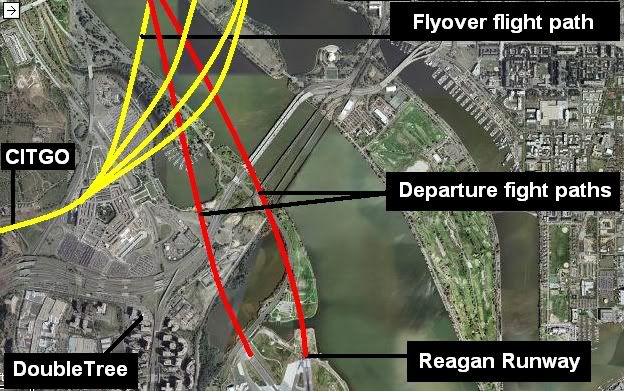
I hope you all are sitting down. I found possible flyover paths posted by Craig March 26th
From that same thread:
LOL when it suits him he cares what it would "look like to everyone on 395" anytime they are at odds with his fantasy they are "suspect" or "planted".
Boy to live in fantasy land on a daily basis. Those meds must be good.
Try drawing a flight path for your landing scenario and try imagining what that would look like to everyone on 395.
LOL when it suits him he cares what it would "look like to everyone on 395" anytime they are at odds with his fantasy they are "suspect" or "planted".
Boy to live in fantasy land on a daily basis. Those meds must be good.
1337m4n
Alphanumeric Anonymous Stick Man

- Joined
- May 10, 2007
- Messages
- 3,510
I hope you all are sitting down. I found possible flyover paths posted by Craig March 26th
[qimg]http://i14.photobucket.com/albums/a327/lytetrip/Pentagon/Pentagon%20folder%202/crankandbank-1.jpg[/qimg]
Only one of those is labeled "flyover flight path". What are those other three yellow lines?
DGM
Skeptic not Atheist

Yeah, no one would notice a plane flying away at full power after a large explosion.I hope you all are sitting down. I found possible flyover paths posted by Craig March 26th
[qimg]http://i14.photobucket.com/albums/a327/lytetrip/Pentagon/Pentagon%20folder%202/crankandbank-1.jpg[/qimg]

DGM
Skeptic not Atheist
I think those are multiple choice. They originally said the plane flew over then landed at 'Regan'. After people started noticing that the aircraft couldn't do this (at least with it's wings still attached) this was the best he could do.Only one of those is labeled "flyover flight path". What are those other three yellow lines?
A W Smith
Philosopher
Only one of those is labeled "flyover flight path". What are those other three yellow lines?
ALL of those yellow lines are 'possible' flyover paths according to the post.
Last edited: