Bigfoot - The Patterson-Gimlin Film

Status
Not open for further replies.
Kitakaze (and Correa):

In case you missed it, here is my description of exactly how to make fake breasts, with or without a fluid filled pouch to simulate a bouncing motion (from my notes, part 2).

"BREAST COMMENTS

The usual simple way of making a suit with full breasts would be to start with a base form, resembling the chest shape of the torso padding. Then sculpt on it the breast shapes. Make a plaster mold of the sculpture, then latex can be brushed into the mold surface, and flexible polyureathane foam can then be introduced into the mold. The back side the torso shaped section is pressed into the mold (in essence, a two piece mold really) and clamped so the expanding foam doesn't push the mold pieces apart. Once the foam cures, you remove the piece and have a light, pliable cast resembling the breasts that were sculpted. But it won't move in any fluid way when the person wearing the suit walks. The foam's strength to hold it's molded form is greater than the weight of it affected by gravity. So it has no "bounce".

To get a fluid bounce, you'd need an outer skin, such as 1/4" cast foam latex shaping the outer form of the breast, and an inner pouch holding a fluid sack, and then a back section shaped like the chest wall, which both the fluid sack and foam skin attach to. The trick is there's no formula of how thick the foam latex outer skin is and how much fluid mass can be put inside. It would either be a guess, or some R&D to test several varying thicknesses of each. And foam latex fabrication wasn't a common skill for anybody but makeup artists. Plus you need the curing oven to bake the foam latex to cure it. So I think we can safely say if it's a hoax, Patterson didn't do this in his garage, didn't do it himself. He had a professional suitmaker, which brings back budget to pay somebody skillful and expensive."

If my agenda was to force a conclusion of "no suit" on you, why would I post exact and purely technical descriptions of how, in 1967, they could have been done, with 1967 materials. As far as i know, nobody has explained this process as well, so i could have just left you all in the dark, wondering if somebody could do that for a suit, and forcing you to insist there is no movement of breasts in the film to get to a technically plausable specification. I gave you all you need to say "the breasts are fake, regardless of whether or not they move. Bill Munns told us exactly how it could have been done in 1967, either fluid or stiff."

Do you see much "incredulus opinion" in this discussion. I see a lot of stuff about molding, casting, and material processes, really dull boring technical "how to" type stuff.

Just thought I might refresh your memory.

Bill
 
My contention is that i have grave doubts that suit technology, especially of 1967, could do what I see. The furcloth of a suit then is my primary concern. If it cannot be a suit, it must be something else, shouldn't it? Maybe a real animal? Just a thought.

Its a big leap to make, Im sure you understand.

If not furcloth, maybe real fur? I mean, the fur of an animal harvested and used to construct a suit?
 
devnull

I readily agree it's a big leap, and I'm not taking it as lightly as people in this forum has presumed in the past two months. My goal is to make the material science studies as rigorous and devoid of opinion as possible, so if a conclusion is reached, the science and factual determination is transparent and repeatable by other researchers if they are so inclined.

Furcloth of the 60's and real animal hides (say bearskins, as an example) do have the common characteristic of a non-stretch base (the furcloth substrate, or the hide's tanned skin). The basic concern is capacity of the base to stretch and bounce back (elongation and memory, in mechanical motion terms). Fur materials with these qualities weren't used then, so the concern is equally applied to a suit of artificial fur and a suit of natural animal fur. Could such a suit move as the apparent fur surface in the film's figure moves? That is the question still remaining to be answered, ideally by scientific method above any professed opinion (mine or anybody elses).

Bill
 
devnull

The PG film is obviously not ideal as film goes, although better than any other film on cryptids. The grain structure is a point of contention, and multiple generations of duplication for most of today's frame scans is a liability. Being able to scan the original film is ideal, but apparently that isn't going to happen, from what I've heard.

The issue of how much information can be gleened from the film is strongly contended on both side of the fence. What I personally would like to see (and even hope to do eventually) is photograph various real animals' fur, alive and tanned hides, and a variety of 1960's verified fur/hair mediums, all in sunlight and on 16mm reversal film, same camera and prime lens, and subject in same approximate size in the frame, so the relation of subject to grain structure is consistant with the original, and the film then duped at least twice before scanning.

Then these known hair/fur mediums and materials can be studied and we can see exactly how much detail is actually apparent in the frame scans. Because we know the true appearance of the source, we can callibrate the loss of detail. Then by comparing the new filmed hair types to the PG Film, we can get a far better point of reference for judgment of the hair/fur/skin surfaces seen in the PG Film.

To my knowledge, this type of reference filming hasn't been done, so we all keep guessing how much detail the film can reveal. Why not film things we know and see for real exactly how much hair/fur detail can be resolved or determined when filmed as described? Seems to me such an experiment would tell us how much we can rely on the PG Film image for data, far better than today's speculation of how much data can be extracted from it. However much we know now, I happen to think we would know more if such were done.

It's one of the things I'm thinking a lot about.

Bill
 
Bill

I fail to see the logic to be honest.

1) You do not know what material Patty is made of, so finding a match will prove impossible (in that you dont know what a match is)
2) Recreating the exact conditions/age/scratches/copying/heat exposure/light exposure required to recreate the exact look of the film is also impossible
3) Even if you manage 1 and 2, you cannot rule out other, unknown, materials looking identical on such aged film. For example, imagine you find that a bear's fur (while still attached to the bear :)) looks nearly identical to patty, while a bearskin rug does not move/look the same on film. This does not prove that patty has real primate fur, as you have no ruled out every other fur and fur like material looking the same as well.

Am I wrong in thinking this plan is flawed from the outset Bill? I cannot possibly see any value being derived from it.

thanks and regards
 
About the PGF... Is this the "best evidence"? A question about the PGF has to be asked. Apologies if this has been asked before, straight out, and answered adequately. If it has, I must have missed it (which is possible).

With the indications presented by others, over the years, but particularly the recent ones, regarding editing of the film, and discrepancies involved in the timeline of events, how can the PGF be even considered potential evidence?

Where is the original? Without the original, it is worthless. All copies are worthless, by themselves. Who examined the "original"? Of those that are supposed to have examined the "original", how can it be verified that they were not checking a copy, presented as "original"? It requires more than old school Bigfoot hunters/researchers, associated individuals, or even nebulous supposed "skeptic" academic/s, back in the 1960's, to "vouch" that what was supposedly "examined", was in fact, untampered, non-edited, original developed film rolls.

What exactly can be verified, about the supposed "original" film, and it's validity as an unedited original developed set of rolls? When was the last time anyone but an enthusiast/proponent examined it? How can it be verified that even this nebulous set of rolls was an original developed set? Where are they now?

How can the PGF be expected to be taken seriously, without an original to examine?
.

That was worth repeating.

RayG
 
Dr. Bernard Heuvelmans:

In all furry animals the hair has a definite pattern, that is, on each area of the body the hairs are oriented in a certain direction. For instance, on a chimpanzee's arm, or even on a man's if he is hairy, they go down from the shoulder to the elbow, and up from the wrist to the elbow. This definite hair pattern can be seen even on photographs of animals from the way the light shines on their fur.

On the creature shown on Patterson's film there is nothing of the sort. As can be seen from the way the hairs shine, giving the fur a speckled appearance, they point in all directions (compare the blowups of the film with photographs of gorillas or, better, of certain bears, which have 'short, shiny, black hair', and you will see that in the latter, the shine on the fur shows that on each part of the body the hairs all point in the same direction).

The aspect of the hair of the creature in the film is exactly what should be expected from artificial fur--whether thick velvet or nylon fur--in which all threads (not actually hairs) are attached uniformly on some canvas base. When you stroke this material in different directions, the artificial hairs get bent in these directions and remain so until you brush them all carefully in the same direction.

Patterson adds--which is also seen in the film-that 'even her big, droopy breasts' are covered with short shiny black hair. This would of course be possible in some unknown species of man, but it would be rather improbable to say the least. In all larger apes the breasts have a slight tendency toward swelling, and even dropping a little, when the female is nursing its baby or if it has been nursing many of them, but even in such hairy primates the chest is almost naked.

I want to add that this (to me) obvious hoax does not shake at all my firm conviction that some large unknown human-like primate lives in the northwest of the United States and in the western provinces of Canada, not to mention of course certain mountain ranges of northeastern and central Asia."
 
Bill

I fail to see the logic to be honest.

1) You do not know what material Patty is made of, so finding a match will prove impossible (in that you dont know what a match is)
2) Recreating the exact conditions/age/scratches/copying/heat exposure/light exposure required to recreate the exact look of the film is also impossible
3) Even if you manage 1 and 2, you cannot rule out other, unknown, materials looking identical on such aged film. For example, imagine you find that a bear's fur (while still attached to the bear :)) looks nearly identical to patty, while a bearskin rug does not move/look the same on film. This does not prove that patty has real primate fur, as you have no ruled out every other fur and fur like material looking the same as well.

Am I wrong in thinking this plan is flawed from the outset Bill? I cannot possibly see any value being derived from it.

thanks and regards


I'm sure Bill will respond to your post later, Devnull...and he can speak for himself...but I think there is indeed value in the analysis he's planning on doing.

Bill doesn't need to know what Patty's hide is made of, to do some comparisons...he's simply doing an in-depth analysis of the suits that were available back in the 60's.
If nothing can be found which compares closely with Patty, when filmed under similar conditions....as he described in his post....then that will help determine whether Patty's hide is most likely fake, or real.


Recreating the exact conditions/age/scratches/copying/heat exposure/light exposure required to recreate the exact look of the film is also impossible


Those requirements are a bit excessive.
As long as the lighting conditions are the same...bright sunlight, in this case...a matching material should appear very similar to Patty's "material"....especially if it's filmed with the same model camera, using the same type film, from the same distance away.
 
If nothing can be found which compares closely with Patty, when filmed under similar conditions....as he described in his post....then that will help determine whether Patty's hide is most likely fake, or real.

Wrong. This is not a sherlock holmes where you eliminate the impossible to get finally to what is the probable (they were bad novels anyway). Not finding any fur which correspond does not make patty a bigfoot. You cannot prove a positive this way by eliminating negative. That would be pretty bad science. To prove pgf=bigfoot, you would have to prove positively the existence of a bigfoot. Proving negatively that some type of fur costume don't 100% reproduce the pgf is not the way to do it.

I am sorry Bill, but all you are proving is that if pgf's Patty is a costume, is that *you* don't know the true method it was done, and none of the method *you* know would be useful to make a pgf costume. NO MATTER how extensive your knowledge, you cannot prove patty is a true bigfoot this way, as there could still be some unknown method to you to make some marten/chinchilla/bear fur looks like pgf (for example by stroking castor oil on it before, or vernice or hairspray or whatever).
 
Don't forget the same time of day, the same violent shaking, the same motion blur, the same shutter speed, the same starts and stops, and the same film resolution.

Of course we don't even know the answer to that first one...

Don't forget to get the original film, too. You'll need that to be sure you have duplicated the scenario as best you can.

You can't really do any of that, of course. Even if you do it really says little about the PGF that we don't already know.

Patty could be a man in a suit, and that is what is most likely.

What is needed is the elimination of the suit possibility, and I have seen no one even attempt that, largely because it can't be done.
 
Last edited:
William Parcher said:
What will he say and do next?

The answer is I'm here, and I'm ready to address all your questions with direct and factual answers. Now the question is, what will you say to me, person to person, with all the forum watching, to see if you are, in fact, a responsible and fairminded critical thinker.

Hi Bill. I don't follow any specific formula or protocol for critical thinking. Whether I am 'responsible' or 'fairminded' is always a matter of personal opinion. I try to be interesting and entertaining without sacrificing relevance. I'm extremely skeptical of the authenticity of the PGF subject, as well as of Bigfoot in general - to the point where I am unapologetically biased. There would be things that could change my mind, but nothing close to that has ever been presented. I do not think that Bob Gimlin is telling the truth. I understand that a variety of factors could cause a person like Gimlin to maintain their position (not a hoax), when they actually did participate in a hoax. It wouldn't be the first, nor the last time, something like that happened. It's a part of human nature, and it wouldn't make Gimlin any 'less human' to go on this way.

I won't load you up with questions or comments, as I see many others are engaging you now. I'll just start slowly by posting one of your BFF quotes, which you can comment on if you wish...

Bill Munns on BFF said:
Sherlock Holmes is often quoted as saying, "Once you eliminate the impossible, whatever remains, however improbable, is the answer." As I apply my expertise and experience in designing suits for the film indusrty, and my familiarity with the state of the art in 1967, to the figure you call Patty, the option of a suit seems less and less possible.

This seems to suggest that your analytical work is progressing increasingly towards Patty being a real Bigfoot.
 
Bill
.. so we all keep guessing how much detail the film can reveal.

You might be guessing, but all of us are not..

We are reasonably sure of what the resolution limits of the film are ..

P.S.

Welcome Bill .. You have brought a fresh perspective to this discussion ...
 
Last edited:
http://www.bigfootencounters.com/biology/fahrenbach.htm

Thus, there can be no talk about detecting individual strands of hair, insect bites, skin blemishes, the pupil, teeth or other similar fine detail.

Any conclusions based on supposed detail below the stated limit are largely a function of the imagination of the examiner, should be viewed with grave suspicion, and would require heroic proof to be convincing.
 
Last edited:
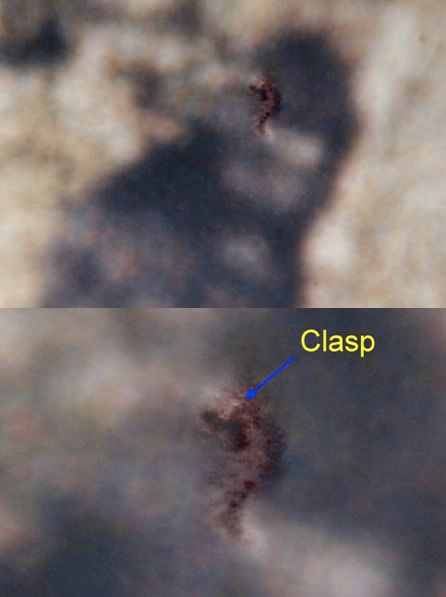
Hair braid with bone clasp. By MK Davis.

0cb96515.jpg
 
I don't have to take it up with them ..

Since you are making an unsubstantiated claim, that would be up to you ...

The BFRO ?!!

The same group that claims this is a Bigfoot ?

[qimg]http://www.bigfootforums.com/index.php?act=attach&type=post&id=28773[/qimg]

:dl:

Of course you don't have to substantiate any counter arguments. What was I thinking? Well I don't think you can back up your counter argument. I'm calling you out back it up! Do the leg work get to the bottom of the quote of "Roger skinned out a dead red horse." I've done a little legwork for you here are a few more sources where the quote can be read. There is some speculation that Howard H. passed the horse story on to Bob but its Bob telling it to the world.

http://home.earthlink.net/~bigfoot46555/id19.html
http://en.wikipedia.org/wiki/Patterson-Gimlin_film

This point is repeated several times: "It stunk: Roger skinned out a dead, red horse" (ibid).

Now about that silly photo you've posted our dispute is about the quote not about photos. One thing though for certain the object in that photo is not the PGF object.
 
Last edited:
Hair braid with bone clasp. By MK Davis.

[qimg]http://i179.photobucket.com/albums/w310/william_parcher/0cb96515.jpg[/qimg]

Its worth remembering that nothing says "bone clasp" better than a film artifact. Now unless I miss my guess bone is white or near white. MK is a victim of his own craft with this one.
 
Bill- this is Drew from BFF.

While I don't believe that you have said that you believe Patty is a real Beast, your writing style can give that impression. Case in point. The Flab Analysis thread. you said;
Call it what you like, the film has definite examples of soft, non-muscular tissue and the skin folds that evidence this.

And when I asked you if you were absolutely certain of this, you added "If it's a real body" http://www.bigfootforums.com/index.php?s=&showtopic=21986&view=findpost&p=447819

Bill Munns said:
if it's a real body, those areas I highlighted aren't skeleton, not muscles as i know them to form, aren't organs, aren't just wrinkles on the skin, and aren't just hair patterns. Doesn't leave much aside from soft non-muscular tissue.

So you can see, that without the 'if it's a real body' part added, it sounds like you are fully aboard the Patty-Wagon. No Pun intended!
 
Last edited:
Hi, Bill. I've had some time to re-examine your relevant writings at the BFF (there's a lot to wade through, you've been very busy at the campfire;)) and I want to stress two things at the outset here. Those being that one, I want to make clear that any criticisms I put forth are for your arguments and not you as a person. The second being that I after further examination of your writing on the subject, I feel even more than before the distinct impression of one engaged in the construction and maintenance of a giant house of cards. But let me proceed and address what's been said so far:
Ray G.

Giganto was presumed to be a knucklewalker quadreped, but I suggested posing him standing and reaching for some kind of fruit in a tree, to show off his height. That's why one arm is up.

Did you have any thoughts at the time about a possible connection between Giganto and bigfoot?

Kitakaze

My notes do explain why i find the suit unlikely. I know you've read them, becase you've quoted from them. They stand as my best argument to date. on your question.

I'm sorry, have I quoted from you somewhere prior to your arrival here? I don't believe that I have. Would you mind providing a link to the post where I quoted you?

I am aware you have criticized me on the issue of the breasts. I'm curious, did you read my lengthy explanation of exactly how they could be fabricated, either still or fluid, with 1960's technology? If you think it's a suit, why not enbrace my arguments of how they can be made for a suit, which I offered?

I have and I have to say that neither is it very lengthy or very related to the issue of what we see in the PGF. Also, I don't feel the need to embrace any of your arguments at this point but I will explain that where you have posted those arguments concerning the breasts below.

Kitakaze:

I have read Correa Neto's critique, so I've replied with just highlights to reference my replies:


Correa Neto Post #11276

On Bill Munn's Patty analysis...

"1. It would be exhausting to perform as Patty and several helpers would be needed. "

I explain exactly why suits, in general need helpers. I've worn them for movies. And I explained how people can condition themselves to more endurance in a suit. And I explained how amateurs can wear them as well. I explained about padded suits and suits that allow for air circulation inside (like stroller costumes for theme park employees. I covered all the considerations. You just failed to read them.

I'm sorry. I failed to see anything in your writing that showed a man in a suit would be the less likely option given the brevity and nature of the alledged performance in the PGF. Could you identify in the film and detail where we are looking at an exhausting performance that would make a human actor unlikely?

Kitakaze (and Correa):

In case you missed it, here is my description of exactly how to make fake breasts, with or without a fluid filled pouch to simulate a bouncing motion (from my notes, part 2).

"BREAST COMMENTS

The usual simple way of making a suit with full breasts would be to start with a base form, resembling the chest shape of the torso padding. Then sculpt on it the breast shapes. Make a plaster mold of the sculpture, then latex can be brushed into the mold surface, and flexible polyureathane foam can then be introduced into the mold. The back side the torso shaped section is pressed into the mold (in essence, a two piece mold really) and clamped so the expanding foam doesn't push the mold pieces apart. Once the foam cures, you remove the piece and have a light, pliable cast resembling the breasts that were sculpted. But it won't move in any fluid way when the person wearing the suit walks. The foam's strength to hold it's molded form is greater than the weight of it affected by gravity. So it has no "bounce".

To get a fluid bounce, you'd need an outer skin, such as 1/4" cast foam latex shaping the outer form of the breast, and an inner pouch holding a fluid sack, and then a back section shaped like the chest wall, which both the fluid sack and foam skin attach to. The trick is there's no formula of how thick the foam latex outer skin is and how much fluid mass can be put inside. It would either be a guess, or some R&D to test several varying thicknesses of each. And foam latex fabrication wasn't a common skill for anybody but makeup artists. Plus you need the curing oven to bake the foam latex to cure it. So I think we can safely say if it's a hoax, Patterson didn't do this in his garage, didn't do it himself. He had a professional suitmaker, which brings back budget to pay somebody skillful and expensive."

If my agenda was to force a conclusion of "no suit" on you, why would I post exact and purely technical descriptions of how, in 1967, they could have been done, with 1967 materials. As far as i know, nobody has explained this process as well, so i could have just left you all in the dark, wondering if somebody could do that for a suit, and forcing you to insist there is no movement of breasts in the film to get to a technically plausable specification. I gave you all you need to say "the breasts are fake, regardless of whether or not they move. Bill Munns told us exactly how it could have been done in 1967, either fluid or stiff."

Do you see much "incredulus opinion" in this discussion. I see a lot of stuff about molding, casting, and material processes, really dull boring technical "how to" type stuff.

Just thought I might refresh your memory.

Bill
OK, here's where I have issue with your comments on the breasts. You go in to detail on creating the illusion of bouncing breasts when anyone can look at the PGF and be hard pressed to notice a miniscule amount, if any, of breast bouncing. Talking a lot about what you know and talking nothing about what we're looking at. You've said that the breasts appear more human than ape. Can you show me one set of natural human breasts (disregarding the hirsute problem for a moment) that are set on the torso and shaped in such a way as we see in the PGF? Those breasts are like nothing in nature that I have ever seen. There shape, position, rigidity, hirsuteness... It's like nothing we know about primate mammary glands.

Now this may offend you, Bill, though I promise that's not my intention. However, what I see seems to be a rather undistinguished former make-up effects and suit creator that has written loads on his incredulity at how the PGF could have been hoaxed while ignoring glaring facts pointing to a hoax. I would like to say that I respect that you had the confidence in your observations to remove them from the mutual backpatters society and bring them to a place where they are far more likely to receive some real scrutiny.

I look forward to your continued participation here at the JREF.
 
Last edited:
I can't believe people are still discussing this. Patterson admitted on his death bed that it was staged. Have you not heard? There is nothing to debate here... let it GO people, please.

If you can quote the source then please furnish it. I do hope that the usual posse of critical thinkers will endevour to seek confirmation as well.
Don't get your hopes up, log. I don't think any of the usual posse feels terribly motivated to waste time.
 
Status
Not open for further replies.

Back
Top Bottom