Why not if they were weakened or damaged in the collision. The weakest sections would fail first, Right?
It isnt just one or two floors, it is several.

Why not if they were weakened or damaged in the collision. The weakest sections would fail first, Right?
Where?
If you mean this post,
then no, he did not. He talks about crush-up at the beginning of the collapse, not before crush-down. Please pay attention to this important distinction. Everyone has been saying all along that crush-up can occur at the beginning of the collapse. It is also discussed in Bazant, et al. paper.

No model will ever match reality perfectly. That's why it's called a model. So the real question is whether the model is sufficiently close to reality to be suitable for the purposes of the study.Also, such a mathematical model is unrealistic because it doesn't match reality.
Thus how can we use the model to define reality?
Just to be on the same page, Sizz, what you consider crush up is the part between the black hole and the red line, right?
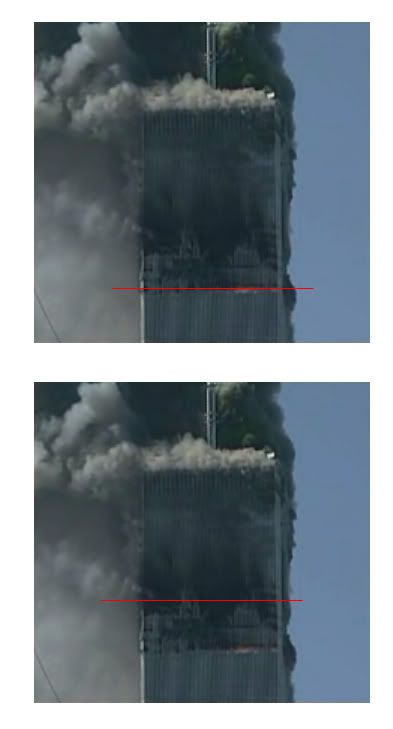
So what you are saying is that crush up did not occur before crush down?
They occurred at the same time?
(according to your observations)
If I remember correctly, didn't Bazant make measurements from large computer screens?
It has become obvious that no one is willing to address this issue.
Surely someone here sees what I see.

[qimg]http://gordonssite.com/demolition/2003-0000.jpg[/qimg]
[qimg]http://gordonssite.com/demolition/2003-0101.jpg[/qimg]
[qimg]http://gordonssite.com/demolition/2003-0120.jpg[/qimg]
Now that is a lot of floors, either being crushed up, or falling inside the perimeter columns.
If they are falling inside the perimeter columns and thus destroying the upper floors of the lower section, what is keeping the perimeter columns stationary? Their connections would have been destroyed.
It is my opinion that we are seeing crush up, simply because the perimeter of the lower section remains intact.
I'm sorry, but this is in direct violation of Bazant's "theory".
Crush-up refers to the falling top section getting crushed (which happens from the bottom up), as opposed to crush-down, which refers to the standing bottom section getting crushed (which happens from top down). Both must occur at some point before the collapse ends.I don't really get that crush up expression. Isn't it just resistance?

I don't really get that crush up expression. Isn't it just resistance?

Since a few floors above the initial failure lines were weakened by the planes and the fires they crushed when they hit the floors below them (crush up), so yes they had less resistance than the undamaged floors.
So is the following an accurate description of why we're still here?
Sizzler will accept 2 or 3 of the weakened upper floors crushing before a bottom floor fails but he sees 5 in the video, so with his extensive engineering experience he decides that all published failure models are incorrect.
Is that that gist of it?

No one who works in the demolition industry...What? Page 11? Damn!
Relax, pomeroo - we'll be there soon. Maybe tomorrow, at this rate. Should we send you a wake-up PM?

I am still wondering if he is calculating the number of crushed upper floors by using the red line drawn in the picture he linked earlier. The collpase CLEARLY begins many floors above that red line. I asked him if he agrees the collpase starts higher but he simply reiterated that Newton's bit had confirmed 'crush up'. So I'll ask again: Sizzler, do you see that the collapse starts up at the black impact hole and not at the red line drawn in the picture you linked? You were quite insistent we address this picture at first.
[qimg]http://www.debunking911.com/nowwhat.JPG[/qimg]
I superimposed the first photo with the last. Now do you see? If it was crush up then what happened to the perimeter columns of the top section? Why do you see them so late in the collapse? You can just see one perimeter tree peeking out from the dust cloud. Why NO columns from the first impacts under crush up??? That violates the crush up story doesn't it?
