Wrong--because we have evidence that people invent gods. By your reasoning, those who believe in demons or psychics are as skeptical and reasonable as those who conclude that there are no such things-- that it's all misperception of a type we are very familiar with (see any Randi video)... these are all illusions cut from the same sort of cultural memes.
By your reasoning... everyone is a skeptic... and all reasoning is skeptical. You've defined skepticism out of existence by pretending both claims are equally valid. In our reality and given the evidence-- they are not. Skeptics might believe-- they might believe that it's logical to believe... but that doesn't make the belief in gods based in any sort of actual logic. Nor does it make anyone's god (or any other invisible form of consciousness) even remotely plausible. The reasons for belief in god are no more substantial the the reasons for belief in the chupacabra-- But god beliefs offer a bonus--they make people feel better... special... chosen... more secure. Belief is said to offer an "insurance" plan in case "hell" is real. God just happens to be a better antidote for fears of death and loss and religion-invented hells then other invisible measurable entities... plus we have very strong memes in place to spread such "faith" and "belief in belief".
You've misunderstood my point. I'm saying that both claims are
invalid from a hard skeptical point of view.
If someone comes to the conclusion that demons are merely imaginary based entirely on (1)
evidence that some people have imagined demons, (2)
people pass on unproven ideas through culture, and (3)
no current evidence of invisible consciousness, they are on pretty weak ground from a skeptical point of view.
(1) This is only evidence that demons
can be imaginary, not that they actually necessarily always
are. In the same way that just because some people have imaginary friends, doesn't mean that all friends are imaginary.
(2) This is pretty much the same reason that we aren't still living in caves. Information that works for people gets passed on. Some of it may not be true. People sometimes believe things they have learned which might not be true. This is the same kind of evidence as point 1.
(3) This isn't evidence. This, by definition, is simply
no evidence at all. It gives us no useful information either way. There are numerous things that we used to have no evidence for, but now know that they exist, and we have no reason to believe that we are now at the pinnacle of discovery and know all there is to know.
The direct conclusion from this evidence and the hard skeptical approach can therefore only conclude that "we don't know, but we know it's possible". Since we didn't have an objective estimate of how probable it was that demons were just imaginary without the evidence, we have no way to say if this evidence changes the objective probability of the claim.
Of course, this is an over-simplified model and in reality, individually, someone comes to such a conclusion based on a whole lifetime of learning, understanding, shaping perceptions, etc. Without knowing every bit of related knowledge that person may have, everything they've seen and how they understand the world, and without objectively knowing exactly what their thought processes have been in reaching this conclusion, in my opinion, it's not really possible to make any kind of objective conclusion as to whether their conclusion has been reached rationally or not.
The same for the claim that demons are real. As we don't have proof that they don't exist, we have to accept that there's a possibility that they do. So we're in the same position from the hard skeptic point of view, that "we don't know, but it's possible".
If someone claims experiences with demons, we are in no position to judge by anything but our imagination what that person may or may not have experienced. Even though we know some people fool themselves, it may be the case that even the most cynical of skeptics might have to conclude almost certainty of the existence of demons when directly faced with such things. Without knowing the full "how"s and "why"s of someone's belief, it's pretty hard to judge the rationality behind it.
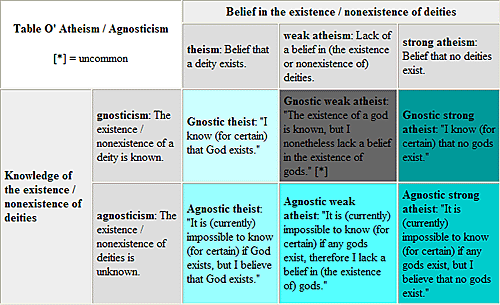
While I agree that a hard/true/absolute skeptic would be an implicit atheist (using the broad definition of the word), that person would hold no firm opinions on
anything unless it had been shown to be objectively proven, and I am highly doubtful that such a person actually exists. Which leaves us in a position of defining "a skeptic" in such a way that either nobody is a skeptic or that skeptics may hold objectively unproven beliefs and opinions.