Should Skeptics, by definition, be Atheists?

Status
Not open for further replies.
Thread title: Should Skeptics, by definition, be Atheists?
The thread seems to have gotten lost somewhere.
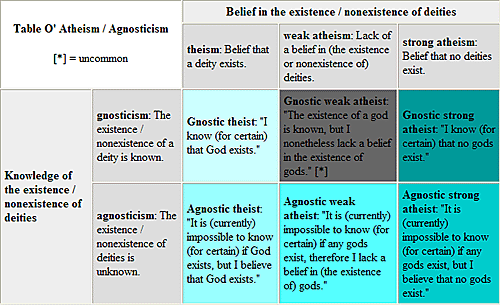
Referring to another thread, a 2-diminsional diagram with "theist - atheist" on the horizontal dimension, and "gnostic - agnostic" on the vertical, helps clarify the issue, at least to me. (Not being allowed to link, you'll have to find it yourselves.)
A "gnostic" knows things "for sure;" an "agnostic" doesn't. An "atheist" does not postulate a god, a "theist" does. I'm an atheist-agnostic - I don't know anything for sure, and don't postulate a god.
Since I don't know anything "for sure," but only with degrees of likelihood, (the sun coming up in the morning = high; the moon made of green cheese = low), nothing is provable to me "for sure." And nothing can be absolutely disproved except by contradiction. Things are only more, or less, likely.
It is entirely possible to live, enjoy life, be relatively healthy and comfortable, with an awareness one lives in an uncertain world.
I am skeptical about everything, to varying degrees, and try to chose my battles where it matters to me.
I cannot imagine a "skeptic" with ANY absolute belief, including an absolute belief in a god.

I think you mean this:

429846c1d38073a8f.gif


And here's the simplified version:

429846c1d380840e4.gif


Unfortunately, I think those who are arguing that theists can't be skeptics are aware of the difference between gnosticism/agnosticism (knowledge of the existence of gods) and theism/atheism (belief in the existence of gods) and the fact that the two are not mutually exclusive. I agree with you that as long as a theist is also agnostic (i.e. admits that they don't know for certain that god exists) one cannot devise a definition of "skeptic" that would exclude them. Essentially, any reasonable definition would have to either include both an agnostic atheist and an agnostic theist or would have to exclude both (and only a "pure" agnostic could be a skeptic).

-Bri
 
Everyone who seems to think a belief in god is not irrational seems to go out of their way not to read my posts or any of the posters I find particularly clear on the topic (Moby, for example)

I do go out of my way not to read your posts, mainly because your posts are excessively wordy.

Just post the definition of "irrational" and "illogical" that you used to come to your conclusion.

-Bri
 
Mobyseven,

Please post it again. I must have missed it too. I see lots and lots of posts where people have claimed that it has been posted previously, but no actual clear definitions posted.

-Bri
 
Last edited:
NeilC:

I've provided a definition and this has been pointed out to you. If you're going to ignore the answer when it's provided, why should we bother to indulge your trolling further? A better idea would be for you to provide your definition to get the discussion started. Stop making noise and start saying something.

Trolling? Are you simple?

Who has pointed out which definition?

Why would I have a definition that includes atheists and exludes all theists? If you had read my posts you would know I'm of the impression, at the moment, that no such definition exists.

There are plenty of definitions of skeptic that I'm happy accept, such as one I previously posted. But (as I previously posted) it doesn't fit the bill. I don't see why this is so complicated. If you think that skepticism includes atheists (by which we mean people who actively believe there are no gods, which includes me by the way) but excludes all theists then it should be possible to put this in a sentence starting with "a skeptic is:". I can't do it personally.
 
Last edited:
Semantics of the silly yet again. You guys aren't saying anything. Give a logical reason for a god belief or describe a logical god that can exist in our world. Give a definition of skepticism that doesn't include believers of magic, woo, demons, or other supernatural conclusions

The question you guys ask are the kind creationists use... they aren't designed to clarify anything--they are made to infer a conclusion. Conclusions or beliefs that presuppose the supernatural are illogical by definition. They defy the rules of logic and evidence. They posit the actual existence of something that is indistinguishable from the non-existence of that something.

We get it... some people who call themselves skeptics think that skeptics can logically believe in a god. They've made no case for that. Instead they are asking us to prove that such things are not skeptical... just like the people who want us to prove that god or other magic doesn't exist.

Most skeptics understand the circular reasoning and call it for the BS that it is. If you assume a god belief is more logical than demon belief or belief in psychics you have not made a case for it. If your definition of skepticism includes the latter--then it must include the former. If not, skepticism becomes a useless term. People can posit the existence of any immaterial undetectable entity or force they wish-- such things cannot be disproven afterall. Randi only proves that some psychics could use trickery... not that they ALL are... that is the level of your reasoning.

Call yourselves what you wish. The rest of us are free to reach our own conclusions
 
Sorry folks... there aren't simple answers to your loaded questions. They are on par with creationists asking "how does information get added to the genome"? You have to define terms before even discussing the topic.

Skeptics utilize occam's razor. Belief in the supernatural of any sort defies occams razor. One cannot reach such beliefs through logic. On can use logic in other areas of one's life while putting their "true woo" off limits for scrutiny--as theistic skeptics are doing.
 
How can there be a god who "doesn't want to be detected", Bri -- when the mere act of "wanting" requires a brain??? Thinking, feeling, loving, wanting, caring, intention, opinions, and "intelligence" all require a brain... these are not things that exist absent a brain.

So, are you saying that it is an absolute fact that it is impossible for consciousness to exist without a brain (i.e. that you have absolute proof that such a thing is utterly impossible), or are you just saying that there is no evidence of consciousness existing without a brain?

If the former -- well, let's see the proof.

If the latter, then you've answered your own question -- there can be a god who "doesn't want to be detected."

-Bri
 
Last edited:
You have to define terms before even discussing the topic.

Which is exactly what we've been waiting for. Let's see your definitions that allow you to come to the conclusions you've apparently come to, given that they aren't in any dictionary I can find.

-Bri
 
So, are you saying that it is an absolute fact that it is impossible for consciousness to exist without a brain

I don't know if Articulett'll say it, but I will.

It is an absolute fact that it is impossible for consciousness to exist without a brain.

Or would you care to show otherwise ?
 
Belz,

So, unless you have proof that it's absolutely impossible, it seems that you hold a belief without evidence. Very unskeptical of you, Belz. Let's see the evidence.

-Bri
 
Wrong--because we have evidence that people invent gods. By your reasoning, those who believe in demons or psychics are as skeptical and reasonable as those who conclude that there are no such things-- that it's all misperception of a type we are very familiar with (see any Randi video)... these are all illusions cut from the same sort of cultural memes.

By your reasoning... everyone is a skeptic... and all reasoning is skeptical. You've defined skepticism out of existence by pretending both claims are equally valid. In our reality and given the evidence-- they are not. Skeptics might believe-- they might believe that it's logical to believe... but that doesn't make the belief in gods based in any sort of actual logic. Nor does it make anyone's god (or any other invisible form of consciousness) even remotely plausible. The reasons for belief in god are no more substantial the the reasons for belief in the chupacabra-- But god beliefs offer a bonus--they make people feel better... special... chosen... more secure. Belief is said to offer an "insurance" plan in case "hell" is real. God just happens to be a better antidote for fears of death and loss and religion-invented hells then other invisible measurable entities... plus we have very strong memes in place to spread such "faith" and "belief in belief".

You've misunderstood my point. I'm saying that both claims are invalid from a hard skeptical point of view.

If someone comes to the conclusion that demons are merely imaginary based entirely on (1) evidence that some people have imagined demons, (2) people pass on unproven ideas through culture, and (3) no current evidence of invisible consciousness, they are on pretty weak ground from a skeptical point of view.

(1) This is only evidence that demons can be imaginary, not that they actually necessarily always are. In the same way that just because some people have imaginary friends, doesn't mean that all friends are imaginary.

(2) This is pretty much the same reason that we aren't still living in caves. Information that works for people gets passed on. Some of it may not be true. People sometimes believe things they have learned which might not be true. This is the same kind of evidence as point 1.

(3) This isn't evidence. This, by definition, is simply no evidence at all. It gives us no useful information either way. There are numerous things that we used to have no evidence for, but now know that they exist, and we have no reason to believe that we are now at the pinnacle of discovery and know all there is to know.

The direct conclusion from this evidence and the hard skeptical approach can therefore only conclude that "we don't know, but we know it's possible". Since we didn't have an objective estimate of how probable it was that demons were just imaginary without the evidence, we have no way to say if this evidence changes the objective probability of the claim.

Of course, this is an over-simplified model and in reality, individually, someone comes to such a conclusion based on a whole lifetime of learning, understanding, shaping perceptions, etc. Without knowing every bit of related knowledge that person may have, everything they've seen and how they understand the world, and without objectively knowing exactly what their thought processes have been in reaching this conclusion, in my opinion, it's not really possible to make any kind of objective conclusion as to whether their conclusion has been reached rationally or not.

The same for the claim that demons are real. As we don't have proof that they don't exist, we have to accept that there's a possibility that they do. So we're in the same position from the hard skeptic point of view, that "we don't know, but it's possible".

If someone claims experiences with demons, we are in no position to judge by anything but our imagination what that person may or may not have experienced. Even though we know some people fool themselves, it may be the case that even the most cynical of skeptics might have to conclude almost certainty of the existence of demons when directly faced with such things. Without knowing the full "how"s and "why"s of someone's belief, it's pretty hard to judge the rationality behind it.

While I agree that a hard/true/absolute skeptic would be an implicit atheist (using the broad definition of the word), that person would hold no firm opinions on anything unless it had been shown to be objectively proven, and I am highly doubtful that such a person actually exists. Which leaves us in a position of defining "a skeptic" in such a way that either nobody is a skeptic or that skeptics may hold objectively unproven beliefs and opinions.

 
Semantics of the silly yet again. You guys aren't saying anything. Give a logical reason for a god belief or describe a logical god that can exist in our world. Give a definition of skepticism that doesn't include believers of magic, woo, demons, or other supernatural conclusions

The question you guys ask are the kind creationists use... they aren't designed to clarify anything--they are made to infer a conclusion. Conclusions or beliefs that presuppose the supernatural are illogical by definition. They defy the rules of logic and evidence. They posit the actual existence of something that is indistinguishable from the non-existence of that something.

We get it... some people who call themselves skeptics think that skeptics can logically believe in a god. They've made no case for that. Instead they are asking us to prove that such things are not skeptical... just like the people who want us to prove that god or other magic doesn't exist.

Most skeptics understand the circular reasoning and call it for the BS that it is. If you assume a god belief is more logical than demon belief or belief in psychics you have not made a case for it. If your definition of skepticism includes the latter--then it must include the former. If not, skepticism becomes a useless term. People can posit the existence of any immaterial undetectable entity or force they wish-- such things cannot be disproven afterall. Randi only proves that some psychics could use trickery... not that they ALL are... that is the level of your reasoning.

Call yourselves what you wish. The rest of us are free to reach our own conclusions

Sorry folks... there aren't simple answers to your loaded questions. They are on par with creationists asking "how does information get added to the genome"? You have to define terms before even discussing the topic.

Skeptics utilize occam's razor. Belief in the supernatural of any sort defies occams razor. One cannot reach such beliefs through logic. On can use logic in other areas of one's life while putting their "true woo" off limits for scrutiny--as theistic skeptics are doing.

Please explain how Hal used illogical reasons when his conclusion doesn't assume fact.

I asked what the evidence was that Hal rejected. Can you point to any specific evidence or not?

What gave you the idea that I have no reason to be skeptical of demon possession? Just point to the post of mine and explain briefly your reasons.

Where did I say that a god belief can be derived logically or skeptically?

Succinct, clear answers, please. Not an avalanche of words that don't answer the questions.
 
Belz,

So, unless you have proof that it's absolutely impossible, it seems that you hold a belief without evidence. Very unskeptical of you, Belz. Let's see the evidence.

-Bri

No evidence? Are you really that ignorant?

If I remove your brain, can you still be conscious? If I start to inject an acid into your brain that eats it away, sliver by sliver, will there be any notable effect on your consciousness?

Where do you think our memory, emotions, and logic come from? Our ass? Well, maybe for you... ;)
 
Last edited:
While I agree that a hard/true/absolute skeptic would be an implicit atheist (using the broad definition of the word), that person would hold no firm opinions on anything unless it had been shown to be objectively proven, and I am highly doubtful that such a person actually exists.

This argument has been advanced several times in this thread, and I'm still not convinced. Of course none of us are perfect, and all of us sitting here as of right now will each hold some irrational and/or unsceptical beliefs. The difference is that most of us seek to correct these errors (for this is what they are). To believe in god is to leave arguably the most profound of these irrational beliefs untouched by one's own scepticism and rationality.

In other words, I thought the whole point was to try not to hold firm opinions on anything unless it had been shown to be objectively proven (to some extent at least).
 
No evidence? Are you really that ignorant?

Belz stated that it "is an absolute fact that it is impossible for consciousness to exist without a brain."

The only evidence that it is an absolute fact would be absolute proof.

If I remove your brain, can you still be conscious? If I start to inject an acid into your brain that eats it away, sliver by sliver, will there be any notable effect on your consciousness?

There would be no way for you to know whether or not you were destroying my consciousness if you destroyed my brain since it is possible that my brain only controls my physical body, but that my consciousness is immaterial and continues to exist even after my brain is destroyed.

But even if my consciousness exists materially in my brain, it does not follow that all consciousness must necessarily exist materially in a brain. There may be some unknown form of consciousness that doesn't require a brain.

You seem to believe that it is absolute fact that both of the above cases are impossible. Can you prove it? If not, then you hold a belief without evidence.

Where do you think our memory, emotions, and logic come from? Our ass? Well, maybe for you... ;)

Ad hom attacks don't seem to advance your argument.

-Bri
 
Last edited:
Belz stated that it "is an absolute fact that it is impossible for consciousness to exist without a brain."

The only evidence that it is an absolute fact would be absolute proof.
All of the scientific evidence points to consciousness residing in the brain. I have yet to see any other evidence.

If I said that I was 99.9999999% sure, would you like that more, even though it's nearly absolute?

There would be no way for you to know whether or not you were destroying my consciousness if you destroyed my brain since it is possible that my brain only controls my physical body, but that my consciousness is immaterial and continues to exist even after my brain is destroyed.
In the same way that there is no way for you to know if there's a flying teapot orbiting Jupiter?

But even if my consciousness exists materially in my brain, it does not follow that all consciousness must necessarily exist materially in a brain. There may be some unknown form of consciousness that doesn't require a brain.
In the way that there is a flying teapot orbiting Jupiter?

You seem to believe that it is absolute fact that both of the above cases are impossible. Can you prove it? If not, then you hold a belief without evidence.
I can prove that it's the most reasonable conclusion based on the empirical data, yes.

Ad hom attacks don't seem to advance your argument.

I love how people throw out "AD HOMINEM!" as soon as you get snarky. The assumption being that every snarky comment is an argument, of course, which goes back to the whole "fallacious logic" thing.

Sometimes an insult is just an insult, and your whining is just funny to people like me. :)

IOW, cry me a river. I'll play the world's smallest violin for ya.
 
Last edited:
If I said that I was 99.9999999% sure, would you like that more, even though it's nearly absolute?

Absolutely! You then would not be claiming it to be absolute fact, but rather you admit that consciousness might exist outside of a brain.

In the same way that there is no way for you to know if there's a flying teapot orbiting Jupiter?

That's correct.

In the way that there is a flying teapot orbiting Jupiter?

No, in the way that there may be a flying teapot orbiting Jupiter.

I can prove that it's the most reasonable conclusion based on the empirical data, yes.

But that doesn't make it absolute fact, does it?

I love how people throw out "AD HOMINEM!" as soon as you get snarky. The assumption being that every snarky comment is an argument, of course, which goes back to the whole "fallacious logic" thing.

Sometimes an insult is just an insult, and your whining is just funny to people like me. :)

IOW, cry me a river. I'll play the world's smallest violin for ya.

Nonetheless, it didn't seem to change the fact that you were wrong.

-Bri
 
The difference is that most of us seek to correct these errors (for this is what they are). To believe in god is to leave arguably the most profound of these irrational beliefs untouched by one's own scepticism and rationality.

Although it is possible that there are people who leave their belief in a god unquestioned, there are also people who do question the existence of gods and are of the opinion that a god exists.

In other words, I thought the whole point was to try not to hold firm opinions on anything unless it had been shown to be objectively proven (to some extent at least).

There are some theists who hold their belief only until such time as it is objectively proven (to some extent at least) that their god doesn't exist. In fact, if you remove the parenthetical, I would say that the vast majority of theists would have little choice but to change their belief if it were proven that their god doesn't exist, just as a vast majority of atheists would have little choice but to change their belief if it were proven that a god exists.

-Bri
 
Last edited:
Absolutely! You then would not be claiming it to be absolute fact, but rather you admit that consciousness might exist outside of a brain.
Okay. Then it's so small a chance as to be so miniscule, that everyone might as well act as if it's not true.

Just like God.

Now what else do you want to talk about?

No, in the way that there may be a flying teapot orbiting Jupiter.
Well, agreed then.

But that doesn't make it absolute fact, does it?
Nope. And you existing isn't an absolute fact, either. And hey, someday I may float off the ground for no apparent reason. But that doesn't seem very likely, now don't it?

I'd still call it a fact that consciousness comes from the brain, in the same way I would say that it's a fact that you exist.

Nonetheless, it didn't seem to change the fact that you were wrong.

About what, exactly?

You claimed that Belz had "no evidence". That's not true. While his evidence might not support absolute certainty, it certainly does support 99.999999% certainty. So to say that he has "no evidence" seems dishonest.
 
Last edited:
I'd still call it a fact that consciousness comes from the brain, in the same way I would say that it's a fact that you exist.

But not an absolute fact.

About what, exactly?

You were wrong when you defended Belz's claim that it's an absolute fact that consciousness cannot exist outside of the brain.

You claimed that Belz had "no evidence". That's not true. While his evidence might not support absolute certainty, it certainly does support 99.999999% certainty. So to say that he has "no evidence" seems dishonest.

I claimed that Belz had no evidence to support his claim that it is an absolute fact that consciousness cannot exist outside of a brain. And he doesn't. Nor do you.

-Bri
 
Last edited:
Status
Not open for further replies.

Back
Top Bottom